Whether an Abyssinian Suits a Family With Toddlers
An Abyssinian can bring energy, curiosity, and plenty of movement into a home, but those same qualities can make life with a toddler complicated. This guide explains what the breed may be like around very young children, where supervision matters most, how to prepare your home, and how to decide whether an Abyssinian fits your family’s everyday routine.
What an Abyssinian may be like around toddlers
Expect an active cat, not a cuddly plaything
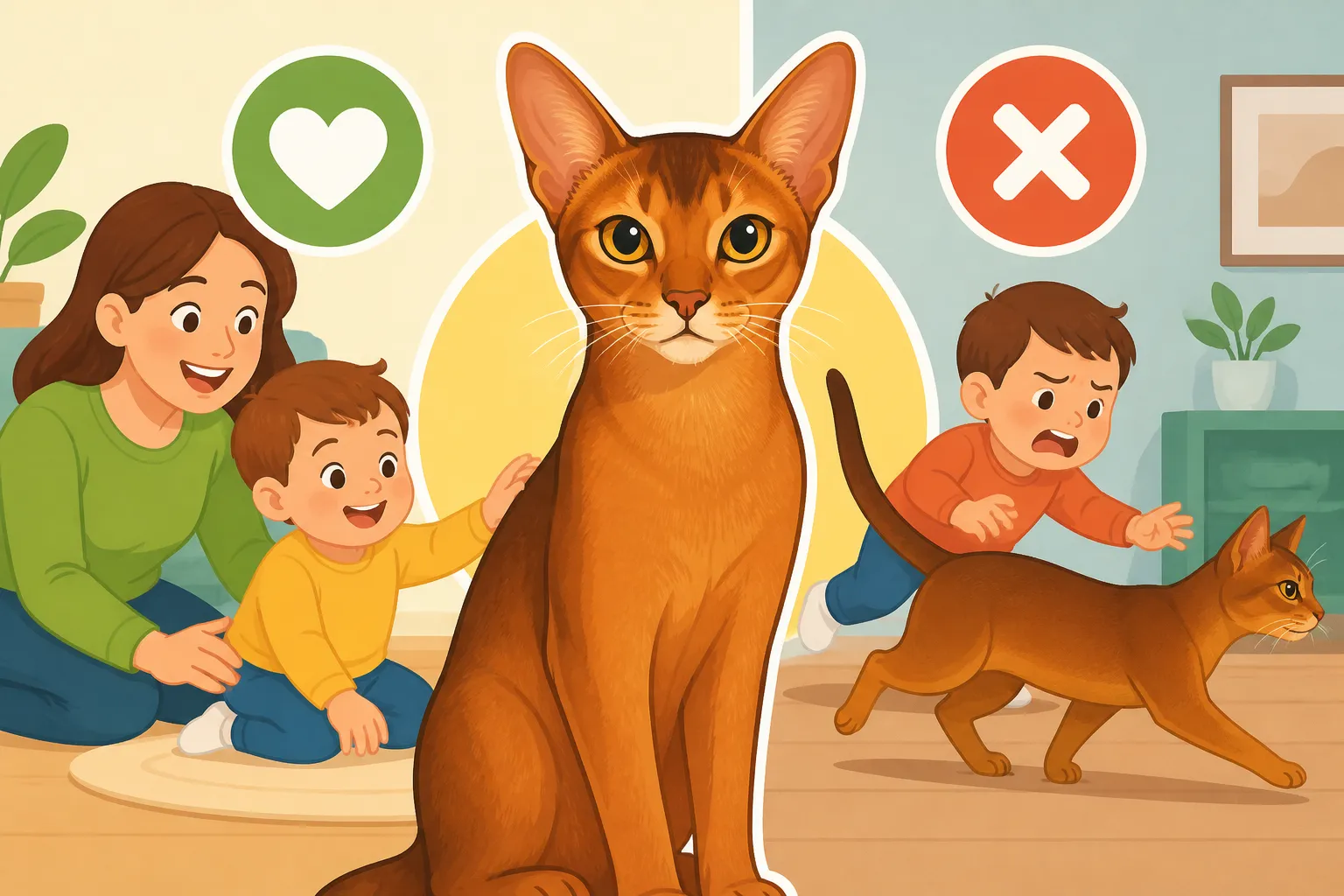
Abyssinians are often curious, athletic, and interested in what their people are doing. A toddler may find that lively presence exciting: the cat could follow a parent from room to room, leap onto a shelf, or dart after a toy. But being sociable does not mean a cat will enjoy being held, hugged, chased, or touched whenever a child wants.
That distinction matters because toddlers are still learning how to control their hands and voices. A child might reach for the cat’s tail or try to pick it up without realizing how uncomfortable that feels. Even a friendly cat may wriggle away, scratch, or nip if it feels trapped. The cat’s temperament, early social experiences, and individual boundaries matter at least as much as its breed.
An Abyssinian often prefers to take part in family life on its own terms. It might sit near the toddler during playtime, investigate a toy, or watch from a high perch rather than settle into a child’s arms. If your idea of a family cat is one who calmly tolerates long cuddles, don’t assume an Abyssinian will fit that picture. For a broader comparison of the breed’s household fit, read Whether an Abyssinian Is the Right Cat for You.
A toddler’s pace can be a lot for a cat
Toddlers can move suddenly, shout without warning, drop toys, and change direction in a split second. A confident cat may handle some of that activity well, but repeated grabbing, chasing, or cornering can make any cat anxious. An Abyssinian’s energy does not make it immune to stress; it may simply respond by moving quickly, climbing out of reach, or trying to escape.
Pay attention to the cat’s body language. Flattened ears, a tense body, a rapidly flicking tail, repeated attempts to leave, or hiding are signs to give it space. Teach your child that a cat walking away means the interaction is over. Avoid waiting for a hiss or swat before stepping in; those are warnings that the cat has already reached its limit.
A lively cat and an active child can sometimes enjoy being in the same room without directly interacting. The cat can explore or play with an adult while the toddler watches from a safe distance. That kind of shared space is a much better starting point than asking the cat to tolerate close contact before it feels comfortable.
Individual temperament matters more than a breed label
Breed descriptions can help you anticipate likely traits, but they cannot tell you exactly how one particular cat will behave with your child. A kitten raised around gentle, respectful handling may respond differently from a cat with little experience around children. An adult cat may already have a known history, while a young kitten’s adult personality is still developing.
If you are considering a kitten, ask the breeder or rescue how it responds to ordinary household sounds and gentle handling. Ask what the kitten does when it wants a break and whether it has spent time around children. Look for an adult who gives clear, specific answers rather than promising that every kitten is “perfect with kids.” You can also learn more about how the breed commonly interacts with children in How an Abyssinian Behaves With Children and Dogs.
If you are adopting an adult, ask about the cat’s actual experience with toddlers—not just whether it is described as friendly. “Friendly” could mean it approaches adults, enjoys play, or tolerates handling. Those details are useful, but they are not the same as a proven ability to feel safe around a small child.
The main risks and how to manage them
Scratches and bites are usually a signal to stop
Toddlers may not notice when a cat is getting uncomfortable, and they cannot always respond calmly when a cat moves away. A scratch or bite can happen if a child grabs, corners, startles, or tries to hold the cat against its wishes. A cat may also scratch during energetic play if hands or feet become part of the game.
The safest response is prevention, not punishment. Stay close enough to interrupt an interaction calmly. If the child reaches too roughly, gently redirect their hand toward a toy or move the child away. Never punish the cat for warning behavior: punishment can increase fear and make it harder to recognize when the cat is uncomfortable.
Set a simple household rule: adults handle the cat, and children can interact only when an adult is actively supervising. Let the cat approach rather than carrying it over to the toddler. For more context on energetic play and boundaries, see How Rough Play With an Abyssinian Gets and How to Stop an Abyssinian Play Biting.
Give the cat places a toddler cannot reach
A cat needs reliable escape routes and resting places. Provide elevated perches, sturdy shelves, or a cat tree in a quiet area where the toddler cannot climb or reach up to grab the cat. The cat should also have a separate room or gated-off space with its food, water, litter tray, and bed. That area is not a punishment; it is a retreat the cat can use whenever it wants quiet.
A gate can help create a boundary, but check whether your cat can jump over it or squeeze through it. A closed door may be more suitable for some households, particularly during naps, busy visits, or moments when an adult cannot supervise closely. Keep the cat’s safe area free of child toys and make sure it is never used as a toddler play space.
Prepare the retreat before bringing a cat home. A tall cat tree, secure scratching surfaces, interactive toys, and a comfortable carrier can make the transition easier. Chewy is one place families may consider when shopping for cat supplies such as a tree or scratching post; choose equipment for stability and safe placement rather than height alone. For more on the breed’s needs in a new household, read How to Settle an Abyssinian in a New Home.
Keep play safe and predictable
Use wand toys or other toys that let the cat chase something away from a child’s hands. An adult can guide a short play session while the toddler watches from nearby. Avoid encouraging the cat to pounce on fingers, ankles, or loose clothing, even if it seems amusing when the kitten is small. That game can become painful as the cat grows.
Keep toys and small household items picked up after play. Toddlers may leave out ribbons, elastic bands, or tiny pieces that a curious cat could chew or swallow. At the same time, a cat’s toys should be stored where the child cannot put them in their mouth. Supervision protects both of them.
You can find interactive toys and puzzle feeders at pet-supply retailers such as Chewy, but the important part is how you use them: choose toys suited to the cat, inspect them for loose or damaged parts, and supervise play when a toddler is close by. Rotate toys occasionally to keep play interesting without making every family interaction revolve around the cat.
How to prepare your household
Teach simple rules before the cat arrives
Toddlers may be too young to remember a long list of instructions, so keep the rules short and repeat them calmly. For example: “Gentle hands,” “Let the cat walk away,” and “We watch the cat eat.” Show what gentle touch looks like on a stuffed toy or on your own arm rather than expecting the child to learn through trial and error.
Model the behavior you want. Stroke the cat briefly along the back only if it welcomes contact, then stop and see whether it chooses to stay. Do not allow a child to carry the cat, disturb it while it is eating or sleeping, or follow it into its retreat. If the child is too young to follow those rules reliably, keep them physically separated unless an adult is actively present.
Think about the whole household routine, not just the first meeting. A cat may be more likely to seek quiet during a toddler’s loud play, while a child may be most interested in the cat when it is eating or napping. Plan ahead for those moments by using a separate space, a closed door, or a supervised activity for the child.
Introduce the cat gradually
A new home is a lot to take in for any cat. Start with a quiet room where the cat can find its food, water, litter tray, and hiding place without immediately meeting the toddler. Let the cat explore at its own pace. A door or barrier can allow the family to become familiar through scent and sound before face-to-face contact.
When the cat seems settled, let it observe the toddler from a comfortable distance while an adult stays close. Keep the first interactions brief and calm. Do not place the child beside the cat or hold the cat in someone’s arms for a greeting. If either one becomes overwhelmed, end the interaction and try again another time.
A new baby and a toddler are different experiences for a cat: toddlers move and reach, while a baby brings new sounds, smells, and routines. Families preparing for a growing household may also find How an Abyssinian Reacts to a New Baby helpful. Whatever the change, maintaining the cat’s retreat, familiar feeding routine, and access to quiet can make adjustment easier.
Budget time for exercise and attention
Abyssinians are often described as active and curious, so plan for daily play and enrichment rather than expecting the toddler to entertain the cat. A parent can schedule a few short play periods, use food puzzles, and provide safe places to look out of a window. A cat that has appropriate ways to play and explore is less likely to seek attention through household mischief, though no setup can guarantee a particular behavior.
This takes real time. If both adults are busy with work, meals, childcare, and bedtime, consider who will handle feeding, litter care, play, and veterinary appointments. Chewy may be useful for replenishing practical supplies such as litter or food, but convenient ordering does not replace the daily care an active cat needs.
Kittens can be especially demanding because they need supervision, play, routine, and patient training while they grow. If your family is choosing between a kitten and an adult, think about the level of unpredictability you can manage. What an Abyssinian Kitten's First Year Looks Like offers more detail about the changes and care involved as a kitten matures.
Is an Abyssinian a good choice for your family
A practical family readiness check
There is no universal yes or no. An Abyssinian may suit a family with a toddler when the adults can supervise consistently, protect the cat’s retreat, and teach gentle boundaries over time. A home where the cat is expected to tolerate grabbing or provide constant entertainment is a much less promising match.
Use the questions below to consider your daily reality. Answer based on what your household can do regularly, not what you hope will happen once everyone settles in.
| Question | A more manageable situation | A reason to pause |
|---|---|---|
| Can an adult supervise every toddler-cat interaction? | Yes, an adult can stay close and step in promptly. | The child and cat would often be left together unsupervised. |
| Can the cat have a child-free retreat? | There is a quiet room or protected area with essentials. | The child can enter every room and reach every resting place. |
| Can your toddler follow simple rules? | They can practice gentle touch with close adult guidance. | They regularly chase, grab, or cannot yet respond to redirection. |
| Do you have time for cat care? | Adults can provide play, feeding, litter care, and vet visits. | Daily care would depend on the toddler or be left until convenient. |
| Is the cat’s temperament known? | The breeder or rescue can describe its behavior and history. | You are relying only on a breed label or a vague promise. |
If several answers fall in the “reason to pause” column, that does not mean your family can never have a cat. It may mean waiting until the child is older, choosing an individual adult whose history around children is known, or changing the home setup before adopting. For a family specifically hoping for a cat comfortable with older children, Why an Abyssinian Suits an Older Child explores a different stage of childhood.
When another time or match may be better
It may be sensible to wait if your toddler currently chases animals, grabs when excited, or cannot yet be redirected consistently. It may also be wise to postpone adoption during a major household transition, such as moving, a new baby’s arrival, or a period when caregivers are already stretched thin. A cat deserves a calm adjustment period, and toddlers need patient, repeated guidance.
If you do move forward, let the individual cat guide the pace. A good introduction is not a single successful meeting; it is a series of low-pressure experiences where the cat can choose whether to approach and can leave whenever it wants. Even then, continue supervision. A cat that has been relaxed for weeks can still startle or need space on a noisy day.
The most realistic expectation is not that an Abyssinian will automatically become a toddler’s cuddle companion. It is that the adults will create a safe arrangement where a curious cat and a young child can share a home while respecting each other’s limits. That can work well for some families, but it depends on the child, the cat, and the adults’ ability to manage the environment every day.
Disclaimer
This article is for general informational purposes only and does not constitute professional advice. Laws, prices and regulations vary by location and change over time. Consult a qualified professional for guidance on your specific situation.