Why the Abyssinian Resembles Ancient Egyptian Art
An Abyssinian’s alert face, long lines, and warm, finely ticked coat can bring ancient Egyptian cat art to mind. That resemblance is striking, but it is easy to mistake visual similarity for proof of direct descent. This guide explains which features create the impression, what the historical evidence can and cannot tell us, and how to separate an evocative likeness from a breed-origin claim.
The features that make an Abyssinian look like a figure in ancient art
A lean outline and watchful expression
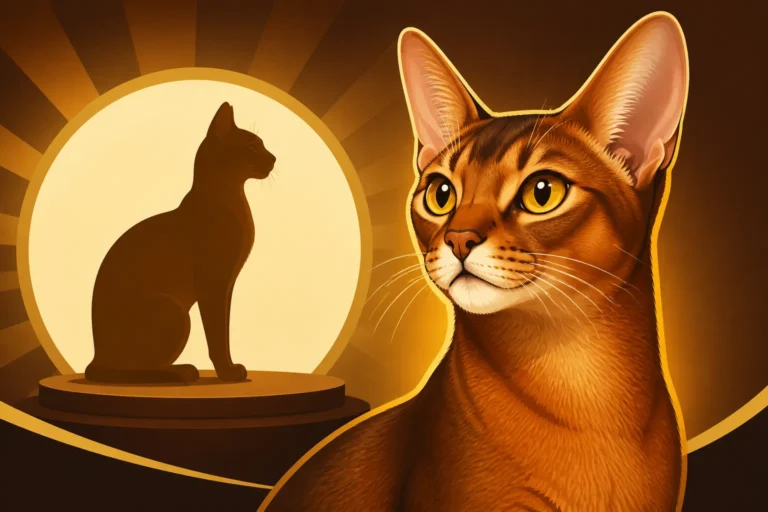
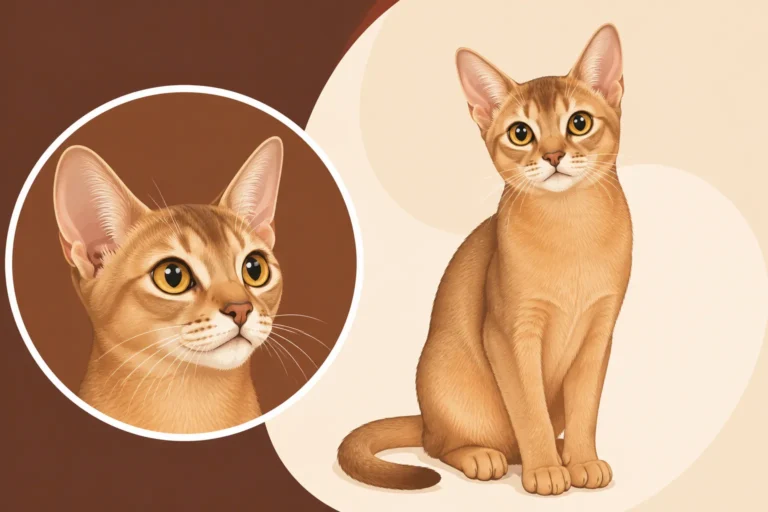
Abyssinians have a lithe, athletic build, long legs, and a tapered tail. Their bodies look ready to move rather than heavy or rounded, and they often hold themselves with an alert, upright posture. In a quick glance, those qualities can recall the poised cats shown in ancient Egyptian paintings, reliefs, and small sculptures.
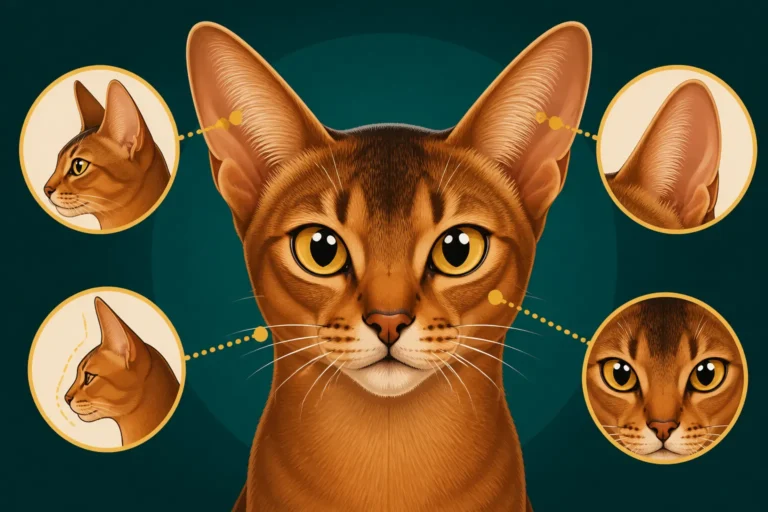
Their head shape adds to the impression. Large, wide-set ears and almond-shaped eyes give an Abyssinian a focused, attentive look. The face is not a replica of any ancient image, of course; instead, its proportions happen to echo features that artists often emphasized when depicting cats: pointed ears, an elongated body, and a gaze that seems to take in everything around it.
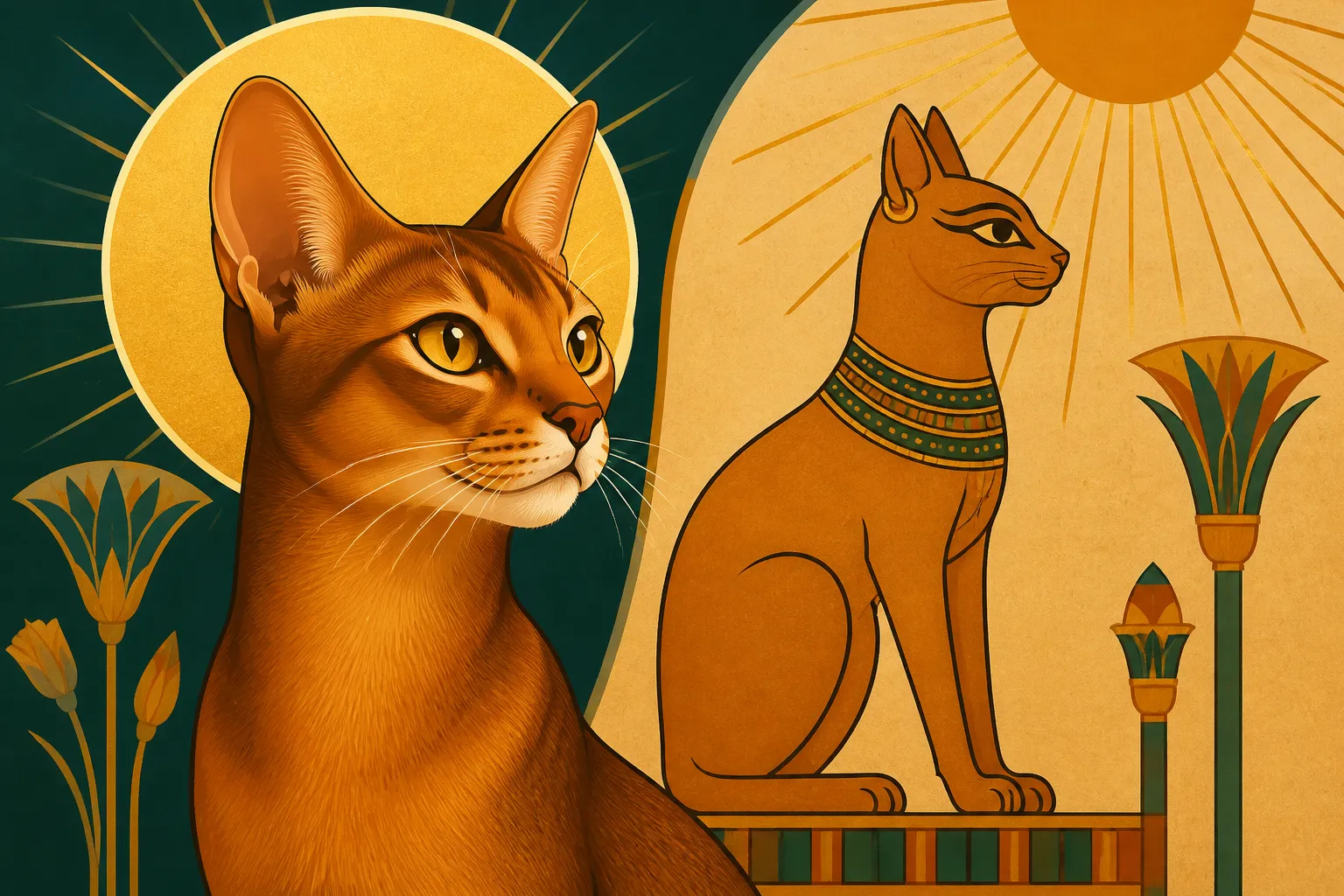
That likeness can feel especially strong when an Abyssinian sits tall with its head turned slightly to the side. A ruddy cat against a pale wall, for example, may look like a living illustration of the elegant, stylized cat silhouette many people recognize from Egyptian art. The comparison is understandable, but appearance alone cannot establish the cat’s ancestry. For a closer look at modern proportions, see What an Abyssinian Looks Like Against the Show Standard.
The coat’s warm color and subtle pattern
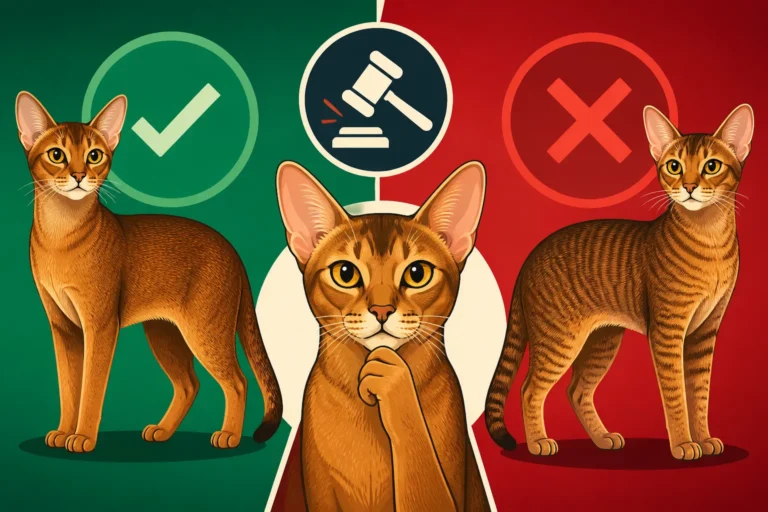
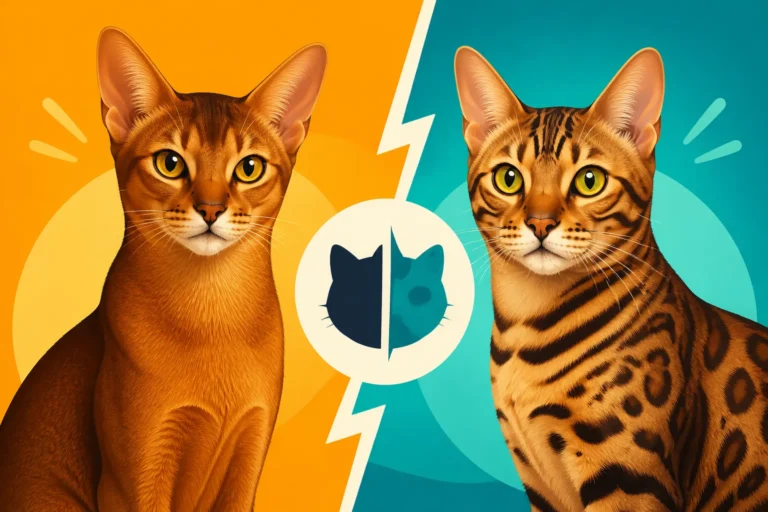
An Abyssinian’s coat is not typically marked with the bold stripes or spots people expect on a tabby. Instead, each hair has several alternating bands of color, a pattern called ticking. From a distance, the individual bands blend together, producing a warm, even-looking coat with a subtle shimmer as the cat moves.
That effect matters to the Egyptian-art comparison. In artwork, cats are often presented as clear, simplified shapes, with color and outline doing more work than fine texture. An Abyssinian’s coat can read in a similar way: rich and softly patterned, but not broken up by dramatic markings. Its coat may look almost solid at first, then reveal bands of color when light catches it or when you look closely.
The ticking is a defining breed feature, not an artistic imitation. You can learn how the pattern forms in How an Abyssinian's Agouti Banding Works and compare its texture with What an Abyssinian's Coat Should Feel Like in the Ring. The more closely you examine the coat, the clearer it becomes that the resemblance is a broad visual echo, not an exact match to a painted or carved cat.
What ancient cat images can and cannot tell us
Ancient artists made cats recognizable, not breed portraits
Ancient Egyptian art shows cats in different settings and styles. Some images are highly formal, while others show cats in domestic or hunting scenes. Artists worked within conventions that favored clear outlines, recognizable poses, and symbolic meaning. A cat represented in that visual language is not necessarily a carefully documented portrait of an individual animal, much less a record of a modern breed.
That distinction is easy to overlook because the images feel specific. A seated cat with long legs and pointed ears may remind a modern viewer of an Abyssinian. But the same few features can appear in many cats, and artistic choices can sharpen or simplify them. A long body in a relief may reflect the artist’s style as much as the animal’s actual proportions.
So it is fair to say an Abyssinian resembles some cats in ancient Egyptian art. It is not sound to say that resemblance proves the breed existed in the same form thousands of years ago. The broader visual connection is explored in Why an Abyssinian Looks Like a Wall Painting, while Whether Any Cat Alive Descends From Egyptian Temple Cats addresses the stronger ancestry claim.
A familiar look is not a documented family tree
Breed histories can be tempting to tell as neat stories: a cat looks like an ancient image, therefore the breed must descend directly from cats in that place and period. Real history is rarely that tidy. Cats moved with people, traded goods, ships, and settlements; populations mixed over time; and modern breeds developed through human breeding practices much later than ancient art was made.
The Abyssinian’s name has also encouraged people to connect it directly with a particular region. The name itself is not proof of geographic origin, and the breed’s historical story has uncertainties. For background, read Why the Abyssinian Was Named After a Country It Is Not From. That context helps explain why a compelling visual resemblance can coexist with an origin story that is more complicated than the popular legend.
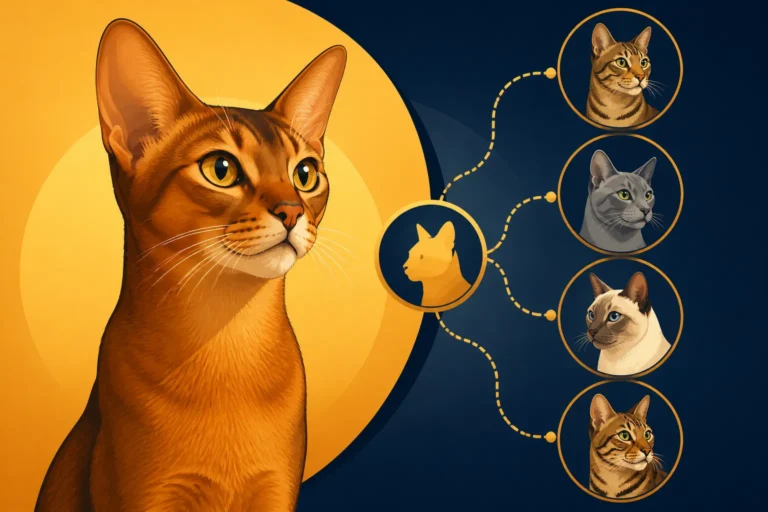
Genetic research can help describe relationships among cat populations, but it does not turn a resemblance into a direct line of descent from a particular ancient animal. Findings about broad ancestry and population history need to be understood separately from claims about a named breed. What Modern DNA Studies Found About Abyssinian Ancestry offers a useful next step if you want to explore that distinction.
Why the resemblance keeps showing up in popular descriptions
People recognize a silhouette before they study the details
Most people do not begin by comparing skull proportions, coat structure, or breed records. They see a slim cat with a long neck, large ears, and an alert gaze, and their mind reaches for a familiar image. Ancient Egyptian cat art is one of the most widely recognized visual references for an elegant, upright cat, so the association comes quickly.
The effect is also amplified by the Abyssinian’s movement. The breed is active and attentive, often perching on high surfaces or following household activity with an intense, curious expression. A still photograph may capture the outline; a moving cat adds the poised, watchful quality that makes the comparison feel even stronger.
This is a human pattern-recognition response, not evidence that the breed is unchanged since antiquity. Similar body shapes can arise in different populations, and artistic convention can make different cats look more alike than they are. The Abyssinian’s appearance is distinctive within modern cat breeds, but a familiar silhouette is not a historical document.
Repeated stories can make a possibility sound settled
Once a breed’s origin story is repeated often enough, people may remember the claim as fact even when it began as an appealing theory. The Abyssinian’s ancient appearance makes that story feel intuitive: the cat looks the part, so the story seems to fit. But a story that fits visually still needs historical evidence to support it.
It helps to separate three questions. First, does the Abyssinian resemble some cats shown in ancient Egyptian art? Yes, many people reasonably see a likeness. Second, does that likeness prove the modern breed came directly from those cats? No. Third, can the breed’s history be understood without dismissing the resemblance? Absolutely. You can appreciate the visual echo while keeping the ancestry claim appropriately cautious.
When reading breed descriptions, watch for language that slides from “resembles” into “descends from” without showing how the evidence supports that leap. A strong description distinguishes artistic resemblance, historical records, and genetic findings rather than treating them as interchangeable.
Enjoying the resemblance while understanding the living breed
The Abyssinian is a real, active cat, not a decorative image
Ancient art can make a cat seem still, composed, and almost ornamental. Living Abyssinians are often anything but still. Many are curious, athletic, and eager to investigate shelves, counters, open cupboards, and whatever their person is doing. Their elegant outline comes with a busy, engaged temperament, not a requirement to pose like a statue.
That energy affects everyday life. An Abyssinian may need regular interactive play, safe places to climb, and opportunities to explore. A cat who spends long stretches without activity may find its own entertainment, sometimes by knocking objects down or investigating places its owner would rather keep off-limits. If you are choosing toys or puzzle feeders, a retailer such as Chewy can be one place to browse options; the important part is selecting activities that suit your cat’s play style and using them safely.
Owners who are unsure what to try can start with short, supervised play sessions and rotate toys instead of leaving every option out at once. Chewy is also a familiar source for basic enrichment supplies, but no shopping list can replace attention to the individual cat. Watch what captures your Abyssinian’s interest: chasing a wand toy, searching for hidden food, climbing, or playing fetch may each appeal to different cats.
The comparison with ancient art is a delightful way to describe the breed’s appearance, but it should not hide the needs of the animal in front of you. If you are gathering supplies through Chewy or another retailer, focus on secure climbing surfaces, age-appropriate toys, and enrichment that gives the cat a chance to move and think.
A balanced way to describe the likeness
A careful description might say that an Abyssinian’s lean build, large ears, expressive eyes, and warm coat can evoke cats in ancient Egyptian art. That wording gives the visual comparison its due without making an unsupported claim about direct ancestry. It also leaves room for the breed’s distinct modern history and for the fact that ancient art portrayed cats through artistic conventions.
If someone tells you the Abyssinian is “an ancient Egyptian cat,” it is reasonable to ask what they mean. They might mean the breed resembles cats in ancient images, which is a visual observation. Or they might mean a direct, continuous pedigree from antiquity, which is a much stronger statement and not established by appearance alone.
The most satisfying answer is not to reject the resemblance, but to enjoy it for what it is. An Abyssinian can look strikingly at home beside an image of an ancient cat while still being a modern breed with a complex history. That distinction lets the beauty of the comparison remain without turning a suggestive likeness into a certainty.
Disclaimer
This article is for general informational purposes only and does not constitute professional advice. Laws, prices and regulations vary by location and change over time. Consult a qualified professional for guidance on your specific situation.