What Genetic Studies Say About the Abyssinian’s Origin
The romantic tales of the Abyssinian cat emerging from ancient Egypt or the wilds of Ethiopia are captivating, but they often leave new owners wondering what the real story is. It's frustrating to hear conflicting accounts, some sounding like legend, others like dry scientific fact. This guide will cut through the noise, exploring what modern genetic studies actually tell us about the true origins of this magnificent and active breed.
The Persistent Charm of the "Egyptian" Abyssinian Narrative
It’s hard to resist a good story, especially when it involves ancient civilizations and exotic lands. For decades, the Abyssinian cat was romantically linked to ancient Egypt, often depicted as a living embodiment of the cats seen in pharaonic art. This narrative paints a picture of a breed with a noble, almost mystical past, a direct descendant of the revered felines that graced temples and palaces thousands of years ago. It’s a compelling image that resonates deeply with our human fascination for history and beauty, making the Abyssinian seem like a living artifact.
Why the Ancient Egypt Connection Endures
The striking appearance of the Abyssinian, with its lithe body, large, expressive ears, and captivating almond-shaped eyes, certainly lends itself to this ancient Egyptian aesthetic. Many people look at an Abyssinian and immediately see a resemblance to the elegant cats depicted in hieroglyphs and tomb paintings, their sleek forms and regal bearing evoking images of goddesses and pharaohs. This visual association is incredibly powerful and, once ingrained, is remarkably difficult to shake, even in the face of contradictory evidence. For many, this belief is a huge part of the breed's allure, adding a layer of mystique to their already engaging personalities. It's a testament to how visual cues can shape our perceptions of history and lineage.
The Problem with the Zula Story
Then there's the more specific, yet still anecdotal, story of Zula, a cat allegedly brought to England from Abyssinia (modern-day Ethiopia) after the Abyssinian War in 1868. This tale often claims Zula was the progenitor of the modern Abyssinian breed, adding a layer of historical adventure to the mystery. You’ll hear it repeated at cat shows and in older breed books, a charming narrative of a soldier bringing home an exotic companion. While it's a lovely narrative, linking a specific cat from a historical event directly to today's breeding lines has proven to be incredibly difficult, often impossible, to substantiate with solid, verifiable evidence. The records are simply too sparse, and the early breeding practices too informal, to establish a clear genetic chain. For a deeper dive into why this specific claim often falls short, you might be interested in The Abyssinian Is Probably Not From Abyssinia.
Historical Gaps and the Limits of Early Pedigree Tracking
Before the advent of modern genetics, tracing the precise lineage of cat breeds was a much more informal and often incomplete process. Early cat fancy records, while valuable for documenting the emergence of breeds, relied heavily on visual descriptions, geographic claims, and sometimes, educated guesswork rather than verifiable genetic links. This reliance on observation rather than scientific proof created many of the enduring myths that we now need to unpack with DNA. It was a time when beauty and perceived exoticism were enough to establish a breed’s identity.
The Scarcity of Early Abyssinian Records
The first cats recognized as "Abyssinians" in late 19th-century England had very sparse, if any, documented pedigrees tracing back to specific imported animals. Often, cats were simply identified by their unique ticked coats and general "exotic" appearance, then assigned the "Abyssinian" label because it sounded interesting and hinted at a faraway origin. This lack of detailed, continuous record-keeping makes it incredibly challenging to establish a direct, unbroken line from any supposed founder cat to the breed we know today. It's like trying to find a specific ancestor in your own family tree when half the birth certificates are missing and you're relying on old photos and vague stories. The initial "Abyssinian" designation was more about a look than a proven lineage.
Why Visual Resemblance Isn't Enough
While the ticking pattern is undeniably distinctive and beautiful, simply looking like an Abyssinian doesn't automatically mean a cat shares the same deep genetic roots as the modern breed. Ticking, or agouti banding, can arise spontaneously in different cat populations through various genetic mutations, meaning it can pop up in various places independently. Early breeders might have simply selected any ticked cat they found and bred them, rather than ensuring they were all from a common, specific origin point in Africa. This means that cats identified as "Abyssinian" in early show rings might have been a genetically diverse group, united primarily by a striking superficial similarity and a desire from fanciers to promote an "exotic" breed. The visual appeal was the driving force, not necessarily a verified common ancestry.
The Dawn of Feline Genetics and DNA Mapping
The 21st century brought a revolution in understanding animal origins: DNA analysis. What used to be the realm of speculation, historical fragments, and charming anecdotes suddenly became a measurable, verifiable science. For the Abyssinian, this meant a chance to finally shed light on its true genetic heritage, moving beyond romanticized stories to hard, scientific data. It opened up a whole new world of understanding that had been impossible just a few decades prior, transforming the way we look at breed history.
How DNA Studies Decipher Breed Ancestry
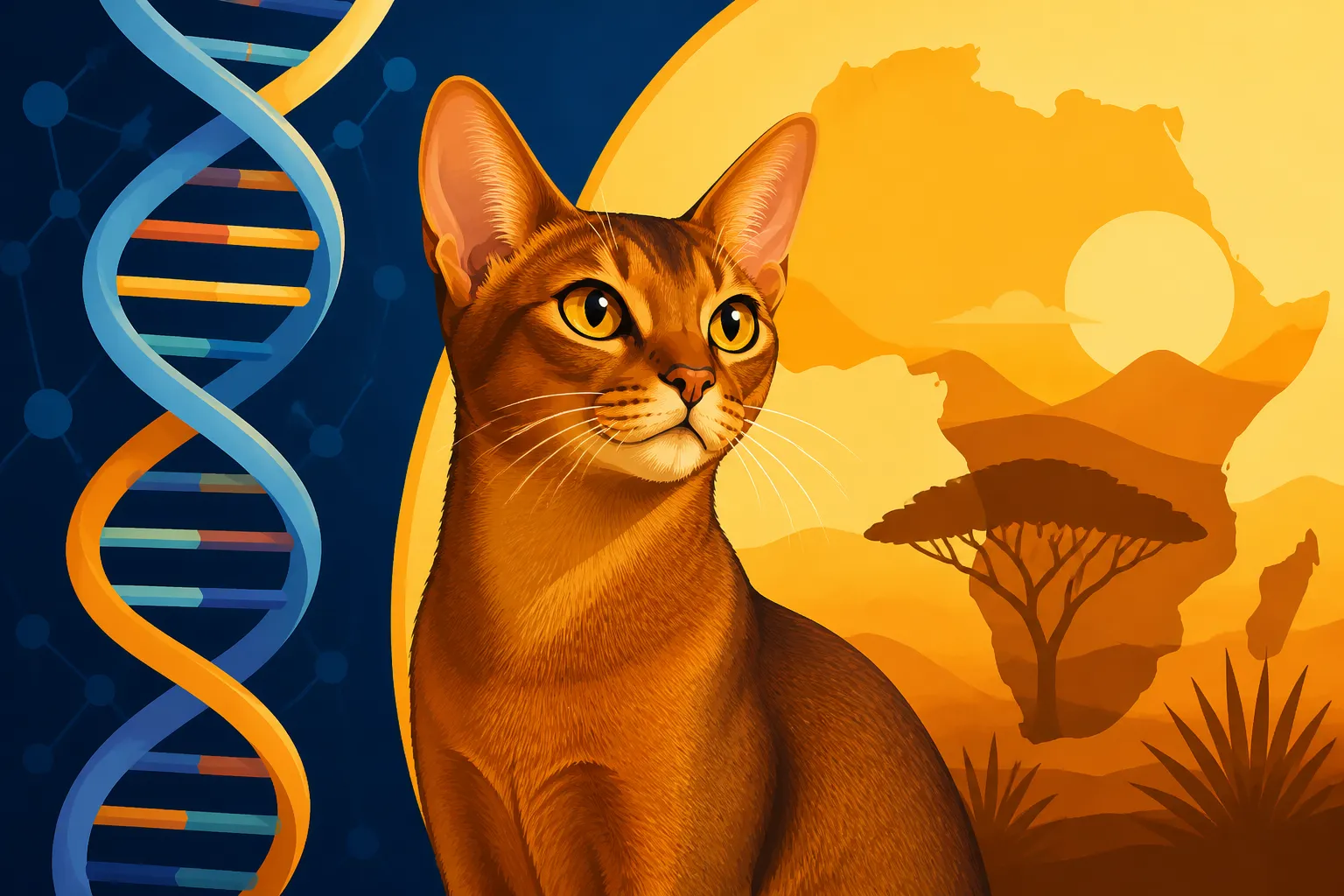
Modern genetic studies analyze specific markers within a cat's DNA, looking for patterns and similarities across different breeds and geographical populations. By comparing these intricate genetic fingerprints, scientists can identify shared ancestry, trace migration routes, and even pinpoint regions where certain mutations or breed characteristics likely originated. It’s like creating a massive, incredibly detailed family tree for all domestic cats, with the Abyssinian finding its specific branch rooted in verifiable data. This scientific approach has helped clarify the true history for many breeds, offering a much more objective view than old records ever could. What Genetic Studies Say About Where Abyssinians Came From highlights how this new science changed everything.
The Power of the Genetic Panel
When you look at today's purebred cats, many come with comprehensive DNA panels that test for genetic diseases and breed characteristics. This wasn't always the case, but the fundamental technology that allows us to test an Abyssinian for serious conditions like Pyruvate Kinase Deficiency Is the Abyssinian's Best Known Test or PRA-rdAc Takes an Abyssinian's Sight by Five is the same science that allows researchers to map out the historical spread of cat populations. These genetic panels offer a deep dive into an individual cat's genetic makeup, revealing not only potential health risks but also distant connections that visual inspection or old, incomplete records could never show. It's about looking beneath the fur and into the very blueprint of life.
Unveiling the Abyssinian's True Genetic Landscape
When the scientific community finally turned its powerful genetic tools towards the Abyssinian, the results were, for some, quite surprising. The romantic tales of ancient Egypt and far-off Abyssinia began to unravel, replaced by a picture that was no less fascinating, but far more grounded in scientific evidence. This shift from legend to lab data provided a new, exciting understanding of the breed's journey. It proved that while history is important, science often has the final word on origins.
The Southeastern Asian Link Emerges
One of the most significant findings from multiple independent genetic studies points strongly towards Southeast Asia as the most likely ancestral home for the Abyssinian. Researchers identified genetic markers in Abyssinians that are prevalent in cats from regions like the coast of the Indian Ocean, including areas around Singapore and Malaysia. This suggests a deep genetic connection to cats from that part of the world, rather than Africa or the Middle East. It completely shifts the geographical focus of the breed's origins, asking us to rethink long-held beliefs. These studies provide compelling evidence that the ticked coat and overall genetic profile align far more closely with Asian cat populations.
The Indian Ocean Coastal Cat Population
Specifically, studies have highlighted a connection to what geneticists refer to as the "Indian Ocean coastal cat" population. This group of cats is thought to have spread along ancient maritime trade routes, carried by sailors and merchants as they traversed vast distances. Cats were invaluable companions on ships, controlling rodent populations and offering companionship during long voyages. The genes of these coastal cats show up consistently in the Abyssinian, painting a picture of a breed that likely developed from felines that traveled extensively before eventually making their way to Europe. This makes for a much more dynamic and globe-trotting origin story than a single, static location like a specific country.
Understanding the Southeast Asian Connection
So, if not Abyssinia or Egypt, why Southeast Asia? This isn't just about finding similar genes; it's about understanding the historical context of cat migration and how a distinctive coat pattern could emerge and be carried across continents. The interconnectedness of ancient trade routes provides a logical pathway for such a spread, demonstrating that cats, much like goods and ideas, traveled globally long before modern transportation.
The Agouti Gene and Ticking Distribution
The unique ticked coat of the Abyssinian, where each individual hair has bands of color, is a result of the agouti gene. Genetic studies have found that the specific variant of the agouti gene responsible for the Abyssinian's ticking is also common in cats from Southeast Asian regions. This isn't just a coincidence; it strongly suggests a shared genetic heritage. Rather than the ticked pattern originating in Africa and then making its way to Europe, it seems more probable it came via the East, carried westward along busy shipping lanes. This particular genetic signature is a key piece of the puzzle, tying the Abyssinian firmly to Asian ancestry.
Historical Trade Routes and Cat Transport
Consider the ancient trade routes that crisscrossed the Indian Ocean and connected Asia to the Middle East and eventually Europe. Cats were indispensable cargo on these vessels, providing natural pest control against rats and mice that could destroy precious goods and spread disease. It's entirely plausible, even highly likely, that cats with the ticking gene were part of these maritime migrations, spreading their unique genetics as they went, breeding with local populations at port cities. These weren't planned breedings but natural dispersion driven by human activity, eventually leading to the foundation stock of what would become the Abyssinian in the West. This historical context makes the genetic findings even more compelling and gives us a richer, more accurate picture of their journey.
Disproving Direct Egyptian and African Ancestry
For many years, the idea of a direct link to ancient Egyptian cats or wild African felines was held as gospel, fueled by captivating imagery and persistent myths. Genetic studies have largely debunked these romantic notions, providing a clearer, more scientific picture. It’s a necessary step to move past attractive but unsubstantiated stories to embrace what the data truly shows about feline evolution.
No Distinct Egyptian Cat Lineage
While cats were undoubtedly revered and widely kept in ancient Egypt, genetic analysis hasn't found a direct, unbroken, and distinct genetic lineage connecting modern Abyssinians specifically to ancient Egyptian cat populations. The domestic cat's presence in Egypt was significant and well-documented, but the specific genetic signature of the Abyssinian doesn't align with what would be expected from a direct, isolated Egyptian lineage. Instead, its markers point elsewhere, suggesting that while the region was important for cat domestication, it wasn't the specific origin point for the Abyssinian breed as we know it today. The ancient Egyptian cats were part of a broader feline history, but not the direct ancestors of this particular breed.
Differentiating from African Wildcats
It's also important to distinguish the Abyssinian from the African Wildcat (Felis lybica lybica), which is considered the primary ancestor of all domestic cats. While all domestic cats share a common ancestor with the African Wildcat, the Abyssinian does not show any closer or more recent genetic ties to the African Wildcat than other domestic cat breeds. In other words, it's not a "wild cat" hybrid or a recently domesticated variant that maintains a stronger link to the wild. It's a long-established domestic breed with its own specific evolutionary path within the wider domestic cat family tree, just like a Siamese or a Maine Coon. Whether the Abyssinian Has Any Wild Ancestry further explores this topic, clarifying that their wild appearance is a coincidence, not a recent genetic link.
The Abyssinian's Place in the Domestic Cat Family Tree
Understanding the Abyssinian's genetic origins helps us place it accurately within the broader story of domestic cat evolution. It's not an isolated anomaly but a fascinating chapter in how humans and felines have co-existed and migrated across the globe, adapting and developing distinct characteristics over centuries. This perspective allows us to appreciate the intricate tapestry of feline genetics and human history.
A Genetically Diverse, Ancient Lineage
The Abyssinian is considered one of the older, naturally occurring breeds, meaning its distinctive traits likely developed relatively early in the history of domestic cats, rather than being the result of recent, intensive selective breeding programs. Its genetic diversity, compared to some newer breeds that have gone through significant bottlenecks, also supports this idea of a more ancient, less bottlenecked origin. This suggests a long period of natural selection and broader genetic contribution before formal breed establishment. This ancient heritage makes its journey from Southeast Asia to global popularity even more remarkable, highlighting the enduring nature of its genetic foundation.
Table: Comparing Traditional vs. Genetic Origin Theories
To help clarify the differences between the long-held beliefs and the scientific findings, here’s a comparison:
| Aspect | Traditional "Zula" / "Egyptian" Theory | Modern Genetic Findings |
|---|---|---|
| Primary Origin | Abyssinia (Ethiopia) or Ancient Egypt | Southeast Asia (Indian Ocean coastal regions, e.g., Malaysia, Singapore) |
| Key Evidence | Anecdotal accounts, visual resemblance to ancient art, Zula's story | Shared DNA markers with Southeast Asian cat populations, specific agouti gene variant |
| Migration Route | Direct import from Africa/Middle East to Europe | Via ancient maritime trade routes from Southeast Asia across the Indian Ocean |
| Genetic Lineage | Direct, ancient lineage from African wildcats/Egyptian temple cats | Part of a broader domestic cat migration, distinct from direct African wildcat link |
| Breed Age | Ancient, directly linked to earliest domestications | One of the older, "natural" breeds, but geographically distinct from earlier beliefs |
| Coat Pattern Origin | Believed to originate in African populations | Specific ticked agouti gene variant strongly linked to Southeast Asian cats |
| Genetic Diversity | Assumed from isolated, ancient stock | Reflects broader original gene pool, consistent with maritime dispersal |
The Evolution of Breed Recognition and Standards
Despite the genetic revelations, the name "Abyssinian" persists, a testament to how history and tradition shape our perception of breeds. The journey from a geographically mislabeled cat to a globally recognized pedigree breed is a story of human fascination and selective breeding, where the name has taken on a life of its own, separate from its literal meaning.
Maintaining the Name, Updating the Knowledge
The name "Abyssinian" is so deeply ingrained in the cat fancy world and public consciousness that it's unlikely to ever change, even with updated genetic knowledge. It's a historical label that has become synonymous with the breed's distinct appearance and lively personality, regardless of its true geographical origin. What has changed, however, is our understanding of the science behind its existence. Breeders and enthusiasts are increasingly aware of the genetic truth, allowing for more informed decisions regarding disease management and population health, even if the romantic name remains. It’s a classic example of tradition holding firm while scientific understanding evolves.
The Role of Early Breeders in Shaping the Breed
While the initial cats that formed the Abyssinian gene pool likely arrived via trade ships, it was the dedicated efforts of early cat fanciers in Europe and later, America, who refined the breed. They selected for specific traits—the even ticking, the elegant body type, the expressive eye color—and established the first breed standards. This human intervention, through careful selective breeding over generations, solidified the "Abyssinian" as a distinct and recognizable purebred cat. The early show cats and their descendants became the foundation, regardless of where their great-great-great-grandparents originally hailed from. What the First Abyssinian Breed Standard Said showcases these initial efforts to define and standardize the breed's appearance.
Practical Implications for Abyssinian Owners Today
For the modern Abyssinian owner, understanding the genetic origins isn't just an academic exercise in correcting old myths. It offers a deeper, more profound appreciation for their cat's unique and truly global history, and reinforces the importance of responsible breeding practices that prioritize health and genetic diversity. Knowing where they truly come from can enrich your bond with your adventurous companion.
Appreciating a Global Heritage
Instead of a narrow, singular origin story confined to a single African country, Abyssinians now carry a more expansive, global heritage. Their ancestors journeyed across vast oceans, representing a living connection to the earliest days of human-feline partnership and global trade. This understanding adds another layer of appreciation for the resilient and adaptable nature of domestic cats and the fascinating path that led to your particular companion. You're not just getting a cat with a specific look; you're getting a piece of living history that spans continents and centuries, a true world traveler in feline form.
The Importance of Genetic Health Testing
While origin stories are about the past, genetic testing is crucial for the future and current well-being of the breed. Understanding the genetic makeup of the breed has led to the development of tests for inherited conditions. Responsible breeders today prioritize health, utilizing DNA tests to ensure they are not inadvertently passing on predispositions to diseases like Pyruvate Kinase Deficiency or progressive retinal atrophy, both of which can impact the Abyssinian. Which Two DNA Tests an Abyssinian Must Have is a critical piece of information for any potential Abyssinian owner, showing how science informs care. These tests are far more valuable than any romanticized origin story when it comes to ensuring a long, healthy life for your beloved Abyssinian.
Disclaimer
This article is for general informational purposes only and does not constitute professional advice. Laws, prices and regulations vary by location and change over time. Consult a qualified professional for guidance on your specific situation.