Whether the Abyssinian Has Any Wild Ancestry
An Abyssinian’s tawny coat, large ears, and alert expression can make it look remarkably wild. That resemblance often leads to questions about African wildcats, ancient Egyptian cats, or even recent hybrid ancestry. The short answer is that Abyssinians are domestic cats, and their appearance is not proof of a recent wild ancestor. Here’s what their history and genetics can—and cannot—tell us.
Does the Abyssinian Have Wild Ancestry
The difference between shared ancestry and recent hybrid ancestry
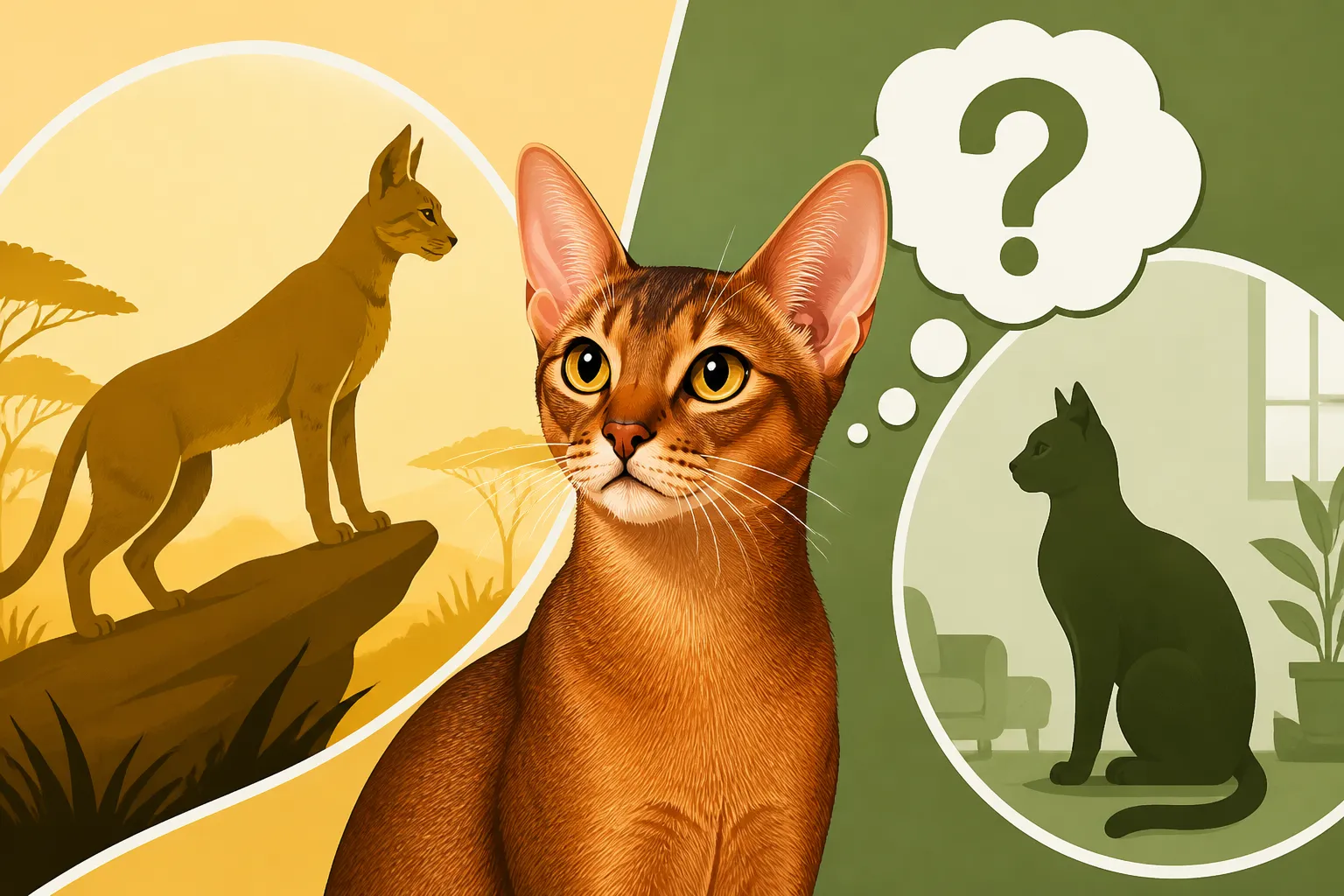
Like other domestic cats, Abyssinians ultimately share ancestry with wildcats. Domestic cats arose from populations of the African wildcat, generally identified as Felis silvestris lybica. That is a deep evolutionary connection shared across domestic cats, not evidence that modern Abyssinians were recently crossed with wild animals.
It helps to separate two meanings of “wild ancestry.” In the broad sense, a domestic cat’s lineage reaches back to wild ancestors. In the narrower sense, people may mean that an Abyssinian breed was recently made by crossing domestic cats with African wildcats or another wild species. The first is true of domestic cats generally; the second is not supported by the breed’s established history.
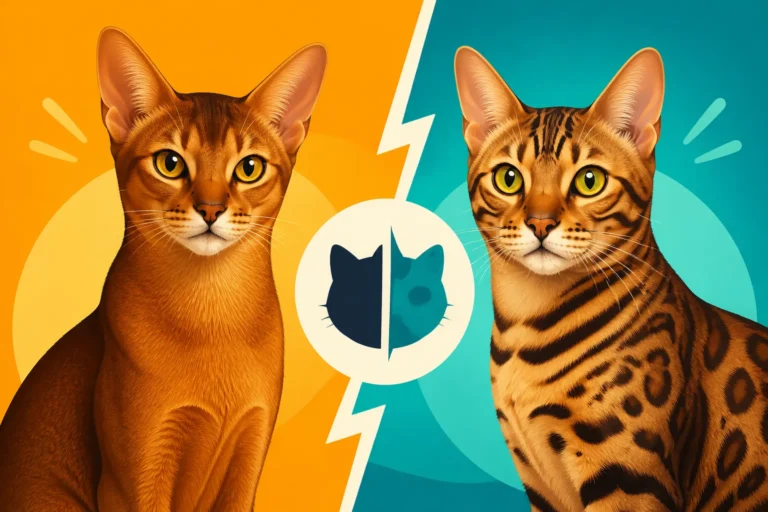
This distinction matters because a cat can look wild without carrying a recent wildcat ancestor. Coat pattern, body shape, ear size, and expression can be shaped over generations through ordinary domestic breeding. A lean, athletic cat with a ticked coat may look like it belongs on a savanna, but those features don’t establish what its recent ancestors were.
For a closer look at the species comparison, see How the Abyssinian Compares to the African Wildcat. The important takeaway is that resemblance and ancestry are different kinds of evidence. One is something you can observe; the other requires records and genetic analysis.
What the breed’s appearance can and cannot tell you
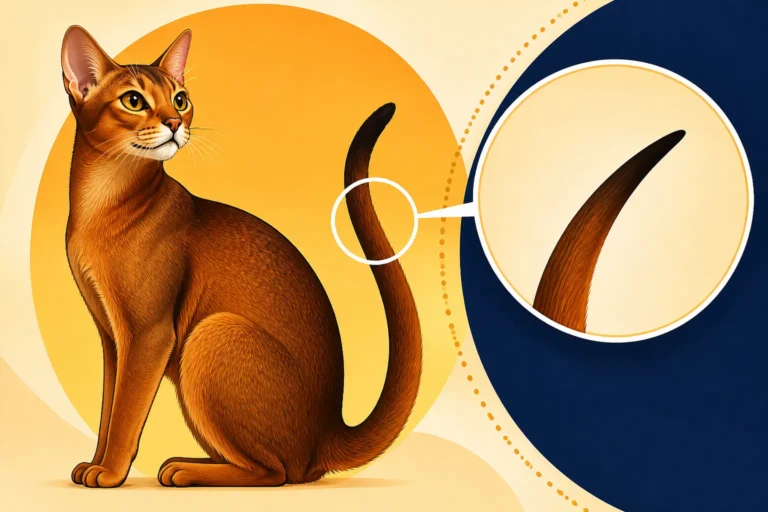
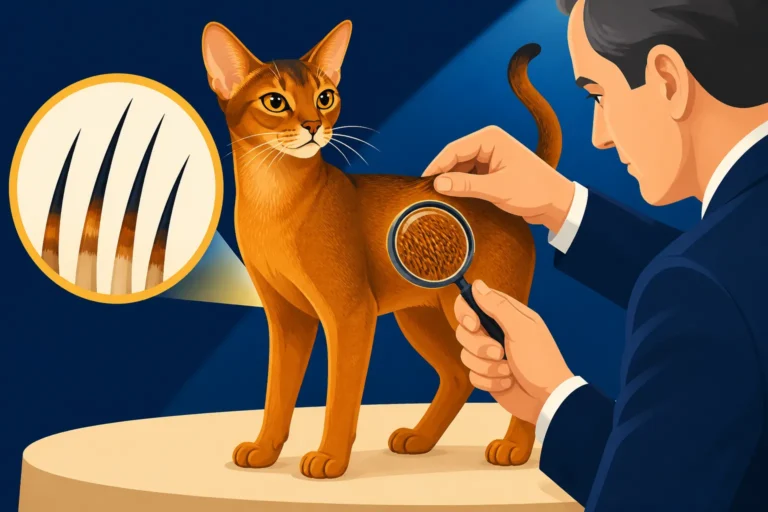
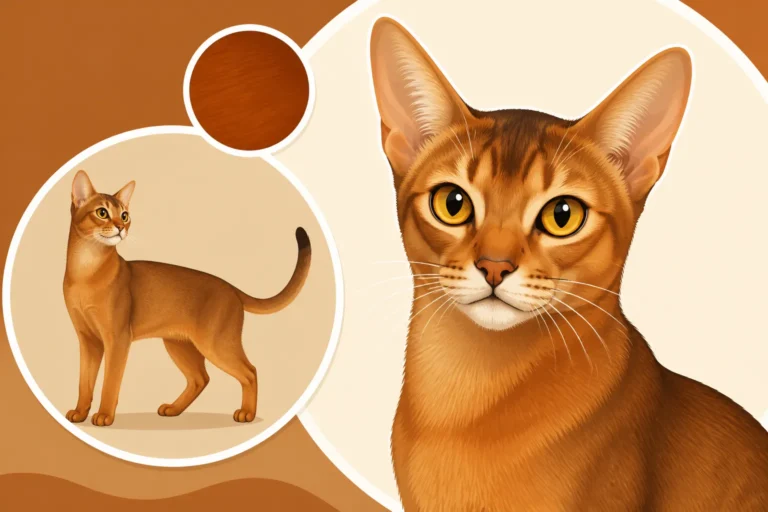
Abyssinians are known for their short, close-lying coats, athletic frames, large ears, and fine-boned appearance. Their characteristic ticking—multiple bands of color on individual hairs—creates a warm, shaded look rather than the familiar stripes of many tabby cats. The overall effect can seem especially wild when an Abyssinian is poised on a high shelf, watching a room with bright, attentive eyes.
But appearance is a poor shortcut for identifying recent ancestry. Domestic breeds can develop striking traits through selection, and similar traits can appear in different populations without a recent cross between them. A cat’s “wild look” is not a genetic certificate.
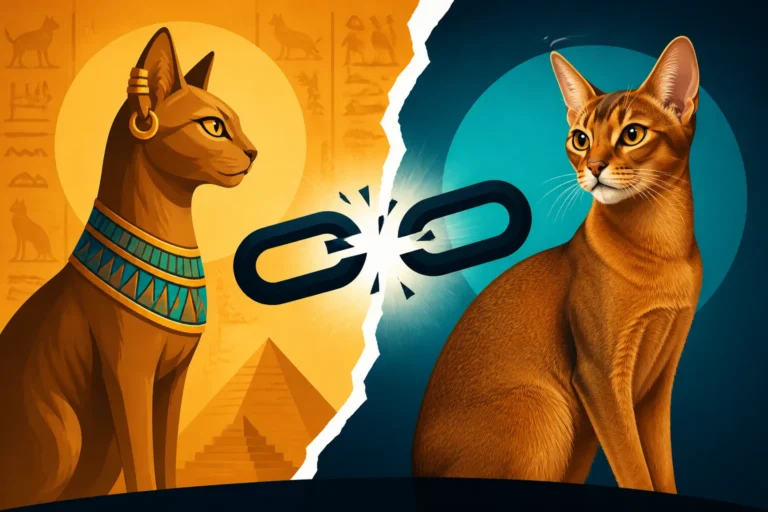
The same caution applies to stories linking Abyssinians to ancient Egyptian cats. Artistic depictions of cats with elegant bodies or upright ears can feel familiar to Abyssinian owners, but visual similarity does not prove an unbroken family line. There is no reliable pedigree trail connecting today’s breed to a particular ancient cat. You can explore that distinction further in Why the Abyssinian Resembles Ancient Egyptian Art and Whether Any Cat Alive Descends From Egyptian Temple Cats.
If you are looking at an individual cat rather than the breed as a whole, its face or coat still won’t reveal whether a wild animal appears somewhere in its recent family tree. Reliable evidence would come from well-documented parentage and relevant genetic testing—not from a dramatic profile or a coat that looks “primitive.”
What Genetics Can Reveal About Abyssinian Origins
Genetic evidence points to a complicated domestic-cat history
Genetic research can help compare cat populations and identify relationships that are not obvious from appearance alone. It can also show that domestic cats moved with people across regions, mixed with local populations, and developed into distinct breeds much later. That broad history is more complicated than a simple story in which one modern breed descends neatly from one ancient place or group.
Studies of domestic-cat populations have found geographic patterns and shared genetic variation, but those patterns do not necessarily identify the exact birthplace of a modern breed. A genetic resemblance between populations is not the same as proof that one breed was directly created from a particular wildcat population. Nor does a broad regional signal automatically establish the route followed by an individual cat’s ancestors.
In other words, DNA can help researchers ask better questions, but it rarely turns a breed’s origin story into a tidy family tree. The available discussion of Abyssinian ancestry is best understood as evidence about relationships and population history, not as proof of a recent wild cross. For more on that broader evidence, see What Modern DNA Studies Found About Abyssinian Ancestry and What DNA Says About Where Abyssinians Came From.
A helpful way to think about it is to imagine tracing a family through migration records. A record might show that relatives lived in several regions over generations, but it would not necessarily identify the exact village where the family began. Cat genetics has similar limits: it can reveal patterns without answering every question about a breed’s beginnings.
Why a genetic result is not the same as a breed origin story
A DNA test’s result depends on what populations are included for comparison and what question the test is designed to answer. A test intended to assess health variants, for example, is not automatically a test of whether a cat has recent wild ancestry. And a result that compares a cat with reference populations does not necessarily provide a complete account of all its ancestors.
There is another complication: cat breeds are relatively recent compared with the long history of domestic cats. Breeds were shaped through deliberate selection and recorded breeding, often using cats from different backgrounds. That means a breed’s modern identity may be much clearer than the exact origins of every cat that contributed to it.
So if an online post says that an Abyssinian “has wild DNA” because it looks like a wildcat or because a test produced a broad regional match, treat that claim cautiously. Ask what the test measured, what reference populations it used, and whether the claim is about ancient shared ancestry or a recent cross. Without that context, the phrase “wild ancestry” can sound more specific than the evidence really is.
| Claim | What it may mean | What it does not prove |
|---|---|---|
| Abyssinians resemble wildcats | Some visible traits look similar | A recent wildcat cross |
| Domestic cats share wildcat ancestry | Domestic cats have a common evolutionary background | That one modern breed is uniquely wild |
| DNA shows regional relationships | Populations share patterns of genetic variation | A precise birthplace or complete family tree |
| A cat has a breed label | It may have documented ancestry or breed-like traits | That every ancestor is known |
How the Abyssinian Became a Recognized Breed
The historical record is more useful than appearance alone
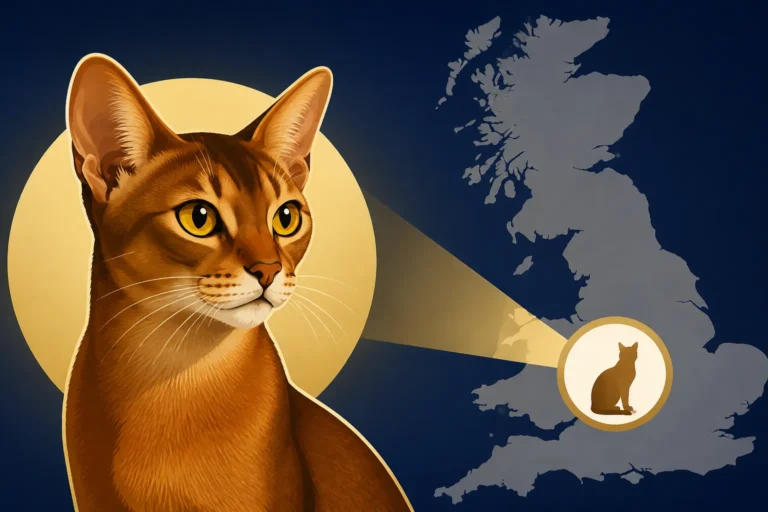
The modern Abyssinian breed took shape through human breeding and registration, particularly in Britain during the nineteenth century and afterward. The popular story that the breed came directly from Abyssinia—now Ethiopia—has long been repeated, but the name and the available historical evidence do not establish that the breed originated there.
Early cat records are incomplete by modern standards. Cats moved through ports, households, and breeding programs without the detailed genetic records that would be expected today. As a result, some parts of the breed’s early history remain uncertain. That uncertainty is not evidence of a hidden wild cross; it simply means the surviving documentation cannot answer every question.
The Abyssinian’s development is better understood as part of the wider history of domestic cats and organized breed development. Breeders selected for a distinctive coat, body type, and overall appearance, gradually establishing a recognizable breed. To see why its name can be misleading, read Why the Abyssinian Was Named After a Country It Is Not From. For a related discussion of early breeding claims, Whether the Abyssinian Was Built From British Tabbies explores another question about the breed’s foundations.
This history also explains why the breed’s origin cannot be reduced to one dramatic moment. A modern breed is typically the result of people choosing and documenting cats over time, with population changes along the way. The story may contain gaps, but gaps in the record should not be filled with confident claims that the evidence does not support.
What the wild look means to an owner today
For an owner, the Abyssinian’s wild appearance is part of its charm, but it does not mean the cat has the needs or temperament of a wild animal. Abyssinians are domestic companions. They may be agile, curious, busy, and keen to climb, but those behaviors fit an energetic domestic cat—not a wildcat in a living room.
That distinction is practical. A person choosing an Abyssinian should plan for enrichment, safe climbing routes, interactive play, and a home environment that gives the cat opportunities to explore. The right response to an athletic, observant cat is not to assume it needs “wild” treatment; it is to meet its needs as a domestic animal with a lively temperament.
A wild-looking cat also needs ordinary domestic care: routine veterinary attention, appropriate nutrition, identification, and a safe indoor environment or secure outdoor enclosure. Appearance does not remove the importance of socialization or responsible ownership. For more about the breed’s general background, see The Abyssinian Is Probably Not From Abyssinia and Whether an Abyssinian Is the Right Cat for You.
If someone is considering an Abyssinian because it seems exotic, it is worth looking beyond the coat and profile. Ask about the cat’s temperament, health history, and breeding records. Those details are much more useful for understanding the animal in front of you than speculation based on its resemblance to a wild species.
How to Evaluate Claims About Wild Ancestry
Questions to ask when you encounter a bold claim
Claims about unusual ancestry often travel farther than the evidence behind them. A social media post may describe a breed as “part wildcat,” while a seller may use phrases such as “ancient bloodline” or “exotic heritage” to make a cat sound rare. Before accepting the story, ask what the claim is actually based on.
Start with the specific species and timeframe. Does the person mean the shared evolutionary ancestry of all domestic cats, a historical contribution from a regional domestic population, or a recent cross with a wild species? Those are very different claims. If the answer shifts between meanings, the claim may be using an impressive phrase without making a clear, testable statement.
Next, ask for documentation. For a registered cat, look for consistent pedigree records and ask how the breeder explains the animal’s lineage. If a genetic test is mentioned, ask what it was designed to detect and whether the result addresses recent hybrid ancestry or something else. A photograph, a coat pattern, or a confident-sounding anecdote is not a substitute for evidence.
Finally, be wary of claims that promise certainty where the historical record is incomplete. A responsible explanation can acknowledge what is known, what remains uncertain, and why appearance alone cannot settle the question. That kind of careful answer is more credible than a dramatic origin story.
A practical way to interpret the evidence
When you hear that Abyssinians have wild ancestry, the most accurate response is to ask which meaning is intended. If the speaker means that domestic cats share ancient ancestry with wildcats, that is broadly true for domestic cats as a whole. If they mean that the Abyssinian breed is known to come from recent crossings with African wildcats, that claim is not established by the breed’s appearance or accepted history.
It is also useful to distinguish breed history from an individual cat’s background. The breed’s broad development can be discussed from historical records and population research, while an individual cat’s recent lineage depends on its own documented parents and ancestors. One does not automatically answer the other.
The most grounded conclusion is modest but clear: Abyssinians are domestic cats with the deep wildcat ancestry shared by domestic cats generally. Their distinctive, wild-looking features do not demonstrate recent wild ancestry, and the breed’s early history contains uncertainties that should not be turned into unsupported claims. That leaves room for fascination without confusing resemblance, ancient evolutionary roots, and documented recent lineage.
Disclaimer
This article is for general informational purposes only and does not constitute professional advice. Laws, prices and regulations vary by location and change over time. Consult a qualified professional for guidance on your specific situation.