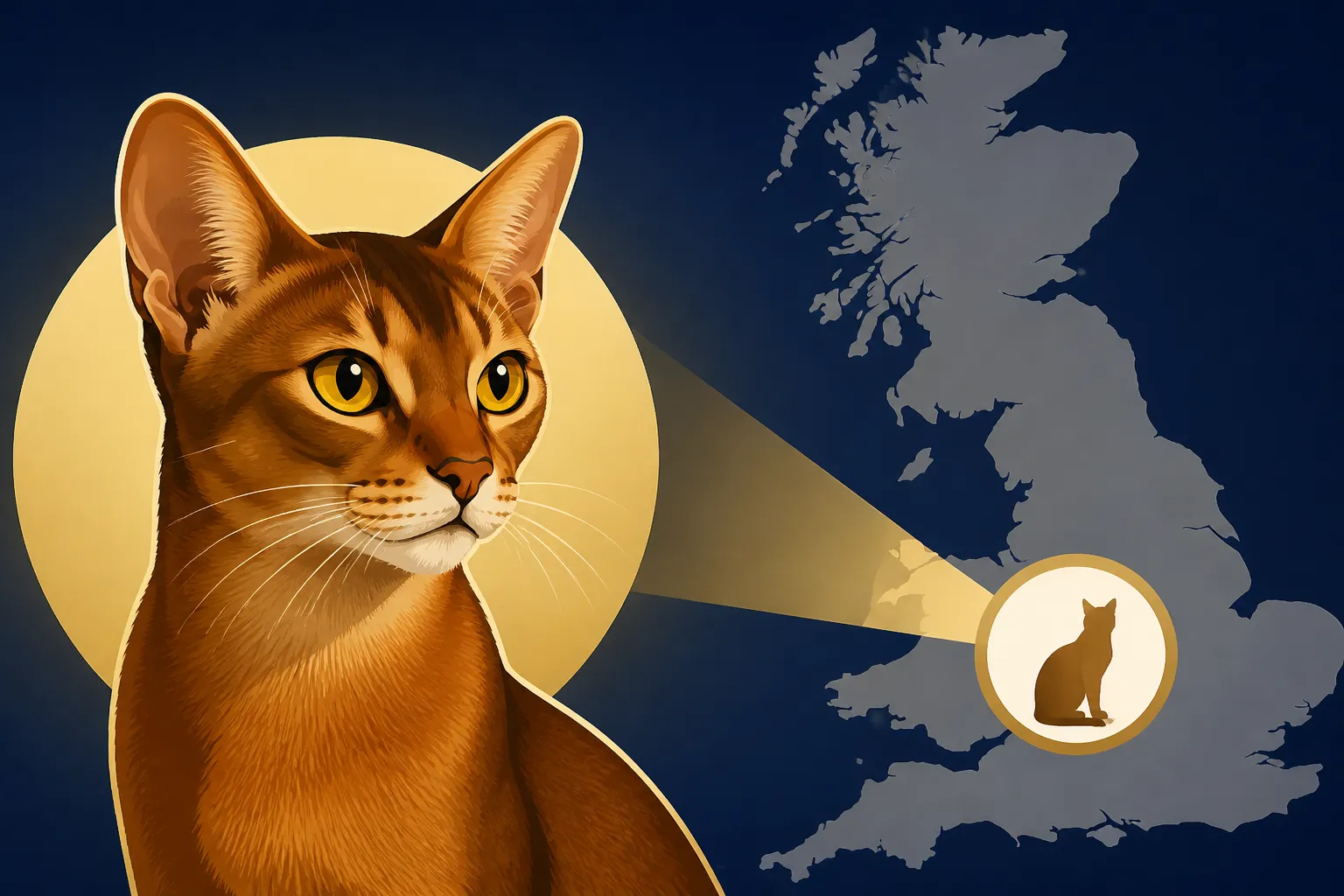
How Few Abyssinians Were Left in Britain by 1900
By 1900, Abyssinians were a recognized but uncommon breed in Britain—not a large, well-documented population that can be counted with confidence. The surviving records tell us more about early shows, registrations, and breeding than about every cat alive. This guide explains what “few” really means, why an exact number is elusive, and how later near-extinction stories can blur the picture.
What “few Abyssinians” meant around 1900
A recognized breed, not a counted population
Abyssinians were already appearing in British cat shows before 1900. A cat described as an Abyssinian was shown at the Crystal Palace in 1871, and the breed name appeared in registration records in the following years. That establishes that the breed existed in Britain and had gained recognition among cat fanciers. It does not tell us how many Abyssinians lived across the country.
There was no complete census of cats, let alone a national count by breed. Show catalogues and pedigree records captured animals connected to the growing cat fancy, not every household pet or unregistered breeding cat. A small number of recorded entries can therefore indicate a small and selective show population without proving that only that many Abyssinians existed.
The best-supported conclusion is modest: by 1900, Abyssinians were a relatively rare, specialist breed in Britain, with a limited pool of recorded breeding animals. The records do not support a precise figure for how many were alive. That distinction matters because a claim such as “only a handful remained” sounds like a verified head count, when the historical evidence is much less complete.
Why historical records do not give a reliable total
Early cat registries were not modern population databases. Registration depended on breeders and owners choosing to submit information, and record-keeping practices developed over time. Cats outside the show circuit, cats with uncertain ancestry, and animals kept as companions could easily go unrecorded.
Names and labels also make comparisons tricky. Early descriptions of cats could reflect coat color, appearance, or an assumed place of origin rather than a consistent modern breed definition. A record that uses “Abyssinian” is valuable evidence, but it should not automatically be treated as equivalent to a present-day pedigree entry.
For that reason, historians often reconstruct a breed’s early story from several kinds of evidence: show catalogues, registration lists, written descriptions, and later pedigrees. Each source offers a piece of the picture, but none provides a complete count of the British Abyssinian population in 1900. The record can show that the breed was uncommon and developing; it cannot provide an exact nationwide total.
The difference between rarity and near-extinction
Rarity is not the same as being on the brink of extinction. A breed can have few breeders, limited show entries, and a narrow pool of recorded pedigrees while still having more cats than the surviving documents suggest. “Nearly extinct” is a stronger claim and should be tied to a particular period and evidence.
In the Abyssinian’s history, accounts of severe population loss are more closely associated with the upheavals of the twentieth century, particularly the World Wars. Those events disrupted breeding programs and reduced populations across many breeds. They happened after 1900, so they should not be used as proof that only a tiny number of Abyssinians existed in Britain at the turn of the century.
A useful way to phrase the situation is that the breed had a small, vulnerable foundation in the British cat fancy. That describes its limited numbers and dependence on a relatively small group of breeders without pretending that anyone counted every cat. For more on the later crisis, see The Abyssinian Nearly Disappeared From Britain Twice and How British Abyssinians Nearly Died Out.
How Abyssinians became established in Britain
The story of Zula and the limits of the origin tale
The familiar account connects the Abyssinian breed name to a cat called Zula, said to have come from Abyssinia with a British military expedition in the nineteenth century. Zula is associated with the 1871 Crystal Palace show, which makes the story an appealing starting point for the breed’s British history.
But an appealing story is not the same as a documented pedigree. No continuous lineage connects Zula to the Abyssinians bred in Britain later on. The early records leave gaps, and the cat fancy was still developing its methods for defining and registering breeds. It is reasonable to treat Zula as part of the breed’s historical lore, but not as proof that every later Abyssinian descended from that one cat.
This uncertainty does not make the early history meaningless. It means that the origin story needs to be read carefully: the breed was named and presented in a period when cat breeders were formalizing types, and the name may not provide a complete account of the cats’ ancestry. Zula and the 1868 Story Everyone Repeats and Why No Pedigree Connects Zula to Later Abyssinians explore that distinction in more detail.
Shows and registration helped define the breed
Cat shows gave breeders a public setting to compare animals and describe the qualities they wanted to preserve. As judges and exhibitors developed expectations for coat, body shape, and color, the Abyssinian became more than a general description of a striking cat. It became a breed type that fanciers could recognize and work toward.
Registration added another layer. A registered cat had a place in the records of the organized cat fancy, which made it easier for breeders to trace pairings and establish lines. Yet registration still reflected participation in that system. It did not capture every cat that might have resembled an Abyssinian or contributed to the breed’s development.
By 1900, then, the breed was established enough to be recognized within British cat circles, but its numbers and records remained limited compared with those of a long-established, widely bred population. The process of setting a standard and building pedigrees was still part of the story. When the First Abyssinian Was Registered and What the First Abyssinian Breed Standard Said provide useful background on how those definitions took shape.
Why the name does not settle the ancestry question
The word “Abyssinian” suggests a clear geographic origin, but breed names do not always function as reliable maps. A name may reflect what people believed about a cat at the time, the route by which it was said to have arrived, or the appearance that made it seem distinctive. Historical claims about origin need to be checked against the evidence available, rather than inferred from the label alone.
Later genetic research has added a different kind of evidence to the discussion. It can help identify broad relationships and patterns in a breed’s ancestry, but it does not fill every gap in nineteenth-century pedigrees. Genetics and written records answer different questions: one can illuminate population relationships, while the other can reveal what breeders and exhibitors recorded.
That is why the cautious historical account is more useful than a neat, overly certain origin tale. The British Abyssinian population around 1900 was small in the formal breeding world, but the exact ancestry and total number of cats remain difficult to reconstruct. See What Genetic Studies Say About the Abyssinian's Origin and What DNA Says About Where Abyssinians Came From for more on the evidence and its limits.
What the historical evidence can and cannot tell us
A practical guide to reading the clues
Different records answer different questions. A show catalogue can confirm that a cat was exhibited at a particular event. A registry can show that a breeder submitted a cat for formal recording. A written description can reveal how people of the time understood the breed’s appearance. None of these sources, by itself, gives a complete count of living Abyssinians.
| Historical clue | What it can show | What it cannot prove |
|---|---|---|
| Show catalogue | An Abyssinian was exhibited at a named event | The total number of Abyssinians in Britain |
| Registration record | A cat was entered into a formal record | That all cats of the type were registered |
| Pedigree | Recorded ancestry across listed generations | A complete account of every ancestor or breeding cat |
| Contemporary description | How people described the breed at the time | That the description matched today’s standards exactly |
| Later population account | How breeders remember or interpret a crisis | A precise count unless supported by records |
When you encounter a precise number for Abyssinians in Britain around 1900, ask what the number counts. Does it refer to registered cats, show entries, breeding animals in a particular cattery, or an estimate of the entire population? Those are not interchangeable measures.
It also helps to look at how the figure was produced. A number repeated in later accounts may have been based on an earlier estimate, not a census. Repetition can make a claim sound settled even when its original evidence is unclear. A careful account distinguishes a documented registration total from a broader estimate and states when the record is incomplete.
The role of pedigrees and early breeding lines
Pedigrees are especially useful for understanding which cats contributed to later breeding lines. They can show that a population was narrow or that particular animals were used repeatedly. But pedigrees are not population censuses. They track ancestry among recorded animals, not every cat living in Britain.
A small number of prominent ancestors can leave a large mark on later pedigrees. That may tell us that a breeding community relied on a limited group of documented cats. It does not necessarily mean that only those cats, or only their close relatives, existed at the time. Some animals may have been left out of formal records, while others may have been known by inconsistent names or descriptions.
For readers interested in how pedigree and breed development connect, How the Abyssinian Was Bred in Victorian Britain offers a closer look at the period. It is useful to keep the scale of the evidence in mind: breeding records tell us about the cats breeders chose to record and use, not the full population of companion animals.
Why later events are often folded into the story
When people remember a breed as having nearly disappeared, they may compress several different periods into one dramatic account. The Abyssinian’s early rarity, later wartime disruption, and subsequent rebuilding can become a single simplified story about a breed that was always on the edge of vanishing.
That compression obscures the chronology. The turn of the century came before the two World Wars. A description of the breed as scarce in Britain by 1900 should not be treated as a count from the later wartime population crisis. Keeping those events separate makes the history clearer and prevents a real later hardship from being assigned to the wrong period.
The rebuilding of the breed also involved more than simply finding surviving cats. Breeders had to re-establish lines and maintain the characteristics associated with the breed. The broad arc—early establishment, later vulnerability, and rebuilding—is well supported as a historical pattern, even when exact population totals are hard to establish. How American Breeders Rebuilt the Abyssinian and Which Countries Rebuilt the Abyssinian Population cover the later part of that story.
What the 1900 population story means today
The breed’s early vulnerability
A small breeding population can be vulnerable even if it is not on the verge of disappearing. If a breed depends on a limited number of breeders and recorded lines, illness, war, or a sudden loss of breeding animals can have an outsized effect. Fewer unrelated breeding choices can also make it harder to maintain a healthy, diverse population.
That is one reason the word “few” matters. It signals that the Abyssinian was not yet a mass-market breed with a large, broadly documented population in Britain. Its future depended on committed breeders and the continued interest of the cat fancy. But without a reliable census, “few” should remain a qualitative description rather than a precise count.
For modern prospective owners, this history is a reminder to look beyond an attractive coat or a dramatic origin story. Responsible breeding today involves health information, careful record-keeping, and transparency about family lines. What an Abyssinian Breeder Should Have Tested Before You Buy explains what health documentation can tell a buyer, while Why the Abyssinian Stayed Popular for 150 Years explores how the breed continued to attract devoted owners.
The clearest answer to the title question
So, how few Abyssinians were left in Britain by 1900? The honest answer is that no dependable nationwide figure is established by the surviving historical record. The breed was uncommon and its documented breeding population was limited, but that is not the same as knowing that only a particular number of cats remained.
The best interpretation is therefore careful rather than dramatic: Abyssinians were a small, developing presence in the British cat fancy around 1900. Show records, registrations, and pedigrees preserve important clues, but they do not amount to a complete count. Later near-extinction accounts should be understood in their own historical context, especially when discussing the effects of the World Wars.
That distinction lets the breed’s history remain compelling without turning uncertainty into a false fact. The Abyssinian’s British story includes early recognition, a narrow recorded breeding base, periods of later hardship, and sustained efforts to rebuild. The details matter, and so does being clear about what the records cannot tell us.
Disclaimer
This article is for general informational purposes only and does not constitute professional advice. Laws, prices and regulations vary by location and change over time. Consult a qualified professional for guidance on your specific situation.