Why the Two World Wars Nearly Ended the Abyssinian
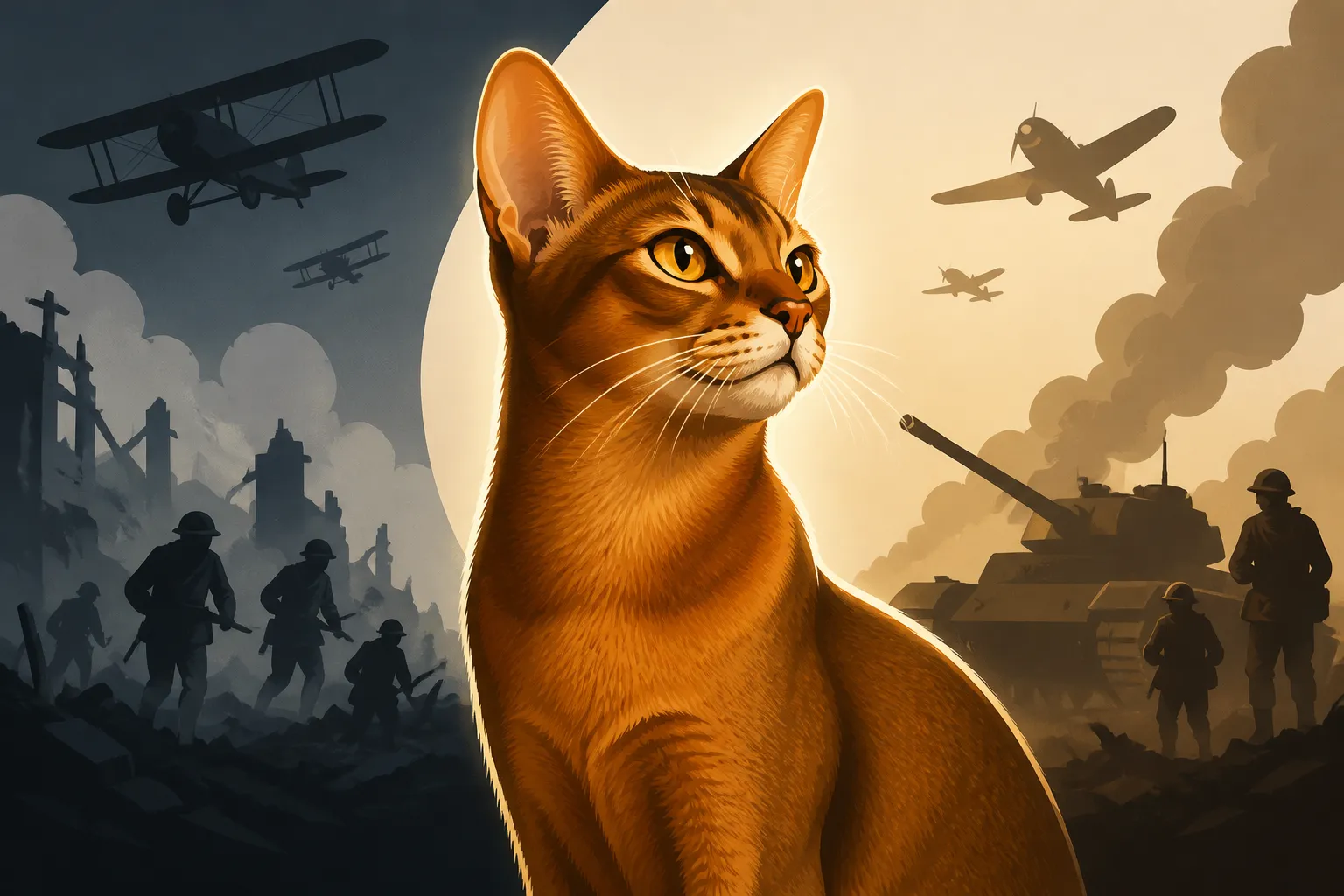
The Abyssinian did not disappear in a single dramatic moment. Two world wars interrupted breeding, scattered families, and made food, shelter, and human safety far more urgent than preserving a pedigree. This guide explains how those pressures pushed the breed close to extinction in Britain, why the postwar population was vulnerable, and how breeders gradually rebuilt it.
Why the First World War Put British Abyssinians at Risk
A young breed depended on a small breeding community
By the time the First World War began, Abyssinians had a foothold in Britain, but the breed was still a relatively small part of the cat fancy. It had become known through late nineteenth-century shows and breeding circles, yet it was not a widespread household cat with a large, geographically scattered population.
That mattered because a small breed population has little backup. If a few breeders stop keeping cats, or several breeding animals are lost, there may not be many others nearby to continue the same lines. A popular breed can sometimes absorb that kind of disruption. A rarer one has less room to recover.
The breed’s early story is often told through the cat Zula, said to have arrived in England from Abyssinia in the nineteenth century. But a famous origin story is not the same thing as a large, well-documented breeding population. The early history is complicated, and there is no simple, unbroken pedigree connecting Zula to every later Abyssinian. For background, see Zula and the 1868 Story Everyone Repeats and Why No Pedigree Connects Zula to Later Abyssinians.
Wartime life interrupted breeding and record keeping
During wartime, daily life changes sharply. People move, household resources become scarce, and routines that once supported breeding become difficult to maintain. For cat breeders, that could mean postponing litters, losing access to veterinary care, or being unable to keep several animals when housing and food were uncertain.
A breeding program depends on more than having cats in the same room. Breeders need time to monitor a queen, care for kittens, find suitable homes, and keep reliable records. When people are dealing with evacuation, military service, financial strain, or the loss of a home, those tasks can become impossible. Even a breeder who keeps a cat may not be able to continue a carefully planned line.
The First World War did not wipe out the Abyssinian, but it weakened the conditions that helped a small breed sustain itself. Breeding slowed, and the already limited population had less resilience if a few important cats were lost. The broader history is covered in The Abyssinian Nearly Disappeared From Britain Twice.
Why the Second World War Was an Even Greater Threat
Bombing, displacement, and shortages affected catteries
The Second World War brought another period of upheaval, including air raids, evacuation, displacement, and severe shortages. Cats could be left behind when families had to move quickly, and breeders faced the same practical choices as other households: protect people first, find safe accommodation, and manage limited supplies.
A cattery requires dependable space and care. A breeder who had to leave a city, share a smaller home, or relocate temporarily might not be able to keep several breeding cats. A cat could survive the disruption while the breeding program around it effectively ended. If records, contacts, or other cats from the same line were lost too, rebuilding became harder.
It is easy to imagine the crisis as one single event, such as a bomb destroying a cattery. In reality, a breed can be endangered by repeated smaller losses: a litter that is never bred, a promising kitten that cannot be kept, a breeder who retires, or a cat that is separated from the people who know its lineage. Those losses add up, especially in a small population.
Keeping a cat alive was more urgent than preserving a breed
Wartime restrictions and shortages placed pressure on ordinary pet keeping, including access to food and supplies. Under those circumstances, maintaining a specialized breeding program was a luxury few people could prioritize. A beloved cat might still receive care, but breeding more cats, raising litters, and planning future pairings were much harder.
That distinction helps explain why the Abyssinian came close to disappearing without requiring every cat to have died. The breed’s future depended on enough healthy, fertile cats remaining in the right places, with people willing and able to continue breeding them. If there were too few animals or too few breeders, the population could shrink rapidly even while some Abyssinians survived.
The following overview shows how different pressures compounded across the two wars:
| Period | Main pressures | Why they mattered to the breed |
|---|---|---|
| Before the First World War | Small breeding community and limited population | Few breeders and cats could carry much of the breed’s future |
| First World War | Interrupted routines, reduced resources, and disrupted breeding | Fewer planned litters and less continuity between generations |
| Between the wars | Recovery from earlier disruption | Breeders had to rebuild while the population remained vulnerable |
| Second World War | Bombing, evacuation, displacement, and shortages | Cats, breeders, records, and catteries could be lost or separated |
| After the Second World War | Small remaining gene pool and need for new breeding stock | Recovery required careful breeding and, in some cases, cats from elsewhere |
This was not a neat, evenly documented decline from one year to the next. The important pattern is the repeated interruption: the breed had limited numbers, lost breeding momentum, and then faced another major crisis before it could fully recover.
How the Abyssinian Survived and Began to Recover
A surviving cat did not automatically mean a surviving breed
A breed is more than a handful of cats that resemble one another. To continue as a healthy, recognizable population, it needs enough breeding animals, enough genetic diversity, and breeders who can plan matings across generations. If too few cats remain, the breed can face a narrow gene pool and difficult choices about how to rebuild.
After the war, breeders had to identify surviving Abyssinians and reconnect breeding efforts. That involved more than finding a cat with the right coat and shape. They needed to understand its background, assess whether it was suitable for breeding, and coordinate with other breeders who might have unrelated or complementary lines.
This kind of recovery can be slow. Cats take time to mature, and a responsible breeding program cannot produce a large population overnight. Even when breeders locate suitable animals, they must make decisions that balance breed type, temperament, health, and the risks of concentrating ancestry too tightly.
International cats helped strengthen the population
Cats from outside Britain became important to rebuilding the Abyssinian population. When breeders can draw on animals from other countries, they may be able to widen the available gene pool and restart lines that have become scarce locally. International exchange also requires careful planning: breeders need to know what animals they are bringing together and how the new lines relate to those already present.
American breeders became part of the larger story of the breed’s development and recovery. The Abyssinian had reached the United States before the Second World War, and breeding communities there continued to develop. For more on this history, see When the Abyssinian Reached the United States and How American Breeders Rebuilt the Abyssinian.
The recovery was not a simple matter of importing cats and declaring the problem solved. Breeders had to rebuild over generations, track ancestry, and maintain the traits that made an Abyssinian recognizable. The international dimension is explored further in Which Countries Rebuilt the Abyssinian Population.
What the Near-Extinction Story Means for the Breed Today
The modern breed reflects rebuilding, not an untouched past
Today’s Abyssinian is the result of many generations of breeding, including periods of hardship and recovery. The breed was not preserved in Britain as a perfectly continuous line untouched by history. War disrupted the people, catteries, and records that supported it, so rebuilding required effort and collaboration.
That history also explains why breed histories can be complicated. A cat’s appearance alone cannot tell you precisely where its ancestors came from or how its line survived. Pedigrees, breeder records, and the broader history of catteries help fill in the picture, though historical gaps may remain.
The Abyssinian’s distinctive ticked coat and lively, athletic look can make the breed seem timeless. But its survival depended on practical, ordinary acts: someone finding a safe place for a cat, a breeder preserving a line, or another breeder sharing breeding stock. Those choices—not just the breed’s popularity—helped keep it going.
Survival should not be confused with freedom from health risks
A narrow or disrupted population can make careful breeding especially important, but the wars do not explain every health issue seen in Abyssinians today. Modern breeders and owners still need to consider health testing, veterinary care, and family history on their own merits. Historical survival is a reason to value good records, not a guarantee that every modern cat is healthy.
For anyone learning about the breed’s development, it can help to separate three questions: how the breed nearly vanished, how breeders rebuilt the population, and what health considerations matter for an individual cat now. These are connected, but they are not interchangeable. The full story of the near-loss and recovery is also outlined in How British Abyssinians Nearly Died Out.
The breed’s early public history helps set the scene, too. Abyssinians were shown in Britain in the nineteenth century, long before the world wars threatened the breeding population. That earlier attention gave the breed a place in the cat fancy, but it could not protect it from later upheaval. For the exhibition history, see What Happened at the 1871 Crystal Palace Show.
Understanding the wars gives the Abyssinian’s survival a human scale. The breed was vulnerable because it was small, and it endured because people continued to care for cats and rebuild breeding communities through difficult periods. Its history is not simply a story of disappearance narrowly avoided; it is a reminder of how much a rare breed can depend on a handful of people and the choices they make.
Disclaimer
This article is for general informational purposes only and does not constitute professional advice. Laws, prices and regulations vary by location and change over time. Consult a qualified professional for guidance on your specific situation.