How Feline Leukemia Hit British Abyssinian Catteries
British Abyssinian breeders faced a frightening problem when feline leukemia virus moved through catteries: cats could look healthy while infection spread through close contact, and losing breeding animals threatened already-small lines. This guide explains how FeLV affected British Abyssinians, why the damage was so serious, and how testing and careful breeding helped protect the breed.
Why feline leukemia was such a serious threat
What FeLV does to a cat
Feline leukemia virus, usually shortened to FeLV, is a contagious retrovirus that can weaken a cat’s immune system and interfere with normal blood-cell production. It is associated with serious illnesses, including some cancers and forms of anemia. Not every infected cat develops the same disease, and infection does not always mean an immediate or visible decline. That uncertainty made FeLV especially troubling in a breeding environment: a cat might appear well while the virus was already affecting its health or putting close companions at risk.
FeLV is not a human disease, and it is not the same as leukemia in people. It spreads mainly through prolonged close contact between cats, particularly via saliva. Mutual grooming, shared food and water dishes, and repeated contact in a closely housed group can create opportunities for transmission. Infected queens may also pass the virus to kittens during pregnancy or nursing.
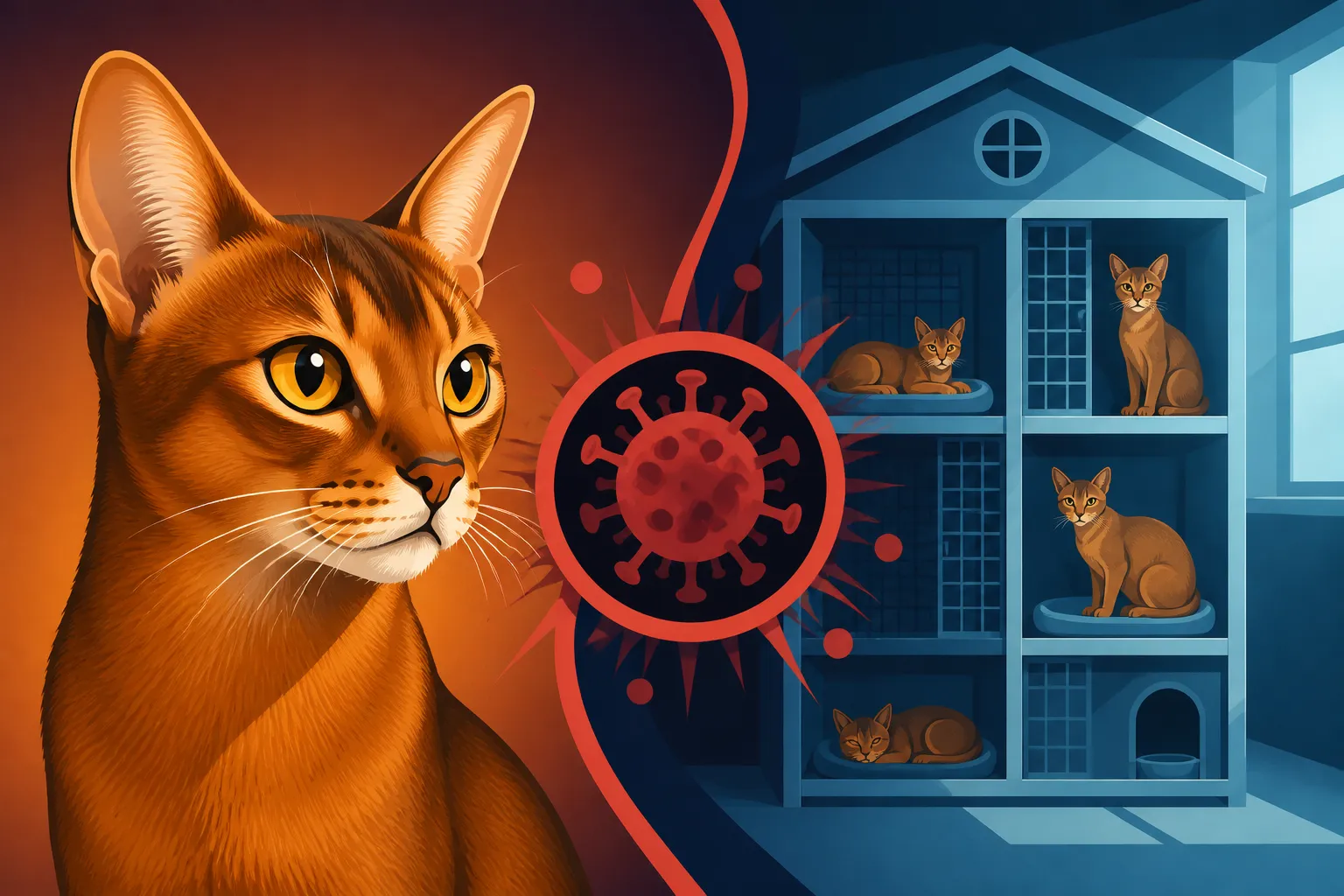
A cattery’s normal routines can therefore become part of the problem. Cats may share rooms, dishes, grooming habits, and nesting areas. An individual animal does not need to be visibly ill for contact to matter. The virus was not an Abyssinian-specific infection, but a tightly managed pedigree population could be vulnerable because many related cats lived in close proximity.
Why a small breed population had less room to absorb losses
Abyssinians in Britain were already part of a relatively limited breeding population. The breed had endured earlier disruptions, including the effects of the world wars. When a population is small, losing even a modest number of healthy, fertile cats can have consequences beyond the immediate deaths. Breeders may lose rare family lines, face fewer choices when pairing animals, and have to work harder to avoid excessive inbreeding.
That is why FeLV’s impact was about more than illness in individual cats. A breeding queen or stud could represent years of careful selection and a branch of a pedigree that was difficult to replace. If an outbreak affected a household or cattery, breeders had to consider both the immediate welfare of infected cats and the risk of carrying the virus into future litters.
The wider history of the breed puts this vulnerability in perspective. The Abyssinian Nearly Disappeared From Britain Twice describes the earlier population pressures that left British lines exposed to further setbacks. How British Abyssinians Nearly Died Out also helps explain why rebuilding a population after a serious loss was not as simple as finding unrelated replacement cats.
How FeLV affected British Abyssinian catteries
Close contact made catteries vulnerable
A cattery brings cats together for breeding, kitten rearing, and social care. Those arrangements can make transmission easier when an infectious cat is present, especially if animals share space over time. A queen and her litter are in close contact by nature, while adult cats may groom one another or eat and drink in the same area. In that setting, separating a sick cat only after obvious symptoms appear may not prevent earlier exposure.
The difficulty is that FeLV does not always announce itself with dramatic signs. One cat may become unwell, while another appears normal. A breeder could face a painful choice between keeping a valued animal in the breeding group and protecting the rest of the cats. In a small population, that decision could affect the future of a whole line.
When people talk about FeLV’s effect on British Abyssinians, it is important not to imagine one uniform outbreak that affected every cattery in exactly the same way. The consequences varied with the cats involved, the timing of detection, and the size and structure of each breeding group. The broader effect was the added pressure on a breed already rebuilding its numbers and maintaining limited lines.
The impact extended beyond the cats that became ill
An infected cat’s health was the first concern, but breeders also had to think about kittens, close companions, and future pairings. A queen’s infection could put a litter at risk, while a stud’s contact with other cats could create concerns across a breeding network. Decisions about quarantine, testing, and whether to retire an animal from breeding could carry emotional as well as practical weight.
The consequences could ripple through pedigrees. If a breeder removed an infected cat from a program, that might mean losing a line that had desirable traits or represented scarce ancestry. If the cat remained in circulation without the infection being identified, further spread could follow. Neither choice was straightforward, and the options available to breeders changed as knowledge and testing improved.
| Cattery challenge | Why it mattered | What it could mean for breeding |
|---|---|---|
| Cats living in close contact | FeLV can spread through repeated contact and saliva exposure | More cats could be exposed before illness was obvious |
| Few breeding animals in a line | A small population has fewer replacement options | Loss of a queen, stud, or family branch could narrow choices |
| Infection without clear early signs | A cat might look well despite infection | Visual checks alone could not reliably protect a group |
| Possible transmission to kittens | Queens and kittens have intense, sustained contact | A litter could be affected along with its mother |
| Limited historical testing | Breeders had fewer ways to identify infection early | Decisions often involved uncertainty and difficult trade-offs |
The breed’s history also connects with the wider story of how Abyssinians reached and developed in the United States. When the Abyssinian Reached the United States and How American Breeders Rebuilt the Abyssinian offer useful context for understanding how cats from outside Britain became important to the breed’s recovery.
How testing and breeding practices helped contain the risk
Testing changed what breeders could know
Before reliable testing became part of routine disease management, a breeder might have had to rely heavily on a cat’s appearance, medical history, and what happened within the household. Those clues could be helpful, but they could not identify every infected cat. Testing gave breeders and veterinarians a way to assess infection more directly and make decisions based on more than outward signs.
A FeLV test is not a substitute for veterinary interpretation. The result needs to be considered alongside the cat’s history, health, and possible exposure. Depending on the circumstances, a veterinarian may recommend follow-up testing or other steps before making a decision about contact with other cats. That matters because an individual test result should not be treated as a complete account of a cat’s health or a cattery’s risk.
For breeders, the key shift was from reacting only when cats became visibly ill toward managing exposure more deliberately. Testing, isolation when appropriate, and careful plans for introducing cats could reduce the chance of unknowingly mixing infected and uninfected animals. What Feline Leukemia Did to British Abyssinian Lines focuses on the breed-specific consequences, while The Abyssinian Has Three DNA Tests and One Disease With None provides a useful reminder that genetic testing and infectious-disease testing answer different questions.
Rebuilding a line meant balancing health and diversity
When a population has suffered losses, restoring numbers is not simply a matter of producing more kittens. Breeders also need to preserve healthy, varied lines and avoid narrowing the gene pool unnecessarily. Bringing in cats from other populations can help, but each introduction requires careful decisions about health, pedigree, and how the animal fits the breeding program.
That balancing act helps explain why the recovery of British Abyssinians is best understood as a gradual process rather than a single rescue event. A breeder might need to protect a vulnerable household while also ensuring that the remaining healthy cats could contribute to future generations. The goal was not just to keep the breed present, but to maintain a sound population with enough diversity to support responsible breeding.
The long-term story is therefore both a warning and an example of adaptation. FeLV exposed how quickly an infectious disease could affect a small, closely managed population. Better awareness, testing, and more deliberate cattery practices gave breeders stronger tools, while careful reconstruction helped preserve the breed. Why the Abyssinian Stayed Popular for 150 Years offers a broader view of the qualities and history that have kept the breed valued despite these setbacks.
What the history means for Abyssinian owners today
FeLV is a household health question, not just a breeding-history detail
For a current owner, the practical lesson is that FeLV status matters most when cats have contact with one another. If you are adopting a cat, bringing a new cat into a home, or managing a cat with known FeLV infection, ask your veterinarian what testing and separation plan makes sense for your situation. A cat’s risk depends on its past exposure and current household, so a generic rule cannot replace an individual veterinary discussion.
If you are preparing a separate area for a cat who may need reduced contact, everyday supplies can make that setup easier. Retailers such as Chewy may be one option for finding a separate food bowl, water bowl, or washable bedding, but the important step is following veterinary guidance about contact and hygiene. Keep supplies assigned to the appropriate cat, and do not assume that buying separate items alone controls infection risk.
A calm, practical setup can help reduce stress while you work through next steps. Chewy is also one place owners may look for an extra litter tray or washable blankets for a separate space. For play and comfort, consider the cat’s temperament and advice from your veterinarian; supplies from Chewy do not replace testing, veterinary care, or a suitable plan for managing contact.
History can guide questions without causing unnecessary alarm
Learning that FeLV affected British Abyssinian lines can make a prospective owner worry that every Abyssinian is at special risk. That is not the right conclusion. FeLV is a virus that can affect cats of any breed. The historical concern arose from the combination of infection, close contact, and a small breeding population—not because Abyssinians are uniquely susceptible to the virus.
If you are choosing a kitten or adult cat, ask about its health history and the breeder’s or rescue organization’s approach to veterinary care. For a household with multiple cats, ask your veterinarian about testing before introducing a newcomer, particularly if the cats’ exposure histories are uncertain. A well-informed plan is more useful than assumptions based on breed name alone.
The history also shows why responsible breeding and good health records matter. The breeder’s role is not to promise that no cat will ever become ill; it is to make thoughtful decisions, share relevant information, and seek veterinary help when concerns arise. For a broader picture of the breed’s development and health, What Genetic Studies Say About the Abyssinian's Origin and How an Abyssinian Differs From a Somali provide additional background on ancestry and breed identity.
Disclaimer
This article is for general informational purposes only and does not constitute professional advice. Laws, prices and regulations vary by location and change over time. Consult a qualified professional for guidance on your specific situation.