Why an Egyptian Mau Is Spotted and an Abyssinian Is Not
An Egyptian Mau’s coat is covered in distinct spots, while an Abyssinian’s looks evenly flecked or softly shimmering. That difference can be confusing in photos, especially when lighting makes ticked hairs look like tiny markings. This guide explains how each pattern forms, what to look for on the body and face, and why the two cats can look alike at first glance.
The main difference between spots and ticking
Egyptian Mau spots are separate markings
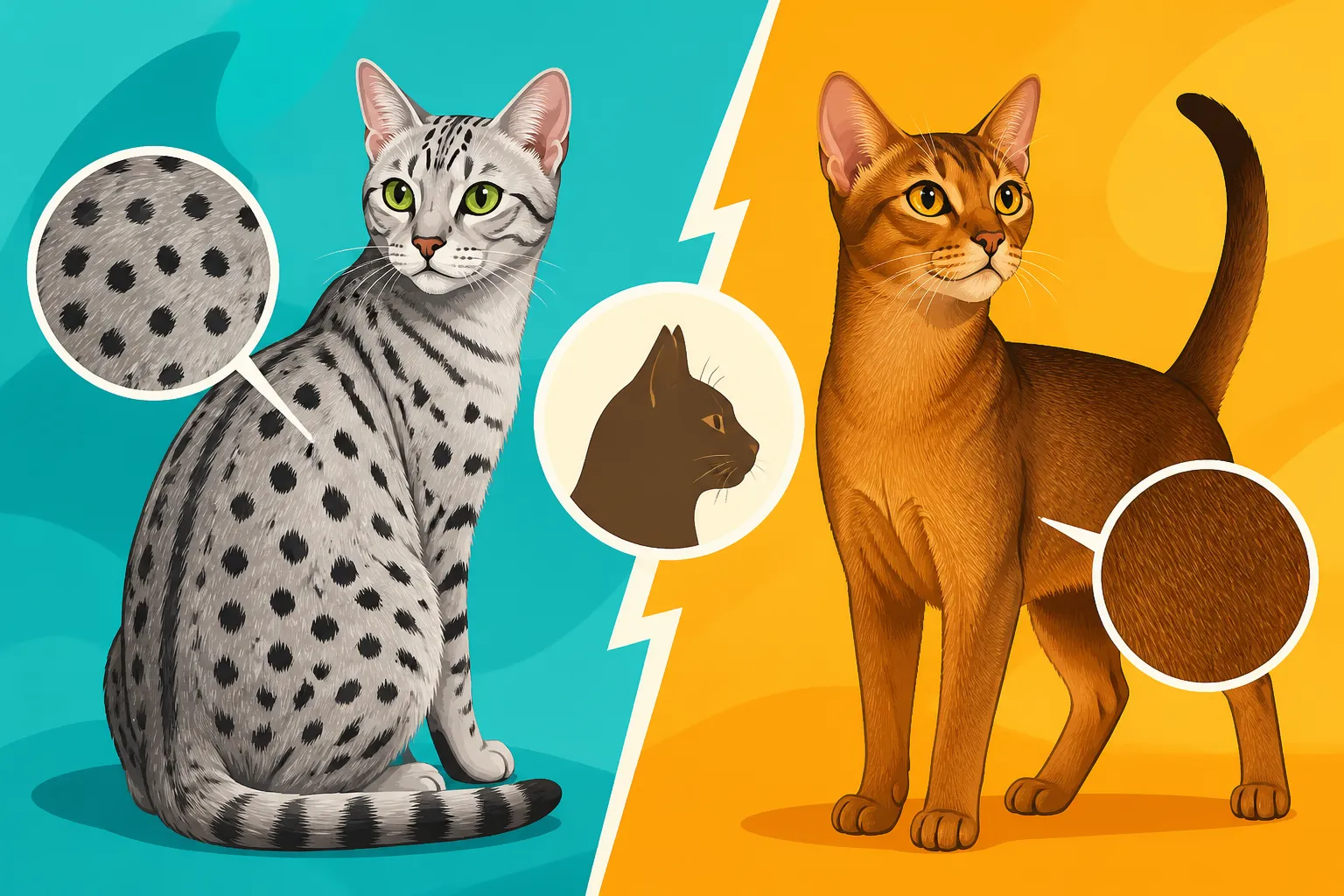
An Egyptian Mau has a spotted tabby pattern: individual spots stand out against a lighter background. They can vary in size and shape, and the rows may look irregular rather than perfectly arranged. Some Mau spots are small and round; others are larger, elongated, or broken-looking. The key is that each spot is a visible patch of darker color, not simply a change in tone along every hair.
Look across the Mau’s sides and back. You should be able to pick out distinct markings on the body, with contrast between the spots and the surrounding coat. The spots are part of the cat’s pattern, not dirt, shadows, or a temporary effect caused by the coat lying in a certain direction.
The Egyptian Mau is a domestic cat, not a wildcat hybrid. Its spotted appearance can seem exotic, but spots alone do not mean a cat has wild ancestry. The breed’s distinctive coat pattern is one of its most recognizable features, alongside its alert expression and athletic build.
An Abyssinian’s color is distributed along each hair
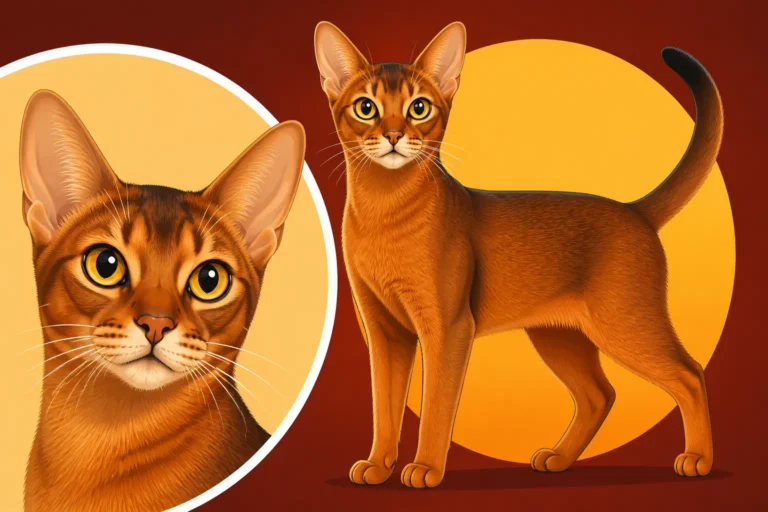
An Abyssinian’s coat is ticked. Instead of having separate body spots, many individual hairs have several alternating bands of light and dark color. When those hairs lie together, the coat appears evenly flecked, warm, and sometimes almost iridescent as the cat moves.
That close-up difference is important: on a spotted Mau, darker areas form markings across the body; on a ticked Abyssinian, color changes occur along the hairs themselves. The overall effect is a smooth, even-looking coat rather than a pattern of dots. For more on the mechanics, see What Makes an Abyssinian's Coat Ticked Rather Than Striped and How an Abyssinian's Agouti Banding Works.
A ticked coat can create subtle shadows and color variations. In a dim room, or in a photograph with strong contrast, those shifts may look like faint spots or stripes. But when you follow the coat across the flank, an Abyssinian should not show the clearly defined body spots that characterize an Egyptian Mau.
| Feature | Egyptian Mau | Abyssinian |
|---|---|---|
| Main body pattern | Distinct spots against a lighter ground color | Evenly ticked coat with banded individual hairs |
| What to look for | Separate dark markings across the body | Color variation along hairs rather than separate spots |
| Overall impression | Spotted, often with visible contrast | Smooth, speckled, or shimmering |
| Common source of confusion | Spots can be irregular and vary in shape | Shadows and ticking can look like faint markings in photos |
Why the two coats can look similar
Lighting and photographs can disguise the pattern
A photograph compresses a three-dimensional coat into a flat image. If the light hits an Abyssinian from the side, the hairs may cast small shadows that resemble faint spots. If the photo is grainy, heavily edited, or taken from a distance, the fine bands on individual hairs disappear, and the coat can look more uniformly marked than it really is.
Lighting can also make a Mau’s spots seem less obvious. A pale background, a low-contrast image, or a pose that hides the flanks may soften the visual separation between spots and ground color. That is why a single headshot is not enough to identify the body pattern reliably. Look for clear side and back views, ideally in natural light.
When browsing listings or breed photos, check whether the markings are described and shown consistently. A close-up of the coat can help, but so can a full-body view. If you’re interested in the Abyssinian’s overall appearance, What an Abyssinian Looks Like Against the Show Standard explains how its build and coat are evaluated together.
Kittens can make coat patterns harder to judge
Young cats may have softer, less settled coats than adults. An Abyssinian kitten’s ticking and adult color can develop over time, so a young coat may look uneven or muted. Some kittens also show temporary or faint tabby-like markings, often called ghost markings. These can make a kitten appear more striped or spotted than the mature cat will look.
A Mau kitten’s spots may also look different as the coat grows and the contrast becomes clearer. The individual markings may be easy to see in one pose and partly hidden in another. So, if you’re identifying a kitten, don’t rely on one blurry image or a quick glance at the back.
For a careful comparison, examine several areas: the sides, shoulders, legs, tail, and face. Look at the coat’s structure as well as its pattern. The Abyssinian’s hairs show banding when inspected closely, while the Mau’s spots read as markings across the coat. You can learn more about why an Abyssinian’s body does not have tabby stripes in Why an Abyssinian Has No Tabby Stripes.
What to check when identifying either breed
Look at the body before judging the face
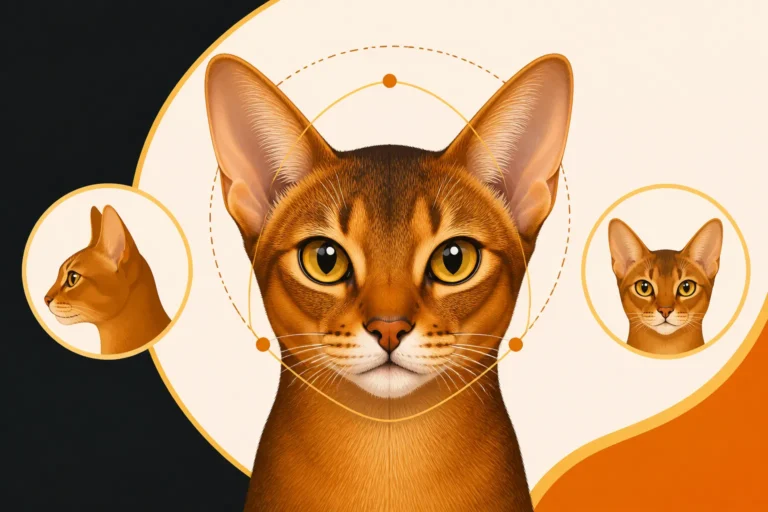
Facial markings can be striking on both cats, so they are not always the best place to start. An Abyssinian may have defined lines around the eyes and markings on the face, while an Egyptian Mau can have its own expressive facial pattern. Those details can draw your attention away from the clearest distinction: the Mau’s separate body spots versus the Abyssinian’s all-over ticking.
Start at the flank, where the coat is usually easier to assess. On a Mau, look for individual dark marks that contrast with the surrounding coat. On an Abyssinian, look for a fairly even surface of colored hairs without a series of separate spots. Then check the back and shoulders to see whether that pattern continues.
Next, take a close look at a few hairs if you can do so without bothering the cat. An Abyssinian’s banding is visible along the hair shaft. A Mau’s markings are visible as part of the coat pattern over a wider area. This distinction is especially useful when the cat’s coloring is subtle or the room lighting is poor.
Use more than coat pattern to identify the breed
Coat pattern is a strong clue, but it is not the whole identification. Body shape, head shape, eye color, coat texture, and pedigree information can all help. A cat that looks spotted is not automatically an Egyptian Mau, and a cat with a warm, ticked coat is not automatically an Abyssinian. Mixed-breed cats can also have coat patterns that resemble those of pedigreed breeds.
If you are considering a kitten from a breeder, ask what registration and pedigree documentation is available, and request clear photos of the kitten and its parents. A responsible breeder should be able to explain the breed characteristics without relying on a dramatic photo or an unsupported claim about appearance. For a broader comparison, see How an Abyssinian Differs From an Egyptian Mau.
The breeds also differ in more than coat pattern. Their typical appearance and breed standards describe distinct combinations of coat, build, and other features. For example, the Abyssinian’s coat is expected to have a particular texture and ticking, as discussed in What an Abyssinian's Coat Should Feel Like in the Ring. Coat colors and registration rules can vary by registry, so check the relevant breed organization if the exact color classification matters to you. Which Abyssinian Colors CFA Recognizes offers more detail on the Abyssinian side.
What the coat difference means for everyday care
Neither pattern requires special grooming because of its appearance
The visual difference between spots and ticking does not mean one cat needs a specialized grooming routine just to preserve its pattern. Both have short coats that are generally manageable with routine care. A gentle comb or grooming mitt can help collect loose hair, but frequent or forceful brushing is not necessary simply because a coat looks spotted or ticked.
Abyssinian ticking can look especially glossy when the coat lies smoothly, so avoid tools that pull harshly at the hair. If you are shopping for a basic grooming mitt, whether at a local pet shop or on Chewy, focus on a gentle tool and introduce it gradually. A cat that treats grooming as a calm, brief interaction is more likely to accept it than one held still for a long session.
The Egyptian Mau’s spots do not need to be enhanced or maintained with a special product. Keep grooming gentle, check the skin as you go, and ask a veterinarian about any sudden change in coat quality, patchy hair loss, or irritation. A pattern that seems different because of lighting is one thing; a new physical change in the coat or skin deserves attention.
Choose enrichment for the individual cat, not its markings
A coat pattern does not predict exactly how an individual cat will behave. Both breeds are athletic cats, and any cat benefits from safe places to climb, play, rest, and observe the household. Choose toys and climbing furniture based on the cat’s size, activity, and preferences rather than assuming that a spotted or ticked coat means a particular temperament.
When comparing scratchers or climbing furniture at a neighborhood store or on Chewy, check that the item is stable and suited to the space where you plan to use it. A tall, wobbly structure is not a good choice simply because it looks impressive. Place climbing options where the cat can reach them safely, and make sure windows and balconies are secure.
Interactive play can also help channel a cat’s energy. A wand toy, treat puzzle, or rotating selection of toys may keep play sessions interesting. If you are browsing toys on Chewy, look at the toy’s materials and intended use, and supervise play when a toy has strings or small detachable parts. The best choice is the one your cat actually enjoys and can use safely.
An Egyptian Mau is spotted because its coat displays distinct body markings. An Abyssinian is ticked because its hairs carry alternating bands of color, creating an even, shimmering appearance. Photos, lighting, and kitten coats can blur the distinction, but checking the flanks and looking closely at individual hairs usually makes the difference clear.
Disclaimer
This article is for general informational purposes only and does not constitute professional advice. Laws, prices and regulations vary by location and change over time. Consult a qualified professional for guidance on your specific situation.