Whether Abyssinians and Somalis Are Still Bred Together
Abyssinians and Somalis are closely related, but they are recognized as distinct breeds, so “bred together” can mean more than one thing. Some breeding programs may allow an Abyssinian–Somali mating under specific registry rules; others restrict it. The pairing can also produce kittens with different coat lengths. Here’s how to understand the rules, genetics, and questions to ask a breeder.
Why Abyssinians and Somalis are so closely connected
The Somali developed from longhaired Abyssinian-type cats
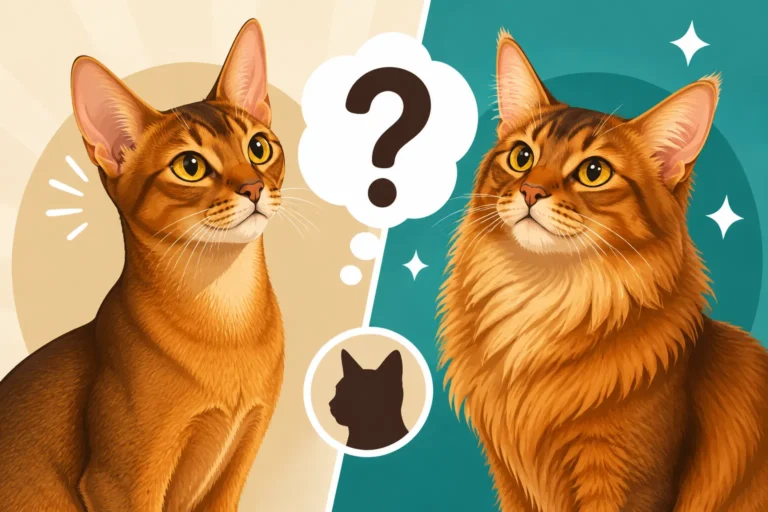
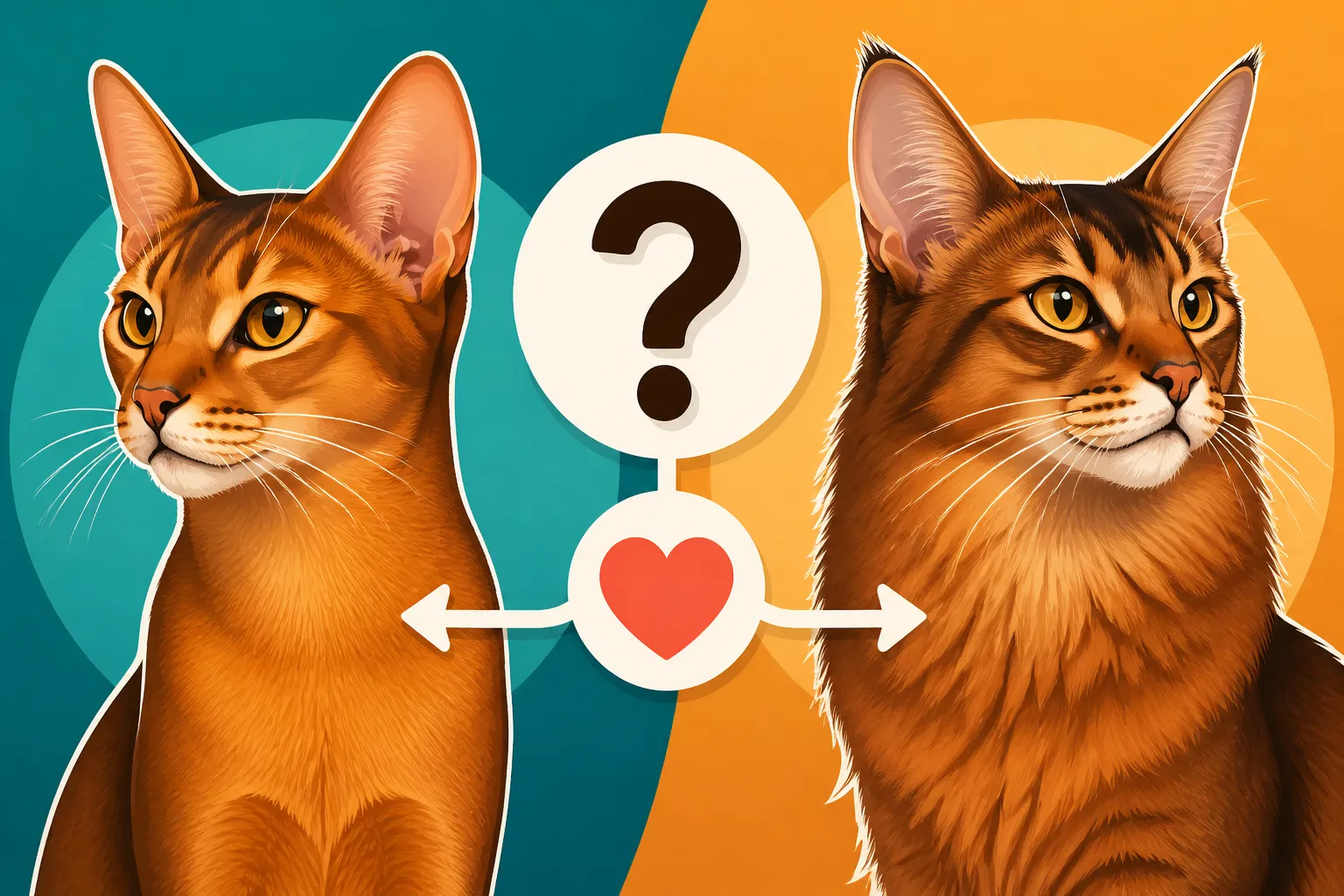
The Somali breed is closely associated with the Abyssinian: its cats have a similar body type, coat ticking, and general appearance, but a longer, fuller coat. Longhaired kittens appeared in Abyssinian lines, and breeders eventually developed those cats into a separate breed. That history is why people sometimes describe the Somali as a longhaired Abyssinian, though today each has its own breed identity and standards. The Somali Is an Abyssinian With Long Hair
The connection is not just visual. The longhair trait can be carried in Abyssinian family lines even when a cat has a short coat. A shorthaired cat can pass that trait to kittens without showing it itself, which can make coat outcomes in a litter surprising if the parents’ genetic backgrounds are unknown. Why the Long Hair Gene Was in Abyssinians All Along
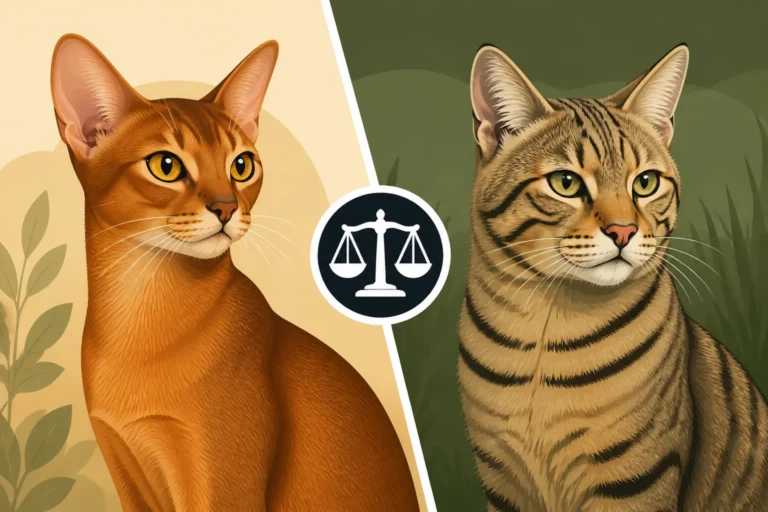
The two breeds are still distinct for registration, breeding plans, and show purposes. A cat’s appearance alone doesn’t tell you how it is registered, what its pedigree says, or whether a particular mating is permitted by a registry. For a clearer comparison of their looks and breed traits, see How an Abyssinian Differs From a Somali.
“Bred together” can refer to different situations
A breeder might mean that an Abyssinian and a Somali were intentionally paired. That is different from saying the breeds share ancestry, or that an Abyssinian carries a longhair gene. It is also different from a kitten simply looking Somali-like because it has a longer coat.
These distinctions matter because a pedigree and registration record document a kitten’s breeding history, while coat length describes what you can see. A shorthaired Abyssinian may carry the longhair trait without being a Somali. A longhaired kitten from a particular pairing may have a different registration status depending on the parents, the breeding program, and the registry’s rules.
When a breeder says “we breed Abyssinians and Somalis together,” ask what they mean in practical terms: Are they planning a specific mating? Is it an approved outcross under their registry? What breed will the kittens be registered as? Those questions are more useful than relying on a casual label.
Are Abyssinians and Somalis still bred together
The answer depends on the registry and breeding program
There is no universal yes-or-no answer. Some breed programs and registries may allow an Abyssinian–Somali pairing under defined conditions; others may have restrictions, approval steps, or rules about how the offspring can be registered. Rules can also differ by country and registry, so a mating acceptable in one program should not be assumed to qualify in another.
This is why breeders should be able to explain the purpose of a planned mating and provide the applicable registration information. A responsible answer should cover the parents’ registration status, the expected kitten coat types, and how each kitten may be recorded. If the breeder is vague, ask for the registry’s written rules or contact the registry directly before making decisions based on a promise about papers.
It’s also worth separating intentional breeding from accidental or undocumented pairings. A kitten may have Somali ancestry in its pedigree without its parents being a Somali and an Abyssinian in the immediate pairing. Likewise, a cat that carries the longhair trait is not proof that its breeder has recently crossed the breeds. Whether Abyssinians and Somalis Are Still Bred Together
The reason for the pairing should be clear
An authorized outcross may be part of a deliberate breeding plan, but “the registry allows it” is not, by itself, an explanation of why a breeder chose that match. Ask what the breeder hopes to preserve or improve, how they assess temperament and health, and how they avoid producing kittens without a clear plan for registration and placement.
A good breeder can talk about both strengths and trade-offs. For example, they should be able to explain how they evaluate the parents’ health history, coat type, body structure, and temperament instead of focusing only on producing a particular-looking kitten. They should also be comfortable discussing whether the kittens are intended for pet homes or future breeding.
If the breeder plans to place kittens as pets, ask what documents will accompany them and whether the contract includes limits on breeding. For background on how the Somali became established as a separate breed, see Who Bred the First Somali and When the Somali Got Championship Status.
What kittens can result from an Abyssinian–Somali pairing
Coat length depends on inherited traits
A Somali’s long coat is generally associated with recessive inheritance. In straightforward terms, a longhaired Somali can pass on a longhair-associated gene variant to every kitten. Whether kittens themselves have long coats depends on what they inherit from the Abyssinian parent as well.
If the Abyssinian parent does not carry the relevant longhair variant, kittens from the pairing may all be shorthaired while carrying it. If the Abyssinian carries one copy, the litter may include both shorthaired and longhaired kittens. The exact outcome depends on the parents’ genetic makeup, so it should not be guessed from the Abyssinian’s coat alone.
That is a simplified explanation, not a substitute for a breeder’s records or genetic interpretation. Coat inheritance can involve details that are not obvious from appearance, and a breeder should avoid guaranteeing a particular litter outcome without a sound basis. If the kittens’ coat development is part of your decision, ask when the breeder expects it to become apparent; When an Abyssinian Litter's Coat Length Becomes Obvious explains why the answer may not be immediate.
Coat type and breed identity are related but not identical
A kitten with a longer coat may resemble a Somali, but looks alone do not determine its registry classification. The kitten’s parents and pedigree, the mating’s status under the relevant rules, and the registry’s policies all matter. Ask the breeder to explain how the kitten will be described on its paperwork rather than assuming that “longhaired” automatically means “registered Somali.”
Likewise, a shorthaired kitten from a Somali–Abyssinian pairing may not be distinguishable from an Abyssinian based only on its coat. Its family history and registration information still matter. For the distinction between a kitten’s visible appearance and its recorded breed, the breeder should be able to show you the pedigree and clarify any special registration terms.
| Parent pairing detail | Possible coat outcome | What to confirm with the breeder |
|---|---|---|
| Somali parent paired with an Abyssinian that does not carry the longhair trait | Kittens may be shorthaired and carry the trait | Whether this mating is permitted and how kittens are registered |
| Somali parent paired with an Abyssinian that carries one copy | Kittens may include both shorthaired and longhaired individuals | Whether coat expectations are based on test results, pedigree, or both |
| Parent status or genetic history is unclear | Coat outcomes are harder to predict | What records the breeder has and what they can document |
These are general genetic patterns, not a promise about any particular litter. Ask to see the parents’ records and the breeder’s explanation of expected outcomes. If you are bringing home a kitten, practical preparation still matters regardless of coat length. Chewy can be one place to look for basics such as food and litter, but follow the breeder’s transition instructions and your veterinarian’s advice when choosing supplies. How a Breeder Tells an Abyssinian From a Somali at Birth
How to assess a breeder’s explanation
Ask specific questions before placing a deposit
A breeder who is making an Abyssinian–Somali pairing should be prepared to explain it plainly. You do not need to be a geneticist, but you should be able to understand the planned pairing, the relevant registry rules, and what the kittens’ paperwork will say. If the explanation changes each time you ask, slow down before committing.
Useful questions include:
- Are both parents registered, and with which registry?
- Does that registry permit this specific pairing?
- What breed designation and registration documentation will each kitten receive?
- What coat lengths are possible, and what supports that prediction?
- What health screening and family-history information do you have for both parents?
- Are kittens being placed as pets, or are any being considered for breeding?
- Can I review the contract and pedigree before deciding?
You can also ask whether the breeder will put the kitten’s expected registration status in writing. That is especially helpful if you are choosing a kitten based on show plans, breeding plans, or a particular breed designation.
Look for transparency, not just an attractive kitten
A careful breeder should welcome reasonable questions and explain what they know, what they do not know, and what the registry permits. They should not imply that a special coat makes a kitten healthier, more valuable, or automatically a different registered breed. If a breeder promises unusual coat results but cannot explain the parents’ backgrounds or provide relevant records, treat that as a reason to seek clarification.
Pay attention to the kittens’ living conditions and behavior, too. You should have a chance to learn how they are being raised, what they are eating, and how the breeder introduces routine handling and household experiences. If you need to prepare for a new kitten, Chewy may help you compare everyday supplies, but check that any food change is gradual and coordinated with the breeder. A final shopping list is less important than receiving clear health records and a sensible transition plan.
For a new owner, the simplest takeaway is this: Abyssinians and Somalis are closely related, and some breeding programs may still allow matings between them, but the rules and paperwork are not universal. Confirm the exact pairing, registration path, and expected coat outcomes directly with the breeder and relevant registry. For wider background on Somali and Abyssinian similarities, see Whether a Somali and an Abyssinian Behave the Same. Chewy can also be a convenient source to compare routine supplies once you know what the kitten already uses, rather than making abrupt changes during the move home.
Disclaimer
This article is for general informational purposes only and does not constitute professional advice. Laws, prices and regulations vary by location and change over time. Consult a qualified professional for guidance on your specific situation.