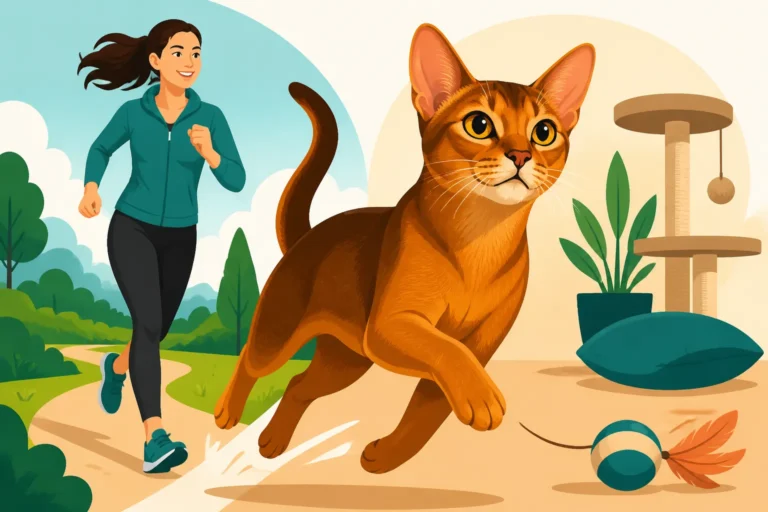
Whether a Somali and an Abyssinian Behave the Same
A Somali and an Abyssinian can look quite different at first glance, but they share a close breed relationship and many familiar habits. Both are often curious, athletic, people-oriented cats that prefer to be involved rather than ignored. The differences owners notice tend to come down to coat care, individual temperament, and daily routines—not a guarantee that one breed will behave a certain way.
Why Somali and Abyssinian behavior is so similar
They are closely related breeds
The Somali is the longhaired counterpart of the Abyssinian. The two breeds share much of their background, and their typical personalities overlap considerably. Both are commonly described as alert, active, inquisitive cats that enjoy exploring high places and investigating whatever their people are doing.
That shared heritage helps explain why a Somali may follow you from room to room, paw at a cupboard, or appear beside you when you sit down to work. An Abyssinian may do the same. Neither breed is best understood as a decorative cat that is content to spend the day unnoticed. They often want access to interesting spaces, play, company, and a chance to participate in household life.
Breed descriptions are tendencies, not promises. One Abyssinian may be a bold greeter while another is cautious around visitors; one Somali may settle beside you for a long snooze while another keeps moving. Age, early socialization, health, and the individual cat’s experiences all shape behavior. If you are choosing between the breeds, meeting the actual cat and asking about its habits is more useful than relying on a breed label alone.
For a fuller picture of the Abyssinian’s energetic reputation, see The Abyssinian Is the Busiest Cat in the House. It is also worth reading Whether the Abyssinian Is the Right Cat for You if you are deciding whether this active, engaged style of companionship fits your home.
Both often want interaction, not just company
A Somali or Abyssinian may happily share a room with you without staying still in your lap. These cats can show affection by following, watching, chirping, bringing a toy, or choosing a nearby perch. If you expect a cat to spend long stretches curled up on your knees, you may find this style of affection puzzling at first. It does not necessarily mean the cat is aloof; it may simply prefer closeness with a little motion.
A common scene is a cat settling on the back of your chair while you answer emails, then getting up to inspect the keyboard as soon as you focus on the screen. That kind of involvement can be charming, but it can also interrupt a quiet evening or a work call. Setting up a comfortable perch near your usual sitting spot gives the cat a way to be included without requiring your hands every minute.
Both breeds may also become bored if their day has too little to do. Short play sessions, food puzzles, and safe climbing routes are practical ways to provide outlets. A puzzle feeder from a retailer such as Chewy can be useful when a cat needs a meal-time activity, but choose one suited to the cat’s experience and supervise at first. If your cat solves it in seconds, rotate the design or make the challenge slightly harder rather than leaving food puzzles as the only enrichment.
For more ideas about keeping an active cat occupied, What an Abyssinian Does When It Is Bored explains why restlessness can show up as mischief rather than an obvious plea for play.
Where their everyday habits may feel different
The Somali’s coat changes the care routine, not the personality
The most obvious difference between the breeds is the Somali’s longer, fuller coat. That can mean more attention to brushing and a greater chance of noticing loose hair around the home. It does not automatically mean the Somali will be calmer, more cuddly, or less interested in climbing. Coat length is not a reliable shortcut for predicting temperament.
A Somali’s coat may need regular combing to prevent tangles, especially where the fur is longer or friction is common. An Abyssinian’s short coat is generally simpler to maintain, though routine grooming and handling still matter. If you want to compare the basics, The Somali Is an Abyssinian With Long Hair gives useful breed context, while How an Abyssinian Differs From a Somali focuses on their distinguishing features.
Grooming can also become a small daily relationship ritual. A cat that enjoys being handled may tolerate a few gentle strokes of a comb, while another may prefer very short sessions and a treat afterward. Keep the experience calm: stop before the cat becomes frustrated, avoid pulling through knots, and ask a groomer or veterinarian for help if mats are tight or close to the skin. Chewy carries grooming tools, but the best tool is the one that suits the cat’s coat and can be used gently; a more aggressive brush is not automatically more effective.
Activity levels are individual, even within the same breed
Both breeds have a reputation for being athletic, but there is no universal daily schedule. A young cat may sprint through the home, climb shelves, and demand several rounds of play. An adult may still be lively but settle more easily after a predictable routine. A senior may want gentle play and accessible resting spots rather than repeated leaps.
Rather than comparing a Somali and an Abyssinian by a fixed activity score, watch what each cat does across the day. Does it seek out toys? Does it climb onto furniture? Does it become vocal or disruptive at a particular time? Does it rest comfortably after play? These observations help you distinguish normal energy from frustration, stress, or a change in health.
A useful routine is to offer several short, interactive play periods and finish at least one with a toy the cat can catch. Follow with a small meal or part of the cat’s regular food if that fits its feeding plan. This gives the cat a satisfying sequence—chase, catch, eat, settle—rather than a fast burst of play that ends abruptly. Treats can help reinforce a game, but count them as part of the overall diet. If you are shopping for wand toys or food puzzles, Chewy is one possible place to browse; focus on safe construction and whether the toy matches your cat’s play style.
Choosing between a Somali and an Abyssinian for your home
Match the cat to your routine, not only its breed
If you work away from home for long stretches, think carefully about how much company and activity the individual cat will need. A lively cat left without enrichment may find its own entertainment by opening cabinets, knocking objects down, or demanding attention as soon as you return. That can happen with either breed. A second compatible cat may help in some homes, but it is not a substitute for thoughtful introductions, human interaction, and an environment with enough resources.
Before adopting or buying, ask how the cat spends a normal day. Does it enjoy interactive play? Is it comfortable being handled? How does it react to visitors, children, or other pets? Has it lived with another cat before? Ask about the individual’s likes and sensitivities rather than asking only whether Somalis or Abyssinians are “good with” a particular household. The answer depends on the cat and on how the household behaves around it.
Consider practical care, too. A Somali’s longer coat may call for more grooming time, while an Abyssinian’s short coat may be easier for someone who wants a lower-maintenance grooming routine. Neither breed is maintenance-free: both need play, attention, safe spaces, veterinary care, and a stable daily rhythm. A cat that gets enough stimulation and gentle interaction is more likely to settle well than one whose needs are guessed at based on appearance.
For a household weighing the time commitment, Why an Abyssinian Should Not Be Left Alone All Day and How to Settle an Abyssinian in a New Home offer useful ideas that can also inform preparations for a Somali.
Make room for climbing, exploration, and safe independence
Both breeds may use vertical space as part of their everyday routine. A sturdy cat tree, secure shelves, window perches, and clear routes between resting spots can make a home more engaging. In a small apartment, thoughtful use of height can provide useful territory without filling every patch of floor with furniture. Check that climbing structures are stable, shelves are securely installed, and windows are protected.
Curiosity also means the home needs a safety check. Store medicines, cleaning products, thread, elastic bands, and small swallowable objects where the cat cannot reach them. Secure cabinets that contain hazards and check that plants are safe for cats before bringing them home. A clever cat may find ways into spaces you assumed were closed, so prevention is more reliable than scolding after an exploration goes wrong.
Give each cat a few options for play and rest, then observe what it actually chooses. One may favor a high perch and a feather wand; another may prefer a cardboard box and a rolling toy. Chewy may be a convenient source for comparing basic enrichment supplies, but you do not need elaborate equipment to start. A rotation of safe toys, a reliable scratching surface, and regular play with you can do more than a pile of toys left untouched.
What to expect from a Somali and an Abyssinian
A Somali and an Abyssinian will often share the qualities prospective owners find appealing: intelligence, curiosity, athleticism, and an interest in household activity. Either may follow you around, seek high vantage points, invent games, or ask for attention in ways that are lively rather than quietly lap-bound. Their similarities are not a promise that every cat will act alike, but they are a useful starting point when planning for either breed.
The clearest predictable difference is the coat. A Somali’s longer fur generally asks for more grooming than an Abyssinian’s short, close-lying coat. In behavior, however, the individual cat matters more than the label. A particular Abyssinian may be less active than a particular Somali, and a Somali may be affectionate in a quieter way than you expect. Age, health, socialization, and home environment all influence what you see.
If you are choosing between them, spend time with the cat when possible, ask specific questions about its routines, and prepare your home for an intelligent, active companion. Keep expectations flexible: the best match is not necessarily the breed with the reputation you prefer, but the individual cat whose needs and temperament fit your household.
Disclaimer
This article is for general informational purposes only and does not constitute professional advice. Laws, prices and regulations vary by location and change over time. Consult a qualified professional for guidance on your specific situation.