How an Abyssinian’s Agouti Banding Works
If you've ever admired an Abyssinian cat, you've no doubt been captivated by their stunning, shimmering coat. It's unlike almost any other feline, with a depth and vibrancy that seems to shift with every movement. But for many, the technical term for this unique beauty – "agouti banding" – sounds complex and a little intimidating. You might wonder what it actually means, why your Aby looks so different from a tabby, or what makes each individual hair so special. This guide is here to demystify the science behind your Abyssinian's incredible coat, breaking down exactly how agouti banding works and what it means for their appearance and care.
The Mystery of the Ticked Coat: What is Abyssinian Agouti Banding?
When you first see an Abyssinian, you might think it's a solid color, but then the light hits them just right, and suddenly you see a cascade of golds, reds, and darker hues. This isn't just trick of the light; it's the magic of agouti banding, the genetic trait responsible for the breed's signature ticked coat. Many cat owners are familiar with striped tabbies, or solid black or white cats, but the Abyssinian's coat is in a league of its own, often leaving people scratching their heads trying to describe its unique texture and visual depth.
Decoding the "Agouti" Part
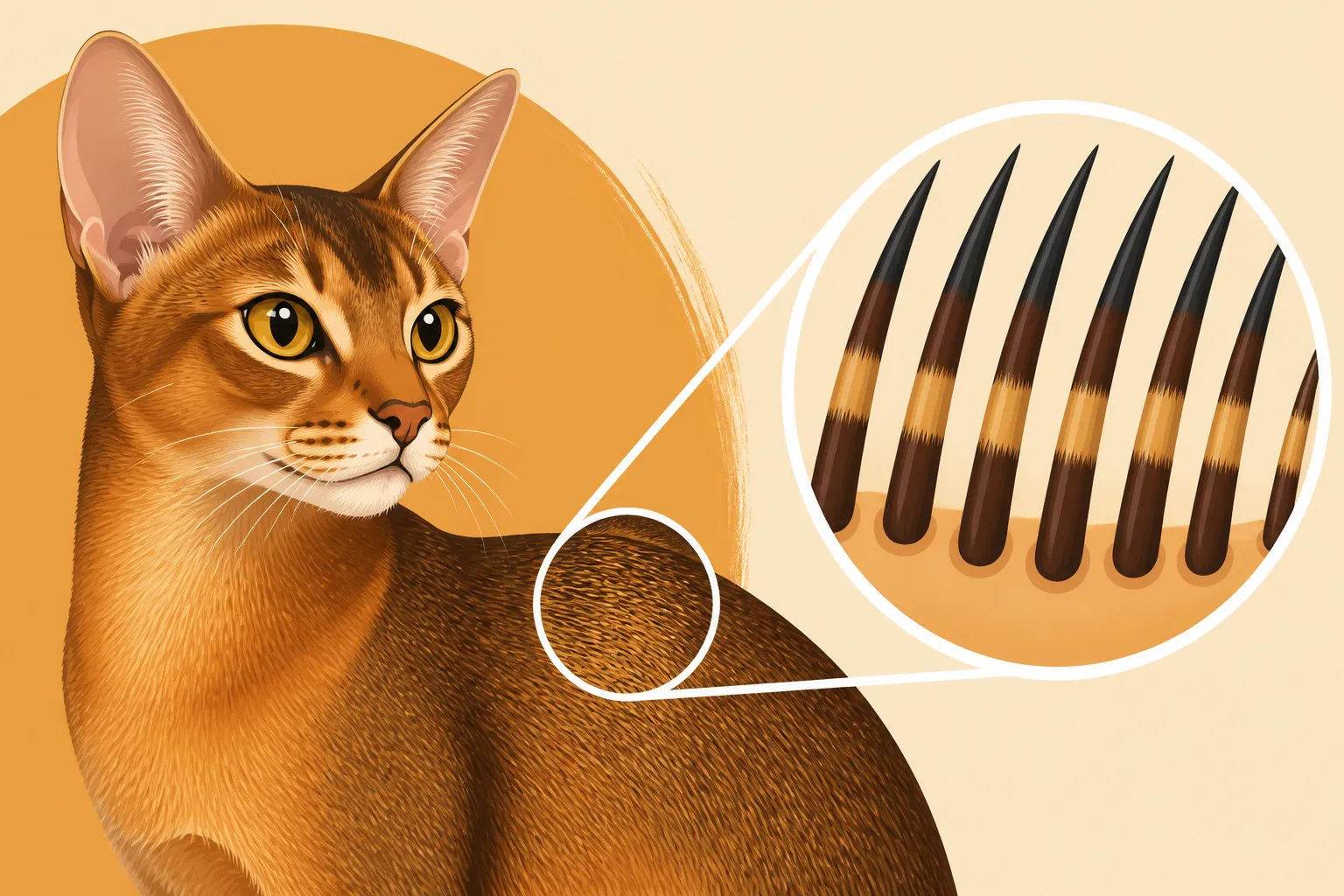
At its simplest, "agouti" refers to a specific pattern of pigment distribution on an individual hair shaft. Instead of being one solid color from root to tip, an agouti hair has alternating bands of dark and light pigment. Think of it like a tiny, perfectly striped barcode on each strand of fur. This banding is governed by the agouti gene, which essentially acts as a switch, telling pigment-producing cells when to turn on and off during hair growth. In most tabby cats, the agouti gene creates distinct stripes, swirls, or spots across the body, with bands of color visible within those patterns. For an Abyssinian, however, the agouti effect is taken to an extreme.
The genius of the Abyssinian coat is that these bands are so finely distributed and the pattern so refined that they create an overall "ticked" appearance rather than stripes. This means that each individual hair has multiple bands of color, giving the illusion of a solid color at a distance, but revealing a complex tapestry of shades up close. It's why their coats have such an incredible depth and warmth, and why they seem to glow from within. It’s also a key reason why they are so often described as resembling miniature wildcats, perfectly camouflaged in tall grasses.
The Visual Magic of Abyssinian Ticking
The most striking aspect of the Abyssinian's agouti banding is how it translates visually. Their coat isn't just a single color; it's a tapestry of hues that shimmer and change with every ripple of muscle. When your Abyssinian moves, chases a toy, or stretches out in a sunbeam, their coat seems to come alive. You'll notice lighter shades gleaming on the tips of their hairs, contrasting with deeper tones closer to the body. This optical illusion of movement and depth is what makes the Abyssinian so mesmerizing to watch.
Unlike other cat breeds where patterns like mackerel, classic, or spotted tabbies are clearly defined, an Abyssinian's ticking is uniform across their entire body, creating a beautifully blended effect. There are no distracting stripes, no blotches, just a smooth, even distribution of color bands that gives the coat its characteristic warmth and iridescence. This absence of traditional tabby markings is a hallmark of the breed, a defining characteristic that sets them apart.
Why the Abyssinian's Coat is Different
So, what makes an Abyssinian's coat different from a regular tabby cat, which also has an agouti gene? It all comes down to specific modifying genes that interact with the basic agouti gene. In Abyssinians, a polygenic modifier, often referred to as the "Ticked" gene (often denoted as 'T' for tabby patterns, but specifically an extreme ticking modifier in Abyssinians), causes the agouti bands to extend over almost the entire body, suppressing the expression of any underlying tabby pattern. This means that while genetically an Abyssinian might carry genes for mackerel or classic tabby, these patterns are effectively "switched off" by the dominant ticking modifier.
This is why, when you look at an Abyssinian, you don't see the usual stripes on their legs, tail, or face that you'd expect from a tabby. Instead, the ticking effect covers everything, creating that wonderfully uniform, wildcat appearance. The depth of color, the way it catches the light, and the overall impression of a coat made of sun-drenched sand or burnished copper are all direct results of this unique genetic combination. It's a marvel of feline genetics that has been carefully cultivated by breeders over generations.
A Closer Look: The Anatomy of an Abyssinian Hair
To truly appreciate the Abyssinian's coat, you need to understand what's happening on each individual hair. It's not just a collection of solid strands; it's a meticulously crafted biological wonder, where each hair tells a story of light and dark. This intricate design is what gives the breed its signature 'ticked' appearance, which is recognized as The Ticked Coat Is the Whole Abyssinian Grooming Job.
The Bands of Color: A Microscopic View
Imagine taking a single strand of an Abyssinian's fur and examining it under a magnifying glass. What you would see is not a single, unbroken shade, but rather a sequence of distinct color bands. Typically, an Abyssinian hair will have three to four alternating bands of light and dark pigment. The very tip of the hair is usually dark, followed by a lighter band, then another dark band, and finally a lighter band closer to the root. This "dark-light-dark-light" pattern repeats across the length of the hair.
The cleverness of this arrangement is that when millions of these individually banded hairs lie together, they create a dazzling visual effect. The lighter bands reflect light, giving the coat its famous shimmer, while the darker bands absorb light, providing depth and contrast. It's like a finely woven fabric where each thread is dyed in multiple shades, resulting in a rich, multi-dimensional texture. This intricate banding ensures that the Abyssinian's coat never looks flat or dull, always vibrant and full of life. It truly embodies the phrase Why Each Abyssinian Hair Carries Three or Four Bands.
Pigments at Play: Defining the Abyssinian Hues
The actual colors you see in an Abyssinian's coat—the ruddy, sorrel, blue, and fawn—are determined by the type of pigment present in those bands. All cat coat colors are primarily controlled by two types of melanin:
- Eumelanin: This pigment produces black and brown colors.
- Pheomelanin: This pigment produces red and yellow colors.
In a Ruddy Abyssinian, which is the most common and often considered the "original" color, the darker bands are rich black or very dark brown, and the lighter bands are warm orange or copper. For a Sorrel (sometimes called Red), the eumelanin has been modified to a cinnamon or reddish-brown, and the lighter bands are golden apricot. Blue Abyssinians show a dilute version of the ruddy, with dark grey-blue bands and lighter sandy-beige bands. Finally, Fawn Abyssinians are a dilute sorrel, with warm cream or rosy-beige bands. These genetic variations mean that while the pattern of banding is consistent across all Abyssinians, the colors within those bands differ, leading to their distinct and beautiful color varieties.
The Absence of Stripes and Undercoat
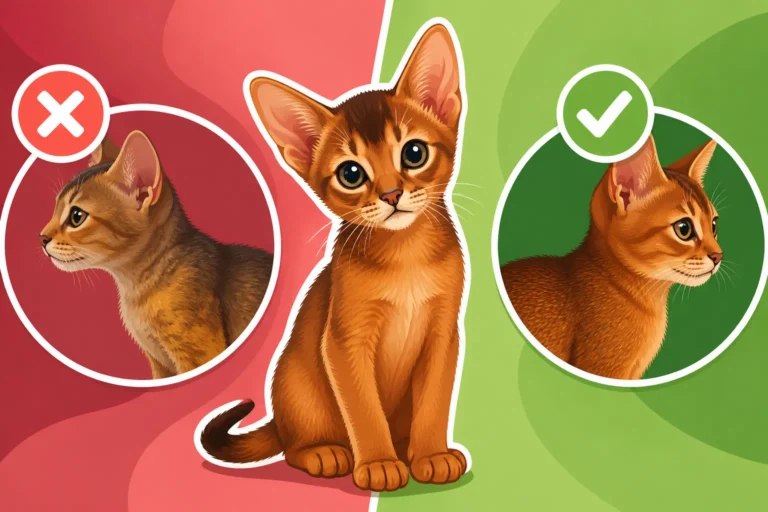
One of the defining features of the Abyssinian's ticked coat is the remarkable absence of distinct tabby stripes or blotches, particularly on the body. While a very faint "ghost barring" might sometimes be visible on the legs or tail of a young kitten, a truly well-bred adult Abyssinian will have a coat that is uniformly ticked, creating a clean, unpatterned appearance. This is due to the extreme ticking modifier overriding the expression of typical tabby patterns.
Furthermore, Abyssinians have a notably short, fine, and close-lying coat with very little undercoat. This isn't just a matter of texture; it directly influences how the agouti banding is perceived. Without a dense, fluffy undercoat to obscure the individual hair shafts, the light can truly play across the banded hairs, enhancing the shimmering effect. This minimal undercoat also contributes to why Abyssinians are generally considered low-shedding (though no cat is truly non-shedding!) and why their grooming needs are relatively simple, often just a quick once-a-week brush. You don't need fancy deshedding tools; a simple grooming mitt is often sufficient, available from retailers like Chewy or Amazon.
The Genetic Blueprint: How Agouti Banding is Inherited
Understanding the visual aspect of an Abyssinian's coat is one thing, but delving into the genetics helps explain why it's so unique and how breeders work to maintain this distinct characteristic. It's a fascinating interplay of specific genes that come together to create that unforgettable ticked effect.
The Dominant Agouti Gene (A) and the Ticked Gene (T)
At the heart of any tabby pattern, including the Abyssinian's ticked coat, is the dominant Agouti gene, represented as 'A'. A cat must have at least one dominant 'A' allele (genetically written as A/A or A/a) to express any sort of tabby pattern. Cats with two recessive 'a' alleles (a/a) will be solid colored, regardless of other genes. So, an Abyssinian must first be an agouti cat.
However, simply having the dominant agouti gene isn't enough to produce the Abyssinian's distinct ticking. This is where a separate, powerful modifier gene comes into play, often referred to as the 'Ticked' gene (genetically, it's actually a specific allele at the Tabby locus, typically T^a for Abyssinian Ticked, distinct from mackerel or classic tabby alleles). This Ticked gene, when present, takes the basic agouti banding and extends it over the entire hair shaft, suppressing the expression of any other tabby pattern. For a true Abyssinian ticked coat, cats are typically homozygous for this ticked allele (T^aT^a), ensuring that no ghost striping or other tabby patterns break through. This genetic combination is what creates the uniform, banded appearance across the entire body. How an Abyssinian's Agouti Banding Works is truly a masterclass in feline genetics.
Color Variations and Their Genetic Basis
Beyond the agouti and ticked genes, the specific color of an Abyssinian's coat is determined by other genes that control the base pigment production and dilution. These are the genes responsible for the classic Ruddy, Sorrel, Blue, and Fawn colors:
| Color | Base Pigment (Eumelanin/Pheomelanin) | Dilution Gene | Appearance |
|---|---|---|---|
| Ruddy | Black-based eumelanin | Non-dilute (D/D or D/d) | Dark bands are black or very dark brown, light bands are warm orange-brown. |
| Sorrel | Red-based pheomelanin | Non-dilute (D/D or D/d) | Dark bands are cinnamon/reddish-brown, light bands are rich apricot/gold. |
| Blue | Black-based eumelanin | Dilute (d/d) | Dark bands are slate grey-blue, light bands are soft beige-cream. |
| Fawn | Red-based pheomelanin | Dilute (d/d) | Dark bands are warm rosy-beige, light bands are pale cream or soft pinkish-beige. |
These color genes interact with the agouti banding, essentially filling in those light and dark bands with the appropriate pigments. For example, a Ruddy Abyssinian has its dark bands filled with dense black eumelanin, while a Blue Abyssinian has those same dark bands filled with diluted eumelanin, resulting in a grey-blue shade. This intricate layering of genetic instructions is why Abyssinians come in a limited but exquisite range of specific colors, all displaying the same fundamental ticked pattern. The Four Colors an Abyssinian Comes In all share this fascinating genetic foundation.
What Breeders Look for in Ticking Genetics
Responsible Abyssinian breeders meticulously select for cats that exhibit a clear, even ticked pattern with minimal to no "ghost barring." Ghost barring refers to faint tabby stripes that can sometimes appear on the legs, neck, or tail of an Abyssinian, especially in kittens. While it often fades as the cat matures, breeders aim to eliminate it entirely through careful selection, ensuring that their lines produce the purest form of the ticked coat. This takes a deep understanding of feline genetics and careful pedigree management.
They also pay close attention to the quality and richness of the color within the ticking, ensuring that the bands are distinct and vibrant, without appearing muddy or washed out. The goal is a truly shimmering, uniform coat that embodies the breed standard. This commitment to genetic purity helps ensure that each Abyssinian kitten inherits the magnificent coat that the breed is famous for. Breeders often rely on genetic testing to confirm the coat color and pattern genes present in their breeding stock, ensuring they are not unknowingly introducing undesirable traits into their lines.
Caring for a Ticked Coat and Appreciating its Beauty
Beyond the science and genetics, the agouti banded coat of an Abyssinian has practical implications for their care and offers immense visual pleasure. Knowing what makes their coat special can help you appreciate its unique beauty and understand how best to keep it looking its best.
Grooming the Abyssinian's Unique Coat
One of the great joys of owning an Abyssinian is their relatively low-maintenance coat. Because they have very little undercoat and their hair lies close to their body, they don't mat or tangle easily, and they don't shed nearly as much as many other breeds. However, their unique ticking does mean that you should approach grooming a little differently than you might with a long-haired cat or even a standard domestic shorthair.
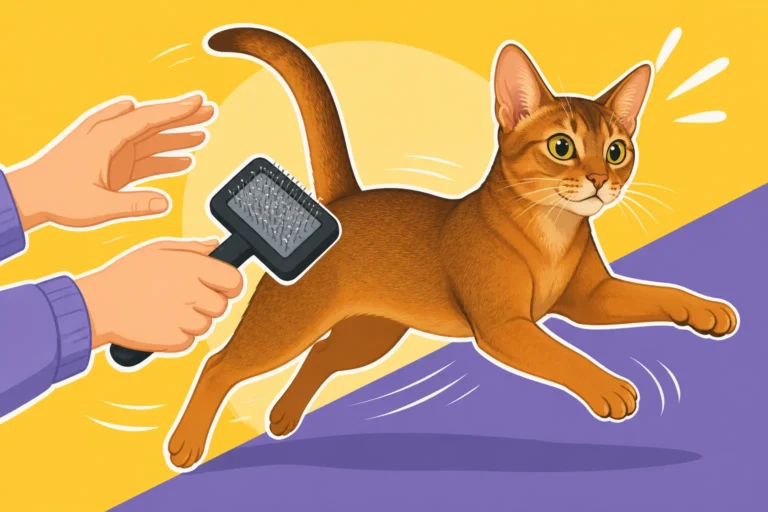
Aggressive brushing with a slicker brush or a deshedding tool can actually damage the delicate hair shafts and flatten the beautiful ticking, making the coat appear dull. Instead, a soft rubber grooming mitt or a chamois cloth is often all that's needed. A gentle weekly rub with a grooming mitt helps remove loose hairs, distributes natural oils, and massages their skin, keeping their coat vibrant and shiny. An Abyssinian Needs Brushing Once a Week and No More is a mantra many owners live by. You can find excellent grooming mitts and chamois cloths on Amazon or at pet stores like those found on Chewy, making it easy to provide this minimal yet effective care. This light touch ensures the individual bands of color remain intact and the coat continues to shimmer.
The Shimmer and the Shine: Beyond Just Color
The agouti banding is responsible for what many call the "shimmer" or "iridescence" of the Abyssinian coat. As light hits the alternating light and dark bands on each hair, it's reflected and absorbed in a way that creates a dynamic, moving sheen. This isn't just a static color; it's a living tapestry that changes as your cat walks, leaps, or even just shifts their weight. It's why they look so wild and elegant, perpetually seeming to glow from within.
Take a moment to observe your Abyssinian in different lighting conditions – bright sunlight, soft indoor light, or even by a flickering fireplace. You'll notice how the nuances of their ticking become more or less pronounced, how the deeper colors emerge, and how the lighter bands almost sparkle. This visual dynamism is a huge part of the breed's appeal and is something you'll come to appreciate more and more over the years. It truly is a coat that demands appreciation, and it's something breeders work hard to maintain, as it's a key part of the breed's allure.
The Importance of Ticking in the Breed Standard
For anyone involved in showing or breeding Abyssinians, the quality and clarity of the agouti banding are paramount. The breed standard, set by organizations like the Cat Fanciers' Association (CFA), places a strong emphasis on a clear, even ticked coat free of any barring or striping. Faint barring on the legs or tail, known as "ghost markings," can be considered a fault in the show ring, as it indicates a less refined expression of the ticked gene.
Judges examine the depth of color, the evenness of the ticking across the body, and the overall impression of a shimmering, unpatterned coat. The dark tipping on the ears and tail is also specifically noted as part of the overall desired appearance. This strict adherence to the ticking standard ensures that the unique beauty of the Abyssinian's coat, painstakingly developed over generations, continues to define the breed. It underscores just How an Abyssinian's Ticking Is Judged in the Ring and why it's such a vital characteristic. For new owners, this means that a well-bred Abyssinian will carry this incredible genetic legacy, offering a truly unique and beautiful companion.
Disclaimer
This article is for general informational purposes only and does not constitute professional advice. Laws, prices and regulations vary by location and change over time. Consult a qualified professional for guidance on your specific situation.