Why an Abyssinian Escapes a Standard Fence
It's a familiar scenario for many Abyssinian owners: you've invested in a seemingly robust fence, only to find your agile, curious cat has somehow bypassed it and is off on an adventure. The sheer athleticism and cunning of an Abyssinian mean that a standard backyard fence, designed for most pets or even children, often stands little chance against their determined escape artistry. This guide will delve into why your Aby is such a phenomenal escape artist and, more importantly, how you can create a truly secure environment to keep them safe and sound.
Understanding the Abyssinian's Natural Drive to Explore
The Abyssinian isn't just a pretty face; they are a bundle of energy, intelligence, and an insatiable desire to explore. This breed truly lives up to its "clown of the cat world" moniker, but beneath the playful antics is a deeply ingrained drive that makes standard fences feel less like a barrier and more like an exciting challenge to overcome.
Their Inherent Athleticism and Agility
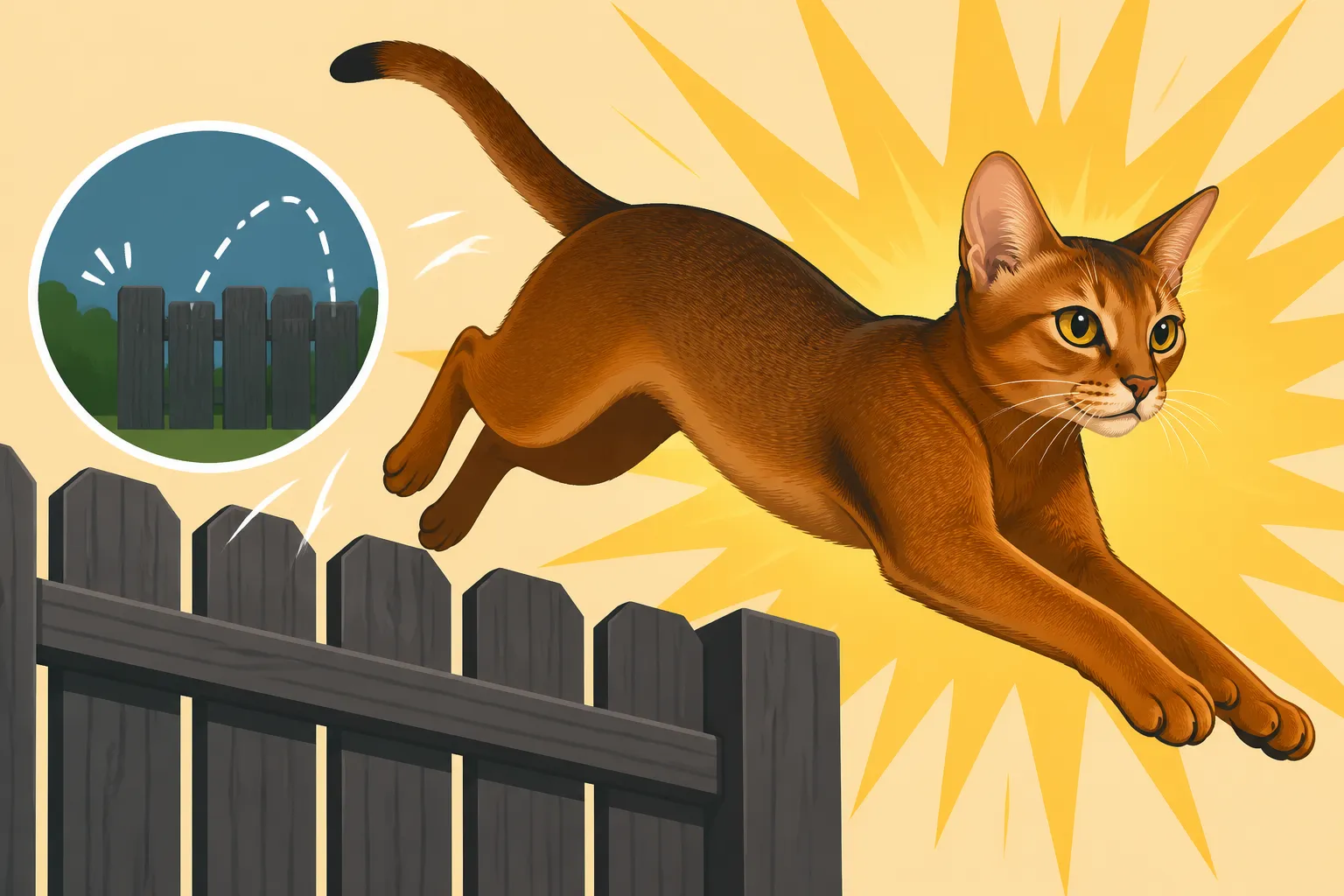
When we talk about an Abyssinian's athleticism, we're not just talking about a cat that likes to jump. We're talking about a miniature feline athlete with springs in its paws and a gymnast's grace. These cats are built for speed, agility, and incredible vertical leaps. Their lean, muscular bodies are perfectly adapted for climbing, pouncing, and navigating complex environments. A typical fence that might contain a more sedentary cat is often seen by an Aby as nothing more than a series of convenient footholds or a stepping stone to higher ground.
They don't just jump over things; they scale them. A wooden privacy fence, with its horizontal slats, becomes a ladder for an Abyssinian. Chain link? That's practically a purpose-built climbing frame. Even smooth surfaces can be overcome with enough determination and a running start. This incredible physical prowess means that height alone is rarely enough to deter them. If there's a way up, an Abyssinian will find it, often leaving owners scratching their heads, wondering how on earth they managed it. They live to explore every nook and cranny, and if that means going up and over, so be it.
The Hunter's Instinct and Curiosity
Beyond their physical capabilities, Abyssinians possess a formidable intellect and an intense curiosity that drives their exploratory nature. They are, at heart, hunters, with a keen prey drive that is easily triggered by the sights and sounds of the outdoors. A fluttering bird, a scurrying squirrel, or even the rustle of leaves in the wind can become an irresistible siren call, pulling them towards the perceived excitement beyond your yard. This isn't just boredom; it's a deep-seated instinct.
Their problem-solving skills are truly remarkable. If a simple jump doesn't work, they'll analyze the situation. Is there a loose board? A branch hanging too close to the fence? A small gap they can squeeze through? They'll meticulously test weaknesses, and once they've found an exploit, they'll remember it. This makes them incredibly persistent escape artists. They don't give up easily, especially when their inquisitive nature is piqued by something just out of reach. For an Abyssinian, the world is their playground, and a fence is merely a suggestion, not a hard-and-fast rule.
Why an Abyssinian Hates a Closed Door
An Abyssinian thrives on being part of the action, on knowing what's happening in every corner of their domain, and beyond. This innate need for involvement translates directly into their dislike of feeling confined. A closed door, for many Abyssinians, isn't just a barrier; it's an affront. They want access, they want freedom of movement, and they want to follow you from room to room. This same mindset applies to the outdoor environment.
When an Abyssinian feels the confines of a standard fence, especially if they can see or hear the exciting world just outside, that "closed door" sensation kicks in. They don't understand the concept of property lines or safety boundaries in the same way we do. To them, if there's an interesting smell, a potential chase, or just a new area to investigate, it's their right, even their duty, to explore it. This strong aversion to feeling penned in fuels their relentless efforts to find a way out, no matter how clever the fence appears to be. They need a lot of space and vertical opportunities to feel truly content, which is why An Abyssinian Needs Height More Than It Needs Floor.
The Limitations of Standard Fencing for an Abyssinian
While a typical fence might seem perfectly adequate for most domestic cats, Abyssinians operate on an entirely different level. Their unique blend of physical prowess and mental determination means that standard fencing simply isn't designed to contain them.
Height and Material Challenges
The average backyard fence stands anywhere from four to six feet tall. For a cat that can launch itself several feet into the air from a standing start, or scale vertical surfaces with ease, this height is often an invitation rather than a deterrent. How Far an Abyssinian Can Jump can be surprising to those unfamiliar with the breed's aerial capabilities. Many Abyssinians can clear a six-foot fence without much effort if they have sufficient motivation or a slight advantage like a nearby tree branch or even a pile of gardening tools.
Beyond height, the material itself presents challenges. Wood fences, especially those with horizontal slats or even just slightly rough surfaces, provide excellent grip for their claws. Chain-link fences are, as mentioned, natural climbing structures. Even smooth vinyl fences can be overcome if there's enough initial momentum or a slight irregularity to gain purchase. Most standard fences are designed to keep people in or out, not hyper-athletic cats who view vertical surfaces as puzzles to solve. Without specific modifications, these fences are often laughably easy for an Abyssinian to conquer.
Overcoming Physical Barriers: The Houdini Effect
Abyssinians aren't content to simply jump over a fence; they will employ a full repertoire of escape tactics, earning them the nickname "Houdini cats." If climbing over isn't an option, they'll look for other vulnerabilities. A loose board, a gap where the fence meets the ground, or even a small hole that has formed over time can become their personal gateway to freedom. They're adept at squeezing through surprisingly tight spaces, often making you wonder if they've somehow flattened themselves.
Digging is another tactic. While not typically as prolific diggers as some dog breeds, a determined Abyssinian will scratch and dig at the base of a fence if they perceive a weakness, especially if the ground is soft or there's a tantalizing scent just on the other side. They'll use anything in their environment to their advantage: a stack of firewood near the fence, a garbage can left too close, or even a sturdy bush can provide the boost they need to clear the top. Their intelligence truly shines when faced with a barrier, transforming your secure yard into their personal escape room challenge. This constant assessment of their environment for escape routes means you can never truly relax with a standard setup.
The Lure of the Unknown Beyond the Fence
For an Abyssinian, the grass is always greener on the other side – literally. Their profound curiosity ensures that the world beyond your fence is perpetually more exciting and intriguing than the familiar confines of your backyard. They are adventurers at heart, driven by a deep desire to explore new territories, investigate new scents, and engage with whatever novel stimuli the wider world has to offer. This isn't necessarily about dissatisfaction with their current environment, but rather an unyielding pull towards the thrill of discovery.
This inherent drive means that even a well-appointed yard with plenty of toys and climbing structures might not be enough to override their exploratory instincts if they know there's more out there. They'll gaze longingly at birds in a neighbor's tree, track the movement of a distant squirrel, or simply be captivated by the sheer mystery of what lies beyond the boundary. This mental engagement with the outside world fuels their physical efforts to escape, making them incredibly persistent. For an Abyssinian, the challenge of breaching the fence is almost as appealing as the reward of reaching the other side, and they will work tirelessly to satisfy their profound curiosity.
Strategies for Preventing Abyssinian Escapes
Given their incredible athleticism and relentless curiosity, keeping an Abyssinian safely contained requires more than just a standard fence. It demands ingenuity, specialized solutions, and a commitment to their safety. Thankfully, there are several effective strategies you can employ to create a secure outdoor space for your adventurous Aby.
Modifying Existing Fencing
If you already have a fence and aren't ready to build a whole new enclosure, modifying your existing structure is often the first step. The goal here is twofold: increase height in an unscalable way and eliminate any footholds or escape routes. One of the most popular solutions for cat owners is a "cat-proof" fence topper. These often involve flexible netting or outward-curving extensions that make it impossible for a cat to get a grip or clear the top. Think of systems like a coyote roller or specific cat fence conversion kits that add a significant, unclimbable barrier along the top of your existing fence. You can find various options for these types of fence extensions and roll bars on sites like Amazon.
Beyond the top, you need to assess the entire perimeter. Fill any gaps under the fence with concrete, heavy landscaping rocks, or an "L-footer" made of wire mesh buried horizontally a foot or so out from the fence line. This prevents digging under. For wooden fences, consider adding smooth acrylic or polycarbonate sheeting to the interior side, extending several feet up from the ground and below the top, to remove any climbing purchase from slats. Regularly inspect your fence for loose boards, weakened sections, or areas where plants have grown too close, providing a new ladder. Remember, these cats are master strategists, and any oversight will likely be exploited.
Creating a Secure Outdoor Enclosure (Catio)
For many Abyssinian owners, the ultimate solution for safe outdoor access is a catio – a secure, enclosed outdoor space. Catios offer a world of enrichment and fresh air without the risk of escape or exposure to outdoor hazards like cars, predators, or poisons. They can range from small window boxes that offer a taste of the outdoors to expansive, multi-level structures attached directly to your home or free-standing in your yard. For such an active and climbing-oriented breed, a catio with plenty of vertical space is ideal. You can learn more about What Size Catio Suits an Abyssinian and How an Abyssinian Uses a Catio to get ideas for your setup.
Within the catio, the possibilities for enrichment are endless. Install sturdy shelves, ramps, scratching posts, and even natural tree branches for climbing and perching. Puzzle feeders, a running water fountain (Abys often love water!), and a variety of toys will keep their intelligent minds and energetic bodies engaged. The key is to make the catio so exciting and stimulating that the outside world loses some of its appeal. Ensure the catio construction is robust, using strong wire mesh (not chicken wire, which is too flimsy) and secure latches on all doors. Look for catio components or complete kits on Amazon to get started. A well-designed catio provides your Abyssinian with the best of both worlds: the mental and physical stimulation of the outdoors in a completely safe environment.
Leash and Harness Training for Controlled Outdoors Time
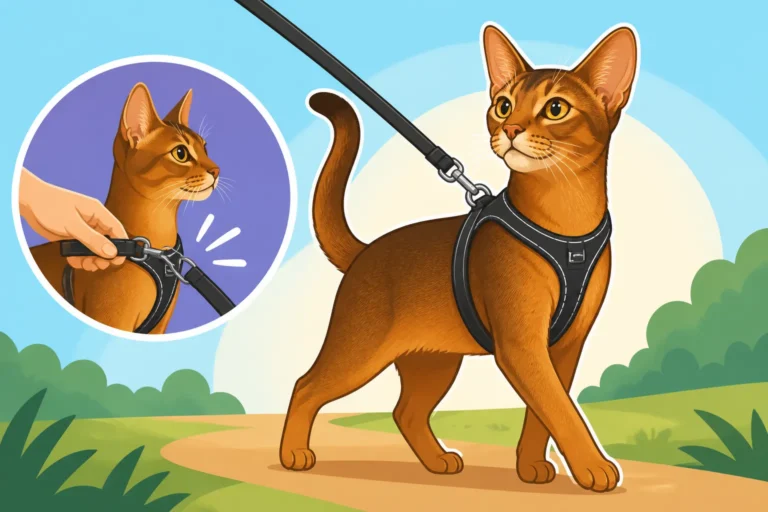
While a modified fence or a catio offers continuous outdoor access, leash and harness training provides a different kind of outdoor experience – one that is completely controlled and supervised. This isn't just a backup plan; it can be a wonderful way to bond with your Abyssinian and let them explore new sights, sounds, and smells in a completely safe manner. Abyssinians are often amenable to harness training, especially if introduced early and positively. How to Harness Train an Abyssinian Without a Fight is all about patience and positive reinforcement.
You'll need a well-fitting harness, not just a collar, which can easily slip off. Look for an H-style or vest-style harness that your Abyssinian cannot back out of, and you can find many suitable options on Amazon. When considering Which Harness Fits an Abyssinian's Narrow Chest, remember that a secure fit is paramount to prevent escapes. Start with short sessions indoors, gradually increasing the time and introducing the leash. Once they're comfortable, move to a quiet outdoor area, allowing them to lead the way and explore at their own pace. Always be present, observant, and ready to guide them away from potential dangers. This method allows your Abyssinian to satisfy some of their powerful curiosity and explore the world, while giving you complete peace of mind that they are safe and secure. It's an active commitment, but immensely rewarding for both you and your adventurous Aby. Remember, Why an Abyssinian Should Not Roam Outdoors is a crucial safety consideration, making supervised adventures all the more important.
Comparing Standard Fences to Abyssinian-Proof Solutions
To truly understand why a standard fence just won't cut it for an Abyssinian, let's look at a quick comparison of their features and effectiveness.
| Feature / Aspect | Standard Fence (e.g., 6ft wood privacy) | Abyssinian-Proofed Fence / Catio |
|---|---|---|
| Height | Typically 4-6 feet | Extended to 8+ feet, or fully enclosed (catio) |
| Climbing Ability | Easily scaled (slats, mesh, rough surfaces) | Outward-curving tops, smooth sheeting, no footholds, fully netted |
| Digging Prevention | Often none | L-footers, buried wire, concrete perimeter |
| Gaps/Weak Points | Common at base, corners, gates | Thoroughly sealed, secure latches, robust construction |
| Escape Likelihood | High, given Abyssinian athleticism and curiosity | Low to none, when properly designed and maintained |
| Safety from Hazards | Limited (cars, predators, toxins) | High (protected from most outdoor dangers) |
| Outdoor Enrichment | Dependent on owner vigilance and yard features | Built-in climbing, perching, play areas |
| Cost | Initial fence cost (moderate) | Moderate to high (modifications/catio construction) |
This table clearly illustrates the fundamental differences in approach. A standard fence is a boundary; an Abyssinian-proofed solution is a secure habitat designed with their unique abilities in mind. Given that How Many Hours a Day an Abyssinian Stays Active is significant, providing a safe and stimulating outdoor space is vital for their well-being.
Conclusion
Owning an Abyssinian is a joyous experience, but it comes with the understanding that these aren't your average lap cats. Their incredible energy, boundless curiosity, and impressive athleticism make them phenomenal escape artists, especially when faced with a standard fence. They are driven by an instinct to explore, and they view barriers not as impenetrable walls, but as exciting puzzles to solve. This can lead to heart-stopping moments for owners, fearing for their beloved cat's safety in the great outdoors.
The key to preventing an Abyssinian escape isn't about trying to change their inherent nature, but rather about understanding it and adapting their environment to meet their needs safely. Whether you opt for clever fence modifications like outward-curving toppers and smooth paneling, invest in a dedicated, enriched catio, or commit to supervised leash walks, the goal remains the same: provide them with safe, stimulating outdoor experiences. By understanding why they escape and implementing these specialized solutions, you can give your Aby the adventure they crave while keeping them securely within your care. It's an investment in their happiness and safety that every Abyssinian owner will find truly worthwhile.
Disclaimer
This article is for general informational purposes only and does not constitute professional advice. Laws, prices and regulations vary by location and change over time. Consult a qualified professional for guidance on your specific situation.