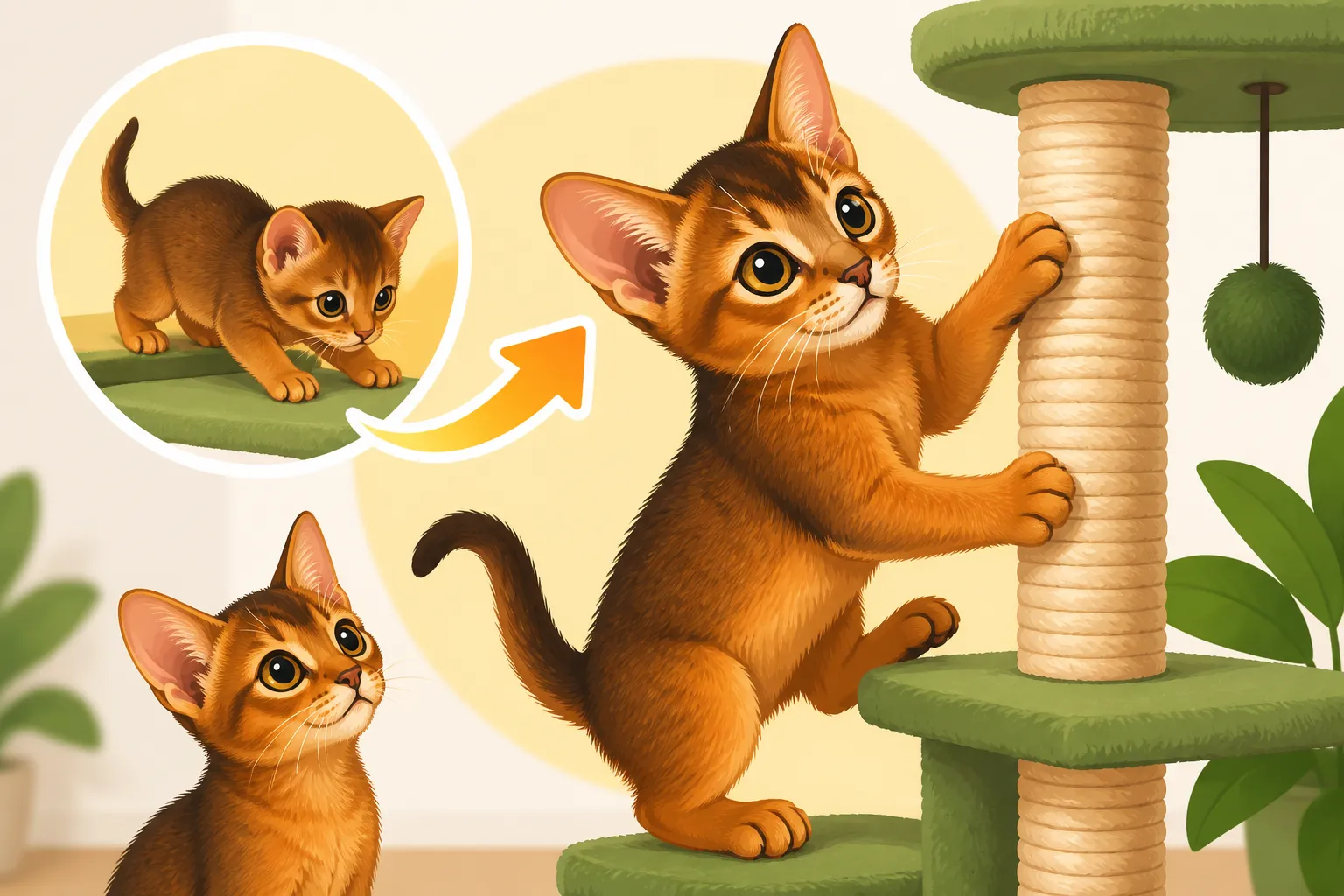
How Early Abyssinian Kittens Start Climbing
An Abyssinian kitten may look as if it can scale the whole room before its legs are ready to manage the landing. That early curiosity is normal, but a kitten can misjudge a jump, slip from furniture, or get wedged somewhere awkward. This guide explains when climbing usually begins, how to make a home safer, and when a change in movement deserves attention.
When Abyssinian kittens begin climbing
From wobbly steps to first climbs
Kittens develop quickly, but their progress is gradual. In the first few weeks, a kitten is mostly focused on nursing, staying warm, and learning to move around its nest. As its legs strengthen and balance improves, it may start pushing up, wobbling forward, and investigating objects close to the ground. Early attempts often look more like clambering than confident climbing.
Around the time kittens become more mobile, a low step, a littermate, or the edge of a soft bed may become a practice obstacle. An Abyssinian kitten may be especially keen to investigate what is above it, but breed tendencies do not make every kitten equally coordinated or ready at the same age. Temperament, opportunity, health, and the surface underfoot all matter.
As the kitten grows, it will usually try higher or more complicated routes: a low stool, a sturdy cat-tree platform, then perhaps the sofa or a chair. These are broad developmental patterns, not a schedule to enforce. A kitten who is cautious about heights may simply need more time and safe chances to explore. For a picture of the typical eight-week-old kitten stage, see What an Abyssinian Kitten Looks Like at Eight Weeks.
What early climbing looks like in everyday life
At first, climbing might be a kitten putting its front paws on a low box and scrambling up, or trying to reach a sibling on a slightly higher bed. It may pull itself up with its claws, pause to look around, then slide or tumble back down. That does not automatically mean something is wrong; young kittens are still learning how their bodies move.
Later, you may find the kitten on a chair you thought was too tall, or watching from a shelf it reached by way of a nearby table. Abyssinians are often active, curious cats, so a kitten may repeat a route again and again once it discovers one. What looks like boldness is still a developing skill, though. A kitten can get up to a perch before it has worked out how to descend safely.
Give exploration a safe outlet rather than trying to stop every climb. A low, stable cat tree, a broad step, or a short sequence of secure platforms can let a kitten practice without relying on a wobbly chair or a stack of boxes. A sturdy kitten-sized tree or scratcher may be available through retailers such as Chewy or at a local pet shop; check that the base is stable and that the platforms are easy for a small cat to reach.
How to make climbing safer at home
Build a route the kitten can manage
A safe climbing route gives a kitten places to pause and move between heights without requiring one ambitious leap. Start with a low platform and add a nearby intermediate step rather than positioning a tempting perch well above the floor. The surfaces should not wobble, tip, or slide when the kitten pushes off. If a cat tree shifts when you press it, secure it according to its instructions or choose a more stable location.
Think about the whole route, not just the top perch. A kitten may be able to jump up but struggle to get back down, especially if the available footholds are far apart or slippery. Keep platforms clear enough for the kitten to turn around. If you are installing wall shelves, attach them to suitable structural support and check that they can safely bear the cat’s weight as it grows. More guidance is available in How to Make an Abyssinian's Climbing Route Safe, Which Shelves Hold an Abyssinian's Weight, and How Far Apart Abyssinian Wall Shelves Should Sit.
Place a scratching post or sturdy scratcher near the route so climbing and scratching have appropriate outlets. A tiny kitten may not need a towering setup immediately; what matters is a secure, accessible place to climb and scratch. As the cat grows, reassess the furniture instead of assuming a kitten-safe arrangement will stay suitable for an athletic adult. Why an Abyssinian Needs More Vertical Furniture Than Most Cats explains how to think about vertical space as a longer-term need.
Remove the hazards that make a fall worse
Look for common launch points and landing zones. A kitten may use a chair to reach a table, then use the table to get to a counter. Move breakable objects away from those routes, secure tall furniture that could topple, and keep windows closed or fitted with strong, secure screens. A screen that is loose or designed only to keep insects out may not withstand a determined cat pushing against it.
Pay particular attention to cords, dangling blinds, unstable lamps, and open spaces behind appliances or furniture. A kitten can become trapped while investigating a narrow gap or tangle itself in a cord. Keep medicines, cleaning products, and small swallowable objects behind closed doors or in secured storage. A playful kitten can reach more than you expect once it has discovered a chair, counter, or open drawer as a step.
If you use a playpen or gated room when supervision is limited, make sure it is appropriate for the kitten’s size and cannot tip or create a climbing escape route. A pet retailer such as Chewy may offer different styles of kitten barriers and play equipment, but check product dimensions and how each item is secured before relying on it. Chewy is one place to compare options; a local store can also help you assess the sturdiness of a product in person.
| Home area | Common climbing risk | Practical adjustment |
|---|---|---|
| Sofa and chairs | The kitten uses them as steps toward a high surface | Move tempting breakables and provide a stable nearby climbing option |
| Cat tree | A narrow base or loose platform shifts during a jump | Check stability regularly and follow the assembly and anchoring instructions |
| Windows | A kitten pushes against a loose screen or slips through an opening | Keep windows closed or use a secure screen designed to resist pressure |
| Shelves | A large gap makes the route hard to navigate | Add a stable intermediate platform or limit access until the kitten is bigger |
| Kitchen and counters | Hot, sharp, or toxic items are within reach | Put hazards away and supervise access to the kitchen |
Helping an energetic kitten learn safely
Supervise without turning every climb into a chase
When the kitten is exploring, stay close enough to intervene if it is balancing on an unstable object or heading into a hazardous area. Try not to turn a safe, ordinary climb into a dramatic chase. Chasing can make the kitten scramble faster and may make the activity feel like a game. Instead, calmly block access to the danger and guide it toward a secure platform or toy.
If the kitten is high up and uncertain about coming down, avoid grabbing at it from below if that might startle it into a jump. Make the area around the landing clear, speak calmly, and give it time to find a route down. If necessary, use a familiar toy or food to encourage it toward a lower, safer surface. The aim is not to teach the kitten never to climb; it is to help it practice on surfaces that can handle its movement.
Keep play sessions interesting, but avoid encouraging leaps from unsafe heights. A wand toy can invite chasing along the floor or across stable platforms without dangling the toy over a drop. Rotate toys so the kitten has fresh things to investigate, and put away toys with strings when play is over. If you shop at Chewy for toys or climbing equipment, inspect the item for loose pieces and follow its age and supervision guidance rather than assuming any product is suitable for unsupervised use.
Make climbing part of a changing home setup
A kitten’s abilities and confidence can change noticeably over a few weeks. Recheck the room as the kitten gets bigger: a low table that once seemed harmless may now provide a route to the stove, and a gap that once looked too narrow may become an appealing hiding place. Move fragile items, secure furniture, and adjust access as the kitten learns new routes.
It also helps to make the approved route more rewarding than the risky one. Put a comfortable resting spot or a toy on a stable perch, and position scratching surfaces where the kitten naturally wants to climb. If the kitten repeatedly targets a counter, look for the reason: it may want a view, attention, a food smell, or access to a higher resting spot. Addressing that need with a safe alternative is generally more useful than relying on a spray or scolding.
Abyssinian kittens are not all alike, and the first year brings changes in size, confidence, and activity. The climbing arrangements that work for a small kitten may need to become taller and sturdier later, while older cats may eventually benefit from easier routes. For a broader look at those changing needs, see How an Abyssinian Kitten's First Year Looks and Why an Abyssinian Kitten Is Relentless.
When climbing behavior may need attention
Normal missteps versus a movement problem
A young kitten may stumble, misjudge a low jump, or need a few tries to work out how to descend. Occasional clumsiness during exploration is different from persistent weakness or a sudden change in coordination. Watch the pattern: Is the kitten using all four legs? Does it seem interested in play and food? Can it stand and walk normally after a minor slip?
Contact a veterinarian if the kitten repeatedly falls, seems unable to support itself, avoids using a leg, cries when moving, or appears unusually weak or disoriented. A fall from height can cause injuries that are not obvious right away, so seek veterinary advice after a significant fall even if the kitten initially appears to recover. Do not assume reluctance to climb is simply a personality quirk if it begins suddenly or comes with other changes.
Take note of when the behavior started and what you observed. A short video can help the veterinarian understand an intermittent issue, provided recording does not delay care or put the kitten at risk. Avoid testing the kitten by placing it on a high surface or encouraging jumps. A veterinarian can assess the kitten’s movement and advise whether an examination or further care is needed.
Give a shy climber room to develop
Not every Abyssinian kitten will rush to the highest surface. Some prefer to watch first, climb gradually, or stick close to the floor until they feel comfortable. Give a hesitant kitten low, stable opportunities and let it choose whether to explore. Forcing it onto a perch can make it more frightened and increase the chance of a fall.
A kitten’s early climbing is one small part of its development, not a test of whether it is healthy, clever, or “typical” of the breed. Provide a safe route, keep hazards out of reach, and notice meaningful changes in movement. As the kitten grows, adjust the setup to match its ability rather than expecting it to stay within the limits it had as a very young cat. If the kitten has just arrived, How to Settle an Abyssinian in a New Home can help you create a calm starting space while it learns the layout.
Disclaimer
This article is for general informational purposes only and does not constitute professional advice. Laws, prices and regulations vary by location and change over time. Consult a qualified professional for guidance on your specific situation.