Whether the Abyssinian Is in the Bengal’s Background
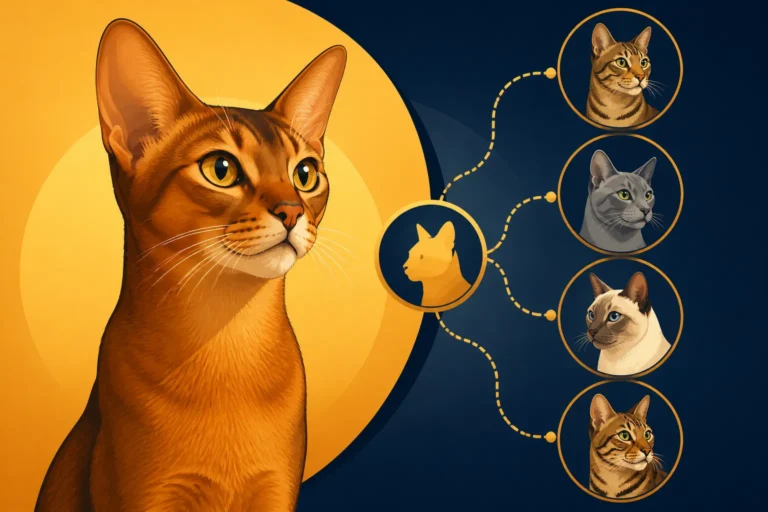
The Bengal’s wild-looking coat can make its family tree seem easy to read, but appearance does not prove a cat came from an Abyssinian. The Bengal was developed from Asian leopard cats and domestic cats, and some early domestic breeding may have involved Abyssinians. Here’s what that connection means, what it doesn’t mean, and how to tell ancestry claims from a specific cat’s documented pedigree.
The Bengal’s Background Is a Mix of Wild and Domestic Ancestry
The Asian leopard cat is the defining wild ancestor
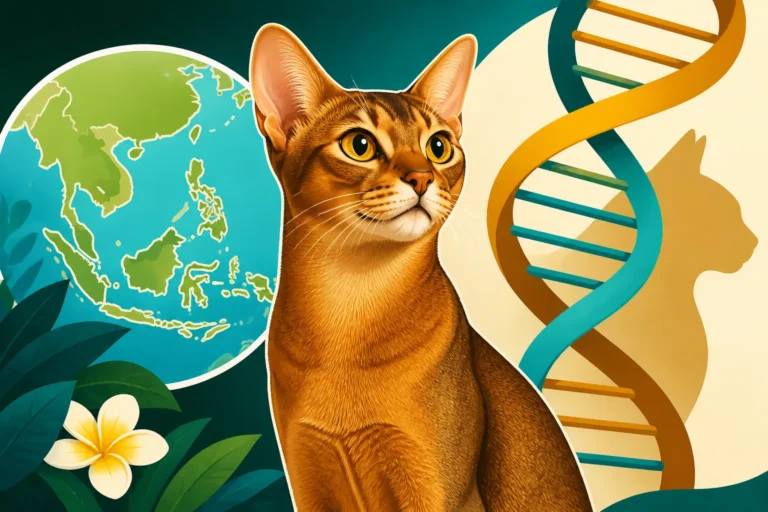
The Bengal breed began through crosses between the Asian leopard cat, a small wild cat, and domestic cats. The name “Bengal” reflects the wild cat’s scientific name, Prionailurus bengalensis. It does not mean that every Bengal is a recent wild-domestic cross, or that the breed is a simple blend of two animals.
Early Bengal breeding programs worked with different cats and generations. Breeders sought domestic cats that could help establish a sociable, manageable companion with a distinctive spotted or marbled coat. As the breed developed, its ancestry became more complex than a single cross. A modern Bengal’s individual pedigree, rather than the breed label alone, is the best place to look for specific ancestors.
That distinction matters because “Bengal ancestry” can refer to several things: the breed’s original wild-domestic foundation, a particular domestic breed used in an early program, or a recent wild-domestic cross. Those are not interchangeable. Most pet owners asking whether the Abyssinian is in the Bengal’s background want to know about the second possibility: whether Abyssinians contributed to early domestic breeding.
Domestic foundation cats came from more than one source
Bengal breeders used domestic cats to develop the breed over time. Accounts of early Bengal development name several kinds of domestic cats, and Abyssinians are sometimes included among the breeds or cats used in some foundation breeding. That makes it reasonable to say that Abyssinians may appear in parts of the Bengal’s early background.
It is not accurate, however, to say that every Bengal descends from an Abyssinian, or that Abyssinians are the sole domestic foundation of the breed. Early breeding histories can involve individual cats, outcrosses, and different programs, so a general statement about a breed’s development cannot establish the ancestry of every Bengal. A particular cat’s pedigree is what can confirm named relatives.
This is also why breed-history summaries may differ in how they describe the domestic contributors. Some focus on the Asian leopard cat and domestic cats as broad categories; others name particular domestic breeds used by breeders. The safest conclusion is measured: Abyssinians are reported among possible early domestic contributors, but that does not make the Abyssinian a universal or defining Bengal ancestor.
What the Abyssinian Connection Does and Does Not Mean
A possible foundation contribution is not a recent cross
A breed can have a distant historical contribution from another breed without a present-day individual being a recent cross of the two. If an Abyssinian was used in an early Bengal program, its descendants could have been incorporated into later generations and pedigrees. That is different from a Bengal produced by mating a Bengal with an Abyssinian in recent generations.
For buyers, the practical question is often whether a kitten’s parents or grandparents are Abyssinians. That is a pedigree question, not something that can be answered by looking at the coat. A breeder who knows a kitten’s documented ancestry should be able to explain it in terms of named cats and generations, rather than relying only on a broad claim that the breeds are related.
The same caution applies to terms like “pure Bengal” and “part Abyssinian.” Breed registration and pedigree records help describe a cat’s recorded lineage, but casual descriptions can blur historical breed development with an individual’s family tree. If a specific cross matters to you, ask for the pedigree and clarification about how the breeder is using those terms.
Shared athletic looks do not prove close ancestry
Abyssinians and Bengals can both look lean, alert, and athletic. Both may have striking coats, expressive eyes, and a lively presence. Those similarities can encourage people to assume that one breed directly shaped the other more strongly than it did. But body type, energy, and a dramatic coat are not reliable proof of a particular ancestor.
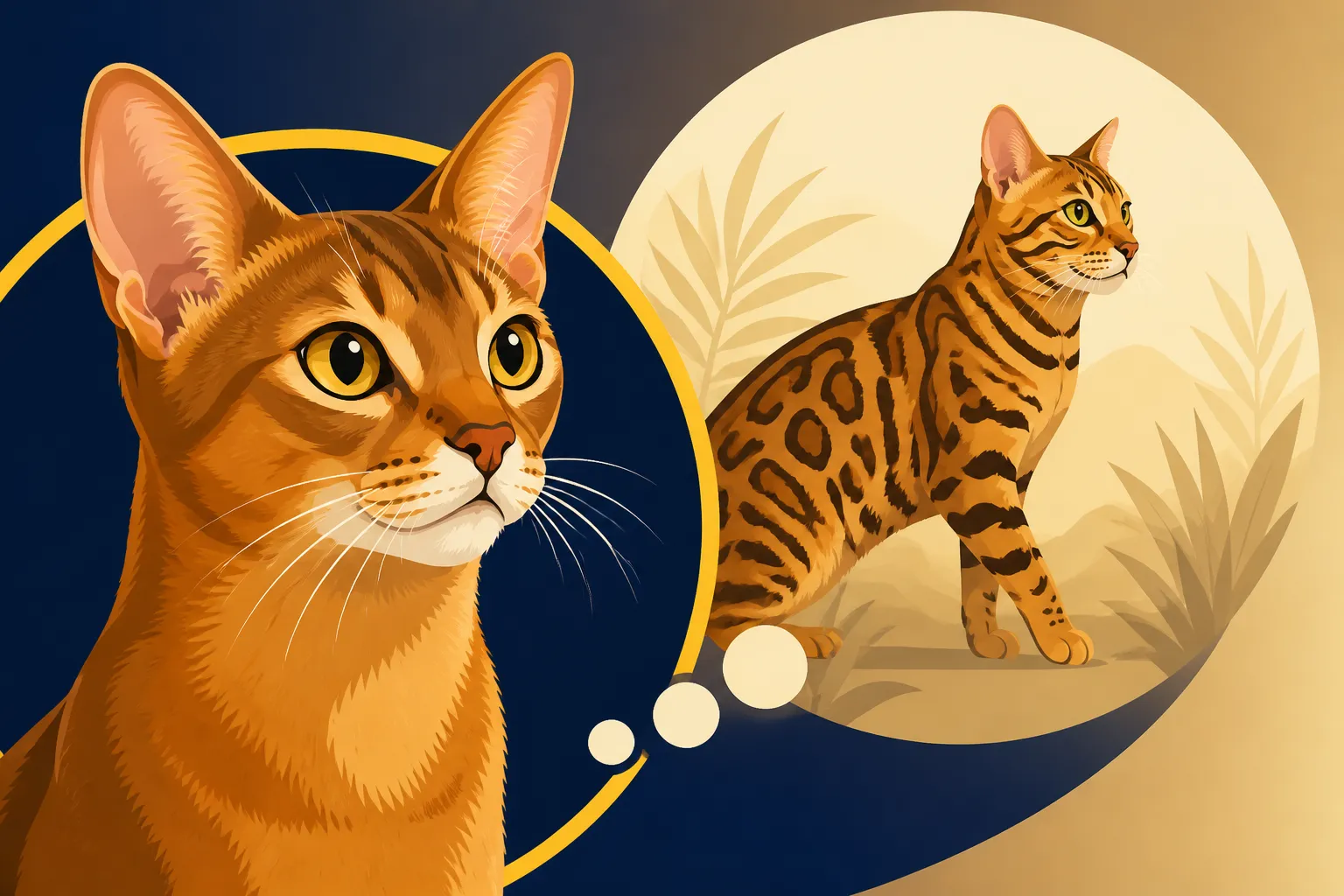
Their coat patterns are notably different. Abyssinians are known for a ticked coat, where individual hairs carry bands of color that create a warm, even appearance. Bengals are recognized for patterned coats, including spots and rosettes, as well as marbled patterns. An Abyssinian’s ticking and a Bengal’s markings are not the same feature, even if both catch the eye. For a closer comparison, see How an Abyssinian Differs From a Bengal and Why a Bengal's Rosettes Never Appear on an Abyssinian.
Breed appearance is shaped by many genes, and similar traits can arise or be selected in different populations. A spotted or rosetted Bengal does not reveal that an Abyssinian was in its immediate family, just as an Abyssinian’s ticking does not establish a Bengal ancestor. Coat appearance can tell you about visible traits; pedigree evidence is needed to make a claim about family history.
How to Check Whether a Particular Bengal Has Abyssinian Ancestors
Start with the pedigree and ask precise questions
If you are considering a Bengal kitten, ask the breeder for its pedigree and the pedigrees of its parents. Then ask a direct question: “Are there Abyssinians in this kitten’s documented ancestry, and if so, how many generations back?” That wording helps separate a recorded ancestor from a general claim about the breed’s history.
A useful answer should identify the cat or generation involved and explain what records support the claim. If the breeder says that all Bengals are part Abyssinian, ask what they mean by “part” and whether they are referring to a specific pedigree or to historical accounts of early breeding. A responsible breeder should be comfortable explaining the distinction without making the ancestry sound more certain or more recent than the records show.
You can also ask which registry records the pedigree and whether the cat is being sold as a Bengal under that registry’s rules. A pedigree is most useful when the names and generations are clear. It does not answer every question about health or temperament, but it is a more dependable ancestry record than a seller’s description or a resemblance in a photograph.
Treat DNA breed estimates as clues, not a complete family tree
Commercial genetic tests may offer breed or ancestry estimates, but those estimates should not be treated as a substitute for a documented pedigree. Domestic cat populations have overlapping ancestry, and a test’s ability to identify a specific breed contribution depends on the test and the reference populations it uses. A result suggesting similarity to a breed is not necessarily proof that a named Abyssinian appears in a Bengal’s family tree.
If you already have a Bengal and are simply curious, a DNA test may be interesting as one piece of information. Read the test’s explanation of what it measures, and distinguish broad ancestry estimates from parentage or pedigree documentation. If you need to resolve a formal lineage question, ask the registry or breeder what records are accepted for that purpose.
For a potential owner, the more useful focus is usually the Bengal’s individual health records, temperament, and the breeder’s practices. Don’t let an intriguing ancestry claim distract from questions about the parents’ health, the kitten’s early care, and how the breeder supports placements. The same thoughtful approach applies when researching an Abyssinian; What an Abyssinian Looks Like Against the Show Standard and What Genetic Studies Say About the Abyssinian's Origin offer further context on breed identity and ancestry.
What This History Means for Cat Owners
Choose for the cat in front of you, not a romantic family story
Whether an Abyssinian appears somewhere in the distant background does not tell you how a Bengal will behave in your home. Individual temperament, socialization, environment, and the needs associated with the breed all matter. If you are comparing the two, look at the daily life each cat may require rather than assuming that shared athletic qualities mean they are interchangeable.
A Bengal is often a highly active, curious cat that benefits from interactive play, climbing opportunities, and regular engagement. An Abyssinian is also typically energetic and interested in its surroundings, but its coat, history, and breed characteristics differ. Think about your schedule, household, and ability to provide enrichment. Whether the Abyssinian Is the Right Cat for You can help you assess the Abyssinian on its own terms, while How an Abyssinian Differs From an Egyptian Mau shows why similar looks should not be mistaken for the same breed history.
Before bringing home either breed, prepare the space for an active cat: secure breakable items, offer safe places to climb, and plan for daily play. If you shop for food, toys, or enrichment supplies through Chewy or a local pet shop, focus on whether an item suits your cat’s age, play style, and safety needs rather than choosing it because it is marketed for a particular breed. A sturdy wand toy, for example, needs supervised use and should be put away afterward if it has strings a cat could chew.
Keep breed history separate from breed care
The Abyssinian’s possible role in early Bengal development is an interesting part of breed history, but it does not mean a Bengal should receive Abyssinian-specific care or that an Abyssinian should be managed like a Bengal. Each cat’s veterinary needs, diet, activity, and behavior should be considered individually, with advice from a veterinarian who knows the cat.
For day-to-day decisions, look at what your own cat is doing. A Bengal that is climbing curtains may need safer vertical routes and more structured play; an Abyssinian who is suddenly less active may need a health check rather than simply “more stimulation.” If you use Chewy to find puzzle feeders or toys, choose options that match your cat’s abilities and supervise new items until you know how the cat uses them. Online product descriptions cannot replace an assessment of an individual cat’s needs.
When a breeder or seller uses ancestry as a selling point, ask for specifics and keep the claim in proportion. “Abyssinians may have contributed to some early Bengal lines” is a cautious historical statement. “Every Bengal is part Abyssinian” is a much broader claim that requires evidence and should not be accepted as a substitute for an individual pedigree. Chewy can be one convenient place to browse routine supplies, but the important decisions—choosing a responsible breeder, understanding a pedigree, and planning veterinary care—depend on reliable records and professional guidance.
Disclaimer
This article is for general informational purposes only and does not constitute professional advice. Laws, prices and regulations vary by location and change over time. Consult a qualified professional for guidance on your specific situation.