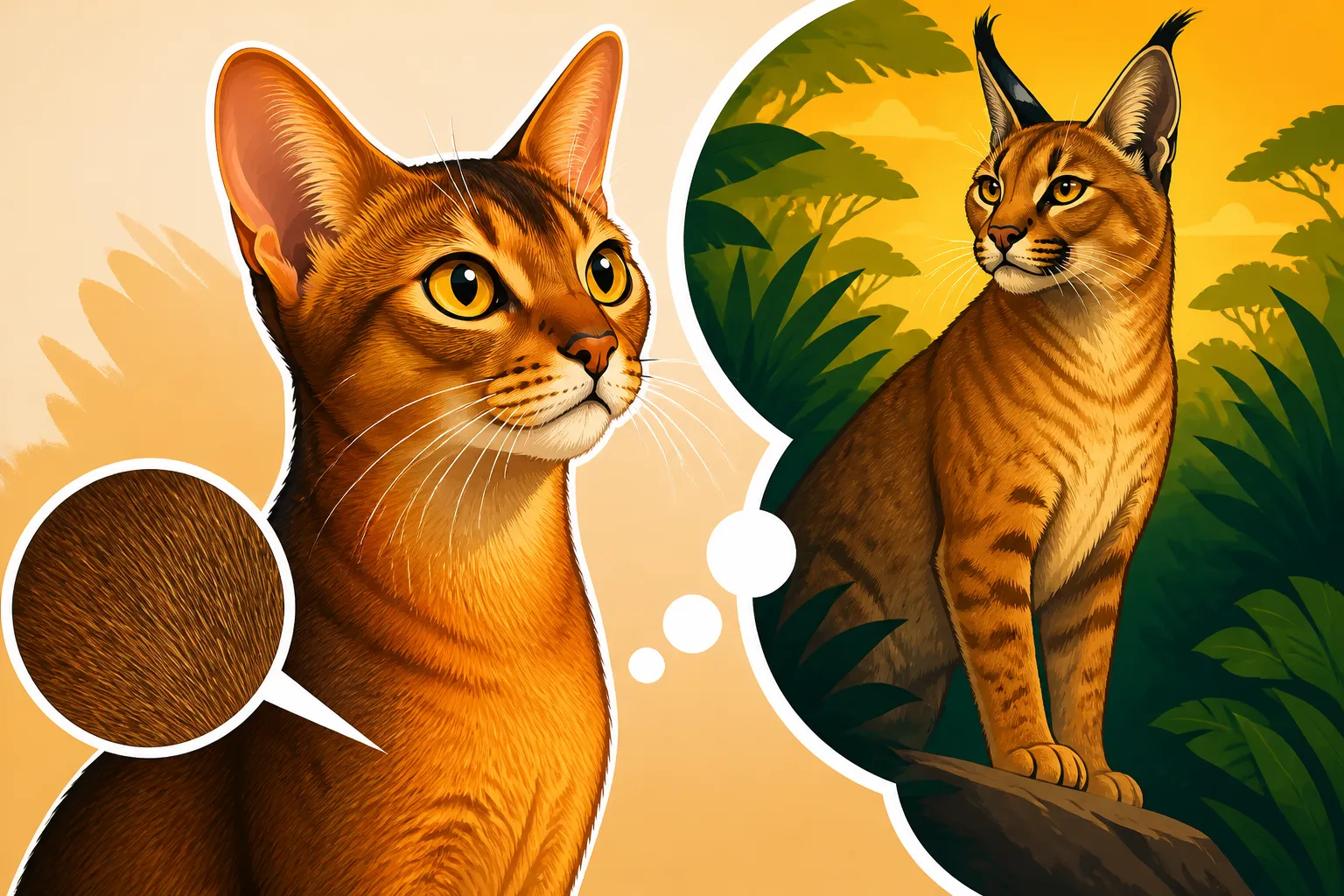
Why an Abyssinian Is Mistaken for a Wild Cat
An Abyssinian’s long legs, alert ears, dramatic eyes, and shimmering coat can make the cat look like a tiny wild hunter. That impression is understandable, especially when one is perched above a doorway or stalking a toy. Here’s what creates the wild-cat look, what it does—and doesn’t—say about the breed’s ancestry, and how to tell striking appearance from actual wild behavior.
Why the Abyssinian Looks Like a Wild Cat
Its coat resembles a wild animal’s camouflage
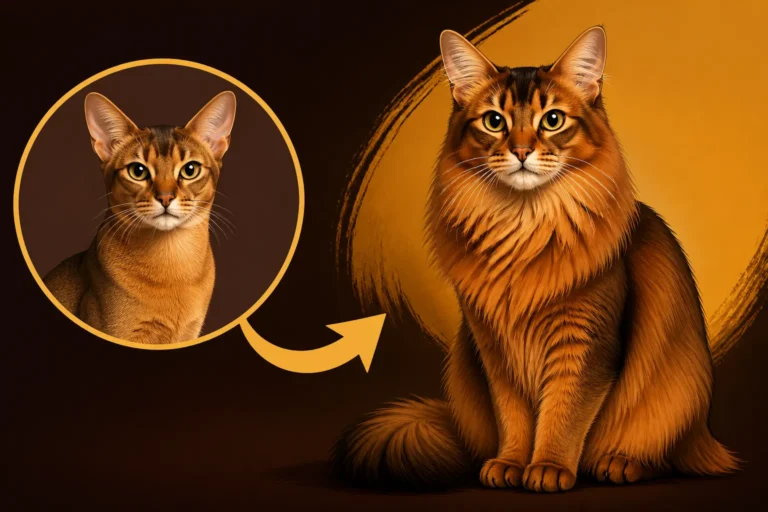
An Abyssinian’s coat is ticked: individual hairs have several alternating bands of color rather than a simple solid color or clearly defined stripe. The effect is a softly shifting, earthy coat that can look a little like the camouflage of a wild feline. When the cat moves through sunlight, the bands catch the light differently, giving the coat a lively, almost burnished appearance.
That coat pattern is part of what makes the breed so easy to mistake for a miniature wild animal. It does not have the bold rosettes of a leopard or the distinct spots of an ocelot, but the overall effect can still seem natural and untamed. The ticking is especially noticeable across the back, sides, and tail. If you want to understand the pattern itself, What Makes an Abyssinian's Coat Ticked Rather Than Striped explains how it differs from the stripes many people expect on a tabby.
Abyssinians are commonly seen in warm, earthy shades, including ruddy and sorrel, as well as blue and fawn. In some light, those colors can look remarkably close to the tawny tones people associate with wild cats. The resemblance is visual, though—not evidence that the cat is part wild.
Its build looks ready for action
Abyssinians have a lean, athletic outline. Their bodies are medium-sized and muscular, with long legs and a fine-boned appearance. They often stand and move with an alert, balanced posture that makes them seem ready to spring, even when they are simply watching a household member make a cup of coffee.
The impression gets stronger when you see one climb. An Abyssinian may scale a cat tree, land on a bookshelf, then watch the room from above as if it has selected a lookout point. That combination of agility and confidence can look more like a small predator’s behavior than the familiar image of a cat curled up on a couch. In practice, it is a domestic cat using its body and instincts in an energetic way. What an Abyssinian's Body Type Is Called gives more detail about the breed’s shape.
Their ears and eyes contribute, too. The ears are relatively large and set wide apart, while the eyes are expressive and often outlined by darker fur. Together, these features give the face a focused, watchful look. The effect can be especially striking when an Abyssinian is looking upward or tracking a moving toy.
The similarities are visual, not proof of wild ancestry
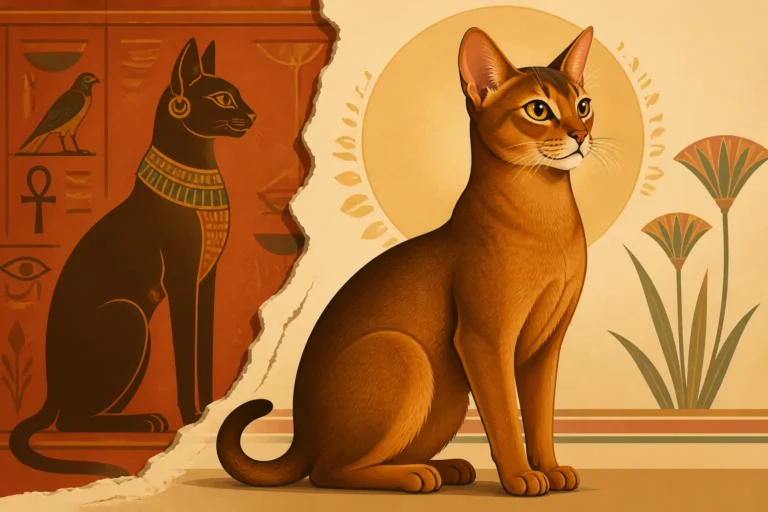
The Abyssinian is a domestic cat breed. Its elegant appearance has inspired comparisons with wild felines and ancient cat imagery, but a resemblance is not the same thing as a direct link to a wild species. Cats with similar body shapes or coat colors can look alike without having a recent wild ancestor.
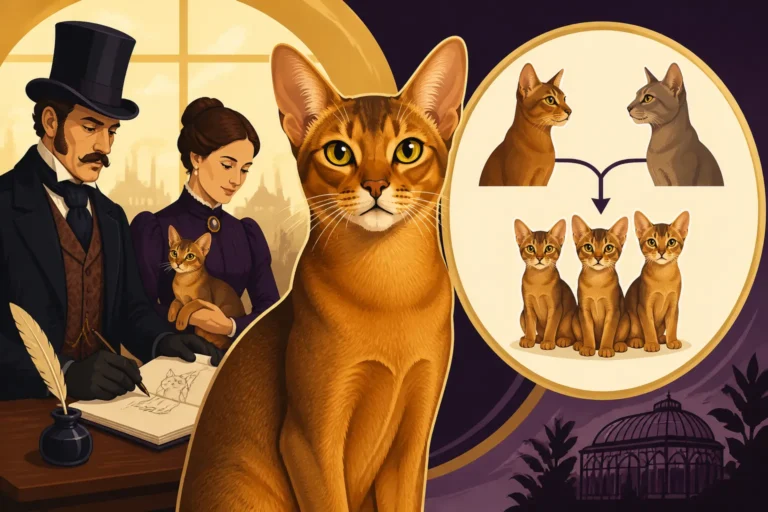
The breed’s origin story is often connected to Abyssinia, the historical name associated with present-day Ethiopia. That story is familiar, but the name alone does not establish exactly where the modern breed began. For a more careful look at the evidence and the popular claims, see What Genetic Studies Say About the Abyssinian's Origin.
It is also easy to overread the breed’s appearance because the Abyssinian’s coat is unusual among familiar household cats. Its ticking, lean body, and alert expression create a coherent “wild” impression. But those traits describe how the cat looks; they do not mean that it needs to be treated like a wild animal or kept in a specialized enclosure.
Why Its Everyday Behavior Adds to the Impression
Abyssinians move like active little hunters
Abyssinians tend to be curious, quick, and highly engaged with what is happening around them. A tossed toy may prompt an instant chase. A rustle from a paper bag may need investigation. A bird outside the window can hold a cat’s attention far longer than the person sitting nearby expects.
That attention to movement is part of normal feline behavior, but the Abyssinian’s energy makes it especially visible. The cat may follow a toy across a room, leap onto furniture, and return to inspect the toy again. When an owner watches this sequence, it can feel like observing a miniature hunting routine. It is play and exploration—not proof that the cat is feral or dangerous.
Abyssinians also often prefer being involved in household activity rather than sleeping undisturbed all day. They may follow people from room to room, watch chores from a shelf, or investigate whatever has just been placed on the counter. Their curiosity can feel intense, particularly if you expected a more settled lap cat. The Abyssinian Is the Busiest Cat in the House explores why this breed can seem so constantly on the move.
Height and observation make them look more imposing
A cat perched on top of a cabinet can appear more dramatic than the same cat sitting on the floor. Abyssinians often seek elevated places because height offers a comfortable place to observe the room. From a high shelf or cat tree, they can monitor movement, choose when to join in, and retreat when they want quiet.
This habit may remind people of the way a wild cat watches its surroundings, but it is also ordinary domestic-cat behavior. Many pet cats enjoy elevated resting places. Abyssinians simply tend to be enthusiastic climbers, so owners may see the behavior more often—and in more surprising locations.
If your cat keeps choosing the top of the bookcase, it is usually more useful to provide a safe climbing route than to treat the behavior as a sign of wildness. A stable cat tree or securely installed shelves can give the cat an appropriate place to climb. An Abyssinian Needs Height More Than It Needs Floor offers ideas for making vertical space useful in a home.
Their curiosity can be mistaken for independence
Abyssinians may be confident explorers, but that does not mean they are aloof or self-sufficient in the way people sometimes imagine a wild animal to be. Many are strongly interested in their people. They may stay close, follow a person around, and look for interaction without settling in one place for long.
That can confuse someone who expects affection to mean prolonged lap-sitting. An Abyssinian might choose to sit beside you, observe from the back of the sofa, or walk alongside you as you move around the home instead. The cat is still seeking company; it simply expresses that interest through activity and proximity. How an Abyssinian Shows Affection Instead of Lap Sitting describes some of these less conventional signs of attachment.
Their confidence can also make them seem fearless. A new box, a visitor’s bag, or a partly open cupboard may quickly become a subject of investigation. But confidence is not the same as good judgment. A curious cat can still get into trouble around hot stovetops, open windows, cleaning products, and small objects that could be swallowed.
Wild-Looking Features Compared With Domestic Cat Traits
| Feature | Why it can look wild | What it usually means in a home |
|---|---|---|
| Ticked coat | Earthy, blended coloring resembles natural camouflage | A distinctive domestic coat pattern |
| Long legs and lean body | Gives the cat an athletic, predator-like outline | A build suited to climbing, running, and jumping |
| Large ears and alert eyes | Creates a focused, watchful expression | A normal part of the breed’s appearance |
| Stalking and pouncing during play | Resembles a hunting sequence | Play that channels ordinary feline instincts |
| Perching up high | Looks like a lookout or hunting position | A preference for secure elevated resting places |
| Investigating rooms and objects | Can seem unusually bold or untamed | Curiosity that needs safe boundaries and enrichment |
What the wild-cat resemblance does not mean
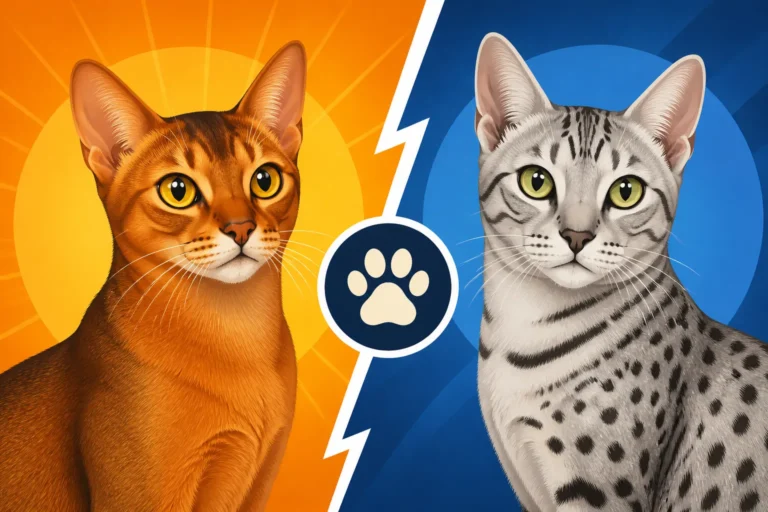
An Abyssinian’s appearance does not mean it is a hybrid with a wild species. Nor does it mean the cat will behave like a serval, caracal, or other wild feline. Domestic cats have their own needs and behavior patterns, and an Abyssinian should be cared for as a domestic companion.
It also does not mean every Abyssinian will act exactly the same way. Individual personality, socialization, health, age, and home environment all matter. One cat may be an enthusiastic climber and toy chaser; another may be more cautious or prefer a quieter routine. Breed tendencies offer a general picture, not a guarantee of temperament.
If you are comparing breeds because the Abyssinian seems “wild,” it helps to separate appearance from the kind of daily life you want. A cat’s athletic build may be appealing, but its need for activity and interaction deserves equal consideration. Whether an Abyssinian Is the Right Cat for You can help you think through that match.
Living Happily With an Abyssinian That Looks Untamed
Give its energy safe outlets
Abyssinians benefit from regular play that lets them chase, leap, and think. Wand toys can encourage short bursts of stalking and pouncing, while puzzle feeders and food-finding games give a curious cat something to investigate. A brief play session before a meal can be a useful routine: the cat gets to move and engage, then settle down to eat.
Rotate toys if your cat loses interest quickly. A toy that is left out every day may become background furniture, while one that reappears after a break can feel interesting again. If you’re browsing for enrichment supplies on Chewy, look for sturdy wand toys, puzzle feeders, and toys that can be used with supervision. Avoid leaving strings or small detachable parts accessible when no one is watching.
Climbing is another important outlet. Provide stable furniture designed for cats or properly secured shelves, and make sure the route between levels does not require risky leaps over fragile objects. A climbing setup can be especially helpful in an apartment, where there may be less room to run. How to Make an Abyssinian's Climbing Route Safe covers the practical details.
Make the home interesting without making it hazardous
A busy cat is likely to investigate cupboards, counters, cords, and anything left within reach. Instead of assuming the cat is being deliberately difficult, look at the environment from its point of view: interesting smells, movement, and access are invitations to explore. Store food securely, keep medication and cleaning products behind closed doors, and remove small items that could be chewed or swallowed.
Set up approved places to watch the world. A secure window perch can give an Abyssinian a place to observe birds, people, and neighborhood activity without roaming outdoors. Make sure the window itself is safely secured; a screen that is not designed to withstand a cat’s weight should not be treated as protection.
If you use Chewy to find a window bed or scratching post, check how the item attaches, whether it fits the window or space you have, and whether the materials suit your cat’s habits. The goal is not to buy a solution for every behavior, but to make the safe option more appealing than the risky one.
Keep outdoor exploration controlled
A wild-looking cat may seem as though it belongs outdoors, but a striking coat and athletic body do not make free roaming a safe choice. Traffic, fights with other animals, infectious disease, parasites, getting lost, and local wildlife risks can affect any pet cat. An Abyssinian’s curiosity and climbing ability may make an unsecured outdoor area particularly challenging.
If you want to offer outdoor stimulation, consider a secure catio or carefully supervised harness training. Introduce a harness gradually indoors and stop if the cat becomes distressed. A cat should never be left tied up or placed in an outdoor space that it can climb or squeeze out of.
For more ideas about safe outings, How to Leash Train an Abyssinian explains the gradual approach. If you are selecting a harness or carrier through Chewy, focus on a secure fit and construction rather than choosing based on appearance alone. A well-fitted harness should allow comfortable movement without giving the cat room to back out.
The Abyssinian’s wild-cat reputation comes from a striking combination of coat, build, alertness, and athletic behavior. Those qualities make the breed memorable, but they do not change its status as a domestic cat. With safe climbing options, engaging play, and a home that accounts for its curiosity, an Abyssinian can look like a tiny jungle explorer while living comfortably as a companion.
Disclaimer
This article is for general informational purposes only and does not constitute professional advice. Laws, prices and regulations vary by location and change over time. Consult a qualified professional for guidance on your specific situation.