Why an Abyssinian Solves a Puzzle Feeder Too Quickly
It's a familiar scenario for many Abyssinian parents: you spend ages researching the perfect puzzle feeder, eager to engage your clever cat, only to have them "solve" it in about five minutes flat. You thought you were buying them hours of entertainment, a mental workout to rival a Mensa meeting, and instead, it's a fleeting moment of triumph before they look at you as if to say, "Is that all you've got?" This guide is for every Abyssinian owner who’s wondered if their cat is just too smart for their own good and how to keep those brilliant minds truly engaged.
The Abyssinian Brain: A Master of Rapid Problem Solving
If you live with an Abyssinian, you already know they're not your average couch potato cat. These felines are bundles of energy, curiosity, and startling intelligence, often outsmarting their human companions. It's this unique blend of traits that makes them such quick studies when it comes to puzzle feeders.
Innate Intelligence and Curiosity
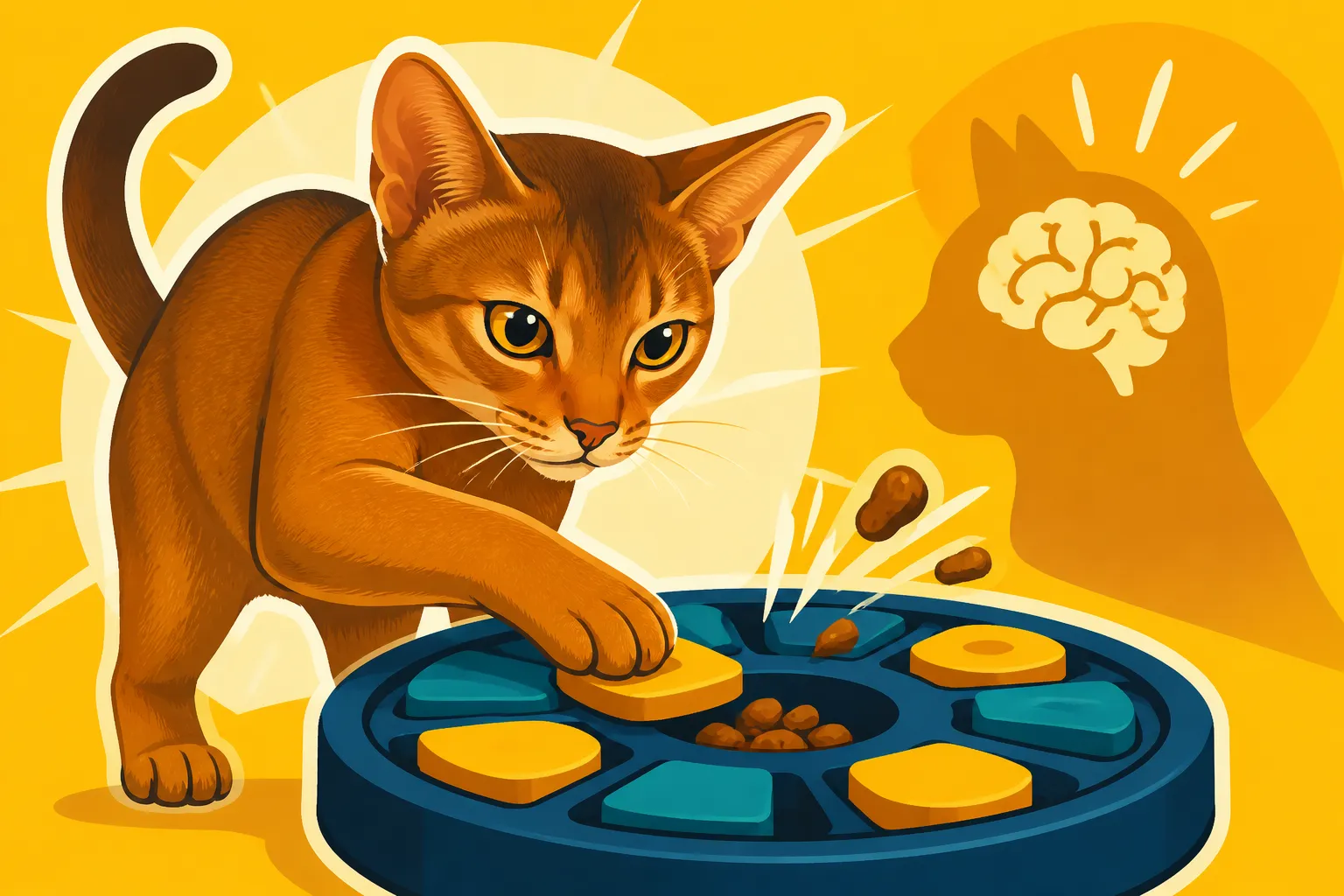
Abyssinians are renowned for their sharp intellect. They're quick learners, highly observant, and possess a remarkable ability to understand cause and effect. This isn't just about figuring out how to bat a toy to get a treat; it's about systematically approaching a problem, testing different solutions, and remembering what works. Think of them as feline engineers, constantly tinkering with their environment. When faced with a new puzzle feeder, their minds immediately begin to analyze its mechanisms. They're not just randomly batting at it; they're actively trying to understand how it releases food. This innate curiosity, combined with their intelligence, means they often crack the code far faster than manufacturers (or owners) ever anticipate. They learn from repetition, too. Once they've solved a particular feeder a few times, it ceases to be a puzzle and becomes a simple chore.
High Energy, High Drive
An Abyssinian's brain is inextricably linked to its body. These cats are incredibly active, and that physical energy fuels their mental drive. A bored Abyssinian isn't just lounging around; it's often actively looking for something to do, something to explore, something to figure out. This high drive means they have incredible persistence when they're motivated. If there's food involved, and food is almost always involved in a puzzle feeder, their focus becomes laser-sharp. They won't give up easily, and their continuous motion and agility allow them to manipulate feeders in ways a less athletic cat might not. They're going to use every ounce of that energy and coordination to extract those delicious morsels. This isn't just about a love for food; it's about the intrinsic reward of the challenge itself. For an Abyssinian, the act of problem-solving is almost as satisfying as the treat it yields. How Many Hours a Day an Abyssinian Stays Active illustrates just how much their bodies and minds are driven to be busy.
A Cat That Loves a Challenge
Unlike some cat breeds that might get frustrated and walk away from a difficult task, Abyssinians tend to thrive on challenges. They enjoy the process of overcoming obstacles, whether it's scaling the highest bookshelf, opening a closed cabinet door, or, yes, extracting a piece of kibble from a multi-chambered device. This love for mental stimulation means that a puzzle feeder, initially, is a game they are eager to win. They don't see it as a hurdle; they see it as an opportunity to flex their considerable brainpower. This isn't just anecdotal observation; it's a common trait reported by Abyssinian owners worldwide. They are thinkers, strategists, and natural explorers. When a puzzle feeder becomes too easy, it no longer offers that satisfying intellectual sparring match, and that's when their interest wanes or they start "solving" it with minimal effort, making it seem like they flew through it. This is why you might see them batting a toy around once, getting the treat, and then just walking away from the "solved" game.
Why Standard Puzzle Feeders Fall Short
It's not that puzzle feeders are inherently bad; it's that many are designed with a "generic cat" in mind, a cat that might be less driven or less agile than our beloved Abyssinians. These designs often fail to account for the unique intelligence and tenacity that comes with the breed.
Simple Mechanics and Predictable Patterns
Many commercially available puzzle feeders rely on very basic mechanisms: a cat bats a ball, pushes a slider, or paws at a small opening to release food. For an Abyssinian, these are child's play. They quickly learn the exact motion required and repeat it with robotic efficiency. The "puzzle" aspect vanishes because there's no real variation in how to achieve the goal. Think about it: if you solved a Rubik's Cube by pressing the same button five times, it wouldn't be a puzzle anymore, would it? The predictability means there's no ongoing mental effort required. Once the Abyssinian figures out "hit the thing, get the food," the novelty is gone. They don't need to strategize or experiment; they simply execute the known solution. This is often why a new feeder is a hit for a day or two, then quickly loses its appeal.
Lack of Variety and Escalating Difficulty
One of the biggest limitations of many single puzzle feeders is their static difficulty level. They are what they are, and they don't get harder as your cat gets smarter. Imagine giving a brilliant child the same kindergarten puzzle every day. Soon, they'll complete it in seconds and be utterly bored. Abyssinians are no different. They need a challenge that grows with them. Most feeders offer only one type of interaction, limiting the skills your cat needs to employ. There's no "level up" option. This means that while a feeder might offer an initial burst of mental stimulation, it doesn't provide sustained engagement. For a cat that thrives on learning and overcoming new challenges, a stationary difficulty level quickly becomes a barrier to continued interest.
Designed for the Average, Not the Abyssinian
Let's be honest, many pet product designers probably aren't exclusively thinking about the hyper-intelligent, incredibly athletic Abyssinian when they create their feeders. They're aiming for a broad market, and that often means designs that are accessible to cats of varying intelligence and activity levels. This results in feeders that are too simple, too easy to overturn, or too quickly mastered by an Abyssinian. You'll find many options on Amazon that are perfectly adequate for a more sedate cat but are merely a warm-up exercise for an Aby. They might have wide openings, easily moved parts, or mechanisms that can be bypassed with a bit of brute force and persistence. What's a challenge for a slower cat is often just a minor inconvenience for an Abyssinian. This isn't a criticism of the feeders themselves, but rather an acknowledgment that our Abyssinians operate on a different cognitive playing field.
Leveling Up the Puzzle Feeder Game
So, if standard feeders are falling short, what's an Abyssinian parent to do? The answer lies in creativity, customization, and understanding that one feeder is rarely enough. We need to create more complex, multi-layered challenges that keep those clever minds truly engaged.
Combining and Customizing Feeders
One of the simplest yet most effective ways to increase difficulty is to combine different feeders or modify existing ones. Don't think of a puzzle feeder as a standalone item. Think of it as a component in a larger, more intricate game. For example, you could place a simpler "beginner" puzzle feeder inside a larger, more complex one, requiring your Abyssinian to solve the outer layer before even accessing the inner one. Or, try securing a feeder to prevent it from being easily tipped over. Use heavy-duty, cat-safe adhesives or non-slip mats. You can also add obstacles within the feeder itself – maybe larger, smooth river rocks (too big to swallow, of course) that make it harder to fish out the treats, or a light fabric barrier that needs to be pushed aside. Look for feeders that offer adjustable difficulty settings, often found on sites like Amazon, which allow you to change the size of openings or the complexity of pathways. How to Make a Puzzle Feeder Harder for an Abyssinian delves into even more creative modifications.
Introducing Multi-Stage Challenges
True mental stimulation comes from tasks that require multiple steps or a sequence of actions. Instead of a single feeder, create a "puzzle circuit." For instance, place small amounts of treats in several different puzzle feeders, scattering them across different rooms or even different vertical levels of your home. To increase the challenge, some feeders might require pushing a lever, while others need a batting motion, and yet others involve digging. The cat then has to remember which feeder is where and how to interact with each one uniquely. This forces them to engage different problem-solving strategies and keeps their mind active as they navigate from one task to the next. You can even hide a small, easy-to-solve feeder under a blanket or inside a cardboard box with holes cut out, adding a layer of concealment and discovery.
Leveraging Technology and Advanced Options
The pet product market is always evolving, and there are increasingly sophisticated options available for highly intelligent cats. Consider electronic puzzle feeders that have timed releases, light-up buttons, or even sound cues that the cat needs to respond to. While these can be pricier, they often offer a level of interactive complexity that manual feeders cannot match. Some advanced feeders require your cat to tap multiple targets in a specific sequence or even involve remote operation where you control the release of treats. Another idea is using feeders that are designed for small dogs, as these often have higher difficulty levels due to the typical cognitive demands of canine enrichment. Just ensure they are cat-safe and appropriately sized. While not all are available everywhere, exploring specialized pet stores or larger online retailers like Amazon can reveal some innovative tools to keep your Abyssinian's brain buzzing.
Beyond the Feeder: Holistic Mental Enrichment
While puzzle feeders are a fantastic tool, they're just one piece of the mental enrichment pie for an Abyssinian. These intelligent, energetic cats need a varied approach to keep them happy, stimulated, and out of trouble. Ignoring other forms of enrichment is like giving a brilliant student only one textbook for the entire school year; they'll master it quickly and then be bored silly.
The Thrill of the Hunt: Foraging and Hiding Food
Abyssinians have a strong prey drive and an instinct to hunt. Tapping into this natural behavior is incredibly enriching. Instead of simply putting food in a bowl, turn mealtime into a scavenger hunt. Hide small portions of their daily kibble or treats in various locations around the house – under a rug, behind a curtain, inside a crinkly tunnel, or tucked into a Why Foraging Suits an Abyssinian's Mind. Start easy, making the hiding spots obvious, and gradually increase the difficulty as your Abyssinian becomes a foraging expert. This encourages them to use their keen sense of smell, their problem-solving skills, and their physical agility to locate their food. It provides a far more satisfying and mentally engaging experience than simply eating from a bowl, replicating the natural challenge of finding food in the wild. This activity can take up a good portion of their day, especially if spread out over multiple "hunts."
Interactive Play and Training Sessions
One of the most effective ways to challenge an Abyssinian mentally is through interactive play and structured training. These cats thrive on one-on-one attention and excel at learning tricks. Dedicated play sessions with wand toys that mimic prey can engage their hunting instincts and provide crucial physical exercise. Don't just wave the toy aimlessly; make it dart, hide, and pounce like real prey. End each session with a "kill" – let them catch the toy, so they feel successful.
Beyond play, Abyssinians are highly trainable. They can learn to fetch, sit, stay, high-five, and even walk on a leash. Which Tricks an Abyssinian Learns Fastest is a great resource for getting started. Clicker training works wonders with their intelligence and eagerness to please. Short, frequent training sessions (5-10 minutes) can provide immense mental stimulation, strengthen your bond, and give them a "job" to do, satisfying their need for purpose. This kind of mental engagement is often far more complex and rewarding than any static puzzle feeder could ever offer.
Vertical Spaces and Environmental Complexity
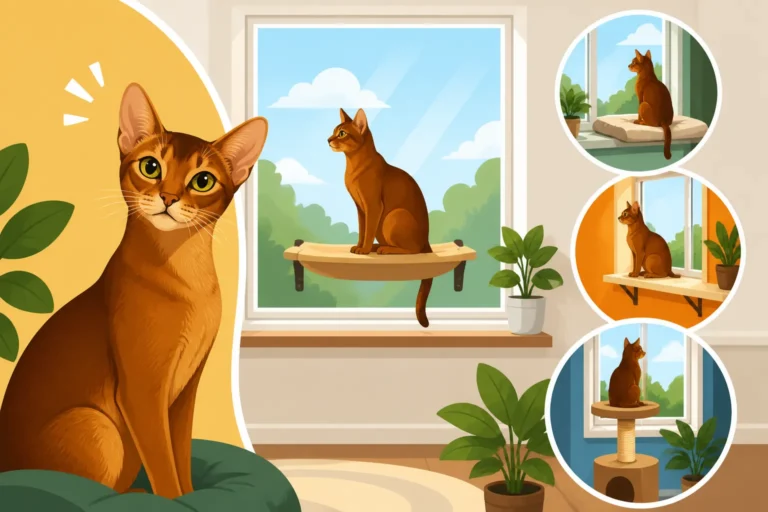
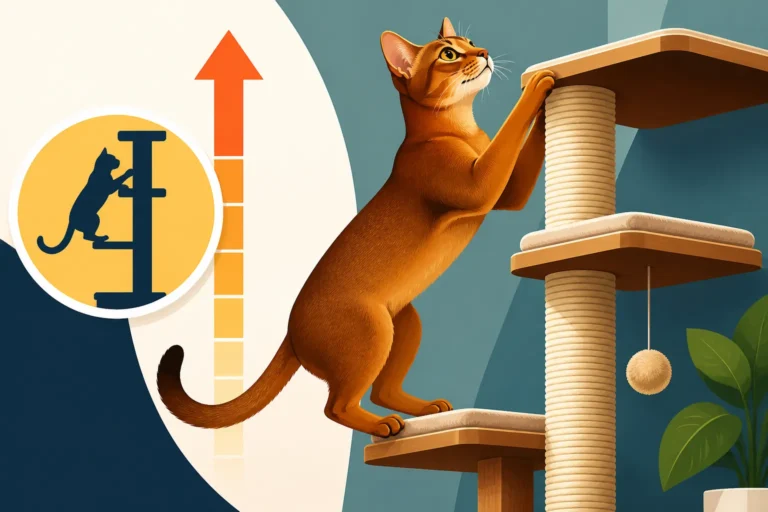
Abyssinians are climbers. They love heights and surveying their domain from above. A mentally stimulating environment for an Aby isn't just about what's on the floor; it's about making use of the entire vertical space. Install cat shelves, provide tall cat trees, or even clear off safe spaces on top of bookshelves or cabinets. These vertical pathways provide both physical exercise and mental stimulation as they plan their routes, jump, and explore. An Abyssinian Needs Height More Than It Needs Floor clearly explains why. Rotate their access to different areas, or rearrange furniture periodically to create new "exploration zones." Provide window perches where they can watch the world go by, perhaps with a bird feeder outside for extra entertainment. The more complex and engaging their physical environment, the more opportunities they have for mental exploration and problem-solving, reducing the likelihood of boredom and destructive behaviors. Creating a dynamic and evolving environment keeps their brilliant minds active and prevents them from quickly "solving" their entire home.
Disclaimer
This article is for general informational purposes only and does not constitute professional advice. Laws, prices and regulations vary by location and change over time. Consult a qualified professional for guidance on your specific situation.