When CFA Recognized the Abyssinian
A date in a breed history can sound like a simple fact, but “recognized by CFA” is easy to confuse with a cat’s first appearance, its registration, or the beginning of a breed. The commonly cited answer is 1917. This guide explains what that date means, what it does not mean, and how CFA recognition fits into the Abyssinian’s longer, less tidy history.
The date CFA recognized the Abyssinian
Why 1917 is the commonly cited year
The Cat Fanciers’ Association, usually shortened to CFA, is a cat registry and show organization. The Abyssinian is commonly listed as having been recognized by CFA in 1917. For a short breed-history answer, that is the date most people are looking for.
The important point is that CFA recognition was an official milestone in the breed’s development within that organization. It gave Abyssinians a place in CFA’s registry and show world. It did not mean that CFA invented the breed, that Abyssinians suddenly appeared in 1917, or that every cat resembling an Abyssinian was automatically a pedigreed one.
The wording can trip people up because “recognized” is often used casually to describe several different things. A breed might be recorded in a registry, permitted to compete in a particular class, or accepted under a formal standard. Those are related steps, but they are not always interchangeable. Historical summaries often compress them into one date, so it helps to read “CFA recognized the Abyssinian in 1917” as a milestone in the breed’s CFA history rather than a complete account of every administrative step.
That distinction matters if you are comparing dates from different sources. One account may focus on CFA recognition, another on a cat being entered in a studbook, and another on a breed’s first show appearance. They can describe different events without necessarily contradicting each other. For a broader timeline of formal records, see When the First Abyssinian Was Registered.
What CFA recognition did and did not establish
Recognition helped establish the Abyssinian as a named, organized breed within CFA. Breed organizations need a shared way to identify the cats they register and judge. A written standard can describe the expected overall appearance, including the body, head, coat, and distinctive ticking. Registration and show rules provide a framework for recording pedigrees and comparing cats in competition.
But recognition does not settle every question about a breed’s deeper history. It does not prove exactly where the earliest ancestors lived, identify a single founding cat, or show that all modern Abyssinians descend directly from one famous animal. Breed history is built from records, photographs, pedigrees, and genetic evidence, and those pieces do not always tell the same kind of story.
It is also useful to separate recognition by CFA from recognition by other cat associations. Organizations make their own decisions and keep their own records. As a result, a breed may have different recognition dates or show milestones in different registries. If you are researching a particular organization, check that organization’s own breed-history materials rather than assuming CFA’s date applies to every registry.
| Milestone | What it refers to | What it does not prove |
|---|---|---|
| CFA recognition, commonly dated to 1917 | The Abyssinian’s formal place in CFA’s breed and registry history | The breed’s precise geographic origin |
| A cat’s first recorded appearance | A documented early appearance in a show or written record | That the cat founded every later Abyssinian line |
| Registration | An entry in a registry or studbook | That every cat with a similar coat is pedigreed |
| A breed standard | A description used to identify and judge the breed | That the standard has never changed |
CFA recognition was not the beginning of the breed
Cats and records appeared before the CFA milestone
A breed’s formal recognition date is a convenient marker, but it is rarely the beginning of the story. Cats with the Abyssinian’s characteristic ticked coat were discussed and shown in Britain before the 1917 CFA date. The Crystal Palace cat show in London in 1871 is often mentioned in accounts of early Abyssinians, although a show appearance should not be treated as proof of a continuous pedigree from that cat to today’s breed. For the event’s place in the story, read What Happened at the 1871 Crystal Palace Show.
This is where historical language can become slippery. A nineteenth-century writer might call a cat “Abyssinian” because of its appearance or reported origin. That label does not necessarily meet the modern standard of a documented pedigree. Show descriptions and illustrations can help historians understand how people viewed these cats, but they cannot provide every missing link in a family tree.
A useful comparison is the difference between recognizing a type and documenting descent. People may notice that cats share a coat pattern or body shape long before a registry formalizes a breed. Later, breeders and registries develop standards and records that make the category more consistent. The cats and the label may have existed in some form well before the organization’s official date.
The name itself can also give a misleading impression. “Abyssinian” sounds like a firm statement of geographic origin, but the name alone cannot prove where the breed began. The popular story connecting a named early cat to the modern breed has gaps in its documentary trail. Why the Link Between Zula and Modern Abyssinians Is Broken explains why that connection is not as straightforward as it is sometimes presented.
Registration, showing, and recognition are different milestones
Imagine a cat described in an old show report, then a later pedigree record, and finally a registry decision recognizing the breed. Those documents answer different questions. The show report may show that people were displaying a cat under a particular name. The pedigree helps establish ancestry for an individual animal. The recognition date shows that an organization formally accepted the breed into its system.
That is why a historical timeline should not flatten every event into “the breed started here.” The first known appearance in a record is not necessarily the first cat of that type. The first registration does not necessarily identify the breed’s origin. And a recognition date is a registry milestone, not a biological starting point.
For readers trying to untangle conflicting dates, it helps to ask what each source is measuring. Is it naming the first public exhibition, first known registration, first written standard, or recognition by a specific association? Once the question is clear, many apparent disagreements become easier to understand.
This approach also avoids treating a famous early cat as the single ancestor of all Abyssinians. A breed can develop through multiple cats, matings, and breeding decisions over time. The documentary limits around early pedigrees are one reason the Abyssinian’s history is best told as a sequence of milestones, not a neat origin story with one proven starting animal.
How the Abyssinian reached CFA recognition
The breed’s development in Britain
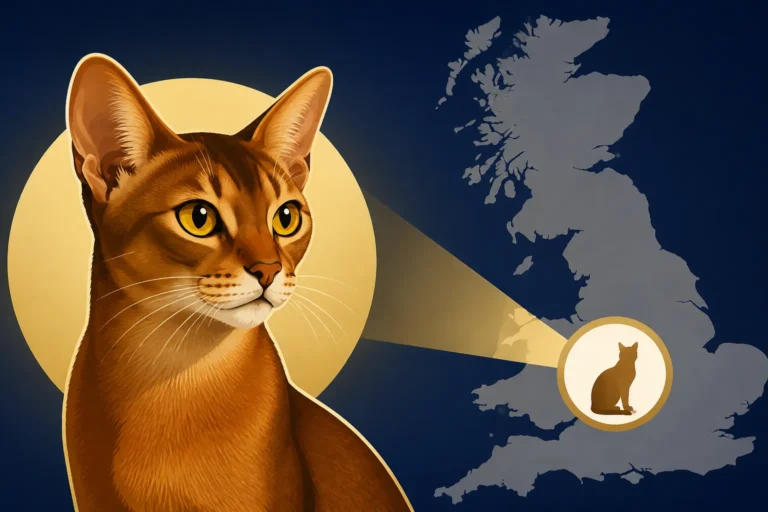
The Abyssinian’s organized history took shape in Britain before its place in CFA became a milestone. Breeders and cat-show communities helped turn cats with a recognizable appearance into a more consistently described breed. Standards, pedigrees, and show classes all contributed to that process, even while questions about the earliest cats and their ancestry remained.
Victorian-era records are valuable, but they need to be read with care. Descriptions can reveal how people understood coat color and ticking at the time, yet older terminology may not match today’s definitions exactly. A cat described as an Abyssinian in an early account may be important to the history without being traceable through a complete pedigree to every modern line. For more on the early breeding context, see How the Abyssinian Was Bred in Victorian Britain.
Over time, formal breed descriptions gave breeders and judges a shared reference point. That helped make the Abyssinian recognizable not only as an attractive cat with a distinctive coat, but as a breed with characteristics that could be recorded and assessed. The ticked coat remains one of its most recognizable features: individual hairs show bands of color rather than forming the familiar continuous stripes of many tabbies.
The path from an early description to a registry-recognized breed was not a single dramatic event. It involved people keeping records, exhibiting cats, and developing ideas about what made the breed distinct. CFA’s 1917 milestone belongs within that broader process. It marks an important point in the breed’s institutional history, not the moment when the Abyssinian first came into existence.
The American chapter and CFA’s role
CFA’s recognition matters especially to people tracing the breed’s history in the United States. Recognition within a large registry creates a formal framework for recording and showing cats under that organization’s rules. It also gives later breeders and owners a clearer historical reference when looking at pedigrees and breed standards.
The American story developed alongside the broader movement of Abyssinians between countries and breeding communities. A registry’s records can show how the breed became established within that system, while individual catteries and breeders influenced the cats that later generations encountered. For related background, see When the Abyssinian Reached the United States and Which American Cattery Founded the Modern Abyssinian.
It is tempting to imagine recognition as a finish line: a breed is accepted, and its history is settled. In reality, registries preserve and organize information, while breeders continue shaping the population. Standards can be clarified, pedigrees can expand, and new evidence can revise old assumptions. CFA recognition made the Abyssinian’s place in that registry more formal; it did not end the breed’s evolution.
That is also why a registry date is useful but limited. It gives owners and researchers a reliable point to anchor a timeline, while leaving room for the older history to be explored separately. A careful account can say both things at once: the Abyssinian was commonly recognized by CFA in 1917, and the cats and ideas that led to that milestone had a longer, more complicated history.
What CFA recognition means to Abyssinian owners today
A registry milestone is not a guarantee about an individual cat
For a prospective owner, the 1917 date is interesting background, but it does not tell you whether a particular kitten is healthy, well socialized, or correctly represented by a seller. Recognition belongs to the breed’s institutional history. Decisions about an individual cat require current, specific information, including veterinary records and credible pedigree documentation where applicable.
A registry entry can help establish that an animal is recorded within a particular system, but it should not be treated as a substitute for asking questions. If you are considering an Abyssinian, ask what records are available, what health screening has been done, and how the breeder supports kittens after they leave. Historical recognition alone cannot answer those practical questions.
The same applies to appearance. A cat may have a ticked coat and look very much like an Abyssinian, but appearance alone does not establish pedigree registration. Conversely, the breed standard is a guide to the recognized type, not a promise that every individual cat will look identical. Like people, cats vary within a breed.
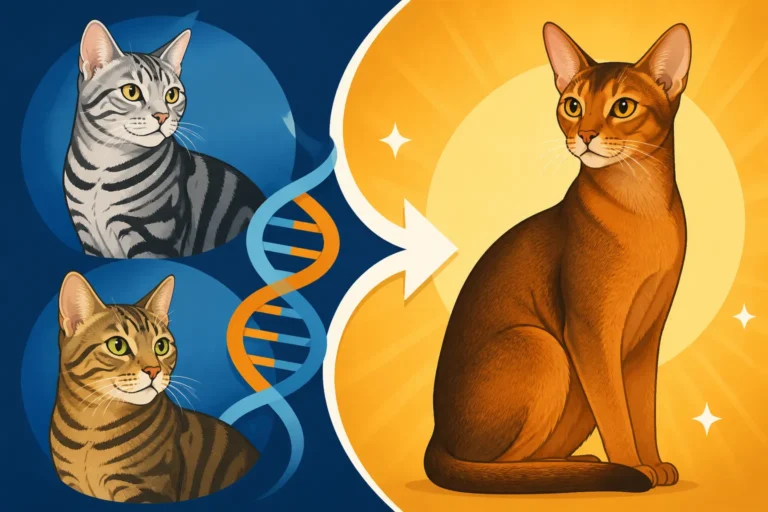
If you want to understand how the breed’s appearance and identity are described, What an Abyssinian Looks Like Against the Show Standard is a useful companion topic. For ancestry beyond registry milestones, What Modern DNA Studies Found About Abyssinian Ancestry explores a different kind of evidence. Registry records and genetic studies can complement one another, but they answer distinct questions.
A simple way to remember the timeline
When you see the date 1917, remember it as the commonly cited year CFA recognized the Abyssinian. It is a concise answer to a specific question about the breed’s standing within CFA. It should not be repeated as the breed’s birth year or as proof of a complete lineage from a particular nineteenth-century cat.
A clear mental timeline has three parts: early cats and descriptions came first; breeding, exhibition, and written standards helped define the breed; and CFA recognition marked an important formal step in the United States registry context. Each stage adds information, but none should be asked to prove more than it can.
The history also explains why Abyssinian origin stories can feel both familiar and unresolved. The breed has a long show and registry record, while some of the earliest claims about where it came from and how modern lines connect to famous early cats remain difficult to verify. That tension is not unusual in cat-breed history. Formal records can be precise about an organization’s decisions even when the older biological story is incomplete.
So, if someone asks when CFA recognized the Abyssinian, the practical answer is 1917. If they ask when the Abyssinian began, that is a broader and more complicated question. Keeping those two questions separate is the easiest way to appreciate the date without turning it into a claim it was never meant to be.
Disclaimer
This article is for general informational purposes only and does not constitute professional advice. Laws, prices and regulations vary by location and change over time. Consult a qualified professional for guidance on your specific situation.