How the American Abyssinian Differs From the British
When comparing American and British Abyssinians, it is easy to expect two clearly different kinds of cat. In reality, they are the same breed, and the differences are usually subtle: regional show preferences, breeding lines, and individual build matter more than a firm national divide. This guide explains what you may notice—and what you should not assume.
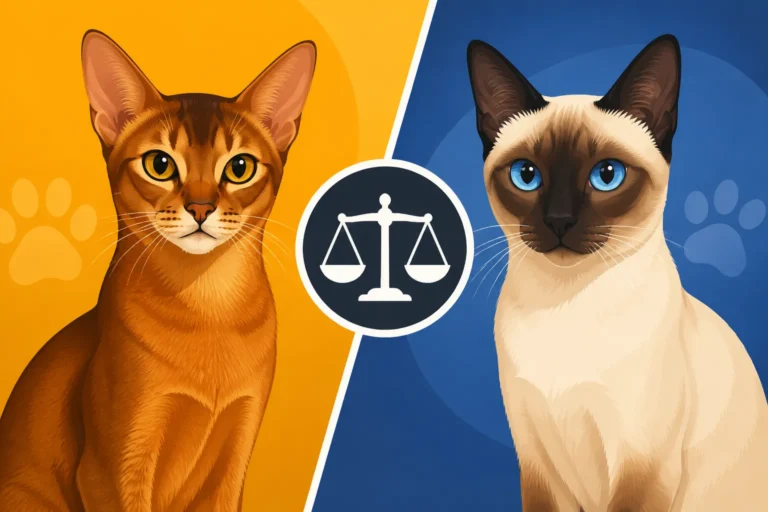
American and British Abyssinians are the same breed
The difference is about regional type, not separate breeds
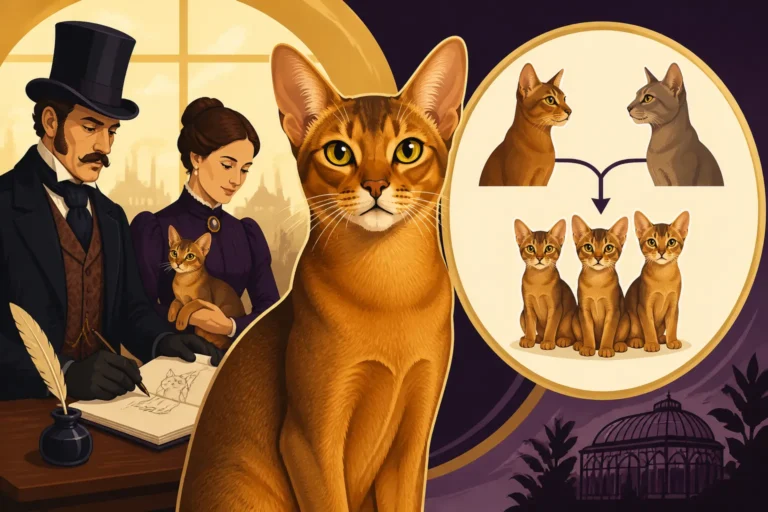
An American Abyssinian and a British Abyssinian are not separate breeds with different ancestry rules. Both are Abyssinians: shorthaired cats known for their fine, close-lying coats, alert expression, and distinctive ticking. The labels usually describe a cat’s regional breeding background or the type favored by breeders and show standards in that region.
That distinction matters because “American” and “British” can sound like fixed biological categories. They are not. A cat bred in the United States may have features that people associate with British lines, and a British-bred cat may look quite close to an American show cat. Individual families and breeders have their own priorities, too.
It helps to think in terms of tendencies rather than rules. Two cats from the same country may differ more from each other than either differs from a cat bred overseas. For a broader look at the breed’s expected appearance, see What an Abyssinian Looks Like Against the Show Standard and What the Abyssinian Show Standard Asks For.
Show preferences can shape the look over time
Breed standards describe the appearance judges are asked to assess. They do not mean that every cat in a region looks identical, or that a cat outside the show ideal is unhealthy or less affectionate. Breeders selecting for particular features over generations can create recognizable regional tendencies, but those tendencies are not a guarantee about any one kitten.
The words used to describe type can also be subjective. One person may call a cat “fine-boned,” while another sees the same cat as “elegant.” A breeder’s photographs, descriptions, and the kitten’s actual parents often tell you more than the national label in an advertisement.
If you are considering a kitten, ask what the breeder means by “American type” or “British type.” A thoughtful breeder should be able to describe the parents’ size, build, head shape, and coat without suggesting that a regional label promises a particular personality or health outcome. For practical background on size, How Big an Adult Abyssinian Gets and How a Male and Female Abyssinian Differ in Size offer useful context.
Appearance differences you may notice
Build and proportions are tendencies, not guarantees
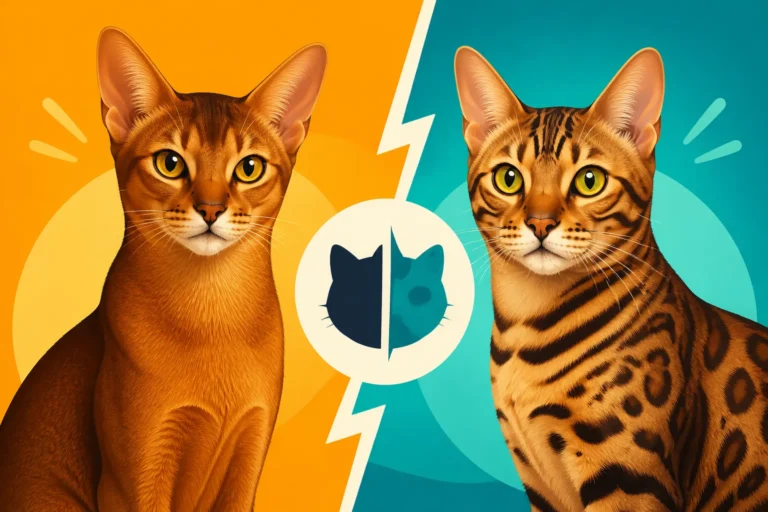
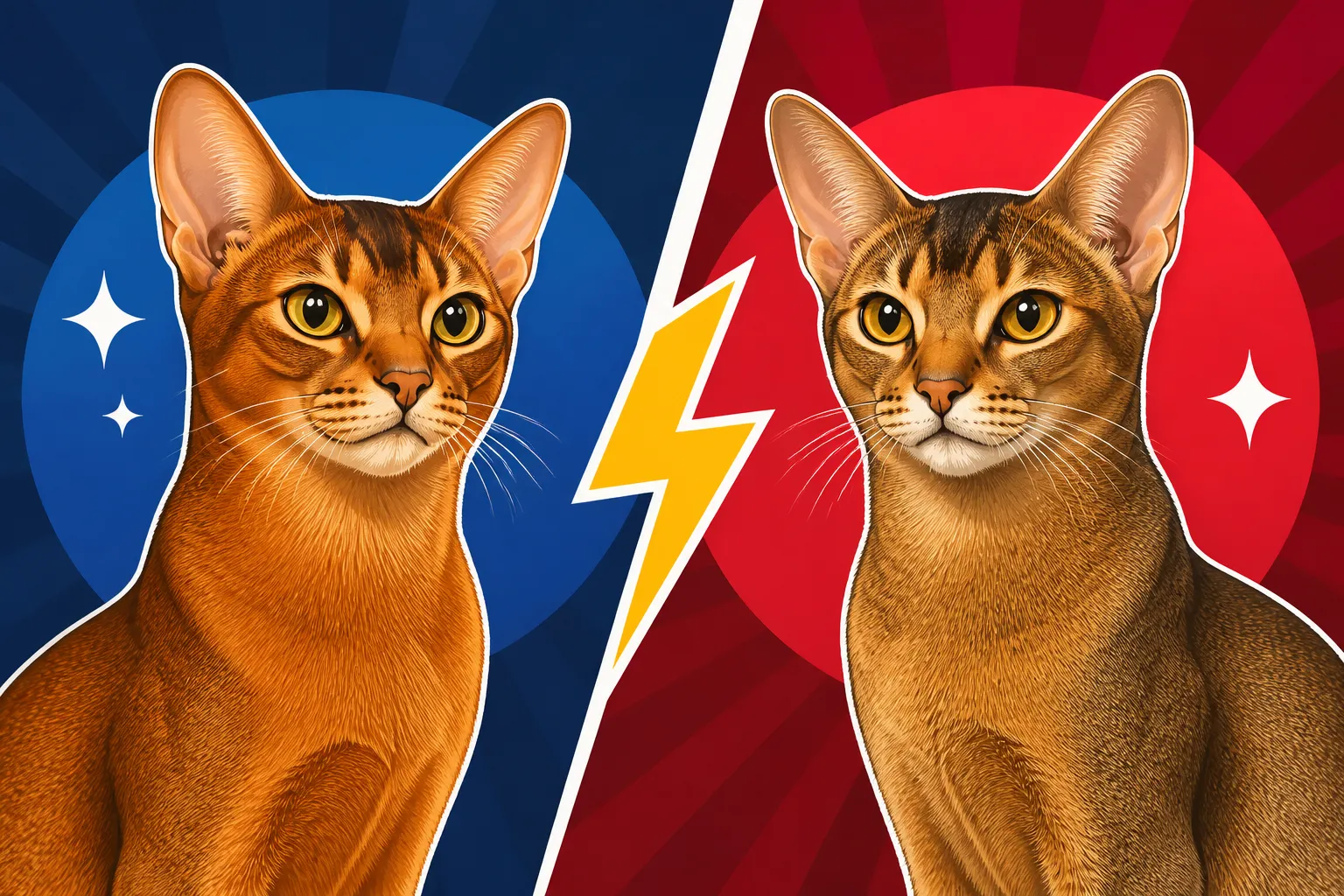
American Abyssinians are often described as having a refined, athletic outline, while British-bred examples may be described as somewhat more substantial or rounded. Those descriptions can help you understand what people mean when comparing regional types, but they should not be treated as a reliable checklist. Abyssinians are generally active, medium-sized cats, and there is plenty of overlap in body shape.
A cat’s sex, age, condition, and family background can all affect how substantial it looks. A young adult may still be filling out, while a lean, muscular cat can look lighter than its actual frame suggests. A photo can exaggerate these differences, especially if the cat is stretched out, crouched, or photographed from an angle.
Rather than deciding from a label alone, look at the whole cat. Does the body appear balanced? Does the cat move comfortably? Is the build appropriate for its age and condition? If you are comparing two kittens, ask to see their parents standing naturally, not only in carefully posed photos.
Head shape, ears, and expression can look different in photos
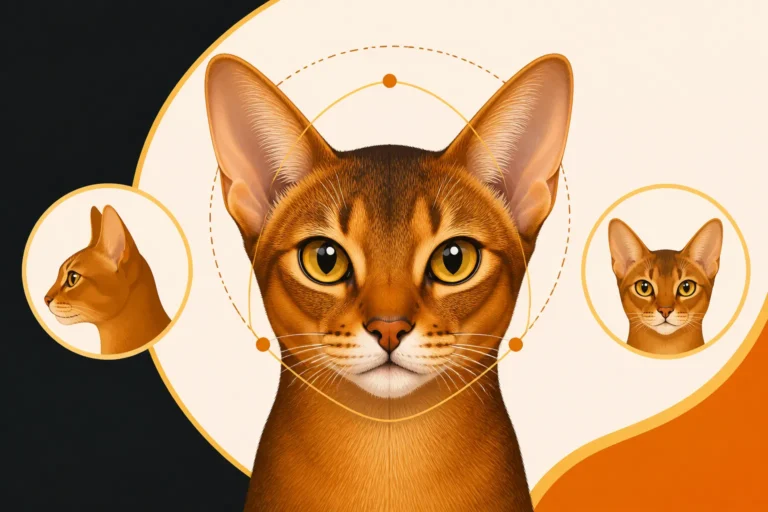
People sometimes describe American Abyssinians as having a more sharply defined or angular expression, and British examples as appearing a little softer or rounder. These impressions may reflect the particular cats being compared, the local show ideal, or simply photography. Head shape is not a dependable way to identify a cat’s country of origin without knowing its breeding background.
The ears and eyes contribute a lot to the overall impression. Large, alert ears and expressive eyes are part of the breed’s familiar look, but their apparent size can change with the cat’s head position, camera distance, and the way the image is cropped. A close-up portrait can make the ears look more prominent than they do in person.
When browsing breeder listings, compare several photos and ask for a short video of the cat moving around. A video can show proportions and movement more naturally than a single posed image. It can also help you see whether the kitten seems comfortable and engaged, rather than judging its suitability from a striking face alone.
Coat color and ticking are not national markers
American and British Abyssinians may come in colors recognized by the relevant registry, but coat color does not reliably identify regional type. Ruddy, sorrel, blue, and fawn cats can appear in breeding programs in different countries. Individual shades and the impression of contrast may vary, but a color name is not proof of a particular body type or temperament.
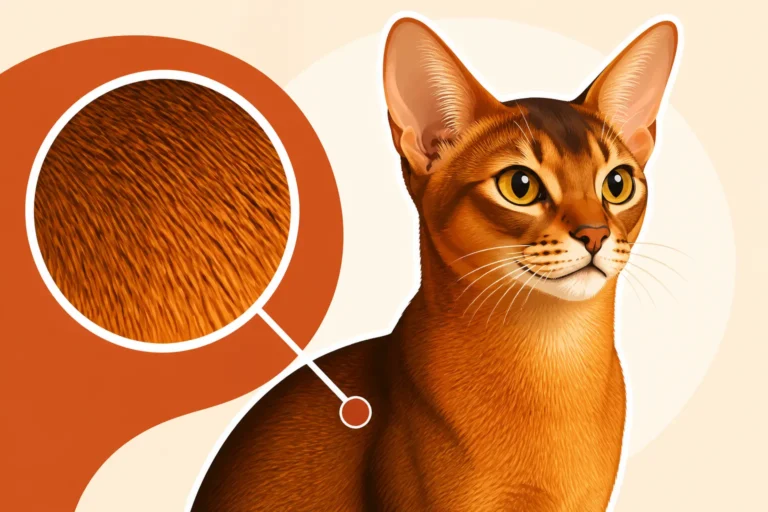
The defining feature is the ticked coat, in which individual hairs carry bands of color rather than forming the familiar stripes of many tabby cats. Lighting can make the coat look warmer, cooler, darker, or more vivid. A sunny room in California and an overcast afternoon in Manchester can make the same shade look surprisingly different in photographs.
Look for a clean, even impression of ticking and a coat that lies close to the body. For examples of how particular colors appear, see What a Ruddy Abyssinian Actually Looks Like and What a Blue Abyssinian Looks Like. For more on coat texture and presentation, What an Abyssinian's Coat Should Feel Like in the Ring explains what judges assess.
What does not reliably differ by region
Personality is shaped by the individual cat
It is tempting to expect an American Abyssinian to be more energetic or a British Abyssinian to be calmer. There is no dependable national personality rule like that. Abyssinians are commonly curious, social, and interested in being near household activity, but each cat has its own temperament. Early handling, socialization, health, and daily environment all matter.
For example, one kitten may race after a feather wand and climb every shelf, while its littermate prefers watching from a high perch before joining in. Both can be typical Abyssinians. A breeder who knows the litter can tell you which kitten is bold, which is more cautious, and how each responds to people and change.
Ask how the kittens behave during ordinary moments: when someone enters the room, when they are gently handled, and when play winds down. Those observations are more useful than claims that a particular national type is automatically more cuddly, quiet, or easy to manage.
Grooming and day-to-day care are much the same
The short, close coat is relatively simple to maintain whether the cat comes from American or British lines. Gentle weekly brushing or a grooming mitt can help remove loose hair, while regular checks of the ears, eyes, claws, and teeth support routine care. A cat that dislikes grooming may need short, calm sessions and rewards rather than a long attempt to finish everything at once.
If you are assembling basic supplies, an online pet retailer such as Chewy may be one convenient place to compare grooming mitts, nail clippers, and cat-safe toothpaste. Check that grooming products suit a short coat and that toothpaste is specifically made for cats. A deshedding tool meant for a dense undercoat is not automatically a good choice for an Abyssinian’s fine coat.
Dental care deserves attention regardless of where the cat was bred. Build a routine gradually, and ask your veterinarian how to handle a cat that resists mouth handling. Chewy may also be useful for comparing cat toothbrushes and dental-care supplies, but product selection does not replace advice from a veterinary professional, especially if the gums look red or the cat seems uncomfortable eating.
Energy needs and enrichment depend on the cat
Abyssinians tend to appreciate play, climbing opportunities, and interesting ways to investigate their surroundings. A tall, stable cat tree, secure shelves, puzzle feeders, and interactive play can help keep an indoor cat occupied. The amount of activity a particular cat wants varies, so pay attention to its behavior instead of relying on a regional stereotype.
A household in a small apartment can still provide useful enrichment. Rotate toys rather than leaving every toy out, schedule a few short play sessions, and create safe places to perch and watch. An active cat that starts waking people, rummaging through cupboards, or demanding attention may need a more engaging routine—not a different national type.
When comparing food or enrichment supplies, Chewy can be a practical place to review options, but choose based on your cat’s age, health, and preferences. Ask your veterinarian before making a major diet change, and introduce new food gradually. The cat’s actual needs matter more than whether its pedigree is American or British.
Choosing between an American and British Abyssinian
Focus on the breeder and the cat in front of you
If you like the appearance associated with one regional type, use it as a starting point for your search, not as the deciding factor. Ask breeders to explain how they describe their lines and what traits they prioritize. Then look at the individual kittens and their parents, paying attention to health, comfort around people, and the home environment in which they are being raised.
A responsible breeder should answer questions clearly and be willing to discuss health screening, veterinary care, socialization, and the family history of the cats. Be cautious if a seller presents “American” or “British” as proof that a kitten is healthier, gentler, or more valuable. A regional label alone cannot establish those things.
If you are also comparing shorthaired relatives, How an Abyssinian Differs From a Somali can help clarify the difference between the breeds. The Somali has a longer coat, while the Abyssinian is shorthaired; their shared family resemblance does not make them interchangeable.
Use a practical comparison, not a national stereotype
| Feature | American Abyssinian | British Abyssinian |
|---|---|---|
| Breed status | Abyssinian | Abyssinian |
| Common description | Often described as refined or athletic | Sometimes described as somewhat more substantial or rounded |
| Certainty of the description | A tendency, not a fixed rule | A tendency, not a fixed rule |
| Coat and color | Short, ticked coat; colors depend on recognized standards and lines | Short, ticked coat; colors depend on recognized standards and lines |
| Personality | Varies by individual, socialization, and home | Varies by individual, socialization, and home |
| Best way to assess a kitten | Meet the cat, ask about its parents, and discuss health and temperament | Meet the cat, ask about its parents, and discuss health and temperament |
For most future owners, the better question is not “Which country’s Abyssinian is best?” but “Is this particular cat a good fit for my home, and does this breeder provide clear, responsible care?” An active kitten may thrive with a person who enjoys daily play and climbing setups. A quieter household may need to think carefully about whether it can provide enough interaction and stimulation.
Whether you ultimately choose a cat from American or British lines, expect an Abyssinian with its own habits and character—not a predictable national template. See What Abyssinian Owners Wish They Had Known for additional perspective on the realities of living with the breed.
Disclaimer
This article is for general informational purposes only and does not constitute professional advice. Laws, prices and regulations vary by location and change over time. Consult a qualified professional for guidance on your specific situation.