What Abyssinian Owners Wish They Had Known
Many people bring home an Abyssinian expecting a graceful, low-maintenance cat, then discover they have adopted a curious little climbing partner who wants to be involved in everything. The surprises are not necessarily bad, but they can make ordinary routines feel harder than expected. Here’s what owners often wish they had known about an Abyssinian’s energy, affection, home setup, and ongoing care.
An Abyssinian’s energy shapes the whole day
They want interaction, not just toys left on the floor
Abyssinians are famously curious and active. A toy mouse tossed into a basket may be fun for a few minutes, but it usually won’t meet the needs of a cat who wants to chase, investigate, solve problems, and follow the household from room to room. Owners often learn that enrichment works best when it includes time and attention from a person, not just a pile of toys.
That doesn’t mean you need to entertain your cat every waking minute. It does mean that a few short play sessions can work better than expecting one toy to keep them occupied all day. A wand toy can create a satisfying chase, while a food puzzle gives an Abyssinian a small problem to solve. Rotate toys rather than leaving everything out; familiar objects can quickly lose their appeal.
If you’re choosing supplies, a puzzle feeder or interactive toy from a retailer such as Chewy can be one option, but the activity matters more than the brand. Try a simple rotation: put away a few toys for several days, then bring them back. If your cat is still losing interest, vary the game—let them stalk around a chair, chase a toy along the floor, or search for a few pieces of their measured meal.
For more ideas, see How Much Play an Abyssinian Needs Each Day and Why an Abyssinian Loses Interest in a Toy Fast.
A busy cat can make a long workday difficult
Abyssinians tend to enjoy company. Some will settle near you while you work; others may repeatedly inspect your keyboard, open a cupboard, or loudly remind you that the closed office door is unacceptable. Owners who expected a quiet cat sleeping in a sunny spot may be surprised by how much this breed wants to participate.
A full workday alone doesn’t automatically mean an Abyssinian can’t fit into your household. But it helps to be honest about the daily routine you can provide. A secure window perch, safe climbing options, a few food-foraging activities, and predictable play before and after work can make the day more manageable. A second compatible cat may help, but it is not a substitute for thoughtful introductions or human interaction.
If your schedule is demanding, think through a typical weekday before bringing a cat home. Where will the cat spend time? What can it safely climb? What happens when you are on a call and the cat wants attention? Making a plan in advance is easier than trying to solve boredom after you find a toppled plant or a newly opened kitchen drawer.
The related guides Why an Abyssinian Should Not Be Left Alone All Day and Whether an Abyssinian Suits a Full Time Worker can help you assess your routine realistically.
Affection may look different from what you pictured
Following you is often the cuddle
Some Abyssinians are lap cats, but many show affection by staying close rather than settling in one place. Your cat may follow you into the bathroom, sit beside your laptop, watch you cook from a safe distance, or perch on the back of the sofa. That can feel deeply companionable, even if it is not the curled-up lap time you imagined.
It’s worth letting the cat set the pace. If you repeatedly pick up an active cat who would rather keep moving, they may start avoiding your hands. Instead, offer a comfortable spot beside you, use a calm voice, and reward voluntary approaches with gentle attention. Some cats become more inclined to cuddle as they mature, while others remain affectionate on their own terms.
This distinction matters especially for households choosing a cat based on temperament. If being able to hold a pet for long stretches is important to you, spend time learning about the individual cat rather than assuming every Abyssinian will behave the same way. A responsible breeder or rescue can describe what they have observed, though a kitten’s adult personality is never guaranteed.
For a closer look at this affectionate-but-active style, read How an Abyssinian Shows Affection Instead of Lap Sitting and Why an Abyssinian Follows You Without Sitting Still.
Curiosity can look like mischief
Abyssinian owners often discover that “cat-proofing” needs to include more than fragile ornaments. A clever cat may investigate cupboard doors, examine grocery bags, reach for objects on counters, or test whether a small item is fun to bat around. The behavior can be entertaining—until the object is unsafe or the cabinet contains something a cat should never reach.
Put away medication, cleaning products, string, and small objects that could be swallowed. Secure cupboards where necessary, and keep food preparation areas clear. If your cat repeatedly jumps onto a surface, consider why the spot is appealing. A high perch near the kitchen may satisfy the desire to observe without giving the cat access to hot pans or food.
Punishment and startling deterrents often make the household more stressful without teaching a cat what to do instead. Redirect the behavior: offer a permitted shelf, a tall scratching post, or a brief play session. Consistency helps. If one person allows counter-surfing and another repeatedly removes the cat, the rule becomes confusing.
Owners who enjoy a neat, untouched home may need to adjust expectations. You can reduce hazards and redirect unwanted habits, but a curious cat will still explore. See Why an Abyssinian Opens Doors and Cabinets and How to Secure a Cupboard Against an Abyssinian for practical prevention ideas.
Your home needs to work vertically
Floor space matters less than safe climbing routes
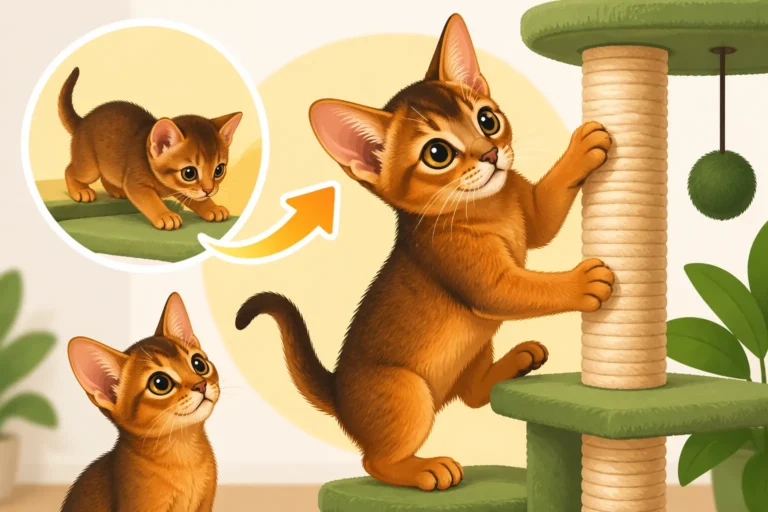
An Abyssinian does not need a huge house, but it often benefits from usable height. A sturdy cat tree, stable shelves, and clear routes between resting spots can give the cat more ways to climb and observe. In a small apartment, vertical territory can be more useful than adding another floor-level bed that the cat ignores.
Safety is the part owners sometimes overlook. Shelves need to be securely fixed to appropriate supports, and the route should not require a risky leap over a stove, a fragile lamp, or a narrow ledge. A tall bookcase may look like an ideal climbing structure, but unsecured furniture can tip. Check the stability of anything your cat might climb, and leave enough room for a safe landing.
You don’t have to redesign every room at once. Start with one high resting place and a sturdy scratching post, then notice where your cat naturally wants to go. If they keep climbing a particular bookcase, consider whether a safer perch nearby could meet the same need. Place scratching surfaces close to the routes your cat already uses, not tucked away in an unused corner.
A single tree may not suit every cat or home. Some cats prefer shelves, while others want a perch near a window. The guides An Abyssinian Needs Height More Than It Needs Floor and Why Wall Shelves Work Better Than a Tree for an Abyssinian offer more on choosing a setup.
Secure windows and outdoor access carefully
Abyssinians can be quick and athletic, which makes open windows, balconies, and unsecured outdoor areas worth taking seriously. A window that seems only slightly open may still be an escape route or a place where a cat could become trapped. Use secure screens designed to withstand pressure, and check them regularly rather than assuming a standard screen is cat-proof.
Outdoor enrichment can be appealing, but free roaming brings risks, including traffic, getting lost, and encounters with other animals. Some owners choose a properly enclosed catio or gradual harness training instead. Neither option suits every cat, and a harness should be introduced patiently indoors before expecting a calm walk outside. Never rely on a fence alone to contain an agile cat.
Think about the whole route, not only the destination. A catio needs secure construction, shade, shelter, and access that cannot be left open by accident. A harness walk requires a calm location and a well-fitted harness; if your cat freezes or panics, stop and return to a quieter practice step.
For safer outdoor enrichment, see Why an Abyssinian Should Not Roam Outdoors and How to Make an Abyssinian's Climbing Route Safe.
Care is manageable, but the details matter
Their coat is easy; health routines still take attention
The Abyssinian’s short coat is generally straightforward to maintain. A gentle weekly grooming session can help remove loose hair and gives you a chance to notice changes in the skin or coat. More brushing is not automatically better; rough or overly frequent grooming can irritate the skin and disturb the coat’s natural appearance.
Dental care is a different story. Getting a cat comfortable with toothbrushing takes patience, and it is much easier to introduce the routine gradually than to begin when a problem is already visible. Start with brief, calm handling around the mouth, use toothpaste made for cats, and ask your veterinarian to demonstrate a suitable technique. A cat that resists should not be forced into a stressful struggle.
Routine veterinary visits are also important because cats can hide discomfort. Pay attention to changes in eating, activity, grooming, drinking, or weight. A cat that stops climbing or seems quieter than usual may be telling you something, even if there is no obvious injury. Breeders and adopters can share health information, but that does not replace care from a veterinarian who knows your cat.
| Part of care | What owners may find surprising | A practical habit |
|---|---|---|
| Coat | Short hair still benefits from gentle upkeep | Use a soft grooming mitt or comb weekly |
| Teeth | Dental care can take more patience than coat care | Build handling and brushing into a calm routine |
| Activity | A cat may need several kinds of enrichment | Rotate play, climbing, and food puzzles |
| Home safety | Curiosity can lead to unsafe exploration | Secure medications, windows, and tempting cupboards |
| Vet care | Subtle behavior changes can matter | Track appetite, weight, and activity |
If you’re building a care routine, Chewy may be a convenient place to look for basics such as cat-safe toothpaste or grooming tools. Check that any product is intended for cats, and ask your veterinary team if you’re unsure what is appropriate. More about coat care is covered in An Abyssinian Needs Brushing Once a Week and No More.
Budget for more than food and a litter box
The purchase or adoption decision is only the beginning of the financial commitment. Food, litter, routine veterinary care, enrichment, and replacement supplies all add up over time. A tall, stable cat tree or secure window setup may also cost more than a basic bed, but it can be a worthwhile part of making an active cat’s home safer and more interesting.
The less predictable costs are often the ones that cause stress. A sudden illness, dental treatment, or urgent veterinary visit can be difficult to manage without a plan. Consider setting aside an emergency fund or comparing pet insurance options before there is a medical concern. Read policy terms carefully, including how they handle pre-existing conditions and hereditary issues, rather than choosing based only on a monthly payment.
It can help to make a simple monthly plan with categories for food, litter, routine care, and an emergency reserve. Then revisit it when your cat’s needs change. For example, a kitten may need different food and more frequent preventive visits than an adult, while a senior cat may need additional monitoring.
Retailers such as Chewy can help owners keep food and litter supplies organized, but recurring deliveries are only useful if the items suit your cat and your storage space. Avoid changing foods abruptly just because a new option is convenient. Introduce dietary changes gradually and consult your veterinarian if your cat has a health condition or a persistent appetite change. For broader planning, see What an Abyssinian Costs to Keep Every Year.
Choose for the cat you’ll live with, not the one you imagined
Match the breed’s habits to your household
An Abyssinian can be a wonderful fit for someone who enjoys an engaged, energetic companion and is happy to make room for climbing, interactive play, and daily company. It may be a tougher match for someone who wants a very independent cat that is content to be left alone for long stretches or prefers a consistently quiet home.
That does not mean an Abyssinian must live in a large house or with multiple people. A thoughtful setup and reliable routine matter more than square footage. What matters is whether you can offer safe places to climb, regular opportunities to play, and patience for a cat that may investigate your routines in a very hands-on way.
If you are meeting a kitten, ask about the parents’ temperaments and what the breeder has observed in the litter. If you are considering an adult cat, ask about the individual’s activity level, comfort with handling, and experience with other pets. Spend time with the cat where possible. The breed gives you a useful general picture, but the individual animal is the one who will share your home.
For help deciding whether the breed aligns with your lifestyle, read Whether an Abyssinian Is the Right Cat for You and What Abyssinian Owners Wish They Had Known.
Expect to adapt alongside your cat
Many owners say the biggest adjustment is not a single dramatic problem. It is the accumulation of small changes: putting away a tempting object, scheduling play before bed, moving a plant, or finding a better place for a perch. Those adjustments can feel like a lot at first, especially if you expected cat ownership to be mostly self-managing.
Over time, a routine often emerges. You learn which games your cat enjoys, where they like to watch the household, and what signals mean they need a break. Your home becomes easier to manage when you focus on prevention and redirection rather than reacting after every curious investigation. A cat tree in the right place can prevent repeated climbs onto an unstable shelf; a short play session can make the evening calmer.
The reward is a lively companion with a strong presence in everyday life. An Abyssinian may not always behave like the quiet lap cat in your imagination, but many owners grow to love the way the cat follows them, watches closely, and turns ordinary moments into shared activities. The key is going in with realistic expectations and building a home that gives that energy safe places to go.
Disclaimer
This article is for general informational purposes only and does not constitute professional advice. Laws, prices and regulations vary by location and change over time. Consult a qualified professional for guidance on your specific situation.