Why the Abyssinian Is Called the Oldest Breed on Thin Evidence
The Abyssinian is often called one of the oldest cat breeds, and its elegant, ancient-looking appearance makes the claim feel believable. But looking old is not the same as having a documented pedigree that reaches back thousands of years. This guide separates the breed’s appealing origin stories from the historical evidence we can actually trace.
Why the Abyssinian Is Called an Ancient Breed
The Egyptian connection is suggestive, not proof
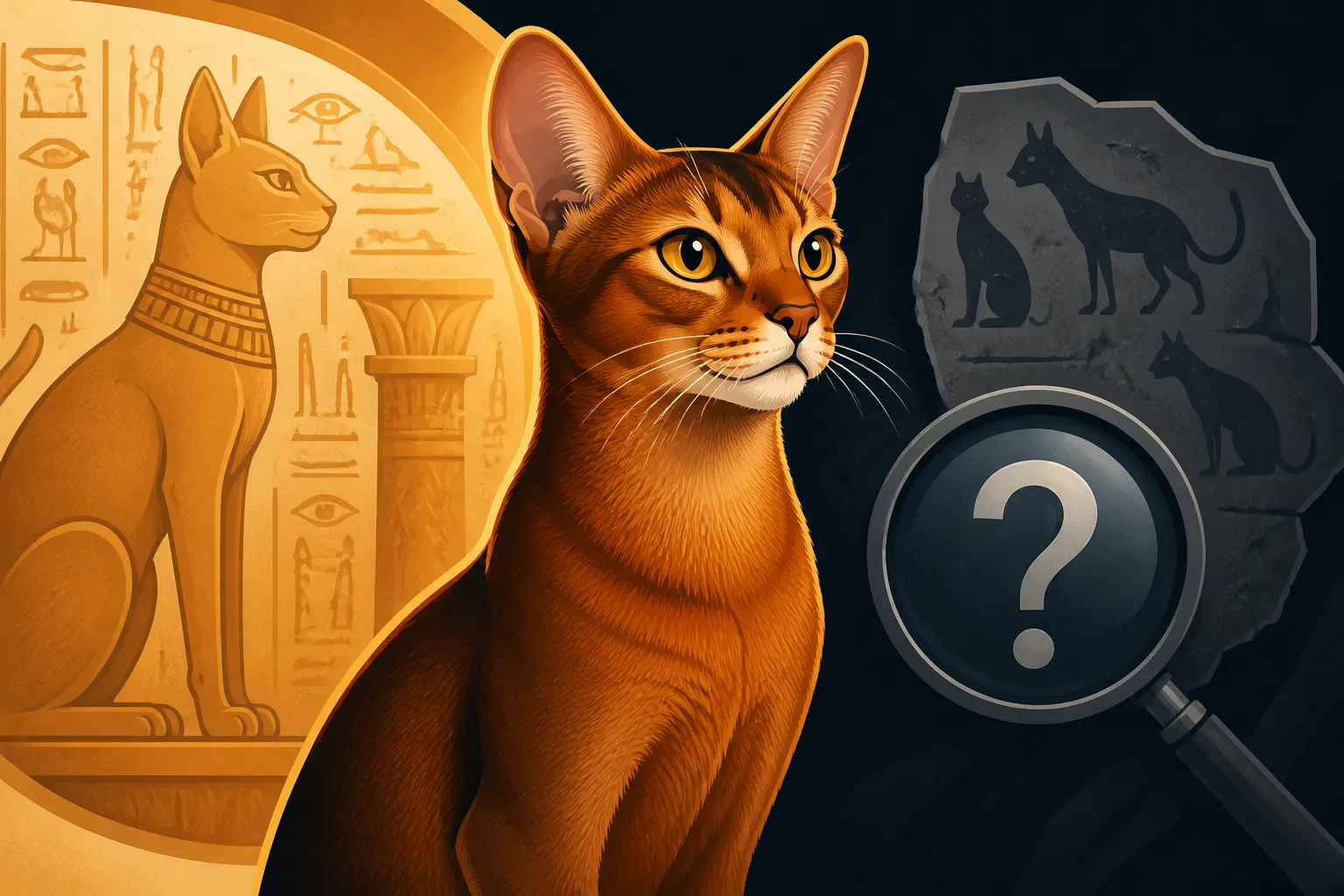
Abyssinians have a lean, athletic build, large ears, almond-shaped eyes, and a short, ticked coat that can look strikingly like cats in ancient Egyptian art. The resemblance is easy to notice, and it has helped fuel the idea that the breed descends directly from cats kept along the Nile thousands of years ago.
But a visual resemblance cannot establish a breed’s ancestry. Ancient Egyptian images show cats with general features that can appear in many modern cats. They do not provide the kind of continuous family records, genetic evidence, or identifying details needed to connect those animals to today’s pedigreed Abyssinians. The idea that the breed resembles an ancient cat is more defensible than the claim that it is demonstrably descended from one.
That distinction matters because people often use “ancient breed” to mean two different things. Domestic cats have lived alongside people for a very long time; a modern registered breed, however, is a defined population with recognizable traits and a recorded breeding history. The history of cats in general is much older than the paper trail for the Abyssinian.
What the breed’s name does and does not tell us
The word “Abyssinian” points to Abyssinia, the former name commonly used for Ethiopia. That name helped shape the familiar story that the breed came from that region. Yet a name is not a reliable travel document. It may reflect what people believed about an animal’s origin, the circumstances under which a cat was brought to Britain, or the way a breed was marketed and described.
This is why the origin story is often presented with more certainty than the surviving evidence supports. The breed’s name and appearance create a compelling narrative, but they do not, by themselves, prove a direct line from Ethiopia or ancient Egypt to modern catteries. For a closer look at the naming puzzle, see The Abyssinian Is Probably Not From Abyssinia.
The most careful way to describe the claim is that the Abyssinian is an old recognized breed with an uncertain early origin. That phrasing leaves room for the possibility that cats resembling the breed existed elsewhere before its documented British history, without turning possibility into established fact.
What the Historical Record Can Actually Show
Zula and the story of 1868
One of the best-known origin stories centers on a cat named Zula. The story says that she was brought to Britain after the British military campaign in Abyssinia in 1868. Zula is often described as an early Abyssinian, and the account gives the breed a memorable starting point: a cat returning from a distant place, then helping establish a distinctive type in Britain.
The difficulty is that the story does not provide a continuous, verifiable pedigree linking Zula to today’s Abyssinians. Even if a cat named Zula was brought to Britain as described, that would not prove that the modern breed descended directly from her. The surviving historical account leaves gaps about her background and what happened to her after arrival. The story is important to the breed’s cultural history, but it is not the same as a documented family tree.
It is also worth separating the expedition date from the breed’s development. A cat arriving in Britain in the late nineteenth century could have influenced later breeding, but a recognized breed generally takes shape through repeated selection and record keeping. That process is more complicated than a single cat arriving at a port. The related discussion Zula and the 1868 Story Everyone Repeats explores why the tale has endured and where its evidence thins out.
Shows, descriptions, and early registrations
Cat shows and breed records provide firmer evidence that a recognizable Abyssinian type was taking shape in Britain during the late nineteenth century. Accounts commonly connect the breed with the 1871 Crystal Palace cat show, while formal registration records are associated with the following decade. These details help establish when people began identifying and organizing cats under the Abyssinian name.
Even these records have limits. A show entry can tell us that a cat was presented under a certain name; it cannot necessarily confirm that the cat came from the place implied by that name or belonged to an unbroken ancient lineage. Early breed labels were not always applied with the consistency expected from modern registries, and surviving records do not answer every question about individual cats’ ancestry.
So the historical trail is useful, but it supports a narrower conclusion than the most romantic version of the story. The Abyssinian was present as a named and increasingly recognized breed in Britain by the late nineteenth century. That is a meaningful history, but it does not establish the breed as the oldest in the world. For context on how that early British period unfolded, see The Abyssinian Nearly Disappeared From Britain Twice and When the First Abyssinian Was Registered.
| Claim | What it suggests | What the evidence can support |
|---|---|---|
| Abyssinians resemble cats in ancient Egyptian art | A possible visual resemblance | Appearance alone does not prove direct ancestry |
| A cat named Zula came from Abyssinia | A memorable proposed origin story | The story does not establish a continuous modern pedigree |
| Abyssinians appeared in British cat-show records | The breed was becoming recognized | Show records document a named type, not an ancient lineage |
| The breed has a long history | The Abyssinian has been established for generations | “Oldest” is difficult to verify across breeds with different records |
Why “The Oldest Breed” Is Hard to Prove
A breed is not the same as a type of cat
The word “breed” can mean a group of cats that share visible characteristics, or it can mean a formally recognized population managed through pedigrees and breeding standards. Those meanings overlap, but they are not identical. Cats with ticked coats and lean bodies may have existed long before anyone used the word Abyssinian, yet that does not automatically make them members of the modern registered breed.
A breed’s history usually becomes easier to trace once people begin recording matings, maintaining pedigrees, and agreeing on which traits define the type. Before those practices became widespread, cats could be described by appearance, location, or owner without belonging to a consistently documented population. A cat that looked like an Abyssinian might have been called something else, or might have had no formal breed label at all.
That makes “oldest breed” an awkward title to verify. To compare breeds fairly, we would need a shared definition of what counts as a breed and comparable historical records for each one. Those records do not exist in a neat, uniform form stretching back through centuries. The label is therefore better understood as a popular reputation than a settled historical ranking.
Competing definitions create competing claims
Some people use “oldest” to mean a breed that looks close to an ancient or natural cat type. Others mean the earliest breed to appear in written records, the first to be formally registered, or the one with the longest continuous pedigree. These are different tests, and they can produce different answers.
The Abyssinian may be described as ancient because of its striking resemblance to cats in historical art. Another breed might be called ancient because of old written descriptions or a long association with a particular region. A third might have especially detailed pedigree records from the period when modern cat fancy organizations developed. None of those measures automatically proves that one breed is older than every other breed.
Modern genetic research can help investigate relationships among cat populations, but it cannot fill every gap in historical documentation. Genetic similarity may offer clues about ancestry and population history; it does not necessarily identify the exact cat that founded a breed or establish a precise date when a modern breed began. For more on what these studies can and cannot tell us, read What Genetic Studies Say About the Abyssinian's Origin and What DNA Says About Where Abyssinians Came From.
What a More Accurate Description Looks Like
A long-established breed with a debated origin
Abyssinians are among the long-established pedigreed cat breeds, and their documented story reaches back to Britain in the nineteenth century. The breed’s distinctive ticked coat and athletic outline have helped it remain recognizable, while its possible connections to cats from other regions continue to invite interest. Those are solid reasons to find the history fascinating without claiming certainty where the records do not provide it.
A careful description might say that the Abyssinian has an uncertain early origin, a famous but incompletely documented connection to Zula, and a clearer history as a recognized British breed by the late nineteenth century. This version respects the historical record and still leaves room for what is genuinely unknown. It avoids presenting an attractive theory as a proven pedigree.
That wording can sound less dramatic than “the oldest cat breed,” but it is more useful. It lets readers distinguish the breed’s documented history from stories about its deeper ancestry. It also helps explain why reputable breed histories sometimes acknowledge the legend while emphasizing that no unbroken line from an ancient cat has been demonstrated.
The coat is a clue to identity, not an age certificate
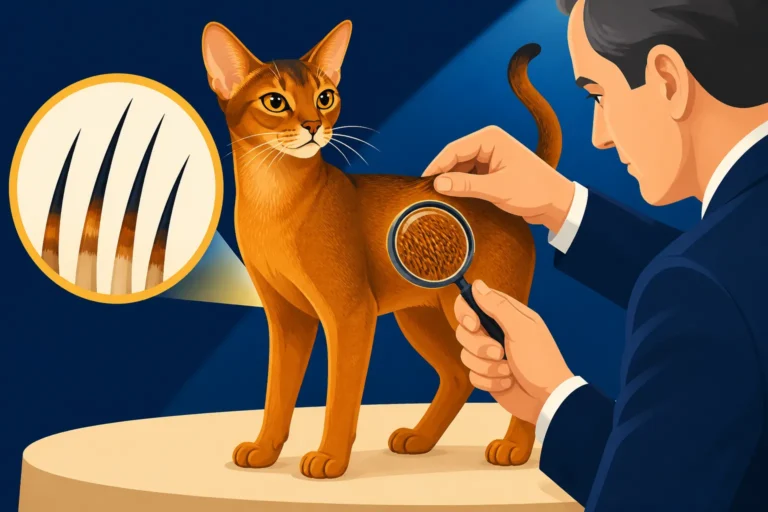
The Abyssinian’s ticked coat is one of its most recognizable features. Individual hairs carry alternating bands of color, creating a softly shaded appearance rather than the clear stripes many people expect from a tabby. This distinctive look is part of the breed’s identity and contributes to the impression that Abyssinians belong to an ancient lineage.
But a distinctive trait does not reveal how old a breed is. The presence of a similar coat pattern in other cats, or in historical depictions, cannot independently establish when the modern Abyssinian breed formed. A coat can help identify a cat’s appearance; documented breeding records and reliable historical evidence are needed to support claims about the breed’s age.
If you want to understand the visual feature that contributes so much to the breed’s reputation, see What Makes an Abyssinian's Coat Ticked Rather Than Striped. For a broader overview of the accepted coat colors and their differences, The Four Colors an Abyssinian Comes In offers a useful next step. These details explain why the breed looks so distinctive, even though appearance alone cannot settle its origin.
Why the story still matters to owners
The uncertain parts of the Abyssinian’s history are not a flaw in the breed. Many popular breeds have incomplete records, changing names, or origin stories that became more polished as they were repeated. The important thing is to be honest about the difference between documented facts and appealing possibilities.
For prospective owners, the “oldest breed” label should not be treated as a health guarantee, a measure of quality, or proof that one breeder’s cats are closer to an ancient original. A kitten’s care, temperament, and health history matter far more than a sweeping claim about age. When researching a breeder, focus on the information they can document about their cats and their breeding practices.
The Abyssinian’s story remains compelling precisely because it includes both evidence and mystery. It has a recognizable place in the history of organized cat breeding, a celebrated origin tale, and a deeper ancestry that cannot be stated with certainty. Calling it one of the oldest breeds captures the legend; describing it as a long-established breed with an uncertain origin better captures what the record can show.
Disclaimer
This article is for general informational purposes only and does not constitute professional advice. Laws, prices and regulations vary by location and change over time. Consult a qualified professional for guidance on your specific situation.