How Far Apart Abyssinian Wall Shelves Should Sit
Installing cat shelves for a high-energy breed sounds straightforward until you watch your pet awkwardly hesitate at a massive gap or overshoot a platform entirely. Abyssinians are born climbers with incredible spring in their hindquarters, but poor shelf spacing can lead to painful slips, damaged drywall, or an expensive wall runway your cat simply refuses to use. This guide breaks down the precise vertical and horizontal spacing requirements for Abyssinian wall shelves, ensuring your setup is safe, functional, and built to match your cat’s athletic capabilities.
Understanding the Abyssinian Jump Dynamics and Spacing Rules
Setting up a vertical climb for an Abyssinian is entirely different from building one for a heavier, lower-energy breed. Abyssinians possess a high muscle-to-weight ratio and exceptional rear-leg power, meaning they handle longer leaps with ease. However, because they move through the air with considerable speed, the margin for landing error on narrow shelves is surprisingly thin. Knowing How Far an Abyssinian Can Jump helps you understand their maximum physical limits, but daily climbing routes should focus on fluid, low-impact movement rather than forcing your cat to execute maximum-effort leaps every time they traverse the room.
When you design a wall layout, you are creating a highway. If the steps are too close together, your cat will feel cramped and prefer to jump over entire steps, which puts unnecessary force on individual wall anchors. If the steps are too far apart, the jump becomes an athletic event rather than a relaxed climb, increasing the risk of misjudged landings as your cat ages.
Vertical and Horizontal Distance Benchmarks
For a healthy, adult Abyssinian, the ideal vertical distance between staggered wall shelves sits between 12 and 18 inches. This vertical rise allows the cat to step or lightly hop from one level to the next without putting excessive shear stress on the wall mounting brackets. If you are creating a direct vertical ladder—where shelves sit directly above one another—you should keep the vertical gap closer to 10 to 12 inches and offset the platforms slightly so the cat can clear the upper shelf while ascending.
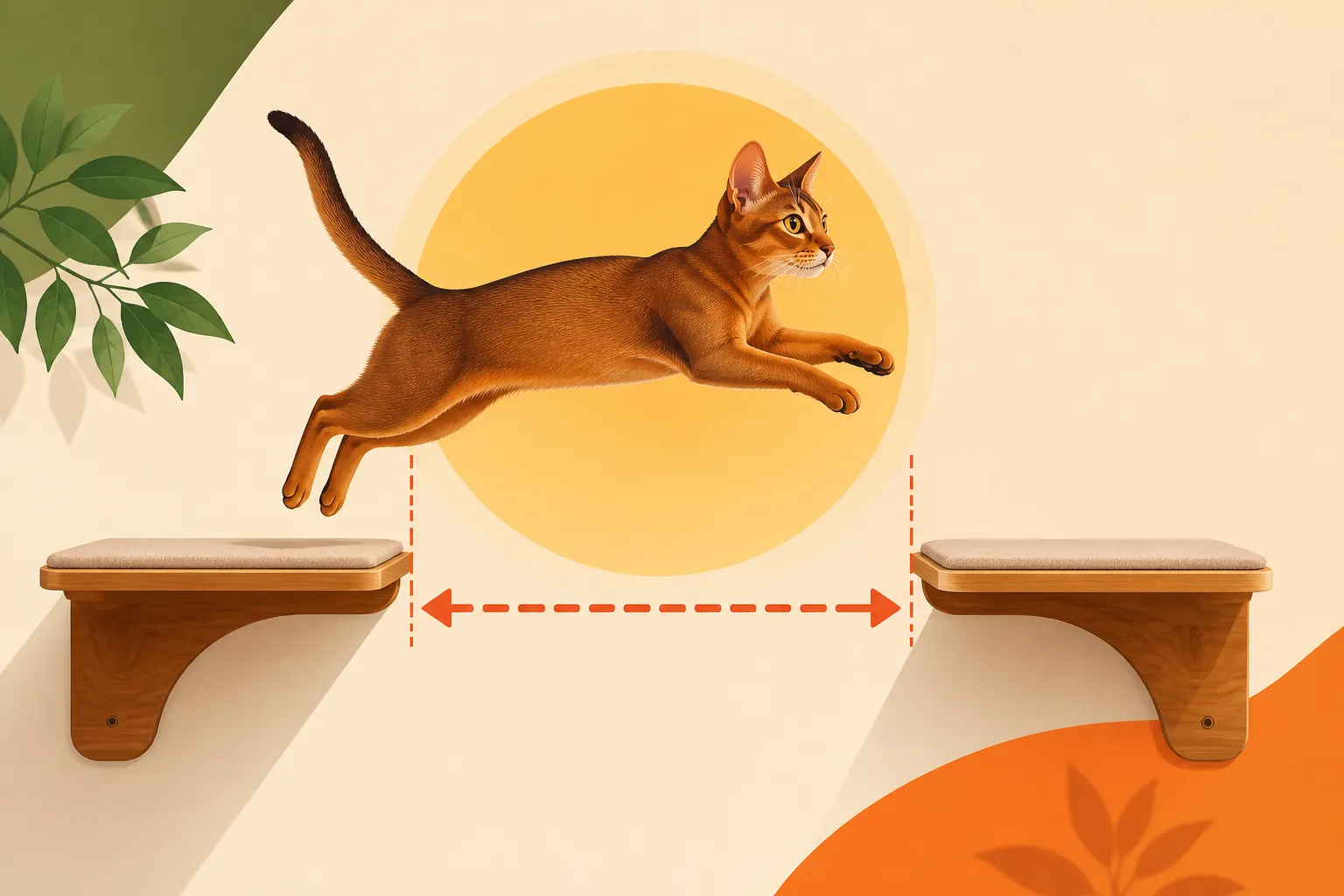
Horizontal spacing between shelves should ideally measure between 16 and 24 inches from the center of one platform to the center of the next. A horizontal span within this range encourages a graceful, trotting leap. You can extend horizontal gaps up to 30 or 36 inches for a “challenge leap” across an open wall section, provided the landing shelf is exceptionally wide and covered with high-traction material. When ordering modular shelf kits on Amazon, always check the individual bracket measurements to make sure the physical footprint of the shelf allows for these exact center-to-center distances without overlapping.
Accounting for Age and Joint Health
An Abyssinian kitten or a young adult under two years old will effortlessly clear gaps that seem intimidating to human eyes. However, spacing must account for the long term. As these cats move into their senior years, explosive leaping capacity gradually diminishes. Overstraining joints over years of landing hard on unpadded boards can contribute to early-onset joint wear, making it essential to plan a layout that accommodates graceful aging.
If you are housing a kitten, start with closer spacing—around 8 to 10 inches vertically—or use temporary lower steps to prevent clumsy tumbles. For mature adults, the standard 12 to 18-inch vertical spacing works best. When an older cat begins to slow down, you should narrow these gaps back down to 8 to 12 inches vertically and add sloped ramps or intermediate steps. Recognizing Why an Old Abyssinian Stops Using the Top Shelf is vital for maintaining their quality of life, as subtle joint discomfort often manifests first as a reluctance to tackle wide shelf gaps. If your cat suddenly hesitates before a jump they used to make without thinking, Why an Abyssinian Stops Climbing Needs a Vet to rule out underlying pain or spinal stiffness before you rearrange the furniture.
| Abyssinian Age & Activity Level | Recommended Vertical Spacing | Recommended Horizontal Spacing | Minimum Shelf Depth | Primary Surface Material Needs |
|---|---|---|---|---|
| Kitten (Under 9 Months) | 8 to 10 inches | 10 to 14 inches | 8 inches | High-grip felt or carpet strips |
| Prime Adult (1 to 8 Years) | 12 to 18 inches | 16 to 24 inches | 10 inches | Sisal, carpet, or ribbed rubber |
| Senior (9+ Years) | 8 to 10 inches | 12 to 16 inches | 12 inches | Padded memory foam with felt cover |
| High-Speed Runway Zone | 10 to 12 inches | 24 to 36 inches | 12 inches | Heavy-duty, tightly woven sisal |
Planning the Layout and Step-by-Step Installation
Before driving a single screw into your wall, you need a coherent layout plan. Abyssinians do not climb simply to sit; they climb to survey their domain, escape household chaos, and track movement below. Understanding Why an Abyssinian Needs Height More Than It Needs Floor changes how you view your living room space. They thrive when given continuous elevated pathways that allow them to circle a room without touching the floor.
A poor layout ends in a dead end—a single high shelf where the cat gets trapped or forced to turn around awkwardly on a narrow ledge. A successful layout provides an ascending route, a resting station, and a safe descending route.
Staggered, Ladder, and Runway Configurations
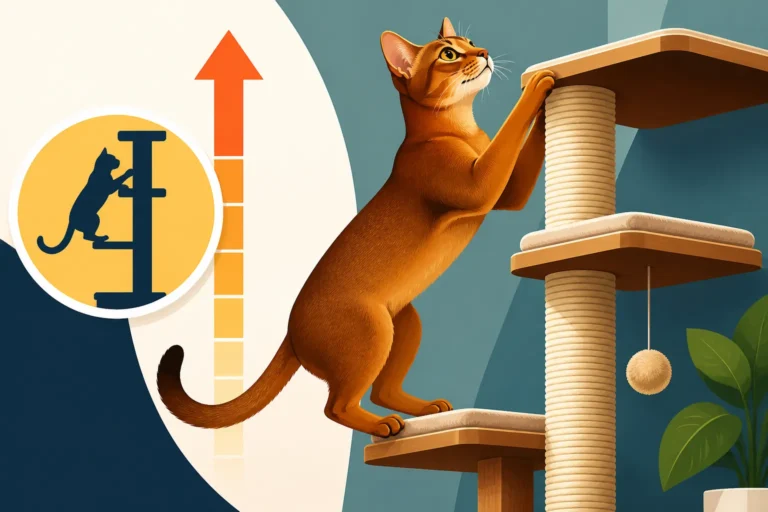
The most popular and functional layout for an Abyssinian is the staggered zigzag pattern. By placing shelves in an alternating left-right-left sequence with a 14-inch vertical rise and an 18-inch horizontal offset, you create a natural rhythm that allows the cat to bound up the wall effortlessly. This layout distributes the impact forces evenly across multiple wall studs as the cat pushes off and lands.
For spaces with limited horizontal wall area, a spiral or vertical ladder layout works better. In this configuration, shelves wrap around a corner or stack vertically with a 45-degree angle rotation between tiers. Keep the vertical gap tight—around 10 to 12 inches—so the cat can weave upward without hitting its head on the shelf above. If you have a long, uninterrupted wall, you can construct a high-speed runway. This consists of two or three long horizontal planks separated by 24 to 30-inch horizontal leaps, culminating in a cozy corner hammock or heavy-duty perching box.
Measuring and Securing Shelves to Wall Studs
Safety begins behind the drywall. An adult Abyssinian weighing 8 to 10 pounds exerts three to four times its body weight in kinetic force when landing from a flying leap. Standard plastic drywall anchors will eventually loosen, wobble, and pull out under the repetitive dynamic stress of an active cat.
To install a secure climbing system, follow these actionable steps:
- Locate Wall Studs: Use a reliable stud finder to locate the vertical wooden studs inside your wall. Wall studs are typically spaced 16 or 24 inches apart on center, which aligns perfectly with standard horizontal shelf spacing.
- Mark Your Elevation: Measure from the floor up to mark your primary anchor points, maintaining your chosen vertical distance (e.g., 14 inches) between tiers. Use a bubble level to draw light pencil lines across your mounting points to ensure individual shelves sit perfectly flat.
- Anchor Directly into Wood: Fasten at least one main bracket screw directly into a wooden wall stud using heavy-duty wood screws at least 2 to 2.5 inches in length.
- Use Heavy-Duty Drywall Hardware for Off-Stud Anchors: If a shelf design requires a mounting hole that misses a stud, do not rely on standard expanding plugs. Instead, use steel toggle bolts rated for heavy loads. You can easily find high-capacity toggle bolts on Amazon that fit standard cat shelf bracket holes.
- Test Weight Capacity: Once mounted, apply firm downward manual pressure on the outer edge of the shelf. The shelf should exhibit zero flex or movement. If it flexes under hand pressure, it will fail when a cat lands on it at full speed.
Understanding Which Shelves Hold an Abyssinian’s Weight is critical before purchasing decorative options. Decorative floating shelves meant for light picture frames rarely feature the reinforced steel brackets required for active pets.
Shelf Dimensions, Surface Materials, and Safety Precautions
Proper spacing means very little if the target landing zone is inadequate. Because Abyssinians feature long, slender bodies and high-speed movement, narrow or slick platforms create a severe hazard. When a cat misjudges a turn on a smooth wood shelf, its claws cannot gain traction, resulting in a fall that can cause muscle strain or ligament damage.
Ideal Shelf Depth and Length for a Tapered Athlete
A basic step shelf designed purely for ascending should measure at least 8 inches deep by 10 to 12 inches wide. This gives the cat enough surface area to plant all four paws during a mid-climb transition. However, resting stations and primary perches require significantly more room.
For perches where your cat will stretch out, curl up, or groom, aim for a shelf depth of 12 inches and a length of 18 to 24 inches. Abyssinians enjoy lounging sideways while keeping an eye on the room below. If a shelf is too narrow, their limbs will dangle uncomfortably, or they may roll off while sleeping. Larger platforms also make landing much safer when completing wide horizontal jumps between wall runs.
Preventing Slips on High-Speed Takeoffs
Raw wood, polished laminate, and smooth plastic are hazardous surfaces for cat wall runs. When an Abyssinian launches into the air, its hind legs exert a powerful backward push. On a slick board, the back paws slip instantly, dumping momentum and causing the cat to short-fall the distance.
To make the climbing environment safe:
- Apply High-Traction Covers: Line every shelf with heavy-duty carpet tile, woven sisal matting, or self-adhesive dense felt. You can purchase roll-on adhesive traction pads on Amazon and cut them precisely to fit your shelf dimensions.
- Secure the Edges: Ensure surface pads are glued or stapled down completely. Loose carpet strips can slide under the cat’s feet during landing, turning the shelf into a slip hazard.
- Avoid Soft, Unattached Cushions: Loose pillow pads look comfortable to human eyes, but they slide instantly when landed on at an angle. If you use foam padding, secure it firmly to the shelf base with industrial hook-and-loop fasteners or wood staples.
Learning How to Make an Abyssinian’s Climbing Route Safe involves reviewing every inch of the path for sharp bracket edges, pinch points near door frames, and unstable top perches.
Integrating Vertical Furniture into the Broader Home Environment
Wall shelves should not exist in isolation. An effective cat enrichment setup connects wall runs to existing home structures, furniture, and vertical items. Abyssinians excel at navigating complex three-dimensional pathways, frequently using high furniture as launch pads or final destinations.
By building bridges between wall shelves and freestanding furniture, you maximize your available square footage and satisfy your cat’s drive to reach the highest point in every room.
Connecting Wall Runs to Cat Trees and Window Perches
Instead of forcing your cat to launch onto the wall straight from the floor, use a sturdy, freestanding cat tree or a low bookshelf as an entry ramp. This creates an inviting, multi-stage climbing sequence that reduces the physical shock on their joints during descent.
Mount your starting wall shelf about 12 to 16 inches above the top platform of a cat tree. This allows the cat to step easily from the tree onto the wall run. From there, lead the path across the wall toward a window perch or above a doorway. Abyssinians love supervising entryways and high-traffic zones; running a shelf line over a interior door frame creates a fantastic vantage point that makes intelligent use of dead architectural space.
It is equally important to think about the descent. Descending puts far more stress on a cat’s front shoulders and wrists than ascending. Make sure your landing zone at the end of the run offers lower intermediate steps, a climbing pole, or a high furniture piece so the cat does not drop five or six feet directly onto a hard floor.
When planning your room layout, compare your options carefully. Many owners wonder Why Wall Shelves Work Better Than a Tree for an Abyssinian, and the answer lies in floor space efficiency and height potential. Wall shelves allow you to reach ceiling-level heights that freestanding trees simply cannot achieve without wobbling.
Finally, ensure your elevated superhighway leads to an undeniable reward—a sunny window view, a cozy ceiling-level bed, or a clear sightline into the kitchen. Providing a functional, securely anchored wall network with correct spacing keeps your Abyssinian physically fit, mentally engaged, and safely elevated high above the everyday household flow.
Disclaimer
This article is for general informational purposes only and does not constitute professional advice. Laws, prices and regulations vary by location and change over time. Consult a qualified professional for guidance on your specific situation.