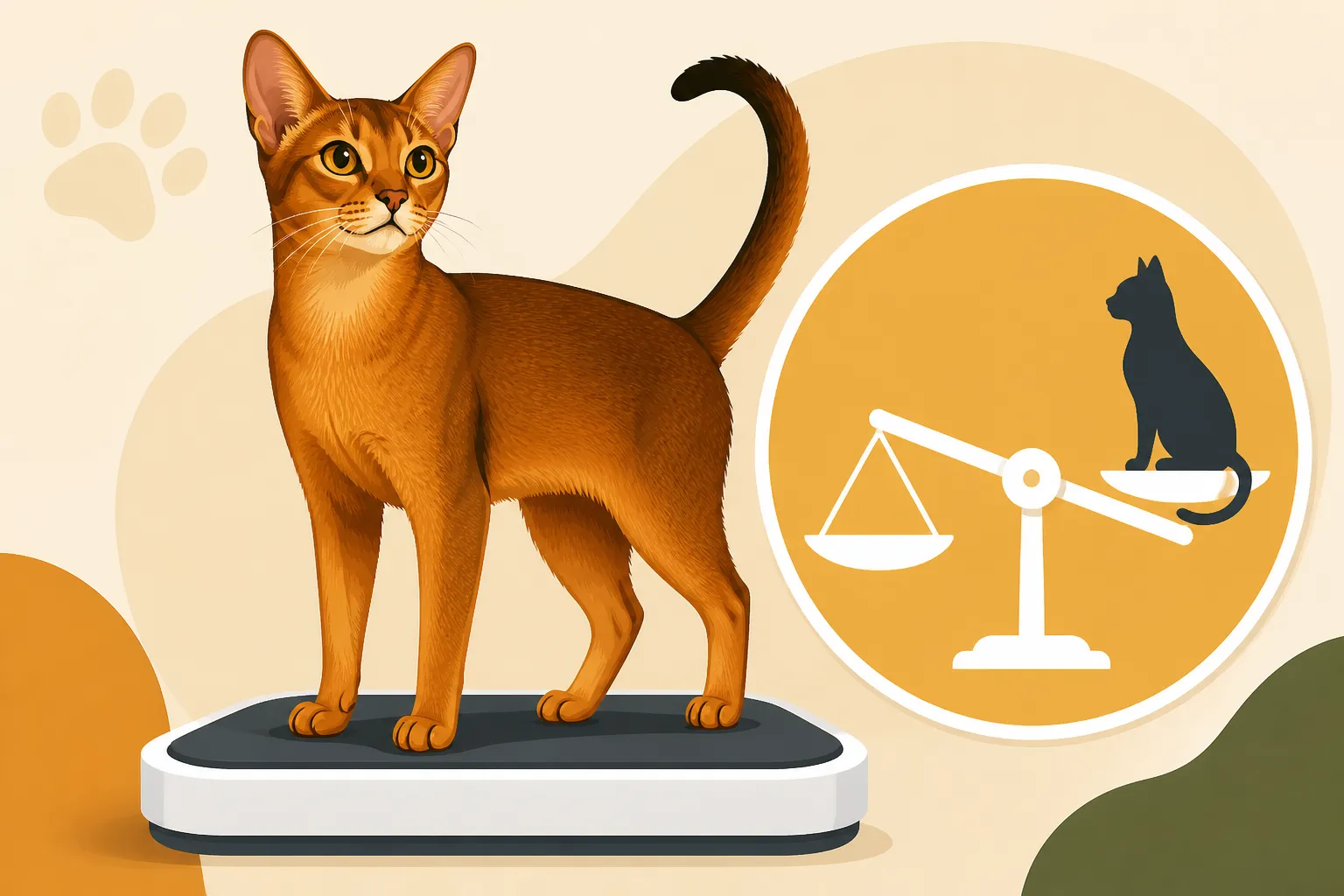
How Much an Adult Female Abyssinian Weighs
An adult female Abyssinian often weighs about 6 to 9 pounds, though a healthy individual may fall outside that range. That can be confusing when your cat looks long, fine-boned, and surprisingly light—or seems heavier than expected despite being active. This guide explains typical weight, how to judge body condition, and when a change deserves a veterinary check.
Typical weight for an adult female Abyssinian
A useful range, not a pass-or-fail number
Many adult female Abyssinians weigh roughly 6 to 9 pounds, or about 2.7 to 4.1 kilograms. Some healthy females are smaller, and others are larger. The number on the scale is only one part of the picture: age, height, frame, muscle, and overall condition all matter.
Abyssinians have a lithe, athletic build. They can look slight beside a broad-bodied cat, even when their weight is right for them. Their long legs and fine outline can also make it harder to judge by sight alone. If you are comparing your cat with a general breed description, What an Abyssinian's Body Type Is Called explains why this breed’s build can seem so different from a stockier cat’s.
It helps to think of the typical range as a starting point for a conversation with your veterinarian, not a target every female must reach. A petite cat who maintains healthy muscle and a stable weight may be doing well at the lower end. A taller, larger-framed female may be healthy at a higher weight. Your veterinarian can assess her frame and body condition rather than judging her against a single number.
| What you’re assessing | What to look for |
|---|---|
| Scale weight | A stable pattern that suits your cat’s frame and health |
| Ribs | Easy to feel under a light covering, without pressing hard |
| Waist | A slight inward curve behind the ribs when viewed from above |
| Side profile | A modest abdominal tuck rather than a round, sagging outline |
| Muscle | Firmness over the back and hindquarters, without new thinning |
| Recent change | An unexplained gain or loss that continues or comes with other symptoms |
Why two healthy females can weigh differently
A cat’s frame makes a real difference. Two Abyssinian females can be similar in age and activity but have different shoulder widths, body lengths, and muscle mass. One may naturally weigh less while still having a well-proportioned body. Another may carry more weight because she is larger overall, not because she is overweight.
Muscle can also affect the scale. An energetic cat who climbs, sprints, and plays may have a different build from a less active cat, even if both eat appropriate portions. For breed context, How Big an Adult Abyssinian Gets and How Much an Adult Male Abyssinian Weighs can help explain the broader size range, but male and female averages do not tell you exactly what any one cat should weigh.
Life stage matters, too. A kitten is still growing, while a mature adult’s ideal weight may be different from her weight during adolescence. Senior cats may lose muscle as they age, sometimes without a dramatic change in the number on the scale. For that reason, a weight that has suited your cat for years is useful context—but it is not a reason to ignore a new change.
How to tell whether her weight suits her frame
Check body condition, not just pounds
A scale can tell you whether your cat weighs more or less than she did last month. It cannot show where that weight sits, whether she has lost muscle, or whether her shape is appropriate for her build. A basic hands-on check gives you more information.
Gently run your fingers along her ribs. You should generally be able to feel them beneath a thin layer of tissue, without digging in. Looking from above, you may see a slight waist behind the ribs. From the side, her abdomen may tuck upward modestly toward the hind legs. These are broad visual and touch cues, not a substitute for an individual veterinary assessment.
Abyssinians’ close-fitting coats can make their outlines easy to see, but coat appearance can still mislead. Lighting, posture, and how recently she has eaten can change what you notice. Use the same gentle checks regularly, and ask your veterinarian to show you how to assess her body condition during a routine visit. How to Feel an Abyssinian's Waist Under Its Coat and How to Read an Abyssinian's Body Condition Through That Coat offer more detail on judging shape through this breed’s sleek coat.
Record trends in a consistent way
Weighing your cat at home can make gradual changes easier to catch. If you have a suitable pet scale, place it on a level, stable surface and try to weigh your cat under similar conditions each time. A small difference from one reading to the next may simply reflect movement, a meal, or the scale’s limitations; a repeated trend is more meaningful.
If your cat will not stand still, you can weigh yourself while holding her and then weigh yourself alone on the same scale. Subtracting the two readings gives an estimate, but it may be less precise than a pet scale. A retailer such as Chewy may offer pet scales or other weighing options; check that any scale you consider is stable and appropriate for your cat’s size before relying on it.
Keep a simple record with the date, weight, and anything relevant, such as a recent diet change or illness. Your regular veterinary clinic can also weigh her and help you interpret the pattern. If you use a food scale or measuring tools bought through Chewy or another retailer, remember that measuring food accurately does not replace checking your cat’s actual weight and body condition.
Feeding and activity without fixating on a target
Portion size depends on the individual cat
There is no single portion that suits every female Abyssinian. Food needs vary with the cat’s age, activity, reproductive status, health, and the calorie content of the food. Feeding instructions on a package can be a starting point, but they are not a personalized prescription. Your veterinarian can help set a suitable daily amount and adjust it if her weight or condition changes.
Measure meals rather than estimating by eye, especially if more than one person feeds the cat. A cup filled differently each time can quietly add up to more food than intended. If you buy food through Chewy or a local pet shop, check the package’s feeding guidance and calorie information, then ask your veterinarian how to adapt it to your cat rather than assuming the label’s serving is exactly right for her.
Treats count toward her daily intake, too. It can be easy to overlook small extras—training rewards, a bite from the table, or treats offered by several family members. If her weight is changing, write down everything she eats for a few days. That record can help you and your veterinarian spot patterns without abruptly restricting food.
Keep her active in ways she enjoys
Abyssinians are often lively, curious cats, but activity still varies from one individual to another. Interactive play, climbing opportunities, and short sessions that let her stalk and chase can support fitness and provide mental stimulation. The goal is not to make her burn off a particular meal; it is to give her regular, safe ways to move.
For a cat who spends much of the day indoors, try a few brief play sessions rather than relying on one long burst. Wand toys, food puzzles, and secure climbing routes can make movement part of the day. Make sure shelves and furniture are stable, and offer lower routes as well as high perches so she can choose how much to climb.
If she is gaining weight, review portions, treats, and activity with your veterinarian before starting a weight-loss plan. Cats should not be put on a crash diet or have food cut sharply without veterinary guidance. If she is losing weight, adding extra food without finding the cause may also delay needed care.
When a weight change needs attention
Gradual changes are worth noticing
Weighing your cat periodically gives you a baseline. If her weight rises or falls over several checks, note when the change began and whether anything else has changed: appetite, thirst, energy, grooming, litter-box habits, or willingness to jump. A cat can look normal while a gradual shift is developing, so the trend may be more useful than one isolated measurement.
Changes in muscle deserve attention even if the scale barely moves. For example, a cat may lose muscle over her back while gaining fat elsewhere, leaving her weight similar but her condition different. An Abyssinian’s lean outline can make this difficult to judge at home, so mention any new prominence of the spine, hips, or shoulder blades at a veterinary appointment. Why a Lean Abyssinian Hides Illness Longer Than a Heavy Cat explains why a trim-looking cat’s health changes can be easy to miss.
Unexplained weight loss should not be dismissed as a harmless effect of a busy temperament. A sudden change in food, household routine, or exercise may contribute, but illness can also affect appetite, digestion, or metabolism. Why an Abyssinian's Weight Loss Is Never Minor and What an Abyssinian Should Weigh at One provide useful context for monitoring changes over time.
Contact a veterinarian when the change is unexplained
Arrange veterinary advice if your cat is losing or gaining weight without an obvious reason, especially if the change continues. Contact a clinic promptly if weight change comes with reduced appetite, repeated vomiting, diarrhea, unusual thirst, increased urination, weakness, hiding, or a noticeable drop in activity. Difficulty eating or breathing, collapse, or severe weakness calls for urgent care.
Before the appointment, write down her recent weights if you have them, what food she eats, how much she gets, and any changes in treats or routine. Include when you first noticed the change and whether she is eating and drinking normally. A clear history helps the veterinarian decide what to examine and whether tests are appropriate.
A healthy adult female Abyssinian does not have to match an exact number to be well. Her stable pattern, body condition, appetite, energy, and veterinary findings matter more than whether the scale lands precisely in the middle of a typical range. If you are unsure what is normal for your cat, ask your veterinarian to record a target range and show you how to check her condition at home.
Disclaimer
This article is for general informational purposes only and does not constitute professional advice. Laws, prices and regulations vary by location and change over time. Consult a qualified professional for guidance on your specific situation.