Why an Abyssinian Opens Doors and Cabinets
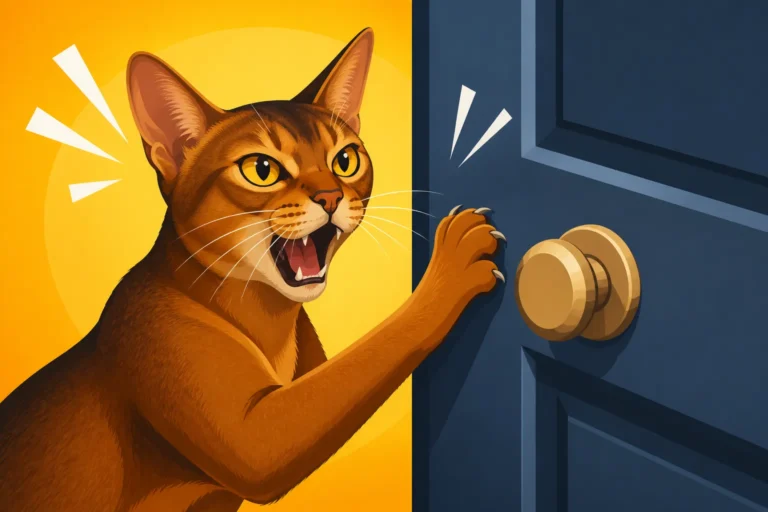
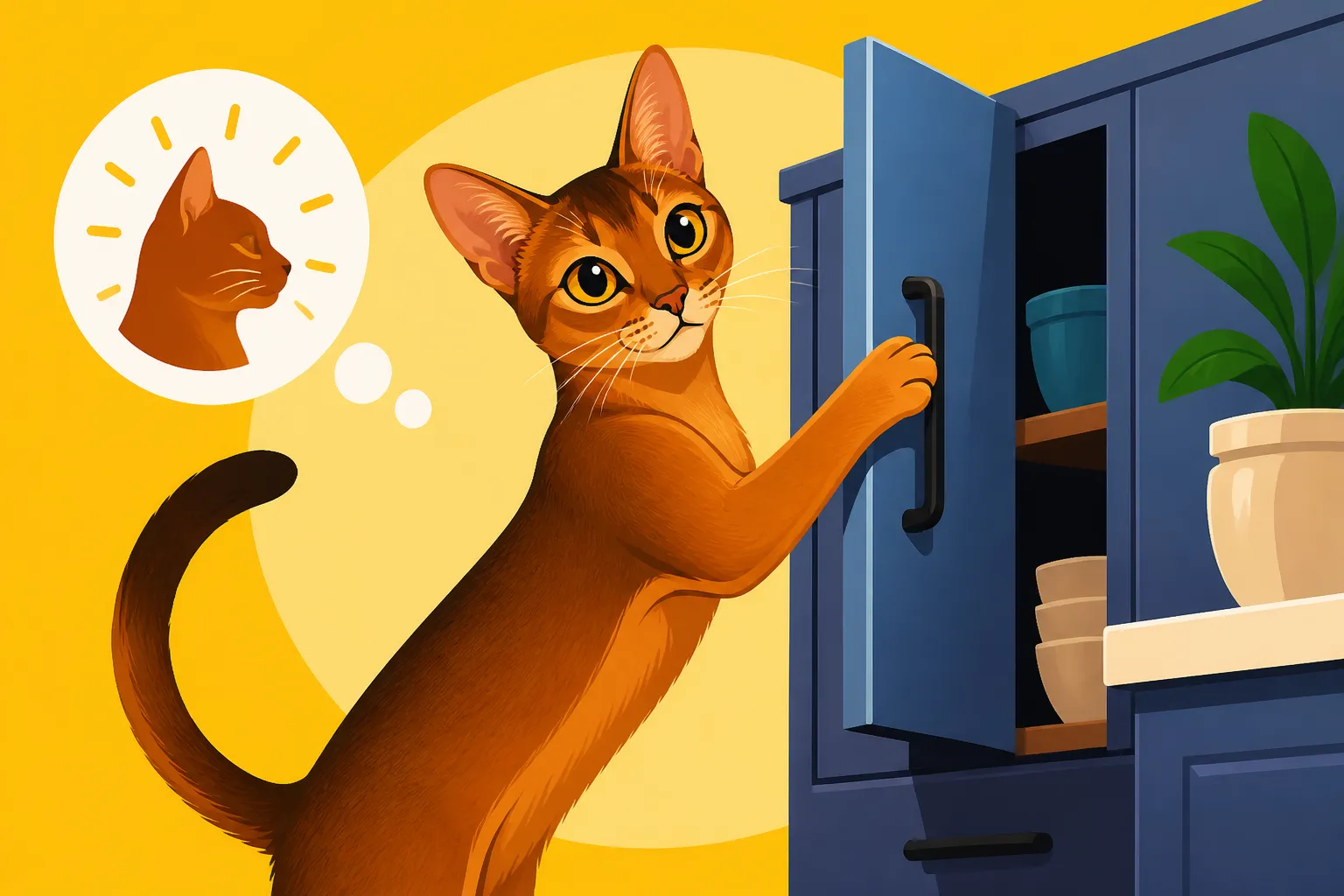
That distinctive Abyssinian curiosity isn't just about batting at a dangling toy; it extends to every nook and cranny of your home, especially those mysterious doors and cabinets. If you've found your Abyssinian routinely breaching the pantry, investigating the linen closet, or even attempting to pry open the fridge, you're not alone. This guide is here to unravel the complex reasons behind this common Abyssinian behavior and provide you with actionable strategies to keep your clever cat safely engaged without them needing to become your home's resident locksmith.
The Abyssinian Mind: A Quest for Engagement
Let’s be honest: Abyssinians aren't your typical, content-to-lounge-all-day kind of cat. They are bundles of intelligent, inquisitive energy, and their minds are constantly whirring, seeking out the next challenge, the next puzzle to solve. This inherent drive for engagement is precisely what turns an ordinary doorknob or a mundane cabinet handle into an irresistible opportunity for exploration and mastery.
High Intelligence and Curiosity Drives
Abyssinians are incredibly smart, almost to their detriment sometimes! They’re not content with a passive existence; they are thinkers, problem-solvers, and endlessly curious about their environment. This isn't just a quirky trait that makes them amusing companions; it's a fundamental aspect of their breed that leads directly to behaviors like opening doors and cabinets. They want to know what's on the other side, what's tucked away inside that cupboard, and how the entire contraption works. This insatiable curiosity is truly a double-edged sword: it makes them fascinating, interactive pets but also transforms your entire home into one giant, intricate puzzle box they are determined to solve.
Imagine a highly intelligent toddler, constantly poking, prodding, and experimenting, utterly fascinated by how objects move and react to their touch. An Abyssinian is remarkably similar in this regard. They aren't satisfied with simply observing; they actively seek out novel experiences and new information. To an Abyssinian, a closed door represents an unknown, an unexplored territory, a potential secret garden, and for a cat with their intellect, an unknown is simply a challenge waiting to be overcome. This deep-seated drive for exploration and understanding is one of the primary, most powerful motivators behind their persistent attempts to breach any barrier in their path.
It’s crucial to understand that this behavior isn't typically born out of malice or a desire to be destructive. Rather, it’s about engagement. If their living environment isn't providing sufficient intellectual stimulation, their powerful, agile minds will find ways to stimulate themselves. More often than not, this involves manipulating their surroundings to uncover new experiences or access hidden "treasures." A static, unchanging, and predictable home can feel like a prison to an Abyssinian's active intellect, and they will quickly figure out how to "break out" into new zones or discover what delights (or dangers!) might be lurking behind a seemingly impenetrable barrier.
The Energetic Nature of the Abyssinian
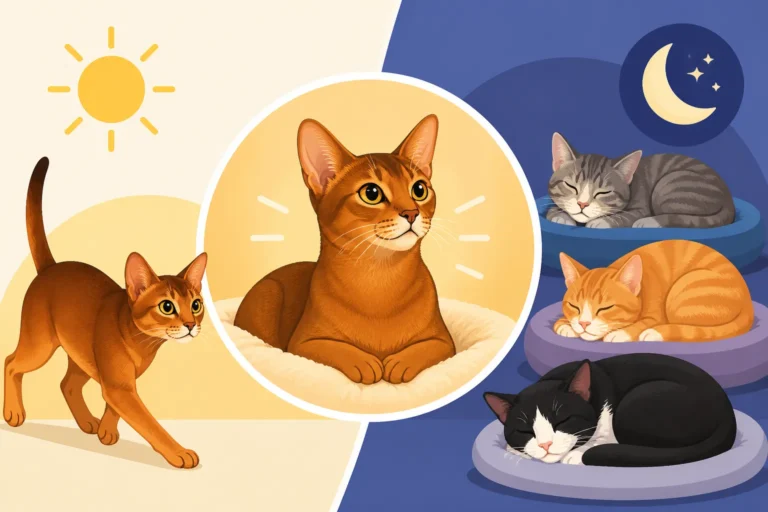
It's truly no secret among Abyssinian enthusiasts that these cats are incredibly high-energy. They are often affectionately described as the "clowns of the cat world" or sometimes, less affectionately, as "busybody cats," and there's a very good reason for these monikers. Their boundless energy isn't just about sporadic bursts of running; it's about a consistent, sustained need for both physical exertion and mental activity throughout their waking hours. If they're not expending that innate energy in positive, directed ways, it often manifests in less desirable behaviors, such as systematically investigating and attempting to open every latch, handle, and knob in your home.
Picture yourself with an endless supply of energy but absolutely no constructive outlet for it. That's a pretty good approximation of how an undersimulated Abyssinian might feel. Their natural athleticism, combined with their incredible agility, means they can easily reach and manipulate objects in places other, less nimble cats wouldn't even consider attempting. This makes doors and cabinets prime targets for their investigations. They possess the physical prowess, the spring, and the balance required to execute their curious explorations, and their high energy fuels their remarkable persistence until they ultimately succeed in their goal.
This profound physical drive works hand-in-hand with their acute mental curiosity. For an Abyssinian, it’s simply not enough to think about what might be behind a closed door; they feel an overwhelming compulsion to do something about it. They will jump, twist their bodies, hang precariously by their front paws, and generally apply their impressive acrobatic skills to any handle or knob that dares to stand in their way. How much “trouble” they might get into can often be directly correlated to How Many Hours a Day an Abyssinian Stays Active. If those hours aren't filled with appropriate activities, they'll fill them themselves.
Decoding the Instinct: Why Doors and Cabinets are Irresistible
The act of an Abyssinian opening a door or cabinet isn't random; it's often a calculated move, born from observation, a natural desire for novelty, and a deep understanding of cause and effect. They are, in many ways, tiny scientists experimenting with their environment.
Mimicry and Observational Learning
Abyssinians are incredibly observant creatures. They watch us, their human companions, with an intensity that can sometimes feel unnervingly intelligent. They meticulously notice how we interact with objects, how we perform the precise movements required to open doors, and how we access various cupboards. From their perspective, we're not just the providers of food, shelter, and occasional cuddles; we're also inadvertent instructors in the intricate art of manipulating the environment. If they see you twist a doorknob, pull a cabinet handle, or even press a button, they log that precise information away in their keen minds.
This isn't merely passive watching; it is an active, engaged process of learning. After observing you, they will then attempt to replicate the motions they’ve witnessed with their own paws and bodies. It might begin as a clumsy, tentative paw swipe at a handle, but with their innate dexterity and truly remarkable persistence, they quickly refine their technique. They possess a surprisingly sophisticated understanding of cause and effect, and they rapidly learn that a specific action on their part leads directly to the desired outcome: an open door or an accessible cabinet. This is often the foundational step in How an Abyssinian Learns to Open a Cupboard.
Think of it as having a highly intelligent, albeit slightly mischievous, apprentice living in your home, one with very strong opinions about where the treats and favorite toys should be stored. If you open the pantry door, your Abyssinian is likely studying your specific hand movements, listening intently to the distinct click of the latch, and keenly anticipating the subsequent reward – whether that’s food, a new toy being retrieved, or even just a fascinating new scent wafting out. They are certainly intelligent enough to connect these crucial dots and will eagerly try their paw at recreating the sequence themselves.
The Thrill of Discovery and Novelty
For an Abyssinian, the act of opening a door or a cabinet isn't solely about getting to a specific item inside, although gaining access to a coveted treat is certainly a delightful bonus. More fundamentally, it's about experiencing the sheer thrill of discovery. Every new space they access, every previously inaccessible compartment they manage to open, represents a fresh sensory experience for them. New smells, intriguing textures, different acoustics, and novel vantage points – these are all incredibly stimulating for their perpetually curious minds and satisfy their deep-seated need for novelty.
Consider a forgotten closet that you simply use for storage. To you, it's just a place to stash old coats and dusty boxes. To your Abyssinian, however, it's a potential cave to explore, a secret hunting ground for phantom dust bunnies, or an enticing new, private napping spot. The very act of pushing through a door they weren't supposed to open is a significant victory for them, a tangible testament to their intelligence, agility, and persistence. This deeply self-rewarding nature of the behavior makes it incredibly difficult to extinguish once it has been established.
This constant craving for novelty is precisely why regularly rotating their toys and enrichment items is so critically important. If their regular environment becomes too predictable, too mundane, they will instinctively seek out novelty elsewhere. In such cases, your closed doors and cabinets become the most obvious and intriguing targets. They are driven by an innate, powerful need to explore and understand every facet of their world, and your domestic barriers are simply another fascinating part of that world, waiting to be conquered and revealed.
The Mechanics of Entry: How They Actually Do It
It’s one thing to understand why an Abyssinian wants to open a door, but quite another to comprehend how they manage to do it. These cats aren't just intelligent; they're incredibly physically capable.
Dexterity and Agility
Abyssinians are justly renowned for their lean, muscular bodies and their absolutely incredible agility. They are, quite literally, built for climbing, for executing impressive jumps, and for intricate, precise paw work. This remarkable physical prowess is a huge factor in their ability to manipulate various latches and handles around your home. Unlike some heavier, more sedentary cat breeds, an Abyssinian can easily leap onto a doorknob, hang by their front paws, and use their body weight to pull the lever down or even twist a round knob.
Their paws are far more than just walking tools; they are highly articulate instruments, almost akin to a primate's hands. They can grip, twist, and pull with a surprising degree of precision and strength. We've all observed cats batting playfully at objects, but an Abyssinian elevates this to an entirely different level, utilizing their paws with a deliberate, almost human-like intelligence to solve mechanical puzzles. It's truly fascinating to witness, even if it is a little frustrating when they're breaking into your cupboards.
Think of your Abyssinian as a miniature parkour expert in your home. They will expertly assess the height of the target, identify potential leverage points, and calculate the required motion, then execute it all with athletic grace and precision. A simple lever-style doorknob is often mere child's play for many Abyssinians; even challenging round knobs can be conquered with sufficient grip strength and clever application of their body weight. Their natural climbing ability, as elaborated in How High an Abyssinian Will Climb, gives them the crucial access to these otherwise out-of-reach targets.
Understanding Latches and Knobs
It’s not just about brute force or random flailing; there’s a genuine degree of understanding and cognitive processing involved. Abyssinians aren't simply batting aimlessly at objects; they actually learn which specific part of a handle needs to be pushed or pulled, and in precisely which direction, to achieve the desired result. They keenly associate the movement of the hardware with the subsequent opening of the barrier. This behavioral pattern is a clear and compelling demonstration of their formidable cognitive abilities in action.
They might begin their efforts by trying various angles, different paw placements, and multiple approaches until they hit upon the correct mechanism. Crucially, once they succeed, they remember. Cats possess excellent spatial memory and highly developed procedural memory, meaning they can accurately recall how to perform a precise sequence of actions to achieve a specific goal. This is why a door-opening Abyssinian rarely needs to "re-learn" the trick for the same door once they’ve mastered it. It’s ingrained in their memory.
This remarkable problem-solving capability extends beyond just basic door and cabinet handles. Some exceptionally clever Abyssinians have even been observed figuring out childproof latches. They don't necessarily understand the nuanced "childproof" engineering, but through relentless persistent trial and error, they eventually discover a weakness in the latch's design or a specific, repeatable motion that allows them to unlock it. Their unwavering persistence is an absolutely key factor here; they will simply keep trying until they succeed, often to the exasperation of their human companions.
The Payoff: What Your Abyssinian Gets Out of It
Every behavior that persists does so because it offers a reward. For your door-opening Abyssinian, the payoffs are often multi-faceted, ranging from tangible goodies to the intangible satisfaction of a job well done, or even just your reaction.
Access to Valuables and Treats
Let's be completely honest about this: often, the most immediate and highly motivating reward for an Abyssinian successfully opening a cabinet is gaining access to something they really want. This could be their most coveted treats, a freshly opened bag of kibble, or even something as seemingly innocuous as a roll of paper towels they find utterly delightful to shred into confetti. They very quickly associate the successful act of opening the door with obtaining these high-value, desirable items, which powerfully reinforces and cements the behavior in their minds.
This is a classic, textbook case of positive reinforcement in action. Every single time they successfully open a cupboard and manage to find something enticing, their inherent drive to repeat the behavior strengthens considerably. Even if they don't always find exactly what they're looking for, the nature of intermittent reinforcement (where sometimes there's a treat, and sometimes there isn't) can actually make the behavior even harder to break. This is because they remain perpetually optimistic about future discoveries and the potential for a payoff.
This is also where we, as unsuspecting owners, can inadvertently teach them. If your Abyssinian gets into a cabinet and you immediately react – even if it’s just with a startled "No!" or a rush to stop them – that's still a form of attention. And for many Abyssinians, any attention, even negative, can be a highly desirable form of reward. More importantly, if they successfully manage to nab a forbidden item, the reward is intrinsically satisfying: the sheer joy and triumph of acquiring the forbidden fruit.
Attention and Engagement
Beyond the tangible rewards like treats or toys, simply eliciting a reaction from you can be an incredibly powerful motivator for an Abyssinian. These highly social and interactive cats absolutely thrive on interaction and love being the undisputed center of attention in their household. If opening a door consistently leads to you rushing over, talking to them (even if it's a scolding tone), or engaging with them in any way, shape, or form, they quickly learn that this particular behavior is an extremely effective way to command your immediate focus.
This dynamic is especially true for Abyssinians who might not be receiving enough dedicated, stimulating play or consistent mental enrichment throughout their day. The fact that Why an Abyssinian Will Not Sit on Your Lap means they often express affection and seek interaction in different, typically more active and demanding, ways. Opening a door or cabinet is a behavior that almost guarantees your attention; it's almost as if they are vocally proclaiming, "Hey! Look what I can do! Now, please interact with me!"
A bored Abyssinian is, quite frankly, a destructive Abyssinian. If they feel under-stimulated, neglected, or simply not challenged enough, even for relatively short periods, they will instinctively find ways to entertain themselves. And sometimes, the most entertaining activity available is figuring out how to do something you clearly don't want them to do, precisely because it guarantees a response from you.
Living with a Locksmith Cat: Managing the Behavior
Now that we understand the 'why' and 'how,' it's time to talk about practical solutions. Living with a cat determined to explore every forbidden zone requires a proactive approach.
Cat-Proofing Your Home
Since preventing an unwanted behavior is almost always easier and less stressful than trying to break a deeply ingrained habit, the very first and most crucial step is to thoroughly cat-proof your entire home. This means critically assessing every single door and cabinet from the unique, resourceful perspective of an Abyssinian. Are there lever handles that they can effortlessly depress with a jump and a swipe? Are there cabinet pulls or knobs they can easily hook a clever claw into and yank open? This is precisely where strategic hardware changes and clever locking mechanisms come into play.
For problematic lever handles that are simply too easy for those nimble paws, seriously consider replacing them with traditional round doorknobs. While not entirely foolproof against the most determined Abyssinian, round knobs are significantly harder for cats to grip securely and turn effectively. For cabinets, childproof latches become your absolute best friend. There are various types available, ranging from sophisticated magnetic locks that require a special key to simple, surface-mounted strap locks you can easily find on Amazon. Even a basic hook-and-eye latch installed on the inside of a pantry door can work wonders in deterring them. The common phrase Why Childproof Latches End Up on an Abyssinian's Kitchen is a reality for countless Abyssinian owners.
Remember not to overlook their incredible vertical access capabilities. Abyssinians are exceptional climbers, and if they can jump from a nearby chair, countertop, or even a strategically placed cat tree onto a doorknob, the specific type of knob might become less relevant. Therefore, it's wise to block off or redirect any obvious climbing routes that lead directly to sensitive doors. Furthermore, ensure that any truly high-value or potentially dangerous items are moved to securely locked areas that they cannot access, even if they somehow manage to breach the initial barrier.
Redirection and Positive Reinforcement
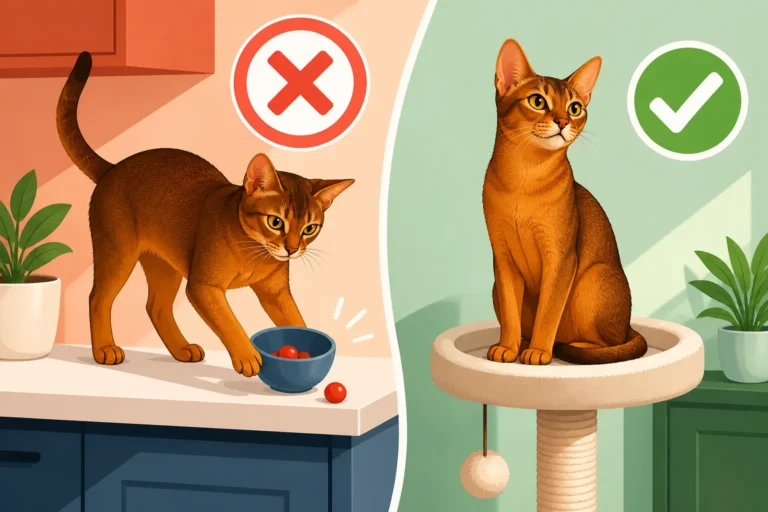
Instead of resorting to scolding or punishing your Abyssinian, which often merely reinforces the attention-seeking aspect of the behavior, focus intensely on redirection. The moment you observe your Abyssinian attempting to open a door or cabinet, immediately and gently interrupt their focus and redirect their attention to an appropriate, desirable activity. This could involve initiating a vigorous play session with an irresistible wand toy, presenting them with a challenging puzzle feeder filled with their favorite treats, or engaging them with an exciting treat dispenser. The overarching goal here is to consistently interrupt the undesirable behavior and then lavishly reward a more desirable, acceptable alternative.
Positive reinforcement is absolutely paramount in this process. Reward them generously and immediately when they engage with their designated toys, scratch posts, and climbing structures, especially if these items are new, particularly challenging, or represent a significant investment in their enrichment. The core idea is to make appropriate and sanctioned activities far more rewarding and intrinsically interesting than the illicit act of breaking into your cabinets. This strategy might necessitate increasing both the frequency and the intensity of your dedicated play sessions with your cat, as outlined in How Much Play an Abyssinian Needs Each Day.
This redirection method demands a considerable amount of consistency and patience on your part. It’s not about punishing the "wrong" behavior; instead, it’s about actively teaching and enthusiastically rewarding the "right" and acceptable behaviors. Over time, through this consistent approach, your Abyssinian will gradually learn that seeking engagement and stimulation through appropriate channels leads to far better outcomes and significantly more positive interaction with you, their beloved human.
Preventative Measures and Environmental Enrichment
The key to a harmonious home with an Abyssinian is to proactively meet their needs for activity and mental engagement. Prevention isn't just about locking things up; it's about providing so many compelling alternatives that they don't need to pick your locks.
Maximizing Vertical Space and Climbing Opportunities
Abyssinians are inherently arboreal creatures, which means they possess a natural and powerful instinct to be up high. Providing ample vertical space in your home isn't just beneficial for their physical health and agility; it is absolutely crucial for their mental well-being and overall contentment. A robust cat tree that stretches all the way to the ceiling, a thoughtfully installed series of wall-mounted shelves, or even just clearing the tops of accessible bookcases can effectively satisfy their innate need to survey their domain from an elevated, commanding position.
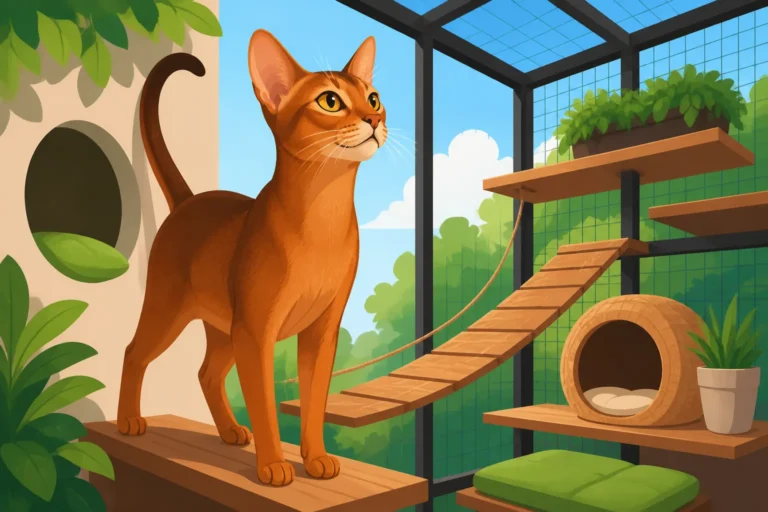
Consider proactively creating an "Abyssinian superhighway" around your living space by strategically installing and connecting wall shelves. This clever arrangement allows them to patrol their territory, exercise their agility, and explore new pathways without constantly needing to be at floor level. It also provides a multitude of novel routes and interesting vantage points, catering to their exploratory nature. A well-designed, stimulating vertical environment can significantly reduce boredom-driven exploration of forbidden horizontal spaces, like your countertops and cabinet interiors. As the saying goes among Abyssinian owners, An Abyssinian Needs Height More Than It Needs Floor – and that's not an exaggeration.
When your Abyssinian has multiple, exciting, and sanctioned options for climbing, perching, and exploring upwards, they are far less likely to view a closed door or cabinet as the ultimate, irresistible challenge. The combined mental and physical effort required to navigate a complex, dynamic vertical landscape can be far more intrinsically rewarding and significantly less problematic for you than them constantly trying to break into your pantry.
Engaging Puzzle Toys and Interactive Play
Boredom is, without a doubt, the sworn enemy of a peaceful and well-adjusted Abyssinian household. These incredibly intelligent cats require their brains to be worked and challenged just as vigorously as their energetic bodies. Therefore, investing in a diverse array of puzzle feeders and genuinely interactive toys is an absolutely crucial component of their care. Don't simply leave a bowl of kibble down for them; instead, make them actively work for their food, turning mealtime into a stimulating mental exercise.
Puzzle feeders that require your Abyssinian to bat, roll, or skillfully manipulate the toy in order to release hidden treats are exceptionally effective tools for mental enrichment. Make sure to rotate these toys regularly to maintain their novelty and keep them consistently engaging for your smart cat. Beyond just food-based puzzles, consider incorporating remote-controlled toys, carefully supervised automatic laser pointers (always remember to end these sessions with a tangible treat or a physical toy to prevent frustration), or even simple DIY cat-safe mazes made from cardboard boxes. These can all provide hours of much-needed mental stimulation. You might find some great options by browsing pet supplies on Amazon. The type of toy that works best can vary, so explore Which Puzzle Feeders Hold an Abyssinian's Attention.
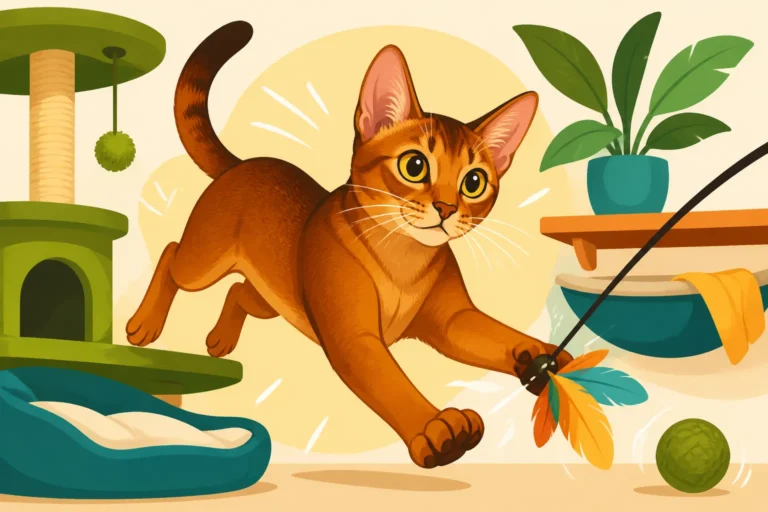
Dedicated, consistent play sessions with you, their human, are truly irreplaceable. Abyssinians thrive on one-on-one interaction and view these playtimes as invaluable bonding opportunities. Utilize wand toys that realistically mimic the erratic movements of prey, allowing them to fully engage their natural chase, stalk, and "kill" instincts. Always conclude these play sessions with a small, healthy treat to provide a satisfying "catch" and to fully satisfy their hunting drive. A physically tired and mentally stimulated Abyssinian is a far happier cat, and consequently, significantly less likely to be covertly picking the locks on your cabinets.
Understanding the "Why": Beyond Just Mischief
It’s easy to get frustrated when your Abyssinian is constantly getting into things, but stepping back and understanding the underlying drivers can shift your perspective and lead to more effective solutions. Their behaviors aren’t arbitrary; they’re deeply rooted in their breed characteristics.
Addressing Underlying Boredom and Lack of Stimulation
It's very easy, and often our first instinct, to label an Abyssinian’s persistent door-opening antics as mere "mischief" or "naughtiness." However, it’s crucial to understand that this behavior is rarely, if ever, malicious. More often than not, it is a clear symptom of unmet needs within your cat. These intelligent, energetic felines are inherently wired to be active, profoundly curious, and constantly engaged with their environment. If their living space doesn't adequately provide sufficient outlets for these fundamental, natural instincts, they will instinctively create their own forms of entertainment and exploration, often in ways that we, as owners, find incredibly inconvenient or even problematic.
Consider the behavior of their wild feline ancestors, who would spend the vast majority of their day hunting for food, extensively exploring their territory, and interacting with their environment in complex, physically demanding, and mentally stimulating ways. Our domesticated cats, especially a breed as active and intelligent as the Abyssinian, retain many of these powerful evolutionary instincts. A quiet, unchanging, and predictable house simply doesn't cut it for them. They crave the mental challenge and the physical exertion that naturally comes from navigating a dynamic, ever-changing world. The range of behaviors covered in What an Abyssinian Does When It Is Bored can be quite extensive, from excessive vocalization to inappropriate scratching, and yes, even opening doors.
So, before you allow frustration to take hold, take a moment to critically assess your Abyssinian's daily routine and overall living situation. Are they truly receiving enough dedicated play time? Is their environment sufficiently stimulating and rich with engaging opportunities? Do they have enough safe and accessible opportunities to climb, explore, and survey their surroundings? More often than not, by proactively increasing positive enrichment and meeting these intrinsic needs, you can dramatically reduce these unwanted exploratory behaviors and foster a happier, more content cat.
The Importance of a Consistent Routine
While Abyssinians certainly love novelty in their play and exploration, they are also, paradoxically, creatures of habit in many aspects of their daily lives. They truly thrive on predictability and a consistent routine. Establishing and maintaining a consistent schedule for feeding times, dedicated play sessions, and regular interactive moments can provide them with a profound sense of security and significantly reduce any underlying anxiety, which can sometimes fuel excessive or obsessive exploratory behaviors, like persistent door-opening.
When an Abyssinian reliably knows when their dedicated play sessions will occur, when they can expect to be fed, and when they can anticipate receiving focused attention from you, they are far less likely to resort to "extreme measures" – such as breaking into cabinets – in an attempt to get your notice or to stimulate themselves. A consistent routine provides them with a clear, predictable framework within which to operate, fostering a sense of control and understanding over their immediate environment.
Furthermore, a consistent daily routine benefits you, the owner, immensely. It makes it considerably easier to ensure that their fundamental needs are consistently being met, and it allows you to more readily track if they are eating, playing, and eliminating normally, all of which are crucial indicators of their overall health and well-being. Ultimately, a happy, well-adjusted, and consistently engaged Abyssinian is significantly less likely to be a frustrated, cabinet-raiding one.
When to Seek Professional Help
Most of the time, managing an Abyssinian's door-opening habits is a matter of patience, environmental adjustments, and consistent redirection. However, there are instances when professional intervention might be necessary.
Persistent Destructive Behavior
While an Abyssinian opening doors and cabinets is often more of a nuisance or an amusing quirk, it can occasionally escalate into truly destructive or even dangerous behavior, especially if they are consistently gaining access to hazardous areas or ingesting harmful substances. If your Abyssinian is persistently causing significant damage, displaying obsessive tendencies, or repeatedly putting themselves in danger despite your most diligent efforts at cat-proofing and providing ample enrichment, it might be a clear signal that it's time to consider seeking professional help.
It's important to clarify that this isn't about blaming you or your cherished cat; rather, it’s about acknowledging that sometimes, an objective, experienced feline behavior expert can offer invaluable insights and strategic solutions that we, as devoted owners, might simply overlook. A certified feline behaviorist can conduct a thorough assessment of the situation, pinpoint specific triggers or underlying stressors, and help you develop a tailored, comprehensive plan to effectively manage and modify the problematic behavior. They are adept at discerning whether the behavior is purely a manifestation of boredom or if there’s a deeper, underlying issue such as anxiety, stress, or even a nascent compulsive disorder.
To assist a professional, it’s highly beneficial to keep a detailed log of when these behaviors occur, what typically precedes them (e.g., specific times of day, your absence, certain sounds), and what the immediate aftermath is. This meticulously gathered data will prove invaluable for a behaviorist in understanding the precise patterns and proposing the most effective, targeted interventions for your specific situation.
Signs of Stress or Anxiety
Sometimes, what initially appears to be mere mischief or playful naughtiness can actually be a significant indicator of underlying stress or anxiety in your Abyssinian. An Abyssinian who suddenly begins to exhibit obsessive door-opening, or one who concurrently displays other unusual behaviors such as excessive vocalization (beyond their normal chirping), frantic overgrooming, sudden changes in their litter box habits, or even uncharacteristic aggression, could very well be communicating distress or unhappiness.
Any sudden, drastic, or unexplained change in your cat's typical behavior absolutely warrants an immediate veterinary visit to thoroughly rule out any potential medical issues. Once a clean bill of health is established by your vet, then a qualified feline behaviorist can effectively step in. Environmental changes (like moving house), the introduction of new pets or household members, significant alterations in the household routine, or even subtle, persistent tensions within the home environment can all act as powerful triggers for stress in sensitive and intelligent cats like Abyssinians.
Understanding signals like What a Stressed Abyssinian Overgrooms or other similar stress cues can provide you with crucial clues that their door-opening isn't just a playful game, but potentially a coping mechanism for something deeper and more concerning. Addressing the root cause of the anxiety, rather than just merely attempting to suppress the symptom, is paramount for their long-term well-being and happiness.
| Type of Latch/Lock | Description | Pros | Cons |
|---|---|---|---|
| Lever Handle Lock | A plastic guard designed to prevent lever handles from being pushed down. | Easy to install, visible deterrent for many cats. | Can sometimes be bypassed by very clever or persistent Abyssinians; not ideal for heavy doors. |
| Round Doorknob Cover | A plastic dome-shaped cover that makes it difficult for paws to grip and turn a standard round knob. | Inexpensive, a good deterrent for casual attempts at twisting. | Extremely determined Abyssinians might still find a way, especially if they can hang from it. |
| Magnetic Cabinet Locks | Installed discreetly on the inside of cabinet doors, requiring a magnetic "key" to open. | Highly secure and completely invisible from the outside, effectively cat-proof. | Requires installation (often drilling); the magnetic "key" can be easy to misplace; can be slow to open. |
| Adhesive Strap Locks | Flexible plastic straps that adhere to the outside of cabinet doors or drawers, with a release mechanism. | No drilling required, portable, good for temporary use or rental properties. | Visible on the exterior; strong or persistent Abyssinians may eventually peel them off; adhesive can damage some finishes over time. |
| Hook and Eye Latch | A simple metal hook that latches into an eye, typically installed on the inside or outside of a door or cabinet. | Very secure and straightforward, inexpensive, highly effective. | Requires drilling; visible if installed on the outside; may not seamlessly fit all cabinet styles or aesthetics. |
| Sliding Door Locks | Devices designed to prevent sliding closet or cupboard doors from being moved laterally. | Simple to install, effective for preventing lateral movement on sliding doors. | Only works on sliding door configurations; can be bypassed if not secured tightly or if cat can lift the door. |
Disclaimer
This article is for general informational purposes only and does not constitute professional advice. Laws, prices and regulations vary by location and change over time. Consult a qualified professional for guidance on your specific situation.