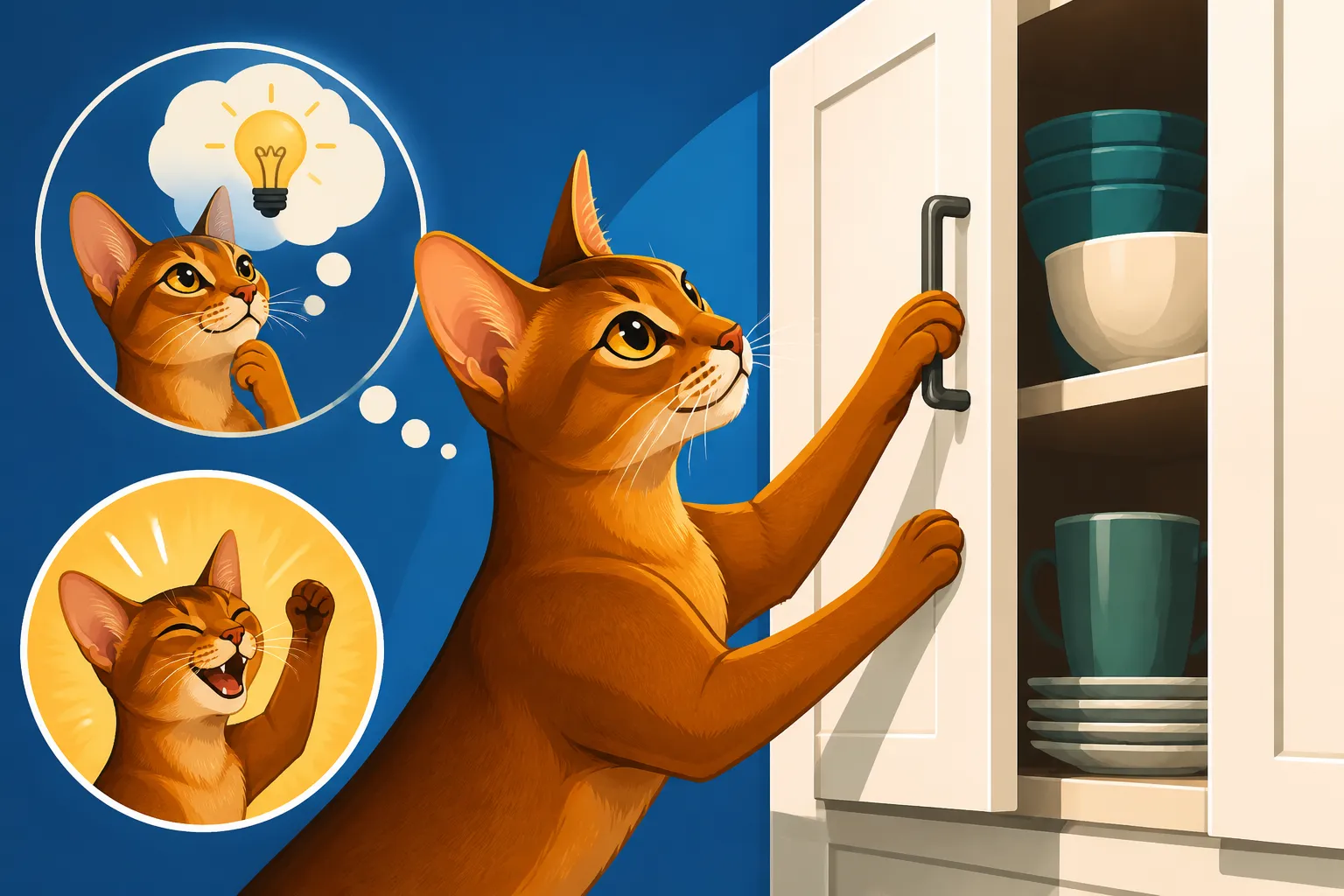
How an Abyssinian Learns to Open a Cupboard
Anyone who shares their home with an Abyssinian cat knows they are far from ordinary housecats. They're a whirlwind of energy and intelligence, always seeking out the next adventure or puzzle to solve. One common, and often frustrating, challenge many Abyssinian owners face is their cat's uncanny ability to open cupboards, turning a simple cabinet into a personal playground or pantry. This comprehensive guide will delve into how an Abyssinian learns to open a cupboard, unraveling the feline psychology behind this behavior, and offering practical, detailed solutions to help you maintain your privacy (and your sanity!).
The Abyssinian's Natural Curiosity and Intelligence
If you've spent any time with an Abyssinian, you already know they aren't your typical lounge-lizard lap cat. These are highly intelligent, deeply curious creatures whose minds are constantly whirring, seeking engagement and understanding of their environment. This innate drive is often the first step on their journey to becoming master cabinet-openers.
The Breed's Innate Drive to Explore
Abyssinians are renowned for their insatiable curiosity. They don't just exist in a space; they investigate it, explore it, and try to understand how every single piece works. This isn't just a casual glance; it's a full-on scientific inquiry from their perspective. They are constantly observing, watching every move you make, especially when those movements involve manipulating objects in their world.
Think about it: when you open a pantry door to grab a snack, your Abyssinian isn't just waiting for a crumb. They're watching your hand, the way the latch turns, the slight pull, the creak of the door. They're absorbing this information, cataloging it, and very likely planning their own experiments for later. Their bright, keen eyes miss nothing, and their brains are always processing, making connections between actions and outcomes. It’s part of what makes them such fascinating companions, even if it occasionally makes them frustrating housemates when your flour sack ends up on the floor.
This constant mental engagement is precisely why a quiet home without much to stimulate an Abyssinian can lead to "inventive" behaviors. If they're not given appropriate outlets for their intelligence, like puzzle toys or interactive play, they'll find their own. And sometimes, "their own" involves delving into forbidden territories like the kitchen cabinets. It’s not malice; it's simply an intelligent mind seeking stimulation, and your cupboards often present the perfect, intriguing challenge.
They see your home as a giant puzzle, and every closed door or cupboard is an invitation to solve it. This isn't just about getting to what's inside; sometimes, the act of opening it is the reward itself. The click of a latch, the swing of a door, the sheer accomplishment of figuring something out – these are all highly motivating factors for a cat that thrives on mental stimulation and physical activity.
Why a Simple Knob Isn't a Challenge for an Abyssinian
For us humans, a knob or a handle is a straightforward mechanism. For an Abyssinian, it's a test of their dexterity, their problem-solving skills, and their sheer determination. And often, they pass with flying colors. These cats have incredibly agile paws, more like hands than typical cat paws, capable of surprisingly fine manipulation.
Their paws are not just for batting at toys or climbing; they can hook, pull, push, and even twist with remarkable precision. This is particularly evident with handles, which offer a perfect purchase for their claws or a hook for their agile digits. They might even use their entire body weight, leaning against a door while simultaneously pulling on a handle, demonstrating a sophisticated understanding of leverage and force. You might be surprised to learn that their ability to use their paws extends to many common household items, much like you might see in Why an Abyssinian Opens Doors and Cabinets.
A simple round knob might pose a slightly greater challenge, as it requires a twisting motion that's harder for most cats to master. However, many Abyssinians, through persistence and observation, learn to hook a claw into any slight crevice or gap, or simply keep batting at it until it turns by sheer luck or repeated attempts. Once they figure out the cause-and-effect – "if I bat this thing, the door opens" – the behavior is quickly cemented. They are quick studies, and any success, even accidental, can quickly lead to intentional replication.
Beyond the physical dexterity, there's the mental component. An Abyssinian isn't just randomly batting; they're connecting the dots. They've watched you, perhaps hundreds of times, interact with that cupboard. They understand that the handle is the key. Their intelligence allows them to mimic actions and experiment with variations until they achieve the desired outcome. This isn't just instinct; it's a demonstration of higher cognitive function, a true sign of a brilliant, if mischievous, mind.
The Learning Process: From Observation to Execution
It's truly fascinating to witness an Abyssinian's learning curve. What starts as pure curiosity often evolves into a sophisticated, repeatable behavior, all through a combination of observation, trial and error, and the potent power of positive reinforcement. They are little scientists, constantly experimenting with their environment.
Mimicry and Reinforcement
The journey to cupboard-opening mastery often begins with simple observation. Your Abyssinian watches you open a drawer or a cabinet. They see your hand grasp the knob, twist it, pull it, or your finger flick a latch. They are taking notes, filing away this information. Later, when you're not around, or perhaps even while you are, they'll begin their own experiments. It might start innocently enough – a jump onto the counter leads to a paw accidentally swiping a handle. The door swings open a crack. Eureka!
This accidental discovery is quickly reinforced. Even if there's nothing particularly interesting inside that first cupboard, the mere act of causing something to open is a huge win for an intelligent cat. It's an affirmation of their mental prowess, a rewarding outcome that encourages them to try again. The sound of the door opening, the new scents, the feeling of accomplishment – these are all powerful motivators. It’s no different from us enjoying solving a complex puzzle; the act itself is pleasurable.
If, by chance, that cupboard does contain something exciting – a bag of treats, a favorite toy, or even just some crinkly paper – the reinforcement becomes even stronger. They quickly learn that "opening this specific thing" leads to "getting that desirable thing." This direct connection creates a strong behavioral loop that can be incredibly difficult to break once established. They're not being naughty; they're simply being efficient problem-solvers in pursuit of their goals. This is also why many Abyssinians learn to engage in behaviors like Why an Abyssinian Steals Small Objects.
Even your reaction can inadvertently reinforce the behavior. If you rush over, exclaiming or scolding, your Abyssinian might interpret this as attention. And for a breed that thrives on interaction, even negative attention can be a form of reward. They've successfully gotten you to react, to engage with them, and that interaction can be just as reinforcing as finding a treat inside the cupboard. Breaking this cycle requires a consistent strategy that avoids accidental reinforcement.
The Drive for Resources: Food, Toys, and Attention
While curiosity is often the initial spark, the drive for resources quickly becomes the fuel for this cupboard-opening habit. Abyssinians are intelligent enough to associate specific locations with specific rewards. If your cat knows the "treat cupboard" or the "toy cabinet," you can bet those will be their primary targets.
Imagine a scenario: your Abyssinian, let's call her Luna, knows that the crunchy treats she loves are kept in the pantry. She's watched you open it countless times. One day, feeling particularly adventurous, she jumps onto the countertop, hooks a paw under the handle, and with a determined pull, the door creaks open. Inside, she finds a whole bag of her favorite salmon-flavored delights. This immediately becomes a highly rewarding behavior. From that moment on, the pantry isn't just a pantry; it's the gateway to deliciousness, and Luna will dedicate considerable mental and physical energy to accessing it again.
It's not just about food, though that's a huge motivator. Many Abyssinians have specific toys they adore, and if those toys are stored away in a cabinet, it becomes a target. The rustle of a crinkle ball or the scent of catnip emanating from a drawer is enough to activate their problem-solving mode. The satisfaction of "hunting" for and "catching" their toy from a closed compartment can be as rewarding as an actual hunt. This speaks to their inherent need for engaging activities, which is why What an Abyssinian Does When It Is Bored often involves things they shouldn't be doing.
And then there's the attention aspect. Abyssinians are deeply social and thrive on interaction with their human companions. If opening a cupboard, even one with nothing appealing inside, consistently leads to you coming over, picking them up, talking to them, or even chasing them away, they've achieved a desired outcome: your attention. This can become a self-perpetuating cycle, especially if they're feeling a bit lonely or under-stimulated during the day. They've learned that cupboard-opening is a reliable way to get you to focus on them, even if it's with a stern voice.
Common Cupboard Opening Techniques
You might think all cupboard-opening looks the same, but Abyssinians, being the clever individuals they are, often employ a variety of techniques, adapting to the type of handle or latch in their way. Observing how your cat does it can actually help you choose the best counter-strategy.
The "Paw and Pull" Method
This is probably the most classic and frequently observed technique. It involves your Abyssinian standing on their hind legs, or perhaps perched on an adjacent counter, and using one or both front paws to hook or bat at the cupboard handle. Their agile paws, often described as almost hand-like in their dexterity, are perfectly suited for this.
Imagine a kitchen cabinet with a horizontal bar handle. Your Abyssinian will typically hook a claw (or several) underneath the handle, then apply a pulling motion, often combined with their body weight. They might lean back slightly, using their powerful hind legs to push off the floor or counter, increasing the leverage on the handle. This can be surprisingly effective, especially with handles that offer a good grip. They learn quickly which angle or amount of force yields results, making them incredibly efficient once they've mastered the technique.
This method is particularly common with standard kitchen and bathroom cabinets, which often feature simple bar or D-shaped handles. These offer an ideal purchase for a cat's paw. Once the door is ajar, even by an inch, their persistent noses and more paws will work to widen the gap, allowing them full access to the interior. They don't just pull once and give up; they will patiently work at it, testing different angles and levels of force until they succeed.
Sometimes, they'll even integrate a jumping component. They might jump onto the countertop, then immediately turn to face the cabinet, giving them a more advantageous position to pull the handle downwards or outwards. Their incredible athleticism, which makes them such prodigious climbers and jumpers, is a huge asset in their cabinet-opening endeavors. It's a testament to their strength and coordination that they can perform these intricate moves with such finesse.
The "Jump and Push" Strategy
While the "paw and pull" method targets handles, the "jump and push" strategy is often deployed for knobs or situations where a direct pull isn't feasible. This technique showcases the Abyssinian's remarkable agility and strength. They leverage their entire body against the obstacle, a true display of feline ingenuity.
Picture a situation where a cabinet has a small, round knob rather than a handle. A direct pull is much harder. Instead, an Abyssinian might jump onto the countertop above the cabinet, or even directly onto the cupboard door itself if it's sturdy enough. From this elevated position, they then use their body weight to push down on the knob or the top edge of the door. The goal is to create enough downward pressure or lateral force to make the latch release or the door swing open. Their ability to reach high places is well-known, as explored in How High an Abyssinian Will Climb.
This strategy also comes into play with certain types of latches that require a downward or inward push to release. An Abyssinian might bat repeatedly at the mechanism or stand on its hind legs and use its chest or shoulders to press against the door, trying to force it open. It's a demonstration of their problem-solving skills – if one method doesn't work, they quickly adapt and try another. They rarely give up easily, especially if they suspect a reward lies within.
The sheer athleticism involved in this approach is impressive. An Abyssinian can launch themselves with surprising power and accuracy, using their strong legs and flexible spines to manipulate their position. This is why having secure cupboard latches isn't just about outsmarting their paws; it's about accounting for their full-body engagement. If your Abyssinian starts showing signs of jumping onto places that aren't typically cat-friendly, it might be a precursor to this particular cupboard-opening technique.
Handles vs. Knobs: Which Is Easier?
When it comes to the battle of the latches, not all cupboard closures are created equal in the eyes of an enterprising Abyssinian. Generally speaking, handles tend to be easier for them to manipulate than knobs, but neither is foolproof when dealing with such a clever cat.
Bar or D-shaped handles offer a perfect grip for an Abyssinian's claws. They can easily hook a paw underneath, pull down, and leverage their body weight to open the door. The larger surface area and accessible design make them low-hanging fruit for feline lock-pickers. I've seen Abyssinians casually walk by a cabinet, flick their paw, and have the door open in a smooth, practiced motion, as if they were born knowing how to do it. It’s almost startling how quickly they can learn to operate these common household fixtures.
Knobs, on the other hand, require a more complex movement: rotation. Most cats struggle with the twisting motion needed to operate a standard round knob. However, Abyssinians are not "most cats." While it presents a greater challenge, a persistent Abyssinian might still figure it out. They could try batting at it until it loosens, or as mentioned, find a tiny crevice to get a claw into and apply turning pressure. The difficulty rating for knobs is higher, but not impossible, especially if there's a significant reward inside the cupboard.
Ultimately, while some mechanisms are harder than others, relying solely on the type of handle or knob to deter an Abyssinian is often a losing battle. Their intelligence means they are constantly assessing and adapting. If they can't open it one way, they'll observe, experiment, and try another. This is why prevention often involves moving beyond the basic door hardware and implementing more robust solutions, like those discussed in How to Secure a Cupboard Against an Abyssinian.
Strategies to Outsmart Your Clever Abyssinian
So, your brilliant Abyssinian has figured out your cupboards. What now? The good news is, there are effective ways to secure your belongings and keep your curious cat out of trouble. It takes a bit of effort and consistency, but it's entirely achievable.
Childproof Latches and Locks
This is hands down the most effective solution for preventing your Abyssinian from opening cupboards. Childproof latches and locks are designed to deter intelligent toddlers, and they work just as well, if not better, on clever cats. The market is full of options, and a quick search on platforms like Amazon will reveal a wide array of choices.
You'll find several types of these safety devices. Magnetic locks are installed inside the cabinet, out of sight, and require a special magnetic "key" to open. These are fantastic because they're discreet and very secure, but you must keep track of the key! Adhesive strap locks are another popular choice, sticking to the outside of the cabinet and requiring a two-step release mechanism that's too complex for most paws. There are also internal spring-action latches that require a human finger to push down from inside before the door can open. For drawers, side-mounted drawer locks can be very effective, securing the drawer to the frame.
When installing, consider the specific "attack vectors" your Abyssinian uses. If they pull from the top of the door, place the latch there. If they try to pry open the bottom, secure that area. Consistency is paramount: every cupboard and drawer that holds something potentially interesting or dangerous needs to be secured. Missing just one can teach your cat that some cupboards are still "fair game." Investing in a good set of these latches will save you endless frustration, damaged goods, and potential vet visits in the long run.
Beyond just physical security, these latches often break the behavioral pattern. When your Abyssinian tries their usual trick and the door doesn't open, the lack of a reward (the open door) helps extinguish the behavior over time. While they might try a few more times, the consistent failure eventually teaches them that this particular puzzle is no longer solvable. It's a gentle but firm "no" to their persistent efforts, allowing them to eventually seek out other, more appropriate forms of entertainment.
Redirection and Environmental Enrichment
While securing your cupboards is crucial, it's equally important to address the underlying motivation for your Abyssinian's mischief: their intense need for mental and physical stimulation. A bored Abyssinian is a destructive Abyssinian, and simply blocking access without providing alternatives often leads to them finding new, equally undesirable ways to entertain themselves.
This is where environmental enrichment comes in. Your Abyssinian thrives on vertical space. They want to climb, perch, and survey their domain from on high. Invest in tall, sturdy cat trees, or even better, install wall-mounted cat shelves. Platforms and ramps that create a multi-level climbing paradise will give them appropriate outlets for their acrobatic tendencies. This satisfies their natural instinct to scale heights and explore, diverting their energy away from your kitchen cabinets. Consider the options available to you with a quick search for "cat shelves" on Amazon or at your local pet store. Your Abyssinian needs to be able to use their athleticism safely. Take a look at An Abyssinian Needs Height More Than It Needs Floor for more ideas.
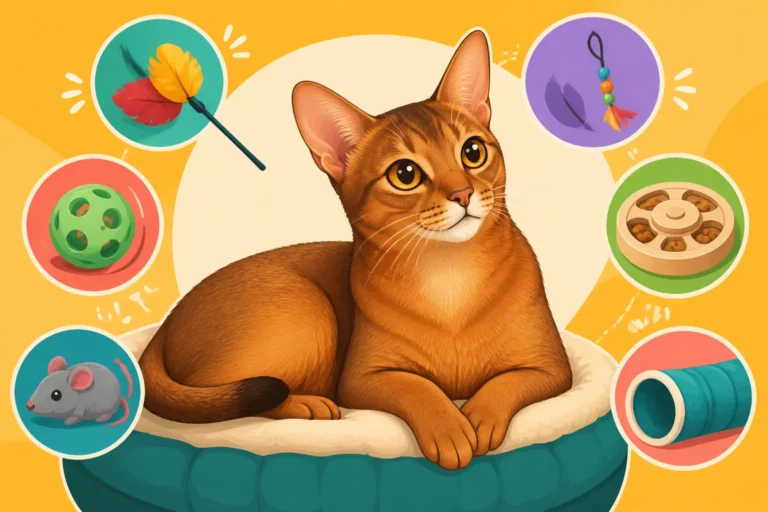
Beyond vertical territory, provide plenty of interactive toys and puzzle feeders. Puzzle feeders, which require your cat to "work" for their food or treats, are excellent for mental stimulation. They tap into an Abyssinian's problem-solving skills and predatory drive, giving them a constructive "job" to do. Rotating toys regularly can also keep things fresh and exciting, preventing boredom. Structured play sessions with wand toys are also vital; aim for several short, intense sessions daily to burn off energy and satisfy their hunting instincts. This kind of engagement can greatly reduce their desire to raid your cupboards. More information on engaging their minds can be found in Which Puzzle Feeders Hold an Abyssinian's Attention.
| Latch Type | Pros | Cons | Best For |
|---|---|---|---|
| Magnetic Locks | Invisible, strong, clean look | Requires drilling, easy to lose key | Kitchens, high-traffic areas, aesthetics |
| Adhesive Straps | No drilling, easy install, versatile | Visible, adhesive may damage surfaces, not always chew-proof | Rental properties, quick fixes, temporary needs |
| Internal Springs | Out of sight, relatively easy to use | Requires drilling, can be difficult to install accurately | Bathrooms, lower use cupboards |
| Sliding Locks | Good for side-by-side handles/knobs | Visible, can be unsightly, less secure for single handles | Double-door cabinets, side-by-side drawers |
Training and Discouragement
While prevention (latches) and redirection (enrichment) are your primary tools, a bit of consistent training and discouragement can also play a role in reinforcing the message that cupboards are off-limits. However, it's crucial to understand how cats learn, as direct punishment is almost always ineffective and can damage your bond.
Consistency is, once again, the golden rule. Every time your Abyssinian even approaches a secured cupboard with the intention of opening it, you need to provide a consistent, non-aversive deterrent. This could be a loud clap, a firm "No!" (without yelling), or a sudden spray from a water bottle (use sparingly and only if it doesn't cause undue fear or stress). The key is that the deterrent happens immediately as they begin the action, not after the door is already open and they're exploring inside. Delaying the discouragement means they won't associate it with the act of opening the cupboard.
Positive reinforcement is far more powerful. When your Abyssinian is playing with their appropriate toys, climbing their cat tree, or using a puzzle feeder, lavish them with praise and treats. This teaches them that engaging in desired behaviors leads to good things, making those activities more appealing than trying to get into your cabinets. You want to make the "right" choices more rewarding than the "wrong" ones. For more on positive reinforcement, you might be interested in Training an Abyssinian Is Easier Than Stopping It.
You might also consider motion-activated air canisters (like Ssscat or PetSafe Spray Barrier) placed strategically near tempting cupboards. These devices emit a harmless, startling hiss of air when motion is detected, effectively deterring your cat without you needing to be present. They create a consistent, impersonal "punishment" for the unwanted behavior, teaching your Abyssinian that the cupboard itself delivers the unpleasant surprise. These should be used with caution, however, ensuring they don't frighten your cat excessively or create general anxiety about the area. The goal is to discourage the specific action, not make your cat fear their own home.
Addressing the Root Causes of This Behavior
Successfully stopping an Abyssinian from opening cupboards isn't just about applying a latch; it's about understanding and addressing the fundamental needs that drive this ingenious behavior. Often, their mischief is a symptom of unmet requirements for mental and physical engagement.
Ensuring Sufficient Mental and Physical Stimulation
Abyssinians are not content to be decorative accessories. They are athletes and intellectuals in feline form. If they aren't getting enough opportunities to exercise their bodies and minds, they will create their own entertainment, which often involves challenging household boundaries. This breed needs significant daily engagement.
Think about how much an Abyssinian runs, jumps, and plays. How Much Play an Abyssinian Needs Each Day is often far more than other cat breeds. They need intense, interactive play sessions with you, using wand toys that mimic prey. These sessions aren't just for fun; they're crucial for satisfying their innate hunting instincts and burning off their boundless energy. If they don't get this outlet, that energy and instinct will be channeled elsewhere – perhaps into prying open cabinet doors. Without a consistent and robust play routine, you’re practically inviting them to find creative ways to cause trouble.
Beyond physical exertion, their sharp minds require constant stimulation. Puzzle feeders are invaluable for this, turning mealtime into a problem-solving exercise. Teaching them tricks using positive reinforcement and a clicker can also be highly rewarding for both of you, engaging their intelligence in a constructive way. Consider giving your Abyssinian a "job," something purposeful that allows them to use their intellect and agility. This could be anything from fetching a specific toy to navigating a complex wall-mounted obstacle course. For more insights on this, read How to Give an Abyssinian a Job.
A lack of appropriate stimulation can manifest in many ways, and cupboard-opening is just one. If your Abyssinian seems excessively restless, destructive in other areas, or constantly seeking attention (even negative attention), it’s a strong signal that they need more enrichment. Providing a rich, stimulating environment where their needs are consistently met is the best long-term strategy for a happy, well-behaved Abyssinian who isn't trying to redecorate your kitchen from the inside out.
The Role of Food Security and Access
For many Abyssinian cupboard raiders, food is the ultimate prize. If your cat has successfully accessed a food source from a cabinet, that behavior is going to be incredibly strong and persistent. Addressing this means rethinking how you store and present food.
First and foremost, secure all food items. This means not just dry kibble, but also bags of treats, opened cans of wet food (even if they're in the pantry for storage), and any human snacks that might be appealing. Many Abyssinians are opportunistic and will chew through bags or boxes if they can get to them. Transfer dry foods into sturdy, airtight containers that are much harder for a cat to open or chew through. Even if they get the cupboard door open, they shouldn't be able to access the food itself.
Consider your feeding routine. If your Abyssinian is free-fed (food left out all day), they might still be driven by the thrill of finding "new" food, or simply the mental challenge of getting into the cupboard. Moving to scheduled meal times, where food is presented and then removed after a certain period, can help establish a more predictable routine and reduce the perceived scarcity that can drive food-seeking behaviors. It can also help them appreciate the food they do get at meal times.
Finally, while it might seem obvious, never leave human food unattended on counters or in easily accessible places. A dropped piece of chicken or an open bag of chips is an open invitation for your Abyssinian to investigate. If they find these high-value rewards outside of a cupboard, it reinforces their notion that "investigating" leads to good things. Your goal is to make all desirable resources available only through appropriate channels (their bowl, puzzle feeders) and to make cupboards an unrewarding endeavor. This combined approach of secure storage, consistent feeding, and ample enrichment is your best bet for turning your cupboard-opening Abyssinian into a contented, well-adjusted companion.
Disclaimer
This article is for general informational purposes only and does not constitute professional advice. Laws, prices and regulations vary by location and change over time. Consult a qualified professional for guidance on your specific situation.