Which Puzzle Feeders Hold an Abyssinian’s Attention
If you've ever owned an Abyssinian, you know the struggle: a cat that never truly seems tired, always on the prowl, looking for the next adventure or, let's be honest, the next thing to get into. Many of us find ourselves wondering how to channel that boundless energy and sharp mind, especially when they've already zoomed through the house for the tenth time. This guide is all about tackling that particular Abyssinian challenge by exploring the wonderful world of puzzle feeders and how to pick the ones that will genuinely capture and hold your intelligent, high-energy cat's attention.
Why Puzzle Feeders are Essential for an Abyssinian's Well-being
Let's face it, owning an Abyssinian is a unique experience. They aren't your typical lap cat, content to snooze the day away. These are incredibly intelligent, active, and curious creatures who thrive on mental and physical stimulation. Just putting their food in a bowl twice a day, while convenient for us, can actually be a disservice to their natural instincts and lead to a whole host of behavioral quirks we'd rather avoid.
The Abyssinian's Innate Drive to Hunt and Forage
Think about it: in the wild, cats spend a significant portion of their day hunting. They stalk, chase, pounce, and solve mini-puzzles to get their meals. An Abyssinian, with its lean, athletic build and keen intelligence, is particularly tuned into this primal drive. Their quick wits and endless curiosity mean they're constantly seeking engagement, constantly looking for something to "do." When that drive isn't met through appropriate channels, it doesn't just disappear; it gets redirected.
This is where puzzle feeders shine. They tap into that deep-seated need to work for food, transforming mealtime from a simple eat-and-run affair into an engaging, problem-solving activity. It's not just about slowing down their eating; it's about giving their brilliant minds a "job." Many Abyssinians are called "the clowns of cats" or "the busiest cat in the house" for a reason – they love to be involved, to explore, and to figure things out. Puzzle feeders allow them to exercise those cognitive muscles, mirroring the mental effort a hunt would require, even if it's just to get a few kibble pieces out of a clever contraption. It satisfies their natural inclination to forage, making them feel productive and engaged. Why Foraging Suits an Abyssinian's Mind is a topic many Abyssinian owners quickly come to understand.
Preventing Boredom and Destructive Behavior
An unstimulated Abyssinian is, shall we say, a creative Abyssinian – and not always in a good way. Their high intelligence means they get bored easily, and a bored Abyssinian will absolutely find ways to entertain themselves. This can manifest as unwanted behaviors like knocking items off shelves (because it's fun to watch them fall, right?), systematically exploring every cabinet, or even destroying furniture. What an Abyssinian Does When It Is Bored can be quite a sight, and often an expensive one!
Puzzle feeders provide an outlet for this energy and intelligence, channeling it into a positive and rewarding activity. Instead of trying to figure out how to open the pantry door, your Abyssinian might be happily strategizing how to get the last piece of kibble out of a tricky feeder. It's a way to keep their minds occupied and their paws busy, reducing the likelihood of them inventing their own, less desirable, forms of entertainment. This also contributes to their overall well-being, helping to manage stress and anxiety that can arise from under-stimulation. A mentally tired Abyssinian is a happier, less destructive Abyssinian, which ultimately makes for a happier household.
Types of Puzzle Feeders and What Works for Abyssinians
The market for puzzle feeders has exploded, offering a dizzying array of options. For an Abyssinian, you need feeders that are robust, engaging, and challenging enough to hold their attention without being so frustrating they give up. We’re looking for things that reward persistence and cleverness.
Beginner-Friendly Puzzle Feeders
When you're first introducing your Abyssinian to the concept of working for their food, you want something straightforward that builds confidence. Starting too complex can lead to frustration and disinterest.
- Slow Feeder Bowls: While not a "puzzle" in the strictest sense, these bowls have mazes or ridges that force your cat to eat around obstacles, slowing down their mealtime. They're a great first step for cats who gobble their food too quickly and are a gentle introduction to not having immediate access to every morsel. Brands like Outward Hound make excellent, sturdy options available on Amazon.
- Simple Treat Balls/Wobblers: These are typically spherical or irregularly shaped toys with small openings. Your Abyssinian bats them around, and as they move, kibble or treats fall out. They're excellent for encouraging physical activity and understanding the cause-and-effect of movement equals reward. Look for ones that are easy to roll and dispense food relatively easily at first. The PetSafe SlimCat Interactive Food Dispenser is a popular choice that allows you to adjust the opening size.
- Basic Activity Mats/Snuffle Mats: These are fabric mats with many folds, pockets, and fringes where you can hide kibble. They encourage sniffing, digging, and gentle pawing to extract food. They're fantastic for engaging their olfactory senses and providing a calmer, more focused foraging experience. They are often machine washable, which is a bonus for hygiene.
These entry-level feeders are crucial for building a positive association with "working" for food. Your Abyssinian needs to feel successful quickly to stay motivated.
Intermediate Challenges for Smarty-Pants Abyssinians
Once your Abyssinian has mastered the basics, it's time to ramp up the mental workout. These feeders require more complex problem-solving and often multiple steps to access the food.
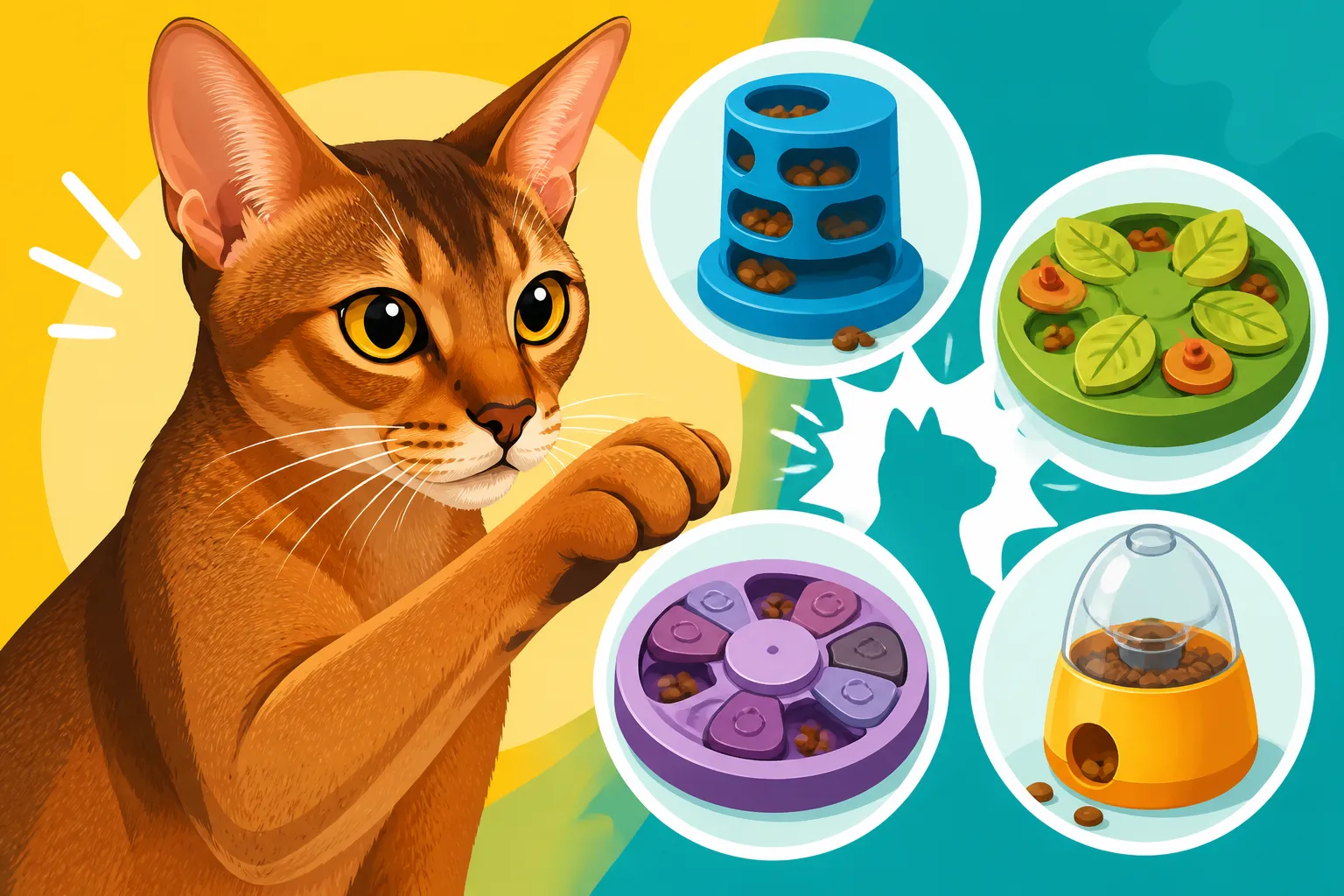
- Feeder Trees/Towers: These often consist of multiple levels or trays where food is placed. Your cat has to use their paws to bat the kibble down from one level to the next until it reaches the base. This engages their natural tendency to bat and "fish" for things. Trixie Pet Products offers several multi-level feeder toys that are often well-received by intelligent breeds.
- Slider Puzzles: These feeders have compartments covered by sliding tops that your cat needs to move with their paw or nose to reveal the food. Some also incorporate pegs or levers that need to be nudged. These are excellent for fine motor skills and sequential problem-solving. They come in various difficulty levels, with some requiring a push, and others a more complex slide-and-lift motion.
- Labyrinth Feeders: Similar to slow feeder bowls but often taller and more intricate, labyrinth feeders force cats to navigate complex channels to get to their food. Think of them as a 3D maze for kibble. These slow down eating considerably and provide a satisfying challenge. Why an Abyssinian Solves a Puzzle Feeder Too Quickly can be a real issue with simpler designs, so these multi-layered labyrinths help extend mealtime.
These feeders will hold an Abyssinian's attention for longer periods because they demand more thought and effort. Many Abyssinians truly enjoy the process of figuring things out, so these types of challenges are right up their alley.
Advanced and DIY Options
For the truly gifted (or easily bored) Abyssinian, you might need to get creative or invest in more advanced, multi-step feeders.
- Multi-Stage Feeder Systems: Some feeders combine elements like a treat ball that dispenses into a slider puzzle, or a tower that feeds into a more complex maze. These require your cat to complete one task before they can even attempt the next, keeping them engaged for longer. Companies like Cat Amazing offer cardboard-based multi-compartment puzzles that can be reconfigured for varied challenges.
- DIY Bottle/Cardboard Puzzles: Don't underestimate the power of a simple cardboard box or an empty plastic bottle. You can punch holes in a bottle, put kibble inside, and cap it, forcing your cat to roll it just right. For cardboard boxes, cut holes, create flaps, or use toilet paper rolls to build a custom foraging tray. This is a cost-effective way to continually offer novelty, which is key for an Abyssinian. How to Make a Puzzle Feeder Harder for an Abyssinian often involves these kinds of homemade adjustments. Just ensure all materials are safe and non-toxic.
- Scattering Food: This might seem overly simple, but scattering a portion of their kibble around the house – on shelves, in a crumpled paper bag, tucked into a cat tree – leverages their natural foraging instincts. It makes them hunt for every single piece, engaging their sense of smell and their desire to explore every nook and cranny. This also encourages more movement throughout the day. How to Hide Food Around the House for an Abyssinian can turn your entire home into an enrichment zone.
When considering feeders, remember the Abyssinian's strong, agile paws. They excel at batting, scooping, and manipulating objects. Feeders that leverage these skills will be more successful.
Choosing and Introducing the Right Puzzle Feeder
Selecting the perfect puzzle feeder for your Abyssinian involves a bit of trial and error, but there are some fundamental principles that can guide you. It's not just about the feeder itself, but how you introduce it.
Factors to Consider When Selecting
When you're browsing options, whether it's online on Amazon or at your local pet supply store, keep these Abyssinian-specific traits in mind:
- Durability and Stability: Abyssinians are energetic and often play rough. A flimsy plastic feeder will quickly be batted across the room and potentially broken. Look for sturdy materials, a wide base to prevent tipping, and designs that can withstand enthusiastic play. Remember, they often get into things, so a robust design is critical. Why an Abyssinian Destroys Cheap Furniture Faster applies to their toys and feeders too!
- Ease of Cleaning: Hygiene is paramount. Food residue can accumulate, and if left unclean, it can deter your cat or become a health hazard. Opt for feeders that are easy to disassemble and wash, preferably dishwasher-safe components if possible.
- Appropriate Difficulty Level: As discussed, start easy and gradually increase the challenge. An Abyssinian that finds a feeder too hard will quickly lose interest. The goal is engagement, not frustration.
- Material Safety: Ensure the materials are non-toxic and durable enough not to break into small, ingestible pieces. Food-grade plastics, ceramics, or unfinished wood are generally good choices.
- Size and Access: Make sure the openings are large enough for your Abyssinian's paw to access the food (or nose, if it's a slider), but not so large that the food just falls out effortlessly. The feeder should also be stable enough that your cat can't easily knock it over to spill all the contents.
Tips for Success and Engagement
Introducing a new puzzle feeder requires patience and a bit of strategy to ensure your Abyssinian embraces it.
- Start with High-Value Treats: Initially, use small, irresistible treats or their favorite kibble to lure them into interacting with the feeder. The higher the reward, the more motivated they'll be.
- Make it Easy at First: For adjustable feeders, set them to the easiest possible setting. Leave some food easily accessible or even just on top of the feeder so they get the idea that food comes from this new object.
- Demonstrate: Cats learn by watching. Gently show your Abyssinian how to use the feeder by nudging a treat out yourself. Let them see and hear the food dispensing.
- Gradual Transition: Once they're comfortable, gradually replace some of their regular bowl meals with the puzzle feeder. Don't go cold turkey; your Abyssinian might just look at you with disdain if their usual meal isn't immediately available.
- Don't Overfill: Start with a small amount of food. A full puzzle feeder can be overwhelming and lessen the reward value of each successful extraction.
- Positive Reinforcement: Praise your Abyssinian when they engage with the feeder, even if they only get one piece of kibble. Keep it a positive experience.
- Location, Location, Location: Place the feeder in a quiet, accessible spot where your Abyssinian feels safe and comfortable. Avoid high-traffic areas or places where they might be disturbed. Why an Abyssinian Ignores the Bed You Bought It can sometimes come down to placement – if it's not where they feel secure or engaged, they won't use it.
By following these tips, you'll set your Abyssinian up for success and help them discover the joy of working for their meals.
Maximizing Long-Term Engagement
Even the most brilliant Abyssinian can get bored with the same toy day in and day out. To truly get the most out of puzzle feeders and keep that bright spark alive, you need a strategy for long-term engagement. This involves novelty and integrating these tools into their daily routine.
Rotation and Novelty
Imagine eating the same meal off the same plate, at the same time, in the same way, every single day. Even we would get bored! Abyssinians thrive on variety and challenge. What's stimulating one week might be old news the next.
- Build a Collection: Invest in a few different types of puzzle feeders – maybe one slow feeder bowl, one treat ball, and one slider puzzle. This allows you to rotate them, introducing a "new" challenge every few days or weeks. When a feeder disappears for a while and then reappears, it often feels fresh and exciting again.
- Adjust Difficulty: Many puzzle feeders offer adjustable difficulty settings. Don't be afraid to make them harder once your Abyssinian has mastered a level. How to Make a Puzzle Feeder Harder for an Abyssinian can involve simply closing a hole a bit more or adding another sliding layer. Keep them thinking!
- DIY Variations: As mentioned before, homemade puzzles are fantastic for novelty because they can be changed endlessly. A new cardboard box configuration, a different set of hidden kibble spots, or even just a new texture can make an old idea feel new.
- Vary the Rewards: While kibble is great for daily feeding, sometimes a special, higher-value treat can reinvigorate interest in a particular feeder. Use strong-smelling, delicious treats occasionally to remind them how rewarding these puzzles can be.
By providing consistent novelty, you tap into your Abyssinian's inherent curiosity and prevent them from becoming complacent. It keeps their problem-solving skills sharp and their enthusiasm high.
Integrating Puzzle Feeders into Daily Routine
Puzzle feeders shouldn't just be an occasional treat; they should be a regular, integral part of your Abyssinian's day. Their high energy levels and intelligent minds mean they need constant engagement.
- Mealtime Replacement: The easiest way to integrate puzzle feeders is to replace some or all of their regular bowl meals with them. Instead of simply pouring kibble into a bowl, portion it out into several different puzzle feeders around the house. This forces them to work for their entire meal, mimicking natural foraging behavior. This can also help regulate their eating pace, especially if they tend to eat too quickly. Which Food Budget Suits a High Energy Abyssinian often factors in the food used for these feeders, so consider portioning their existing diet.
- Scheduled Play Sessions: Use puzzle feeders during specific times of day when your Abyssinian is usually most active or demanding. For instance, if they tend to get a case of the "zoomies" in the evenings, setting out a more challenging puzzle feeder can redirect that energy. You might find that How Much Play an Abyssinian Needs Each Day can be partially satisfied by these engaging mealtime activities.
- Mental Stimulation When You're Busy: Puzzle feeders are lifesavers for those times when you can't actively play with your Abyssinian but they still need stimulation. If you're working from home, on a call, or simply needing a few minutes of peace, a puzzle feeder can keep them happily occupied.
- Beyond Food: While primarily for food, some puzzle feeders can also be used with small, non-food toys (like crinkle balls or soft pom-poms) to encourage interaction and play. This expands their utility beyond just mealtime.
Consistency is key. The more you integrate puzzle feeders into your Abyssinian's daily life, the more they will see them as a normal, enjoyable part of their routine. They'll come to anticipate the challenge and the reward, leading to a more enriched and well-behaved feline companion.
Puzzle Feeder Comparison for Abyssinians
Here's a quick look at how different types of puzzle feeders stack up for your energetic Abyssinian:
| Feeder Type | Difficulty (1-5, 5 hardest) | Key Benefits | Best For | Considerations |
|---|---|---|---|---|
| Slow Feeder Bowl | 1 | Slows eating, gentle introduction to obstacles | First-time users, fast eaters, senior Abyssinians | Limited mental challenge, easily mastered |
| Treat Ball/Wobbler | 2 | Encourages active play, cause-and-effect learning | Energetic cats, introducing movement-based puzzles | Can be noisy, may roll under furniture, some cats get bored if too easy |
| Snuffle Mat | 2 | Engages sense of smell, promotes calm foraging, reduces gulping | Less active play, olfactory enrichment, quiet feeding | Can get messy, requires regular cleaning, not physically challenging |
| Feeder Tree/Tower | 3 | Utilizes paw dexterity, vertical thinking, multi-level engagement | "Fisher" cats, those who enjoy batting and scooping, good for mental and physical | Can be tipped if not stable, requires space, some cats prefer ground-level foraging |
| Slider Puzzle | 3-4 | Develops problem-solving, fine motor skills, sequential thinking | Highly intelligent cats, those who enjoy deliberate problem-solving | Can be frustrating if too hard initially, small pieces can be lost, thorough cleaning needed for grooves |
| Multi-Stage/DIY | 4-5 | Maximum engagement, customizable difficulty, endless novelty, cost-effective | Advanced users, cats prone to boredom, creative owners | Requires owner creativity, safety checks for DIY, can be messy with multiple components |
Disclaimer
This article is for general informational purposes only and does not constitute professional advice. Laws, prices and regulations vary by location and change over time. Consult a qualified professional for guidance on your specific situation.