Why an Abyssinian Destroys Cheap Furniture Faster
It's a frustrating, all-too-common scenario for Abyssinian owners: you bring home a new piece of furniture, thinking it will finally complete your living space, only to find it shredded, toppled, or otherwise "redecorated" by your energetic feline friend within weeks. This guide is here to shed light on why your spirited Abyssinian seems to have a particular knack for dismantling anything less than fortress-grade furnishings, and what you can do about it.
The Abyssinian's Innate Drive for Activity and Exploration
Abyssinians aren't just cats; they're tiny, perpetually in motion, highly intelligent bundles of boundless energy. If you've ever owned one, you know the drill: they're constantly on the go, exploring every nook and cranny, and engaging with their environment in ways that would exhaust a less determined creature. This isn't a flaw in their character; it's simply who they are. Their natural instincts drive them to climb, jump, hunt, and investigate, and if your home isn't set up to channel that energy constructively, your furniture often becomes the unwitting victim.
Why "The Busiest Cat in the House" Needs Outlets
The Abyssinian's reputation as The Abyssinian Is the Busiest Cat in the House is well-earned. They don't just nap away the day; they're actively observing, planning their next ascent, or figuring out how to get into that intriguing cabinet. This constant mental and physical activity means they need far more stimulation than many other breeds. A lazy Sunday afternoon for a domestic shorthair might be spent napping on the couch, but for an Aby, it's a prime opportunity to scale the curtains, explore the top of the bookshelf, or test the structural integrity of your armchair. Without adequate outlets for their physical prowess and keen minds, they will invent their own entertainment, and quite often, that entertainment involves your belongings.
Consider it from their perspective: a plush, soft sofa isn't just a place to lounge; it's a mountain range waiting to be conquered, its woven fabric an ideal surface for a quick claw sharpening session before the next adventure. That flimsy bookshelf? A climbing challenge. The delicate end table? A perfect springboard. Their high intelligence, which makes them so trainable and engaging, also means they quickly get bored. And when an Abyssinian is bored, destruction is often its chosen pastime. What an Abyssinian Does When It Is Bored can range from opening doors and cabinets to systematically dismantling objects that weren't designed for such rigorous interaction.
The Curious Case of Abyssinian Intelligence
Beyond their physical energy, Abyssinians possess a sharp, inquisitive mind. They love to solve problems, whether it's figuring out how to open a childproof latch or how to access a forbidden countertop. This intelligence means they quickly learn the weaknesses of your household items. If a chair wiggles a little, they'll exploit that weakness. If a cabinet door doesn't quite latch, they'll be inside in no time. Why an Abyssinian Opens Doors and Cabinets isn't just a cute quirk; it's a testament to their problem-solving abilities, which can, unfortunately, extend to deconstructing your home if not properly managed.
This combination of intense activity and high intelligence means that furniture isn't just furniture to an Abyssinian; it's a landscape of opportunity, a series of challenges to be met. And if the furniture isn't up to the task, it will inevitably succumb.
The Specific Ways Abyssinians Interact with Furniture
It’s not just that Abyssinians are active; it’s how they are active. They have a particular set of behaviors that put specific stresses on your home furnishings, often far beyond what typical furniture is designed to withstand. Understanding these behaviors is key to realizing why cheap, mass-produced items just don't stand a chance.
Climbing to New Heights: The Vertical Domain
Abyssinians are arboreal by nature, meaning they love to climb and occupy high vantage points. They are not content to stay at ground level; they constantly seek out the highest perches in the room. This isn't just about comfort; it's an instinctual need for security and observation. An Abyssinian Needs Height More Than It Needs Floor is a fundamental truth for owners of this breed. Your bookshelf isn't just for books; it's a multi-level climbing structure. Your wardrobe isn't just for clothes; it's the summit of Mount Bedroom.
When an Abyssinian launches itself up a dresser or scales a curtain, the force exerted on that furniture is considerable. Cheap furniture, often made of particle board with weak joints, can quickly become unstable. Shelves designed only to bear static weight will buckle under the dynamic impact of a leaping Abyssinian. Over time, repeated ascents and descents will loosen screws, warp panels, and compromise the entire structure, leading to wobbles, creaks, and eventually, collapse.
The Instinct to Scratch and Mark Territory
Scratching is a natural, necessary feline behavior. It keeps claws healthy, stretches muscles, and serves as a visual and scent marking of territory. While Abyssinians are no different, their intense energy and enthusiasm mean they can be particularly fervent scratchers. If a proper scratching post isn't readily available and appealing, or if the furniture offers a more satisfying surface, they'll use what's at hand.
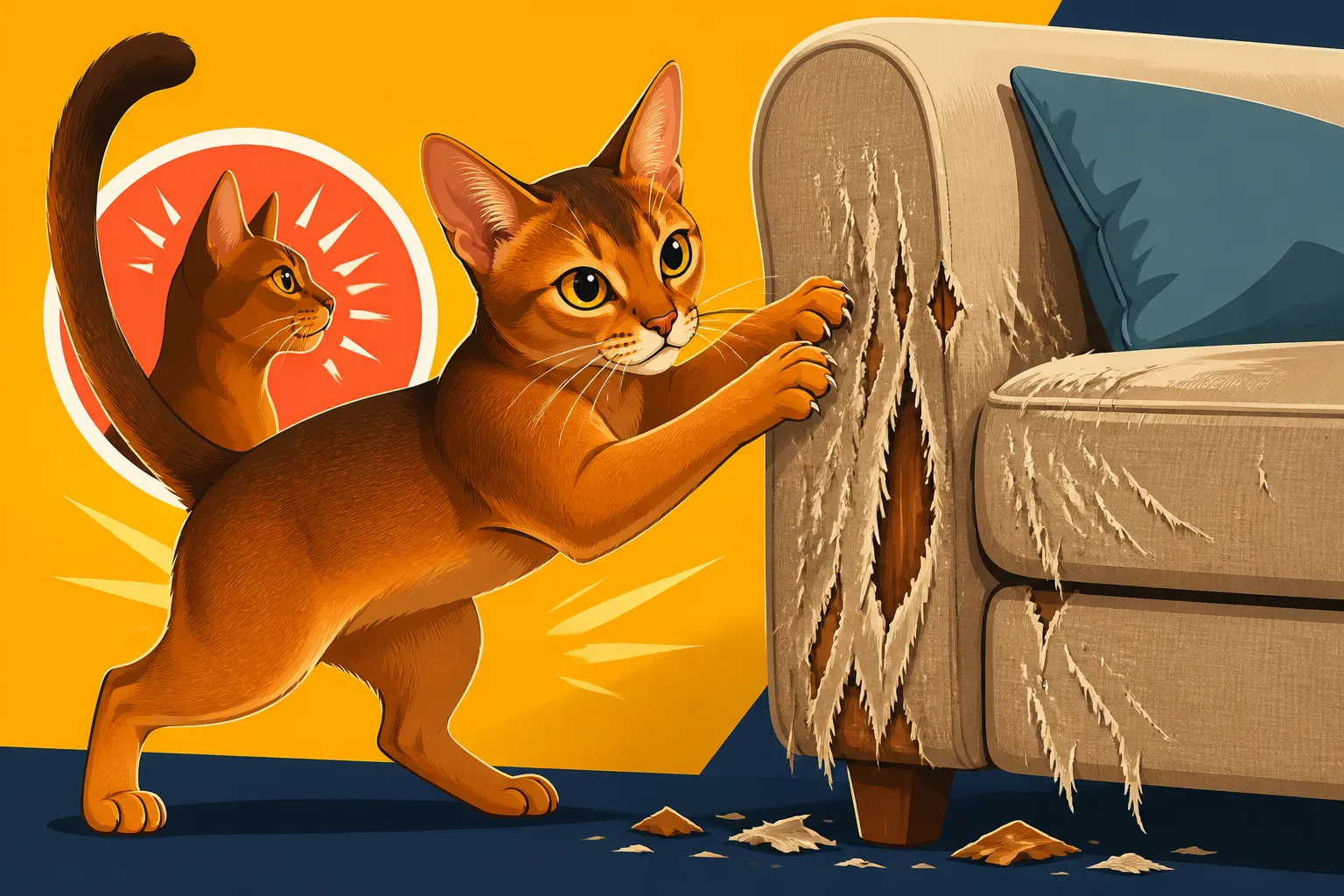
Cheap upholstery, often thin and loosely woven, offers little resistance to an Abyssinian's sharp claws. A single enthusiastic scratching session can pull threads, create snags, and quickly unravel the fabric. Unlike some cats who might casually scratch, an Abyssinian often engages with a full-body stretch, digging its claws in deep for maximum satisfaction. This repetitive, vigorous action on a fragile material guarantees rapid deterioration. Investing in robust scratching solutions, like Why an Abyssinian Prefers a Tall Sisal Post, is crucial to diverting this natural behavior away from your sofa.
Chewing and Investigating: A Mouthy Approach
Abyssinians are highly curious and use their mouths to explore their environment. This isn't always destructive chewing, but it can quickly become so, especially with tempting textures or loose components on furniture. Tassels, loose threads, corners of cushions, or even wooden legs can become targets for a curious Aby looking for sensory input or an outlet for pent-up energy.
For inexpensive furniture, which might have exposed staples, poorly finished edges, or small, easily detached decorative elements, this can pose not only a risk to the furniture but also to the cat. Swallowing small parts, ingesting synthetic fibers, or even chewing on electrical cords (if not properly managed, see How to Cable Manage a Room for an Abyssinian) can lead to serious health issues, necessitating veterinary intervention and highlighting the importance of durable, safe household items.
Why Cheap Furniture Fails Faster
The allure of inexpensive furniture is undeniable, especially when furnishing a home on a budget. However, when you live with an Abyssinian, that initial saving can quickly turn into a revolving door of replacements and repairs, making the "cheap" option anything but economical in the long run. The fundamental issue lies in the materials and construction methods employed in budget-friendly pieces, which simply aren't designed for the dynamic, high-impact lifestyle an Abyssinian brings.
The Fatal Flaws of Particle Board and MDF
Many affordable furniture items are constructed from particle board (also known as chipboard) or Medium-Density Fibreboard (MDF). These engineered wood products are made by compressing wood particles or fibers with resin. While they offer a smooth surface for veneers and keep costs down, they possess critical weaknesses when faced with the rigors of an active Abyssinian:
- Low Density and Durability: Unlike solid wood, particle board and MDF are less dense and much weaker. They chip, dent, and swell easily, especially if exposed to moisture (like a knocked-over water glass or a cat's curious lick).
- Poor Screw Retention: Screws, a primary fastening method in these pieces, don't hold well in particle board. With repeated stress from climbing, jumping, or even just general use, screw holes strip out, joints loosen, and the furniture quickly becomes rickety and unstable. A cat tree made of flimsy particle board, for instance, won't withstand the repeated launching and landing of an agile Abyssinian.
- Veneer vs. Solid Finish: Cheap furniture relies heavily on thin veneers or laminates to mimic the look of real wood. These coverings are easily scratched, peeled, or chewed off by an Abyssinian, revealing the unsightly, vulnerable particle board underneath. Once compromised, the piece quickly looks dilapidated and is hard to repair aesthetically.
The Limitations of Thin Upholstery and Weak Frames
Beyond the structural core, the exterior of cheap upholstered furniture is equally vulnerable. Thin, loosely woven fabrics, often made of synthetic materials, are no match for an Abyssinian's claws. They snag easily, pull threads, and quickly show wear, transforming a new sofa into a tattered mess in short order. The stuffing in cheap cushions might also be less resilient, quickly flattening under the weight and repeated movement of an active cat.
Beneath the fabric, the frame itself is often the weakest link. Inexpensive upholstered pieces might use softwoods, stapled joints, or minimal bracing. This leads to wobbling, squeaking, and eventual structural failure when subjected to an Abyssinian's leaps and bounds. An Abyssinian needs furniture that can withstand dynamic forces, not just static loads. The table below highlights some key differences:
| Feature | Cheap Furniture (Particle Board/Thin Upholstery) | Durable Furniture (Solid Wood/Robust Fabric) |
|---|---|---|
| Material | Particle board, MDF, flimsy plastic | Solid hardwood, metal, high-density composites |
| Construction | Staples, glue, minimal screws, weak joints | Dovetails, dowels, strong screws, reinforced joints |
| Upholstery | Thin, loosely woven synthetic fabrics | Dense, tightly woven, pet-friendly fabrics |
| Stability | Prone to wobbling, sagging, and structural failure | Solid, stable, designed for impact and weight |
| Durability | Quick to scratch, peel, break, or wear out | Resists scratches, holds up to climbing and play |
| Lifespan | Short, often requires frequent replacement | Long-lasting, withstands years of active use |
| Repairability | Difficult to repair, often irreversible damage | Easier to repair, maintain aesthetic appeal |
Ultimately, the lack of inherent strength, the susceptibility to damage, and the rapid degradation of appearance mean that cheap furniture offers very little return on investment for an Abyssinian owner. The continuous cycle of replacement and repair can often cost more than a single, well-chosen, durable piece in the long run.
Investing in Durable, Abyssinian-Proof Alternatives
Given the Abyssinian's natural inclinations, the solution isn't to try and "train out" their instincts, but rather to provide them with appropriate, durable outlets that satisfy their needs without sacrificing your home. Investing upfront in high-quality, pet-friendly furniture and enrichment items is not just a luxury; it's a necessity for peaceful coexistence with this dynamic breed. It also contributes to What an Abyssinian Costs to Keep Every Year.
Robust Climbing Structures and Vertical Spaces
Since Abyssinians live for heights, providing ample, stable vertical territory is paramount. Forget the flimsy carpeted cat trees that wobble with a mere breeze. You need structures designed for serious climbing.
- Solid Wood Cat Trees: Look for cat trees made with solid wood posts and heavy, stable bases. These can withstand repeated leaps and bounds without tipping or disintegrating. Many brands offer modular systems that allow you to customize the height and layout, ensuring it fits your space and your Aby's ambition. You might find a great selection of robust options on platforms like Chewy, offering various sizes and materials. What a Cat Tree Tall Enough for an Abyssinian Costs might seem significant upfront, but it's an investment that pays off by saving your other furniture.
- Wall-Mounted Shelves and Perches: Wall shelves are an excellent way to utilize vertical space without taking up floor area. These should be securely mounted into wall studs and made of strong wood or metal. Create an intriguing "cat highway" with multiple levels, leading to high perches where your Abyssinian can survey its domain. What Wall Shelves for an Abyssinian Cost to Install can vary, but their longevity and effectiveness make them worthwhile. When planning, consider Why an Abyssinian Needs More Vertical Furniture Than Most Cats. Ensure the path is clear and safe, as How an Abyssinian's Climbing Route Safe is paramount to preventing accidents.
- "Catio" Outdoor Enclosures: For those with the space, a catio offers a safe, stimulating outdoor environment where your Abyssinian can climb, bask, and observe nature without endangering local wildlife or itself. It's a fantastic way to provide natural enrichment. What a Catio Costs for an Abyssinian is a bigger investment, but it offers unparalleled stimulation.
Scratch-Resistant Upholstery and Protective Measures
Protecting your upholstered furniture requires a multi-pronged approach, combining deterrents with appropriate alternatives.
- Durable Fabrics: When purchasing new upholstered furniture, opt for fabrics known for their durability and scratch resistance. Microfiber, denim, canvas, and tightly woven blends can stand up much better to claws than delicate weaves. Some modern materials are specifically engineered to be pet-friendly, resisting snags and making cleaning easier.
- Strategic Placement of Scratching Posts: Ensure you have multiple scratching posts in various locations and materials, especially near furniture your Abyssinian is fond of attacking. Tall sisal posts are often a hit because they allow a full-body stretch. Why an Abyssinian Prefers a Tall Sisal Post is key – if it's not appealing, they won't use it. You can find a wide variety of these on pet supply sites like Chewy.
- Furniture Protectors: Clear, adhesive protectors can be applied to furniture corners and sides to deter scratching. While not the most aesthetically pleasing, they are highly effective in protecting vulnerable areas. You might also consider sturdy slipcovers for sofas and armchairs.
Engaging Toys and Mental Stimulation
Remember, destruction often stems from boredom. A tired Abyssinian is a less destructive Abyssinian.
- Interactive Play: Dedicate regular time each day for interactive play with wand toys, laser pointers, and fetch games. Abyssinians love to engage, and this focused attention helps burn off excess energy.
- Puzzle Feeders: Challenge their intelligence with puzzle feeders that require them to work for their food. This provides mental stimulation and can slow down meal times, mimicking natural foraging behavior.
- Rotation of Toys: Keep their toy collection fresh by rotating toys in and out, so they don't get bored with the same items. You can explore a vast array of stimulating toys on Chewy to keep your Aby engaged.
By understanding the unique needs of your Abyssinian and making thoughtful investments in durable, appropriate home furnishings and enrichment, you can save yourself a lot of frustration and expense. While pet insurance providers like Healthy Paws can offer peace of mind for unexpected veterinary bills if your curious cat gets into something it shouldn't, the best approach is always prevention by creating a stimulating and safe environment from the start. This proactive approach ensures a happier cat and a healthier home for everyone involved. Why a Single Abyssinian Costs More in Damage is a common refrain, emphasizing that proper preparation saves money in the long run.
Disclaimer
This article is for general informational purposes only and does not constitute professional advice. Laws, prices and regulations vary by location and change over time. Consult a qualified professional for guidance on your specific situation.