How Long It Takes to Clicker Train an Abyssinian
It's a common misconception that cats, especially active and independent breeds like Abyssinians, can't really be "trained" in the way dogs can. But if you're holding a clicker and looking at your Abyssinian with a gleam in your eye, wondering how long it'll take to teach them some impressive tricks, you're on the right track! This guide will delve into realistic timelines for clicker training your Abyssinian, understanding that their unique personality plays a huge role in the process.
Understanding the Abyssinian Mindset for Training
Before we even talk about timelines, we need to talk about Abyssinians. These aren't your average couch potatoes; they're incredibly intelligent, endlessly curious, and possess an energy level that can surprise even experienced cat owners. This intense intelligence is a double-edged sword when it comes to training. On one hand, they pick things up remarkably fast. On the other, they get bored just as quickly if the training isn't engaging or stimulating enough.
Their Intelligence and Energy: Why Patience is Key
Abyssinians thrive on mental stimulation. Their active minds are constantly observing, processing, and trying to figure out how things work – especially how to get what they want. This means they're excellent candidates for learning, but they also have very strong opinions about what's worth their time. If a training session feels repetitive or unrewarding, you'll lose their attention faster than they can scale your tallest bookcase. Patience isn't just a virtue; it's a necessity when working with an Abyssinian. You might set out to teach "sit" in one session, only for your cat to decide that exploring the new dust bunny under the sofa is far more interesting.
It’s crucial to remember that Abyssinians are not motivated by a desire to please you in the same way a dog might be. They are motivated by what benefits them. This means high-value treats and engaging sessions are paramount. If you try to force them into a rigid training schedule, you’ll find yourself with a frustrated cat and even more frustrated human. Instead, approach it as a collaborative game, where you’re offering an interesting challenge and a tasty reward. You might find that some days, your Abyssinian is simply not in the mood, and pushing them will only create a negative association with the clicker and the training process. Recognizing these signals and knowing when to end a session is a key part of successful training. How Many Hours a Day an Abyssinian Stays Active will give you a good idea of their boundless energy.
Why Clicker Training Works on an Abyssinian
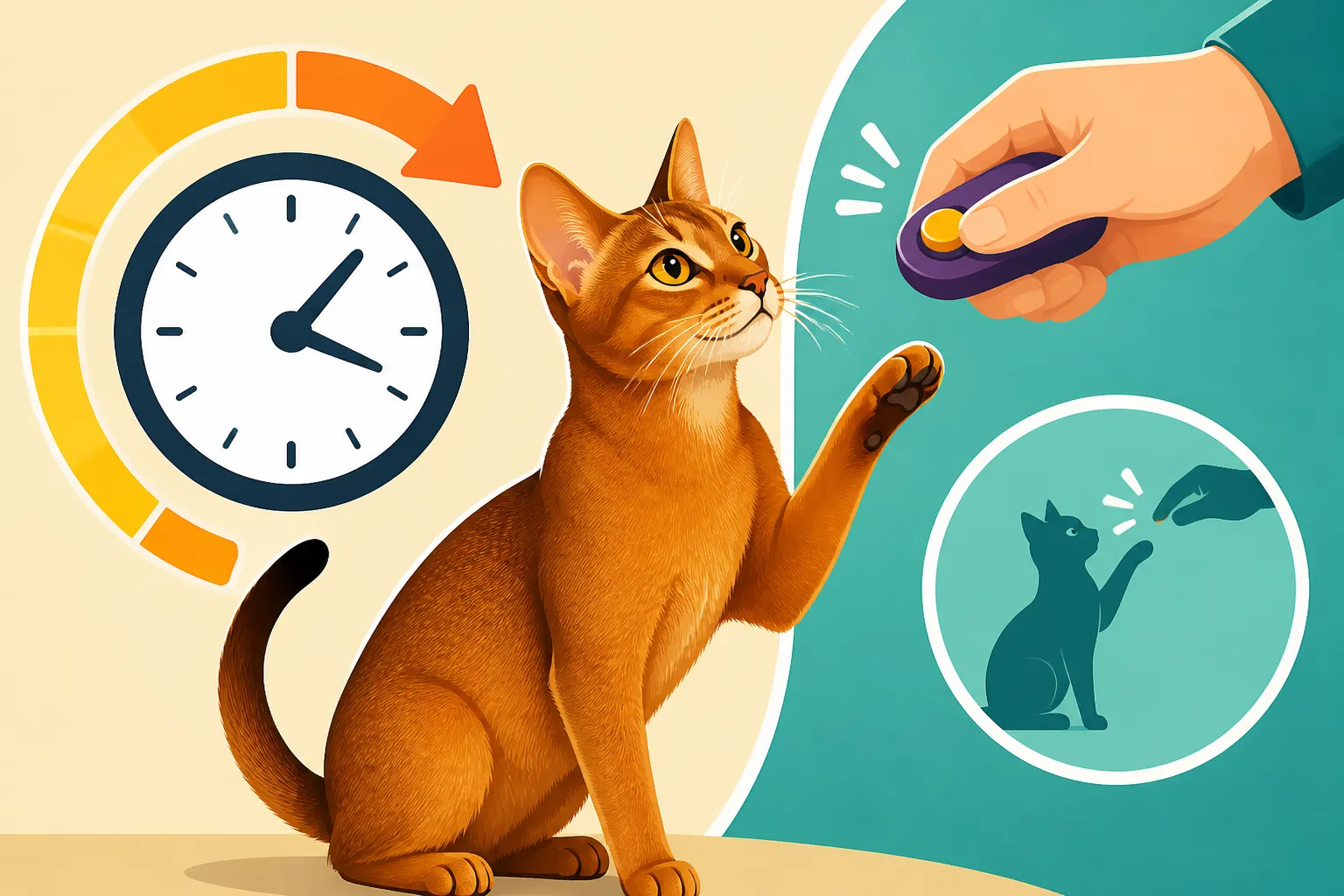
Clicker training is particularly effective for Abyssinians because it offers clear, immediate communication, which their intelligent minds appreciate. The "click" precisely marks the exact moment they perform the desired behavior, followed immediately by a reward. This clarity bypasses any frustration that might arise from vague praise or delayed treats. For a cat that is constantly analyzing its environment, this precision is invaluable. They quickly understand the cause-and-effect relationship, allowing them to problem-solve and figure out what action earns them that satisfying click and treat.
Furthermore, clicker training focuses on positive reinforcement, which is essential for a breed that responds poorly to punishment or negativity. An Abyssinian will simply shut down or become more determined to do things its own way if it feels coerced. The clicker method builds trust and makes training a fun, engaging game that strengthens your bond, rather than a chore. It taps into their natural curiosity and desire for interaction, turning learning into a highly anticipated activity. You'll likely see how quickly they grasp the concept of the clicker as a predictor of good things, often within just a few short sessions.
The Foundation: Getting Started with Clicker Training
Before you jump into teaching complex tricks, you need to establish the basics. This involves "charging the clicker" and then introducing a very simple first behavior. Think of it as laying the groundwork for all future learning. Without a strong foundation, the whole training house might just collapse.
Charging the Clicker: A Few Minutes to a Day
"Charging the clicker" is the very first step, and it's remarkably quick. This is where your Abyssinian learns that the sound of the clicker predicts a treat. It's less about teaching a behavior and more about creating a positive association with the click itself. You're essentially telling your cat, "When you hear this sound, something good is coming!"
To do this, simply click, then immediately give your Abyssinian a high-value treat. Repeat this about 10-20 times in a short session. Do this a few times throughout the day, maybe 2-3 sessions. Most Abyssinians, with their sharp minds, will pick up on this connection within one or two sessions, certainly within a day. You'll know it's "charged" when you click, and your cat immediately looks at you expectantly or for the treat, rather than being startled by the sound. You can find excellent clickers, often with wrist straps for convenience, on platforms like Amazon, making them easy to keep handy for impromptu training moments.
Teaching the First Simple Behaviors: Days to a Week
Once the clicker is charged, it's time for that first, simple behavior. A common choice is teaching your Abyssinian to "sit." This relies on "luring" or "capturing."
- Luring: Hold a treat near their nose and move it slowly over their head. As their nose follows, their rear end will naturally lower into a sit. The instant their bottom touches the ground, click and reward.
- Capturing: Simply wait for your Abyssinian to sit on its own. The moment their rear touches the ground, click and reward.
For an Abyssinian, who is often highly food-motivated, this first behavior can be learned remarkably fast. With consistent, short (2-5 minute) daily sessions, many Abyssinians will reliably offer a sit on cue within a few days to a week. The key is to keep sessions short, positive, and end on a high note. Don't push them if they're not focused. Remember, How to Teach an Abyssinian to Sit is a great next step, and you’ll want to have those high-value treats ready, because Why an Abyssinian Learns Faster When It Is Hungry.
Progressing with Your Abyssinian: Building a Repertoire
After mastering the first trick, you'll find that your Abyssinian starts to understand the game of clicker training. This opens up a world of possibilities, from more complex behaviors to chaining tricks together. The speed at which you progress from here will largely depend on your consistency and the cat's individual drive.
Expanding the Repertoire: Weeks to Months
Once your Abyssinian understands the concept of the clicker, expanding their repertoire of tricks can be quite rapid. They've figured out the system: do this, get a click, get a treat. Now, it's just a matter of applying that understanding to new actions. Tricks like "come," "spin," "paw," or even simple jumps can be introduced.
For each new trick, you'll follow a similar process: lure or capture the behavior, click the exact moment it happens, and reward. With consistent daily practice (again, short sessions of 5-10 minutes are ideal to avoid boredom), an Abyssinian can often learn a new, simple trick within a few days to a week. Mastering a small collection of 3-5 distinct tricks can easily take a few weeks to a couple of months. Don't be surprised if your Abyssinian starts trying to offer behaviors they think you want, trying to "hack" the system for more treats – it's a sign of their intelligence! For ideas, check out Which Tricks an Abyssinian Learns Fastest.
Consistency is Key, Not Just Time
It’s less about the sheer amount of time you spend, and more about the consistency of your efforts. Ten minutes of focused, fun training every day will yield far better results than one hour-long, frustrating session once a week. Abyssinians thrive on routine and clear expectations. If training is sporadic, they might lose interest or forget what they've learned, requiring you to re-establish connections.
Think about incorporating training into your daily interactions naturally. Waiting for their meal? Ask for a "sit" first. Want them to come when called? Use the clicker and a treat every time they respond to their name. These small, consistent efforts build over time. Remember, the goal isn't just to teach tricks, but to engage their minds and strengthen your bond. How to Recall Train an Abyssinian is a fantastic skill to work on with daily consistency.
Factors Influencing Training Time
While Abyssinians are generally quick learners, several factors can influence how long it takes to clicker train them. It's not a one-size-fits-all timeline, and understanding these variables can help you manage your expectations and adapt your approach.
Age and Temperament
Just like people, cats have individual personalities and learning curves. A young Abyssinian kitten, full of boundless energy and curiosity, might pick up new concepts faster but also be more easily distracted. Their attention span is shorter, so training sessions need to be even briefer and more frequent. What an Abyssinian Kitten's First Year Looks Like is a wild ride, and training fits right in.
An older Abyssinian might take a little longer to initially grasp the clicker concept, but once they do, their maturity can mean more focus and less distraction. They might not be as quick to react, but they can be more deliberate in their learning. Some Abyssinians are naturally bolder and more food-motivated, making them easier to train. Others might be a bit more cautious, requiring more patience and gentle encouragement. Understanding your cat's unique temperament is crucial for setting realistic timelines.
Your Consistency and Engagement
This is perhaps the biggest factor. If you're only training once a week for five minutes, progress will be slow. If you're doing short, engaging sessions a few times a day, every day, your Abyssinian will progress much faster. Consistency helps reinforce the learned behaviors and keeps the cat engaged in the process.
Your enthusiasm and patience also play a huge role. If you're frustrated, your Abyssinian will pick up on that energy and become less willing to participate. Keeping the sessions fun and positive, celebrating every small success with a click and a treat, will encourage them to keep trying. Think of it as a dance: both partners need to be in sync. The quality of your interaction and the value of your treats are far more important than the clock.
The Complexity of the Trick
Naturally, some tricks are harder than others. Teaching a simple "sit" or "paw" will take significantly less time than teaching a multi-step routine or a complex agility course. Breaking down complex behaviors into smaller, manageable steps (a process called "shaping") is key to teaching advanced tricks.
For example, teaching "fetch" might involve first clicking for touching the toy, then picking it up, then bringing it closer, then dropping it in your hand. Each step is a mini-lesson. While the initial steps might be learned quickly, mastering the full behavior can take several weeks or even months of dedicated practice. Remember, How Much Play an Abyssinian Needs Each Day is a lot, and training can be a fantastic part of that playtime.
Here's a general idea of typical clicker training timelines for an Abyssinian, assuming consistent, positive daily sessions:
| Behavior Stage | Example Behaviors | Typical Abyssinian Timeframe | Notes |
|---|---|---|---|
| Foundation | Charging the clicker | A few minutes to 1 day | Crucial first step, establishes click-treat association. |
| Basic Commands (Simple) | Sit, Come (recall in quiet environment), Paw | 3 days – 1 week per trick | Focus on luring or capturing. Short, frequent sessions are best. |
| Intermediate Commands | Spin, Target touch, Stay (short duration), Go to mat | 1-3 weeks per trick | Requires more focus and understanding. May involve shaping. |
| Advanced Commands/Chains | Fetch, Leash training, Multi-step routines | 1 month+ per behavior/chain | Break down into small steps. How to Leash Train an Abyssinian can take patience. Consistency over time is vital. |
| Behavior Modification | Stopping counter-surfing, Crate training | Weeks to several months | More about redirecting and reinforcing desired alternatives. Can be a longer-term project depending on the cat and the behavior. Why an Abyssinian Gets Into the Bin explains their curiosity. |
Ultimately, how long it takes to clicker train your Abyssinian isn't a race. It's a journey of discovery and bonding with your amazing feline friend. Enjoy the process, celebrate the small victories, and revel in the intelligence and companionship your Abyssinian brings to your life.
Disclaimer
This article is for general informational purposes only and does not constitute professional advice. Laws, prices and regulations vary by location and change over time. Consult a qualified professional for guidance on your specific situation.