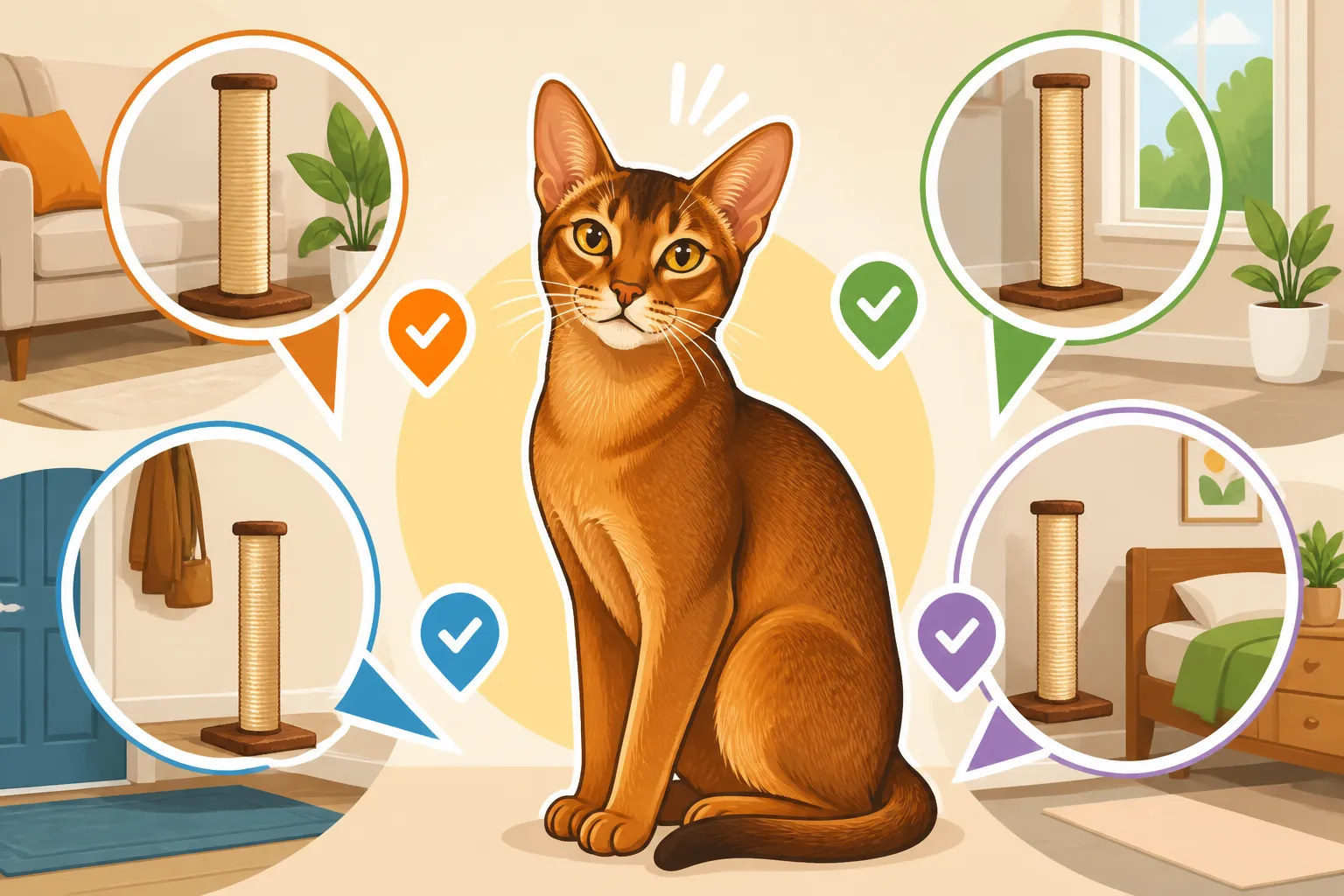
Where to Put an Abyssinian’s Scratching Posts
One of the most common frustrations for any cat owner, especially those with an active and intelligent Abyssinian, is destructive scratching. You’ve brought home this gorgeous, energetic companion, only to find them eyeing your favorite armchair with predatory intent, or systematically shredding the corner of your brand new rug. This guide is here to help you understand why your Abyssinian scratches, and more importantly, where to strategically place scratching posts and surfaces to satisfy their natural instincts and protect your home.
Understanding Your Abyssinian's Innate Need to Scratch
Let's be real: your Abyssinian isn't scratching your furniture to spite you. It's not a sign of bad behavior in the way we might perceive it in humans. Scratching is a fundamental, deeply ingrained feline behavior, and for a cat as intelligent and driven as an Abyssinian, it’s an essential part of their physical and mental well-being. Trying to stop an Abyssinian from scratching altogether is like trying to stop them from breathing – it's simply not going to happen, and attempting to do so will only lead to a frustrated cat and a more stressed household.
Why Abyssinians Scratch: More Than Just Sharpening Claws
While many people assume scratching is solely about filing down claws, it's actually much more complex. For your Abyssinian, scratching serves multiple vital purposes. Firstly, it allows them to shed the outer layers of their claws, revealing the sharp, healthy new claw underneath. This is crucial for their mobility, climbing, and even their ability to play and interact with their environment. Imagine trying to navigate the world with dull, uncomfortable claws; it simply wouldn't work for such an agile creature.
Beyond claw maintenance, scratching is a powerful form of communication and territorial marking. Cats have scent glands in their paws, and when they scratch, they leave behind their unique scent. This tells other cats (and you!) "I was here, this is my space." In a multi-cat household, or even with just one Abyssinian, these scent markers are important for establishing a sense of security and ownership over their territory. It's their way of signing their name on the invisible guestbook of your home. It's also a fantastic full-body stretch, engaging muscles from their shoulders right down to their toes, and a great way to relieve stress or excitement. An Abyssinian winding up for a good scratch is often letting out pent-up energy, much like a human might stretch after a long sit or during a workout.
Vertical vs. Horizontal: What Your Abyssinian Prefers
Cats have preferences when it comes to scratching, and your Abyssinian is no exception. Some cats are vertical scratchers, extending their full body length upwards as they rake their claws down a surface. This satisfies their instinct to stretch their back and shoulders. Think of those magnificent full-body stretches they do when they wake up. Other cats prefer horizontal surfaces, sprawling out on the floor to scratch. This often engages different muscle groups and can feel more like digging or tearing.
Many Abyssinians will use both, depending on the material and location. Observing your cat's natural inclinations is key. If they're constantly trying to scratch the side of your couch, they're likely a vertical scratcher. If they go for the rug or a mat by the door, a horizontal option might be more appealing. Providing both types of surfaces in your home ensures you're covering all their bases. Remember, this breed is known for its agility and athleticism, so offering a variety of scratching opportunities caters to their dynamic needs.
Prime Real Estate: Where Scratching Posts Absolutely Belong
The placement of your scratching posts is just as, if not more, important than the post itself. A fancy, expensive scratching post is useless if it's tucked away in a corner where your Abyssinian never goes or doesn't feel the need to mark their territory. Think like your cat. Where do they go when they first wake up? Where do they hang out most often? What areas do they seem to consider "theirs"? These are the prime locations.
Entryways and High-Traffic Areas
Your Abyssinian is a social creature, even if it sometimes feels like they're just tolerating your presence while they zoom around the house. They consider the main pathways and entry points of your home as crucial parts of their territory. Placing a sturdy scratching post near your front door, in a hallway, or in the main living area where you and your cat spend a lot of time will serve a dual purpose.
Firstly, it provides an immediate, appropriate outlet for scent marking. When you come home, your cat might greet you and then head straight for "their" post to mark their presence. It's a reaffirmation of their place in the home. Secondly, these are often the areas where undesirable scratching occurs. If your Abyssinian is trying to shred the carpet in the hallway, putting a compelling scratching surface right next to that spot is your best bet for redirection. It says, "Hey, I get it, you need to scratch here. Here's something much better for that!" A tall, stable sisal post from a retailer like Chewy or Amazon can be a great starting point for high-traffic zones.
Near Sleeping Spots and Waking Areas
Think about what your Abyssinian does right after a nap. They wake up, stretch, and then often have an immediate urge to scratch. Placing a scratching post or a horizontal scratch pad right next to their favorite sleeping spot – whether that's a cat bed, a sunny window perch, or even your own bed – can preempt unwanted scratching on bedding or nearby furniture.
This placement capitalizes on their natural routine. They roll out of bed, have a good stretch, and boom, there's a satisfying scratching surface right there. This reduces the chances of them wandering off to find something less appropriate to scratch. For instance, if your Abyssinian loves napping on a particular blanket on the sofa, a small, horizontal cardboard scratcher placed on the floor directly beside that spot can work wonders. The goal is to make the "right" choice the easiest and most appealing choice.
Next to "Forbidden" Furniture
This is perhaps the most critical placement strategy for preventing damage. If your Abyssinian has already decided that your prized antique armchair, the corner of your sofa, or a specific piece of wooden furniture is the perfect scratching spot, you need to offer an even more appealing alternative directly adjacent to it.
Don't move the furniture; move the post. Place the scratching post or surface right in front of, or directly beside, the offending piece of furniture. You might even initially place it at an angle or position that directly mimics how they were scratching the furniture. For a vertical scratcher, ensure it's tall enough for your Abyssinian to fully stretch upwards. If they're targeting the arm of a sofa, a sturdy post wrapped in sisal or a scratch guard that integrates a sisal surface can be incredibly effective. The idea is to intercept the habit by offering a superior alternative in the exact location they're already programmed to scratch. Why a Single Abyssinian Costs More in Damage highlights the importance of getting this right early on!
Optimizing for Success: The Right Scratching Tool for the Spot
It's not enough to just have a scratching post; you need the right scratching posts, in the right places, made of materials your Abyssinian actually enjoys. Abyssinians are discerning, active cats, and a flimsy, short, or unstable post will quickly be ignored in favor of your solid, stable furniture.
Material Matters: Sisal, Cardboard, and More
The texture of a scratching surface is paramount. Cats have strong preferences for how a material feels under their claws.
- Sisal: This is often the gold standard for vertical scratching posts. Sisal fabric or rope provides a durable, shreddable texture that cats absolutely adore. It allows their claws to sink in and pull, giving them that satisfying sensation of tearing and stretching. Look for posts where the sisal is tightly woven and secured to prevent it from unraveling too quickly. Why an Abyssinian Prefers a Tall Sisal Post is a great resource if you want to dive deeper into this specific material.
- Cardboard: For horizontal scratchers, corrugated cardboard is hugely popular. It's inexpensive, easily replaceable, and cats love the way their claws shred the layers. Cardboard scratchers come in various shapes – flat pads, bowls, or even ramps. These are excellent for those Abyssinians who prefer to stretch out on the floor. Many Abyssinians also enjoy vertical cardboard scratchers, especially those integrated into cat trees.
- Carpet: While some cats enjoy carpeted posts, be cautious. If your cat learns to love carpet scratching posts, they might generalize this to your actual carpets. Sisal and cardboard are generally safer bets to avoid confusion.
- Wood: Some cats, particularly those who have outdoor access or natural climbing instincts, might enjoy scratching on untreated wood, like logs or thick branches. This can be a very satisfying, natural surface for them.
Experiment with different materials to see what your Abyssinian gravitates towards. You might find they have a favorite for vertical scratching and another for horizontal.
Height, Stability, and Variety: The Abyssinian Standard
An Abyssinian isn't a dainty little lap cat; they are athletic, powerful, and love to stretch. This means their scratching posts need to match their capabilities and desires.
- Height: A vertical scratching post should be tall enough for your Abyssinian to fully extend their body upwards without their paws leaving the ground. For many Abyssinians, this means a post of at least 28-36 inches (70-90 cm) or more. If it's too short, it won't allow for that satisfying full-body stretch, and they'll quickly lose interest.
- Stability: A wobbly scratching post is a useless scratching post. Your Abyssinian needs to feel secure when they're putting their full weight and energy into scratching. If a post tips over, it will deter them from using it again. Choose posts with a wide, heavy base or consider wall-mounted scratchers that offer ultimate stability. Investing in quality means the post will last longer and actually get used. Why an Abyssinian Destroys Cheap Furniture Faster applies to scratching posts too!
- Variety and Quantity: Don't just get one scratching post. You need multiple, varied options placed throughout your home. Think of it as providing a comprehensive "claw care station" network. Have a tall sisal post in the living room, a horizontal cardboard scratcher by their favorite napping spot, and perhaps a smaller, angled scratcher in a hallway. The more appropriate options you provide, the less likely they are to resort to your furniture. In fact, most experts recommend at least one scratching surface per cat, plus one extra, and ensuring a mix of vertical and horizontal options.
Here's a quick overview of scratching post types and their benefits:
| Scratching Post Type | Ideal Placement | Best Materials | Key Benefits |
|---|---|---|---|
| Vertical Post | High-traffic areas, next to vertical furniture | Sisal rope/fabric | Full-body stretch, territorial marking, claw shedding |
| Horizontal Pad/Mat | Near sleeping spots, on floor in high-traffic areas | Corrugated cardboard | Satisfies horizontal scratching, easy to replace, good for stress relief |
| Cat Tree with Posts | Near windows, in active rooms, against walls | Sisal-wrapped posts | Combines scratching with climbing and perching, provides vertical territory |
| Wall-Mounted Scratcher | Corners, entryways, next to damaged walls/furniture | Sisal fabric, wood | Space-saving, extremely stable, great for consistent vertical scratching |
| Scratching Ramp | Near stairs, by low furniture, for older cats | Sisal, carpet | Offers angled scratching, gentler on joints, good for variety |
Maximizing Success and Troubleshooting Common Issues
Even with the perfect posts in the ideal spots, you might still encounter a few challenges. The key is patience, positive reinforcement, and a bit of detective work to understand what your Abyssinian needs.
Encouraging Use: Making the Post Irresistible
Sometimes, your Abyssinian just needs a little encouragement to discover the joy of their new scratching post. Here are a few tricks:
- Catnip: A light sprinkle of catnip on a new post can make it instantly more appealing. The scent often draws cats in, and once they're there, the satisfying texture takes over.
- Playtime: Lead your Abyssinian to the post with a wand toy, encouraging them to "catch" the toy on the post itself. When they naturally extend their claws and scratch during play, heap on the praise and maybe a treat. This creates a positive association with the post.
- Treats and Praise: Whenever you see your Abyssinian using the post, immediately offer praise and a small, high-value treat. They'll quickly associate using the post with positive rewards.
- Location, Location, Location: Re-evaluate your placement if the post isn't being used. Is it in a high-traffic area? Is it near their favorite sleep spot? Is it offering a better alternative to something they are scratching? If a post isn't used, try moving it.
What to Do When They're Still Scratching Furniture
If your Abyssinian is still going for the couch, don't despair, and never punish them. Punishment will only make them fearful and confused, and they'll likely just learn to scratch when you're not around.
- Make the furniture unappealing: Cover the favorite scratching spots on your furniture with something your Abyssinian dislikes, such as double-sided sticky tape (like Sticky Paws), aluminum foil, or heavy blankets. You can also use plastic sheeting. This creates a temporary barrier that makes the surface undesirable.
- Redirection: As soon as you see them approach the furniture to scratch, gently pick them up and place them on an appropriate scratching post. Immediately reward them if they even lightly touch the post with their claws.
- Consider more posts: You might simply not have enough posts, or they might not be in the right places. Go back to basics: observe where and how they're scratching the furniture, and place a superior alternative directly there.
- Vertical Climbing & Enrichment: Abyssinians are highly energetic and intelligent. Sometimes, destructive scratching can be a sign of boredom or insufficient enrichment. Ensure your Abyssinian has plenty of opportunities for vertical exploration, such as cat trees, wall shelves, and puzzle toys. An Abyssinian Needs Height More Than It Needs Floor and How Many Vertical Levels an Abyssinian Needs are essential reading for providing this kind of enrichment. A satisfied, well-exercised Abyssinian is less likely to engage in destructive behaviors. Retailers like Chewy and Amazon offer a vast selection of cat trees, wall furniture, and puzzle feeders that can greatly enhance your cat's environment.
Integrating Scratching Posts into Vertical Space
Abyssinians are known for their love of climbing and being high up. They often prefer to scratch on surfaces that are part of their vertical territory. This means incorporating scratching surfaces into cat trees, wall-mounted cat shelves, and other elevated structures.
A large, sturdy cat tree with sisal-wrapped posts can serve as a scratching post, a climbing apparatus, and a perch, all in one. Placing these by windows or in areas where your Abyssinian can survey their domain from above provides not only scratching satisfaction but also mental stimulation. Ensure these structures are robust enough to handle the energetic leaps and bounds of your Abyssinian. Which Cat Tree Height Suits an Abyssinian and Why an Abyssinian Needs a Tall Cat Tree can guide you in choosing the perfect climbing and scratching solution for your agile companion. By thoughtfully placing a variety of scratching options in both ground-level and elevated locations, you'll be well on your way to a happy Abyssinian and an intact home.
Disclaimer
This article is for general informational purposes only and does not constitute professional advice. Laws, prices and regulations vary by location and change over time. Consult a qualified professional for guidance on your specific situation.