Which Breeds the Abyssinian Helped Create
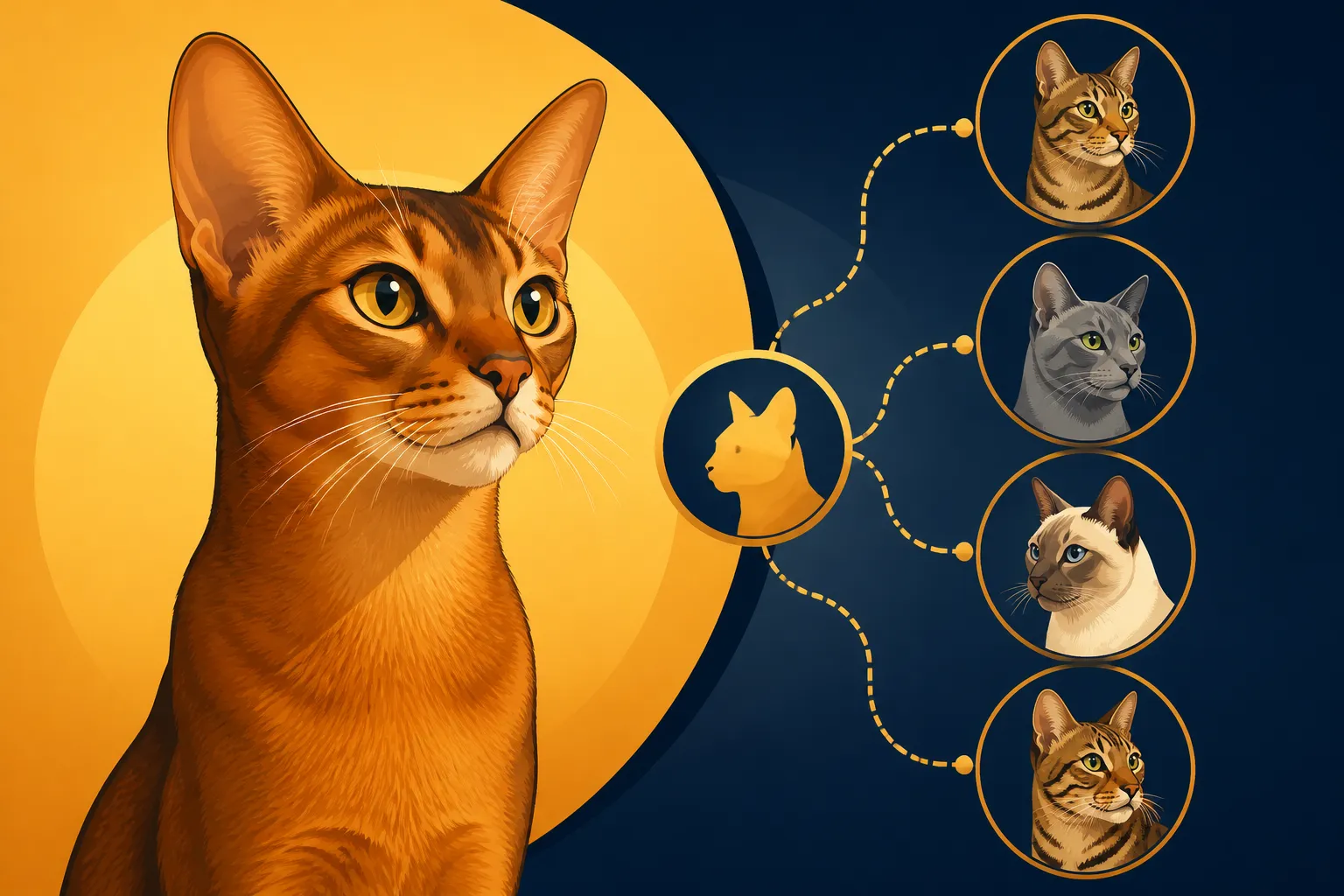
The Abyssinian’s influence on cat breeds is real, but it is easy to overstate. It helped establish the Ocicat and contributed to the Australian Mist, while its relationship to the Somali is a different story: the Somali developed from longhaired Abyssinians rather than from a planned cross with another breed. This guide separates documented breed development from looser claims about ancestry.
The Abyssinian’s clearest contribution is the Ocicat
How Abyssinian ancestry helped launch the Ocicat
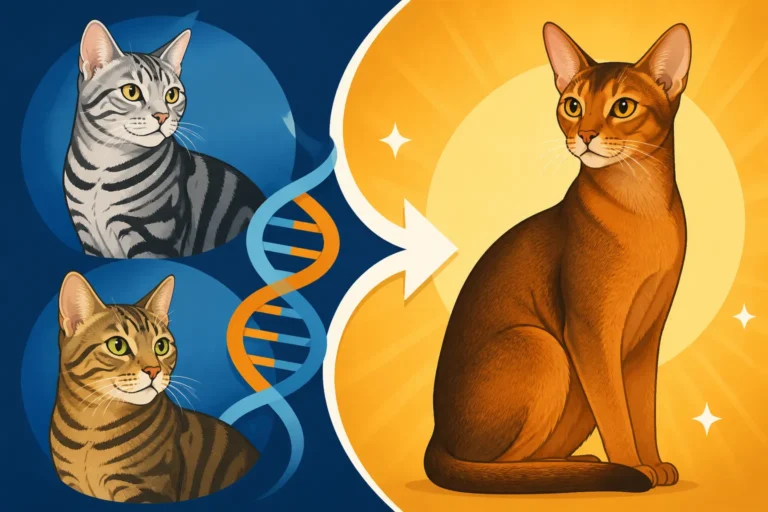
The Ocicat began with a deliberate breeding experiment in the United States. Breeder Virginia Daly set out to produce a Siamese with the pointed pattern associated with the Siamese breed, using a Siamese and an Abyssinian. One kitten in the resulting litter had a striking spotted coat. That kitten, named Tonga, became the unexpected starting point for a new breed.
Tonga’s spots were not the result Daly had originally aimed for, but they caught people’s attention. Subsequent breeding developed the look further, with Siamese and American Shorthair cats also playing important roles in the Ocicat’s development. The American Shorthair helped broaden the breed’s gene pool and contributed to the sturdy body and coat characteristics breeders wanted.
That history makes the Abyssinian a genuine part of the Ocicat’s foundation, but it does not mean that an Ocicat is simply an Abyssinian with spots. The modern breeds have distinct standards and appearances. The Ocicat’s spotted pattern, larger build, and broader genetic background set it apart from the Abyssinian’s finely ticked coat and more slender outline. For a closer look at the spotted breed’s background, see How the Abyssinian Contributed to the Ocicat.
Why the Ocicat is not just a spotted Abyssinian
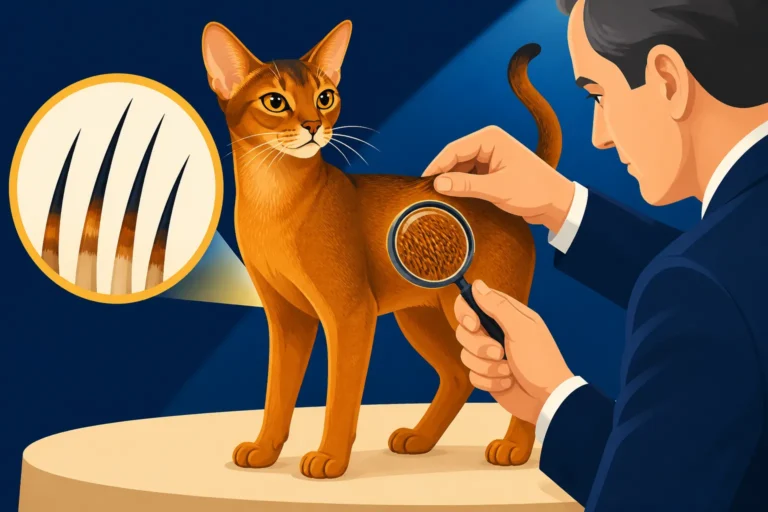
The most obvious difference is the coat. An Abyssinian’s individual hairs have alternating bands of color, creating a warm, shimmering effect rather than clear stripes or spots. An Ocicat’s coat has distinct spots arranged across the body. From across a room, both cats may look athletic and alert, but their patterns come from different breeding histories and are judged differently.
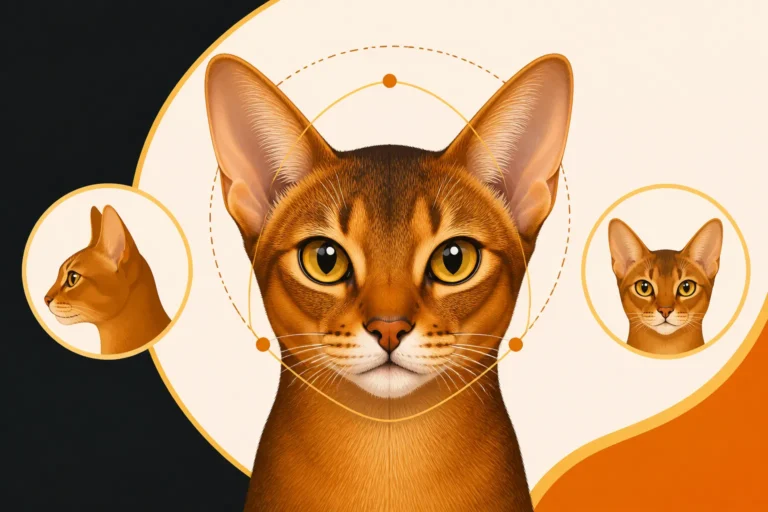
Their body types also differ. Abyssinians tend to have a lithe, fine-boned appearance, with long legs and a gently curved profile. Ocicats are generally more substantial and muscular. Neither shape is better; they reflect different standards and goals. A person who loves the Abyssinian’s elegant outline should not assume every Ocicat will have the same build or coat texture.
The two breeds can also share a lively, interactive presence, but individual temperament varies. Breed history can give useful context, not a guarantee about a particular kitten. If you are comparing their looks and characteristics, How an Abyssinian Differs From an Ocicat offers a useful companion read. When preparing for a high-energy cat, focus on practical needs such as climbing space and play sessions; retailers such as Chewy may be one place to compare basic toys, but supplies do not tell you anything about a cat’s pedigree.
The Australian Mist also has Abyssinian ancestry
How the Australian Mist was developed
The Australian Mist was developed in Australia by Dr. Truda Straede. Its foundation involved Burmese cats, Abyssinians, and domestic shorthairs. Breeders aimed to create a cat suited to life as a companion, with a distinctive misted or spotted coat and a temperament that could work well in a home environment.
The Abyssinian contributed to the breed’s foundation, but it was one part of a planned mixture rather than the sole source of the Australian Mist’s appearance or personality. Burmese cats and domestic shorthairs were also important to the development program. As with any established breed, the resulting cat reflects generations of selection, not just the traits of one ancestor.
The Australian Mist is best known for a coat that appears spotted or marbled against a softly shaded background. That differs from the Abyssinian’s even ticking, where individual hairs carry bands of color. A kitten with an Abyssinian ancestor does not automatically inherit the Abyssinian coat pattern; traits are shaped by the combination of genes passed down from all sides of its family.
What the shared ancestry does and does not tell you
When two breeds share ancestry, it can be tempting to expect them to behave alike. In practice, ancestry is only one influence among many. Breeding choices, socialization, health, and a cat’s individual temperament all matter. The Australian Mist was developed with its own goals and has its own identity, even though Abyssinians were part of its early foundation.
For someone looking at an Australian Mist, the useful question is not simply, “Does it have Abyssinian in it?” Ask about the breed’s own characteristics, the kitten’s parents, and how the kittens have been raised. A breeder should be able to explain the breed’s background without suggesting that one ancestor makes every kitten predictable.
It also helps to separate visual resemblance from documented ancestry. A short-haired cat with a warm, patterned coat may remind you of an Abyssinian, but that alone does not establish a connection. The Abyssinian’s distinctive ticking is specific: a cat with spots, stripes, or a marbled coat may look equally striking while belonging to a different breed or having no known Abyssinian ancestry.
The Somali is closely related, but it is not a planned crossbreed
Why the Somali emerged from Abyssinian lines
The Somali developed from longhaired cats that appeared in Abyssinian breeding lines. Long hair is a recessive trait, which means a kitten can inherit the gene from both parents and have a longer coat even when its shorthaired parents do not. When longhaired kittens appeared, breeders eventually developed them as a separate breed rather than treating them as an unrelated cross.
This makes the Somali different from the Ocicat and Australian Mist in an important way. The Somali was not established by crossing Abyssinians with a separate breed to create a new combination. It arose within Abyssinian lines and was later recognized as its own breed. The Somali is often described as a longhaired counterpart to the Abyssinian, though the breeds have separate standards and are not interchangeable.
Their coats make the difference immediately visible. Abyssinians have a short, close-lying coat with ticking across the body. Somalis have a longer, fuller coat, often with a noticeable ruff and a bushier tail. Both share a family connection and can have an alert, active presence, but a particular cat’s personality should be judged individually. Learn more in How an Abyssinian Differs From a Somali and Whether Abyssinians and Somalis Are Still Bred Together.
Why a longhaired kitten does not mean a different breed was crossed in
A longhaired kitten in an Abyssinian litter can raise questions, especially for someone who expects every kitten to have the same short coat. But the appearance of long hair does not by itself prove that a different breed was recently introduced. Recessive traits can remain hidden in a line and show up when a kitten receives the relevant gene from both parents.
That is one reason responsible breeding records matter. Pedigrees and clear explanations of parentage help distinguish a known trait within a breed’s history from a genuine outcross. If a breeder makes a claim about a kitten’s ancestry, ask what documentation supports it rather than relying only on coat length or appearance.
Breed names can also create confusion. A Somali may look like a longhaired Abyssinian, and the breeds are closely related, but the Somali is recognized as its own breed. The distinction is not an insult or a matter of one being more authentic. It reflects how the cats are classified and bred today.
Other claims about Abyssinian influence need careful wording
The Bengal connection is not as direct as the Ocicat’s
The Bengal was developed from crosses involving the Asian leopard cat and domestic cats, followed by generations of selective breeding. Some accounts of domestic-cat ancestry mention breeds such as the Abyssinian among cats used in early Bengal development. However, the Abyssinian is not the defining foundation of the Bengal in the clear, direct way it is for the Ocicat.
That distinction matters because statements such as “the Abyssinian created the Bengal” can flatten a more complicated history. The Bengal’s development involved multiple domestic cats and breeding programs, and its defining ancestry includes the Asian leopard cat. An Abyssinian may appear in discussions of some early domestic contributions, but that does not make every Bengal an Abyssinian descendant or mean Abyssinians were the sole source of the breed.
The Bengal’s coat is also quite different. Bengals are known for spots or rosettes, while Abyssinians have a ticked coat without the same marked pattern. If you are trying to understand the relationship, Whether the Abyssinian Is in the Bengal's Background is a useful next step. For a broader look at the difference in appearance and breed type, see How an Abyssinian Differs From a Bengal.
How to assess breed-origin claims
A reliable breed history usually names the cats or breeds involved, explains the purpose of the breeding program, and distinguishes established facts from possibility. A vague claim that a breed “comes from” the Abyssinian may mean anything from documented foundation breeding to a general resemblance or an unverified story.
Use these distinctions when you encounter claims about the Abyssinian’s influence:
| Relationship | What it means | Example |
|---|---|---|
| Documented foundation contribution | Abyssinians were deliberately used during the development of another breed | Ocicat |
| Part of a mixed foundation | Abyssinians were one of several types used in a breed’s development | Australian Mist |
| Related through a trait in established lines | A breed emerged from a trait found within Abyssinian lines | Somali |
| Possible or limited contribution | Some histories mention Abyssinians, but they were not the defining foundation | Bengal |
A cat’s coat or body shape cannot confirm its pedigree. Even cats with similar coloring may have different ancestry, and cats from related lines can look quite different. For the wider question of the breed’s historical roots, What Modern DNA Studies Found About Abyssinian Ancestry explores how ancestry research adds context without proving every popular origin story.
It is also worth distinguishing breed development from broad genetic ancestry. Modern breeds may share ancestors far back in their histories, but that does not mean one breed was directly created from another. If you are choosing a cat, breed descriptions can help you form questions, while a breeder’s records and the individual cat’s behavior give more practical information. For everyday setup needs, Chewy is one option for browsing cat toys and climbing accessories; a retailer’s product listings, however, are not evidence of pedigree or breed history.
What the Abyssinian helped create in practical terms
The clearest answer is one direct breed and one mixed foundation
The strongest, easiest-to-explain example is the Ocicat. An Abyssinian was central to the initial breeding experiment that produced the spotted kitten from which the Ocicat program grew. Later breeds and breeding choices shaped the Ocicat into the cat recognized today, so it is accurate to say the Abyssinian contributed to its creation, but not that the Ocicat is simply an Abyssinian variety.
The Australian Mist is another documented case of Abyssinian contribution, but it was developed from multiple types of cats. The Abyssinian was a component of its foundation, alongside Burmese cats and domestic shorthairs. That makes “helped create” fair wording, as long as it is not presented as sole parentage.
The Somali belongs in a separate category. It is closely connected to the Abyssinian through longhaired kittens appearing within Abyssinian lines, rather than through a planned cross with an unrelated breed. The Bengal should be described with more caution: Abyssinians are mentioned in some accounts of early domestic contributions, but they are not the Bengal’s central or exclusive foundation.
Why the distinction matters to cat owners
Knowing the history can make breed comparisons more meaningful, but it should not substitute for asking about the actual cat. A kitten’s energy, confidence, sociability, and comfort with handling are shaped by more than its breed label. Ask how the kitten has been raised, what the parents are like, and what health information the breeder can provide.
If you are considering a breed with an Abyssinian connection, think about your household and the cat’s needs rather than assuming a shared ancestor means identical care. Active cats generally benefit from regular interactive play, safe places to climb, and predictable attention. Chewy may offer ways to compare toys or scratching products, but the best choices depend on the individual cat and the space available in your home.
For buyers looking at an Abyssinian itself, a breed history can explain its appearance and some of its development, but a breeder’s documentation is more useful for confirming a kitten’s lineage. The breed’s ancestry is a story of changing breeding goals, chance traits, and careful selection—not a simple family tree in which every related cat is the same breed.
Disclaimer
This article is for general informational purposes only and does not constitute professional advice. Laws, prices and regulations vary by location and change over time. Consult a qualified professional for guidance on your specific situation.