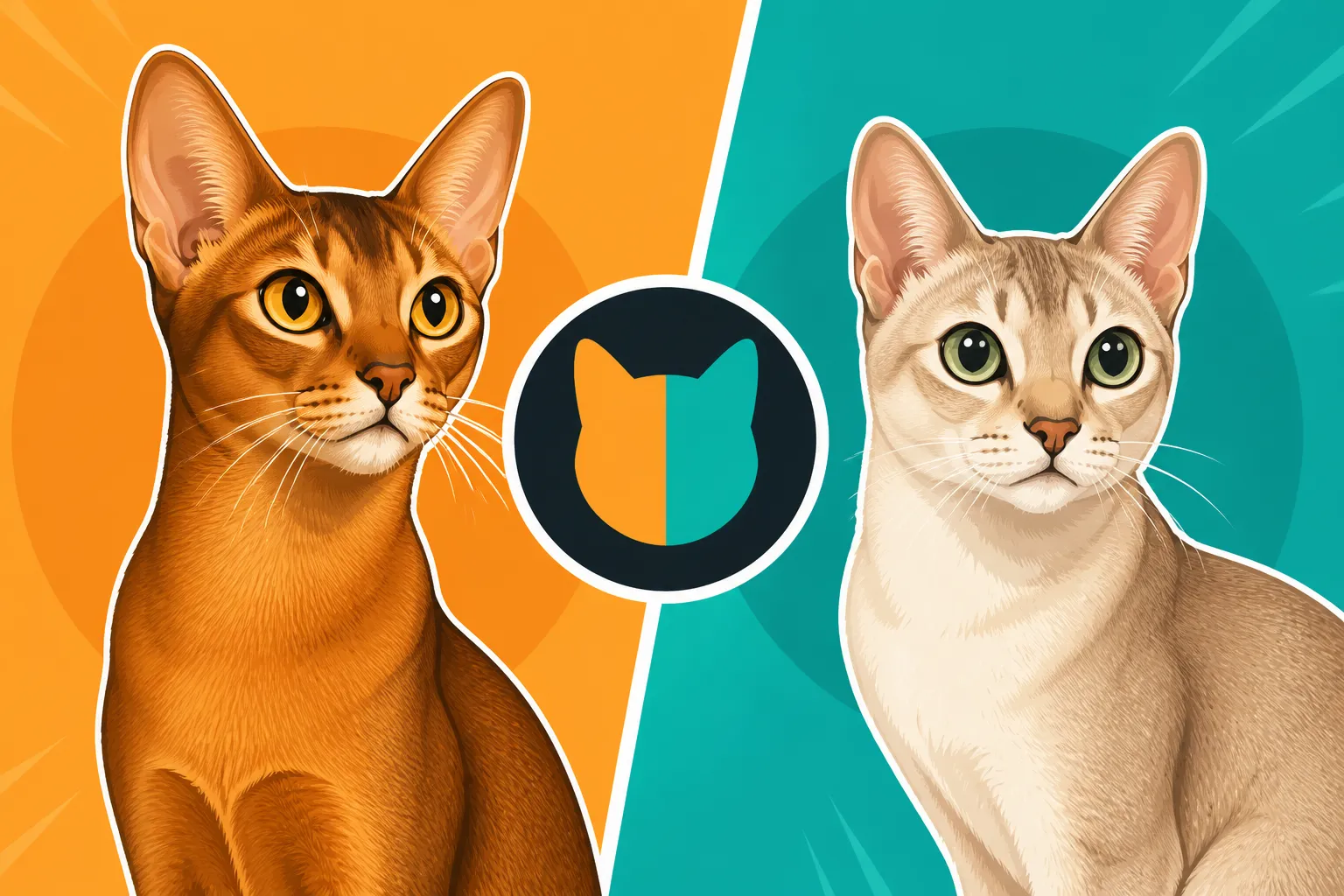
How to Tell an Abyssinian From a Singapura
Abyssinians and Singapura cats can look remarkably alike at first glance: both are small-to-medium, shorthaired cats with large ears, expressive eyes, and ticked coats. That resemblance makes shelter listings and casual photos especially confusing. The most reliable clues are the coat’s color and texture, the cat’s proportions, and its documented pedigree—not one striking feature on its own.
The quickest clues that separate an Abyssinian and a Singapura
Both breeds have coats where individual hairs carry bands of color, rather than the familiar stripes or spots seen on many cats. Both can also look alert and delicate, with prominent ears and bright eyes. So if you are trying to identify a cat from one photo, you may not get a confident answer. Look for a combination of features instead.
| Feature | Abyssinian | Singapura |
|---|---|---|
| Overall build | Medium-sized, fine-boned, athletic and longer-lined | Small, compact and fine-boned |
| Coat color | Commonly ruddy, sorrel, blue or fawn, depending on registry | Sepia brown ticking on a warm ivory background |
| Coat impression | Rich, warm color with distinct ticking | Pale, softly shaded coat with delicate brown ticking |
| Head and expression | Wedge-shaped head, alert expression and large ears | Rounded-to-moderately wedged head, very large eyes and ears |
| Best identification evidence | Pedigree and breeder or registry records | Pedigree and breeder or registry records |
The table is a useful starting point, not a diagnostic checklist. Cats vary, photographs distort proportions, and mixed-breed cats can inherit features from either parent. A cat with a ticked coat is not automatically an Abyssinian, and a small cat with big eyes is not automatically a Singapura.
Start with coat color, not just the ticking
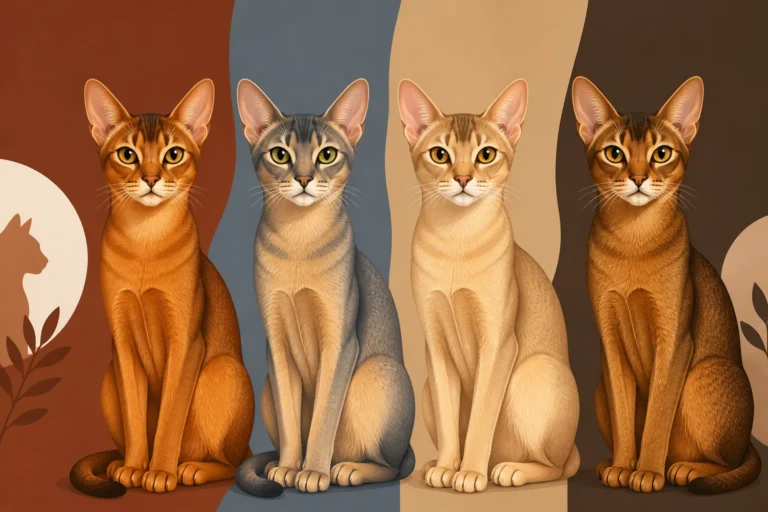
The Abyssinian’s ticking can make its coat seem to shimmer as it moves. The hairs have alternating bands of color, and the finished effect depends on the cat’s color variety. Ruddy Abyssinians tend to look warm and rich; sorrel cats have a redder tone, while blue and fawn coats appear cooler or paler. For a closer look at the coat pattern itself, see What Makes an Abyssinian's Coat Ticked Rather Than Striped.
A Singapura’s coat is also ticked, but the overall effect is usually much paler and more uniform: sepia brown ticking over a warm ivory ground. The contrast is subtler than the rich, more saturated look many people associate with a ruddy or sorrel Abyssinian. If you are viewing a phone photo, indoor lighting can wash out an Abyssinian’s coat or make a Singapura look darker than it is, so color alone should not settle the question.
The two breeds do not simply have different shades of the same coat. Their recognized colors and breed standards differ. An Abyssinian photographed in deep shade may look brown all over, while a Singapura in bright light may appear almost cream. Compare several clear photos of the whole cat and its coat, ideally in natural light, rather than relying on a single close-up.
Compare the whole silhouette
An Abyssinian is typically a medium-sized, athletic cat with a long, flexible-looking outline. Its body should look lean and muscular rather than fragile. It often appears ready to move, with a balanced stance and a tail that adds to its streamlined shape. The breed’s body type is described in more detail in What an Abyssinian's Body Type Is Called.
A Singapura is generally smaller and more compact. It is still fine-boned and active-looking, but its body often reads as shorter and more petite beside an Abyssinian. This is easier to judge when two adult cats are standing in similar poses. A kitten beside an adult, or a cat photographed close to the camera, can make size comparisons misleading.
Size is a clue, not proof. Individual cats differ, and nutrition, age, sex, and body condition affect how large a cat looks. If you need a more specific reference for the Abyssinian, How Big an Adult Abyssinian Gets explains the breed’s general build and size. Avoid deciding from weight alone: a healthy cat’s frame and condition matter as much as the number on a scale.
Face, eyes, ears and coat texture
Faces are tempting to use as a shortcut, especially when an image shows a cat looking straight at the camera. But ears, eyes, and head shape can look exaggerated by a close lens. Check how these features work together with coat and body type.
Look at the head and expression as a set
Abyssinians usually have a gently wedge-shaped head, with a defined muzzle and large, alert ears. The overall expression is often described as watchful or intent. The ears are noticeable, but they should not be treated as a breed identifier on their own; many cats have large ears, and camera angle can make them look even larger.
Singapuras are also known for strikingly large ears and large eyes, which can give the face a particularly open, expressive look. Their eyes may appear especially prominent relative to their petite head. That can be a helpful visual clue when combined with a small body and pale sepia coat, but it is not a guarantee. A young Abyssinian may also have a disproportionately large-eyed, big-eared kitten look.
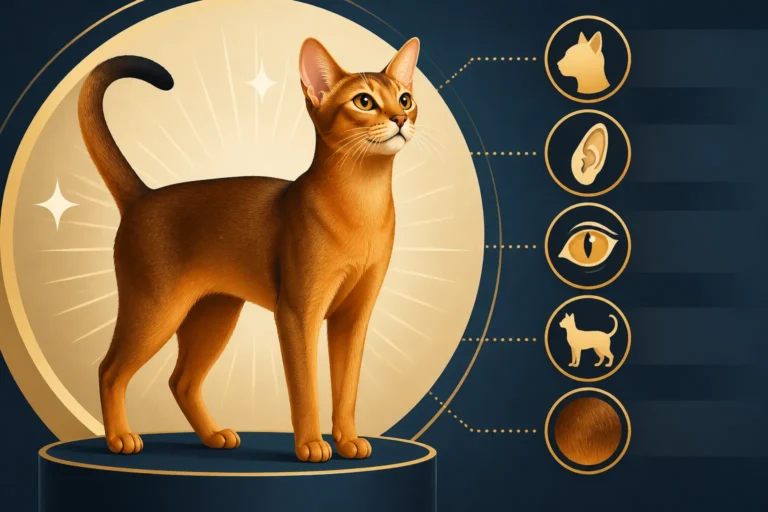
If you are comparing cats for a show-standard appearance, use a full breed description rather than trying to match a single feature. What the Abyssinian Looks Like Against the Show Standard describes the Abyssinian’s overall proportions and features. The same caution applies to both breeds: a pet cat can be a healthy, lovely example of its own individual appearance without matching every show ideal.
Notice the coat’s feel and finish
Abyssinian coats are short and close-lying, with the ticking creating their characteristic depth of color. The coat should not look long or heavily plush. If you can safely meet the cat, notice whether the coat feels fine and close to the body rather than dense and woolly. What an Abyssinian's Coat Should Feel Like in the Ring offers more detail about the desired coat quality.
A Singapura’s coat is also short and fine, so touch alone may not distinguish the breeds. Instead, consider the overall finish: the Singapura’s coat tends to look pale and delicately shaded, while an Abyssinian’s color often appears more pronounced. Again, lighting, season, and individual variation can change what you see.
If the cat is in a shelter or rescue, do not handle it just to assess coat texture. Give the cat time to settle, ask staff what they know, and rely on records where available. A nervous cat may flatten its ears, crouch, or avoid interaction, making its proportions and expression harder to judge. Breed identification should never come at the cost of making an already unsettled cat more uncomfortable.
Why photos and behavior can mislead you
A photograph is only one moment, and a cat’s posture can change its apparent size dramatically. A stretched Abyssinian may look longer and larger than it is; a Singapura curled into a ball may appear even more petite. Filters and warm indoor bulbs also alter coat color. When evaluating an online listing, ask for several recent, unedited photos: a side view, a face-on view, and a standing shot with the cat’s full body visible.
Behavior is an even less dependable breed test. Abyssinians are often described as active, curious, and people-oriented, but individual cats have their own temperaments. A Singapura may also be lively and engaged, while an Abyssinian may be shy in a new environment. A cat’s behavior at a shelter, during a vet visit, or around unfamiliar people may reflect stress more than breed.
Treat temperament as a supporting clue
People sometimes assume that a particularly energetic, inquisitive cat must be an Abyssinian. That can create false confidence. Many cats enjoy climbing, chasing toys, or following people from room to room. Likewise, a quiet cat is not necessarily a Singapura. Age, health, socialization, home life, and the immediate setting all affect behavior.
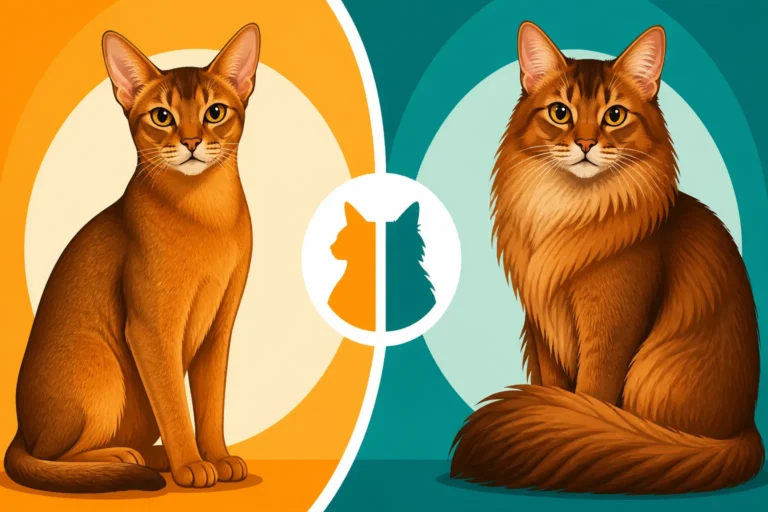
If a cat’s habits are part of your decision, look at them as an individual. Ask how the cat responds to play, handling, visitors, and time alone, and give it a chance to show its normal behavior after it has settled. For a broader guide to identifying an Abyssinian’s relatives, How to Tell an Abyssinian From a Somali explains another comparison that can be confusing because the breeds are closely connected.
Use retailer breed pages as a starting point, not proof
When you are researching a possible breed, a pet retailer’s educational material can help you learn the vocabulary and recognize common traits. Chewy is one example of a place people may encounter general pet and breed information. Use any such overview to create questions, not to confirm a cat’s identity from appearance alone.
If you are comparing information from Chewy with a breeder’s description or a rescue listing, check whether the details agree on the breed’s coat color, body type, and documented background. A general breed profile can describe typical traits, but it cannot verify the ancestry of a particular cat. The same is true of social media posts, classified ads, and image searches.
For practical care decisions, buy supplies based on the cat in front of you rather than assuming its breed dictates every need. A small cat still needs appropriately sized equipment, and an active cat needs a safe environment whether it is an Abyssinian, a Singapura, or a mix. Chewy may be one retailer to consider when looking for ordinary pet essentials, but confirm that any item suits your cat’s size, habits, and veterinary needs.
How to confirm a cat’s breed responsibly
When breed matters—for example, because you are adopting a cat advertised as a pedigree breed—the most useful evidence is reliable documentation. A distinctive coat can suggest a breed, but it cannot establish ancestry. A cat can resemble an Abyssinian or Singapura without having a verified pedigree.
Ask for records and clear identification
For a cat from a breeder, ask to see the pedigree and registration information, and make sure the records identify the cat you are considering. Ask the breeder to explain how the kitten’s parents are documented and whether you can see information about the litter. A responsible breeder should be comfortable answering reasonable questions and should not rely only on a kitten’s appearance to prove its breed.
For a rescue or shelter cat, staff may have limited background information. The listing might use a breed label to describe appearance rather than verified lineage. Ask what the label is based on. If the cat arrived without records, it may be more accurate to say “Abyssinian-like” or “Singapura-like” than to treat the breed as confirmed.
This distinction is not a criticism of mixed-breed cats. It simply helps you make decisions with realistic expectations. Breed-associated traits can be useful background, but a cat’s health, temperament, and needs should be assessed individually. If a specific breed history matters to you, How an Abyssinian Differs From an Egyptian Mau is another example of why a strong resemblance does not by itself establish a cat’s ancestry.
Keep online descriptions in perspective
Online listings can be incomplete, and sellers may use breed names loosely. Before relying on a claim, ask for multiple current photos, available records, and a straightforward explanation of the cat’s background. Be cautious if a seller will not provide basic information or pressures you to pay before answering questions. For Abyssinians, How an Abyssinian's Coat Color Is Registered can help clarify how recognized colors are described, while Which Eye Colors an Abyssinian Can Have covers another feature that people sometimes overinterpret.
Chewy and other retailers can be useful for general pet-care reading or supplies, but no product page or general breed description can authenticate a cat’s pedigree. If a decision depends on whether a cat is a purebred Abyssinian or Singapura, ask for the original records and, when needed, consult a knowledgeable breed organization or veterinary professional. A DNA test may offer ancestry clues, but genetic results and pedigree documentation are not interchangeable, and a test’s usefulness depends on what it actually evaluates.
The most practical approach is to separate three questions: What does the cat look like? What is known about its ancestry? What does this individual cat need? The first can be answered by observing coat, proportions, and facial features. The second depends on trustworthy records. The third comes from the cat’s health and behavior, ideally discussed with a veterinarian.
A simple comparison routine for a real cat
When you have a cat in front of you, take a moment to compare the features in a consistent order. Start with the coat in natural light. Then observe the body from the side, followed by the face and ears. Finally, check any records. This makes it less likely that one memorable feature—such as unusually large eyes—will dominate your judgment.
- Check the coat color and pattern. Is the coat a pale sepia brown over ivory, which is typical of a Singapura, or does it show one of the richer or cooler colors commonly associated with Abyssinians?
- Look at the full-body outline. Does the cat look compact and petite, or more medium-sized, athletic, and elongated?
- Compare the face in a neutral pose. Note the head shape, ears, and eyes together rather than judging one feature.
- Consider age and condition. A kitten, senior cat, or underweight cat may not show typical adult proportions.
- Ask what documentation exists. A pedigree is more persuasive evidence of breed than a visual impression or an online label.
- Describe uncertainty honestly. If records are missing, say the cat resembles a breed rather than stating the breed as fact.
You may find that the evidence points in different directions. For example, a small, pale cat may have the longer outline associated with an Abyssinian, or a cat with a richly colored coat may have no pedigree records at all. In that situation, the best answer is not to force a label. Describe the visible traits and treat ancestry as unknown unless it is documented.
If you are choosing a companion, focus at least as much on fit as on breed. Ask about activity level, health history, comfort around people and animals, and the environment the cat will need. A cat’s breed can provide context, but it cannot promise a particular personality or guarantee a specific care requirement.
Disclaimer
This article is for general informational purposes only and does not constitute professional advice. Laws, prices and regulations vary by location and change over time. Consult a qualified professional for guidance on your specific situation.