How an Abyssinian’s Coat Color Is Registered
An Abyssinian kitten can look warm brown in one room, coppery in another, and noticeably paler as its coat develops. That makes the color entry on registration papers easy to second-guess. This guide explains how registries record Abyssinian coat color, why the same shade may have different names, and what to check before accepting a kitten’s paperwork as correct.
What coat color registration means for an Abyssinian
A registration records a color category, not a perfect description
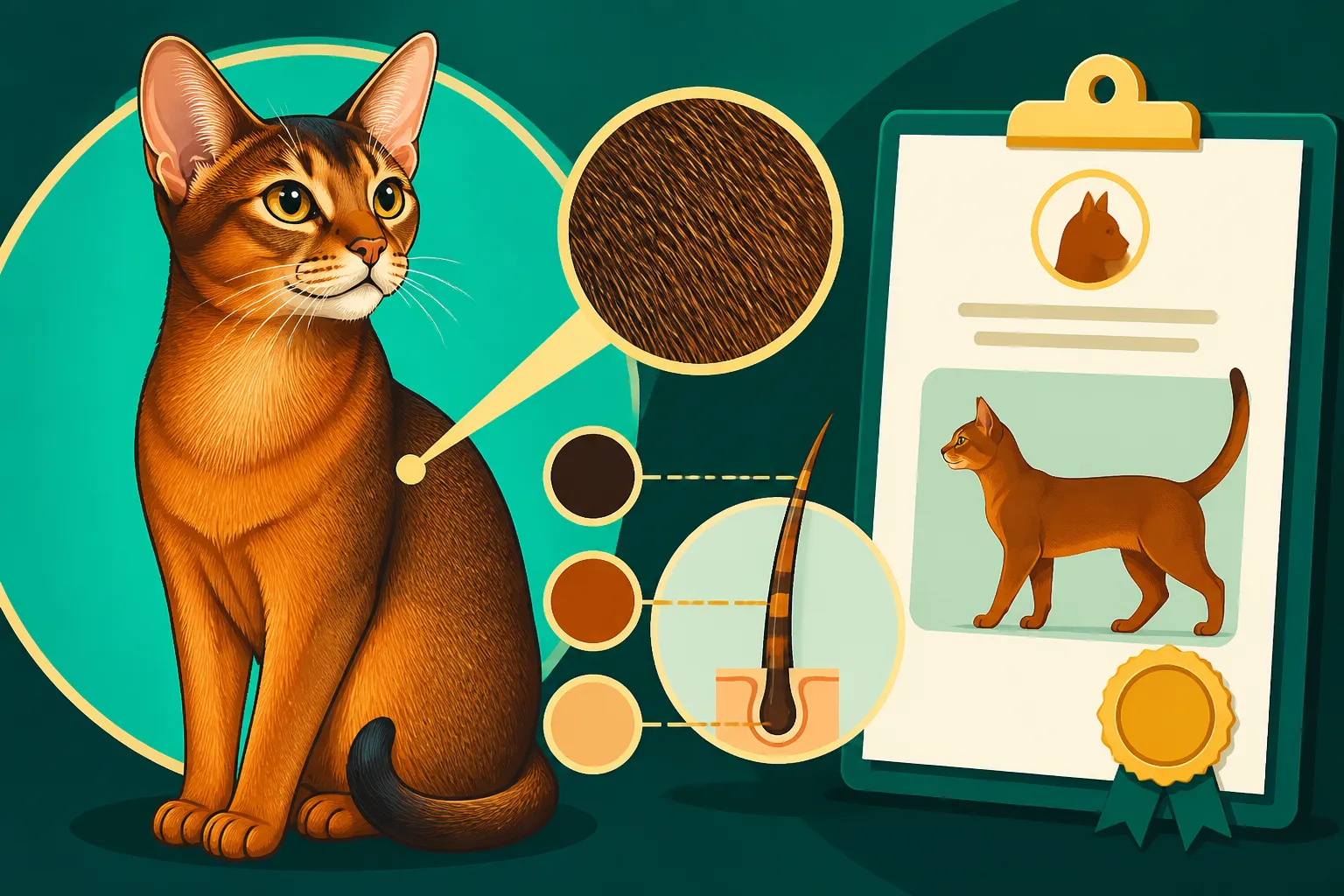
When a breeder registers an Abyssinian, the breed registry records information about the cat, including its registered name, parentage, sex, and coat color. The color is entered using that registry’s categories and terminology. It is not usually a detailed description of every shade visible in the coat, and it is not a guarantee that a show judge will consider the cat’s color ideal.
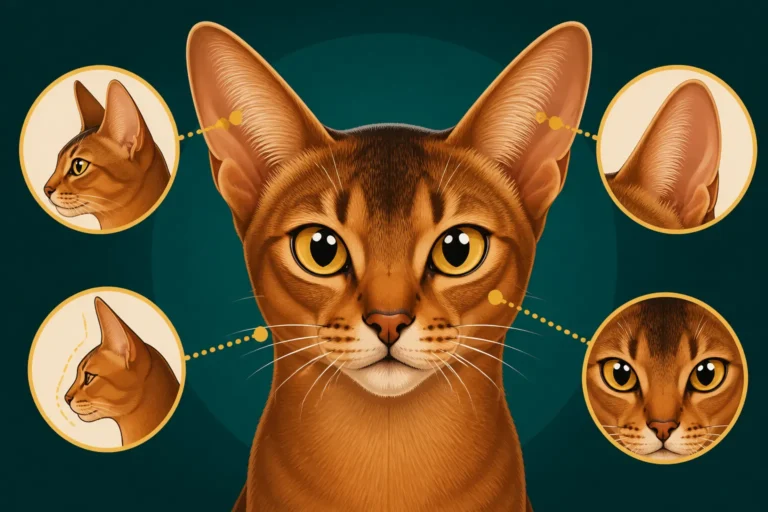
That distinction matters because Abyssinian coats are ticked. Individual hairs have alternating bands of color, so the overall impression can shift with lighting, the cat’s age, and the warmth or intensity of its coat. A kitten may look darker along the back and lighter on the chest, while an adult’s color may appear richer in outdoor light than it does beside a cool indoor window.
A registration entry should therefore be read as the registry’s official label for the cat, not as a promise that every observer will use the same everyday word for its color. A breeder might call a kitten “sorrel,” for example, while paperwork from a registry using another naming convention records the corresponding category as “red.”
If you are comparing a kitten’s papers with photographs or a breeder’s description, start by identifying the registry named on the documents. The same color word may not be used in every association, and some registries recognize categories that others do not. For an overview of the breed’s familiar palette, see The Four Colors an Abyssinian Comes In.
Registration, color inheritance, and show evaluation are different things
A cat’s coat color is influenced by inherited traits, but registration is an administrative record rather than a genetic test. A breeder generally reports the kitten’s color when submitting its registration information. The registry then records the color in the format it uses. That entry does not, by itself, prove the cat’s genetic makeup or certify its quality as a show prospect.
Show evaluation is a separate process. Judges assess the cat against the applicable breed standard, which can include the coat’s ticking, tone, clarity, and overall condition, as well as other physical features. A cat can be correctly registered under a recognized color category without having the ideal shade or even ticking that a show judge might prefer.
For example, a blue Abyssinian may have the correct registered color but show uneven ticking or a coat tone that differs from the ideal described in a particular standard. The color entry can still be accurate; the judge’s evaluation concerns how closely the individual cat meets the standard. To understand how coat quality is assessed, compare the registration label with What an Abyssinian's Coat Should Feel Like in the Ring.
This is also why a photo alone can be a shaky way to confirm color. Camera settings, flash, sunlight, indoor bulbs, and screen adjustments can all change how a warm brown or muted blue coat appears. Use photographs as helpful context, but rely on the registry’s written color entry and the breeder’s records when checking formal details.
How Abyssinian color names vary between registries
The same familiar color may have more than one name
Abyssinian color vocabulary can be confusing because breed communities and registries do not always use identical terms. In some places, a warm, reddish coat may be called sorrel; another registry may use red. The darkest traditional color may be called ruddy in one system and usual in another. Those differences do not automatically mean that two different colors are being described.
The table below gives a general orientation to common terms. It is not a substitute for a registry’s own rules: the exact accepted names and categories depend on the association handling the registration.
| General appearance | Names you may encounter | What to keep in mind |
|---|---|---|
| Deep, warm brown with darker ticking | Ruddy or usual | Terminology depends on the registry; check the label used on that cat’s official papers. |
| Warm cinnamon or reddish tone | Red or sorrel | These terms may refer to corresponding color categories in different systems, but confirm with the specific registry. |
| Cool, muted blue-gray appearance | Blue | The visible coat still has ticking; it is not simply a solid gray coat. |
| Pale, warm cream or beige appearance | Fawn | Lighting can make the coat look warmer, cooler, or lighter in photographs. |
| Pale or silver-toned variations | Registry-dependent terms | Recognition and naming vary, so do not assume every association accepts the same categories. |
The names are especially easy to mix up when people are discussing cats from different countries or associations. A breeder may use a familiar local term in conversation and then use the official term required by the registry on the paperwork. If the cat is transferred to another registry, the terminology may be translated into that organization’s system rather than copied word for word.
For the standards in a particular system, check Which Abyssinian Colors CFA Recognizes and Which Abyssinian Colors Other Registries Allow. These distinctions are useful if a breeder’s description, a pedigree, and a registration certificate appear to use different color words.
A color label does not always settle questions about rarer shades
Questions often arise when a kitten appears unusually pale, has silver-toned areas, or does not look like the common examples people have seen online. Before treating an unfamiliar appearance as proof of a rare registered color, check whether the relevant registry recognizes that color for Abyssinians and what documentation it requires.
A seller’s use of words such as “rare,” “special,” or “unusual” is not the same thing as formal registration. A color can be visually distinctive without being an accepted category in a particular association. Conversely, a color may be recognized under a name that is unfamiliar to a buyer. The paperwork and the registry’s published rules are the practical reference points.
Ask the breeder to clarify the color entry in writing, including the registry that will appear on the papers. If the kitten’s appearance seems inconsistent with the stated color, ask how the breeder identified it and whether the color was recorded by the registry or is only a casual description. A responsible explanation should make the terminology easier to follow, not turn a simple question into a sales pitch.
How breeders identify and report a kitten’s color
Coat development can make early identification less straightforward
Abyssinian kittens do not always look like finished adults. Their coats develop over time, and a young kitten’s ticking, warmth, and overall depth may not yet resemble the settled appearance people expect from an adult. This can make early photographs seem at odds with a breeder’s color description, especially when the kitten is only a few weeks old.
A breeder may use the kitten’s appearance, the parents’ colors, pedigree information, and experience with the breed to determine the likely category. The registry’s available categories still govern what can be entered on the official paperwork. The kitten’s later coat development may make the original label easier to recognize, but an entry is not necessarily updated automatically just because the coat looks more mature later.
If you are looking at a very young kitten, avoid judging its registered color from a single image. Ask for photographs taken in natural, indirect light, and request the breeder’s explanation of how the color is described on the registration application. For a sense of how much a young kitten’s appearance can change, see What an Abyssinian Kitten Looks Like at Eight Weeks and When an Abyssinian's Adult Color Settles.
The adult coat’s development can be particularly noticeable in the degree of ticking and in the contrast between bands. These details help create the breed’s characteristic appearance but can be hard to assess in a small, moving kitten. How a Ruddy Abyssinian's Coat Develops, How a Blue Abyssinian's Ticking Differs, What Sorrel Means on an Abyssinian, and Why a Fawn Abyssinian Is the Palest of the Four offer useful comparisons when you want to understand how specific colors are described.
What to check on the paperwork
When a breeder shares registration documents, check the details calmly and systematically rather than relying on a verbal color description alone. The name of the registry matters because it tells you which naming rules apply. The cat’s registered name and identifying information should also match the records the breeder has provided.
A practical check looks like this:
- Identify the registry. Find the association named on the certificate or application. Do not assume a color term has the same meaning across all organizations.
- Read the color entry exactly as written. Note whether it uses a word, a code, or a combination of color and pattern information.
- Compare the entry with the breeder’s description. If the breeder uses a different everyday name, ask whether it is an alternate term or a separate category.
- Ask whether the color is final or still being assessed. This is especially reasonable for a young kitten whose coat is developing.
- Confirm what you are receiving. Ask whether the document is a completed registration certificate, a registration application, or pedigree paperwork. Those documents serve related but different purposes.
- Contact the registry if a discrepancy remains. If the paperwork appears inconsistent or the breeder’s explanation does not resolve the issue, the registry can clarify its own categories and procedures.
A mismatch in terminology is not automatically a problem. For instance, a breeder may use one common breed term while the registry records a recognized equivalent under its own vocabulary. A mismatch in the actual cat’s identity or the registry’s stated color category deserves clarification, however. Keep the conversation specific: ask which official category was submitted, and request that the breeder point to the corresponding entry on the paperwork.
What to do when the registered color and appearance seem different
Check lighting, age, and the registry’s vocabulary first
Before concluding that papers are wrong, consider the ordinary reasons a coat can appear different. Warm household lighting may make a coat look more reddish; cool daylight can make the same cat appear more muted. A phone camera may increase contrast or alter warmth. And an immature coat may not yet show the same depth and definition as the adult coat.
Next, compare the breeder’s words with the registry’s terminology. A difference between “sorrel” and “red,” for example, may reflect naming conventions rather than a mistake. Use the registry’s own color list as the deciding reference for what it records, and ask the breeder to explain any alternate term in plain language. You can also review How an Abyssinian's Coat Color Is Registered only if it refers to a separate registration guide in your library; for this article, the key point is to treat the registry’s official entry as the formal label.
If the coat still seems substantially different from the registered category, ask for a clear explanation before finalizing a purchase or completing a transfer. Share the specific concern, such as “The certificate lists blue, but the kitten looks warm brown in these indoor photos,” rather than asking a broad question like “Is this color real?” That gives the breeder a chance to explain lighting, age, or terminology without leaving you guessing.
Avoid reading more into the entry than it tells you
A color entry tells you how the cat is categorized for registration. It does not confirm the kitten’s health, temperament, pedigree accuracy, show prospects, or breeding suitability. Those require separate records, conversations, and, where relevant, professional evaluation. Likewise, a color that sounds uncommon should not be treated as a health or quality advantage.
For buyers, the most reassuring paperwork is paperwork that is easy to match to the kitten and supported by a breeder who answers ordinary questions clearly. If a breeder cannot explain which registry issued the documents or why the color name differs from the one used in conversation, pause and seek clarification. You are not being difficult by asking what a formal label means; it is reasonable to want the information attached to your cat to make sense.
Once you understand the registry’s naming system, the color line is usually much less mysterious. Read it as an official category within that organization, account for the kitten’s age and lighting when judging appearance, and ask the breeder or registry to resolve any genuine inconsistency. That approach keeps the focus on what the documents actually establish, without mistaking a coat description for a complete assessment of the cat.
Disclaimer
This article is for general informational purposes only and does not constitute professional advice. Laws, prices and regulations vary by location and change over time. Consult a qualified professional for guidance on your specific situation.