Whether a Timed Feeder Works for an Abyssinian
Oh, the age-old question for Abyssinian owners: how do you manage that bottomless pit of a cat that seems to live for food and vocalizes its hunger at every waking moment? Many of us have looked longingly at timed feeders, imagining a peaceful existence where a machine takes over the relentless "feed me now!" chorus. But the truth about whether a timed feeder truly works for an Abyssinian is far more nuanced than simply setting a timer and walking away. This guide will delve into the Abyssinian's unique feeding behaviors and explore if, and how, automated feeders can fit into their demanding little lives.
The Abyssinian's Unique Relationship with Food
Let's be honest: Abyssinians are not your average couch potato cats who might pick at a bowl once or twice a day. They are creatures of incredible energy, sharp minds, and often, an insatiable appetite. Understanding why they behave this way around food is the first step to figuring out any feeding strategy.
Their High Metabolism and Constant Hunger
One of the most defining characteristics of an Abyssinian is their boundless energy. They are constantly on the move, exploring, climbing, and playing, which means they burn through calories at an impressive rate. It's not uncommon for an Abyssinian to eat more than a much larger, less active cat. This high metabolism means that they genuinely get hungry faster than many other breeds. When you hear that insistent chirping or demanding meow, it's often not just for attention – they probably feel a genuine pang of hunger. We've all been there, looking at our sleek, lean Aby wondering, "Where does it all go?" Their bodies are finely tuned machines, constantly expending energy, and they need fuel to keep that engine running. This isn't a cat that's likely to become overweight easily, provided their diet is appropriate and they maintain their activity levels. How Many Calories an Adult Abyssinian Burns is often higher than you'd expect, leading to their constant desire for snacks or another meal.
This inherent biological drive often clashes with our human schedules. We eat three meals a day, maybe a snack or two. An Abyssinian might genuinely benefit from several smaller meals throughout the day to keep their energy levels stable and their tummies from rumbling too loudly. Think of them as tiny athletes who need consistent fuel. If they're not getting enough, or if the gaps between meals are too long, they'll let you know, usually with dramatic flair. This constant need for sustenance also means they're acutely aware of their food source, which plays a big part in their interaction with timed feeders. They don't just eat when hungry; they anticipate, they plan, and they demand.
The "Empty Bowl" Syndrome and Demand Eating
Beyond their metabolic needs, Abyssinians are masters of conditioning their humans. They quickly learn that loud vocalizations and persistent rubbing against legs will often result in food appearing. This leads to what many Aby owners affectionately call "empty bowl syndrome," even if the bowl isn't actually empty. They see the bottom, and in their minds, it's a crisis requiring immediate intervention from their human staff. Why an Abyssinian Empties a Bowl Immediately is often less about true starvation and more about ensuring there's always a fresh supply. They are smart enough to realize that a loud protest usually yields results.
This demand eating isn't just a quirky habit; it's a deeply ingrained behavior that can be challenging to manage. If you've ever woken up to an Abyssinian sitting on your chest, staring intently into your soul at 4 AM, you know exactly what I mean. They are persistent, intelligent, and relentless when they want something, especially food. This is where the allure of a timed feeder becomes so strong: the promise of offloading that demanding role to an inanimate object. You dream of quiet mornings and a cat that understands "the machine feeds you now." However, this deeply ingrained human-cat feeding dynamic is exactly what a timed feeder often struggles to fully address. They thrive on interaction, even if that interaction is you begrudgingly refilling their bowl for the fifth time.
How Timed Feeders Could Help
Despite the challenges, timed feeders aren't entirely useless for Abyssinians. For certain situations and with the right approach, they can offer some genuine benefits, primarily by bringing structure and control to an otherwise chaotic feeding routine.
Structuring Meal Times for Consistency
One of the biggest advantages a timed feeder offers is consistency. Cats, Abyssinians included, thrive on routine. Knowing exactly when food will appear can help regulate their internal clock and reduce some of the anticipatory anxiety and demand behaviors. Instead of you being the unpredictable food dispenser, the feeder becomes the reliable, scheduled source. This can be especially helpful for households with busy or irregular schedules, where human-led feeding times might be all over the place. A timed feeder can ensure your Aby gets How Many Meals a Day an Abyssinian Should Get at the same time every single day, even if you're stuck in traffic or sleeping in on the weekend.
This consistency can lead to a calmer cat, at least in theory. If your Abyssinian learns that food always appears at 7 AM, 12 PM, and 5 PM, they might eventually stop pestering you at 6:30 AM. It shifts their focus from "nag human" to "wait for machine." For owners who have struggled with early morning wake-up calls fueled by hunger, a timed feeder can be a godsend. It teaches them that you are not the one to pester, the machine is. This can create a much-needed boundary and improve the overall household harmony, letting you catch those extra precious minutes of sleep without feeling guilty.
Portion Control and Preventing Overeating
While most Abyssinians are lean machines, some can be prone to overeating, especially if food is constantly available. Or perhaps you have a multi-cat household where one Aby is a food hog and another is more reserved. A timed feeder with portion control allows you to dispense precise amounts of food at each interval, ensuring your Abyssinian gets exactly what they need without gorging. This is particularly useful for managing weight or ensuring specific dietary needs are met, preventing the "eat until it's gone" mentality that some cats develop.
Being able to measure out exact portions helps in managing What an Abyssinian Costs to Feed Each Month as well, as you won't be constantly topping up a bowl that your cat has just emptied, or seemingly emptied. It gives you a clear picture of their intake. If you have an Abyssinian that tends to scarf down its food, some timed feeders can also be set to dispense smaller amounts more frequently, slowing down their eating pace and potentially reducing digestive upset. This granular control is something that manual feeding often lacks, especially when we're rushing or distracted. For the rare Abyssinian that does struggle with weight management, this feature can be invaluable in keeping them healthy and active.
The Reality Check: Why Timed Feeders Often Fall Short for Abyssinians
Here's where the rubber meets the road. While the theory of timed feeders sounds fantastic, Abyssinians often have other ideas. Their unique blend of intelligence, athleticism, and social needs can turn a well-intentioned automated feeder into a frustrating, or even counterproductive, experiment.
The Abyssinian's Intelligence and Problem-Solving Skills
Abyssinians are incredibly smart. They aren't content to simply wait patiently for food to drop; they will observe, experiment, and strategize. Many timed feeders, especially simpler gravity-fed or basic programmable models, pose little challenge to a determined Aby. They'll figure out how to knock it over, jam the dispenser, or even open the lid to get at the food inside. It quickly becomes a game of "cat vs. machine," and trust me, your Abyssinian probably has more time and motivation to "win" than the machine does. They'll use their paws, their nose, and sometimes their sheer body weight to get what they want.
I've heard stories of Abyssinians dismantling feeders, using tools (okay, their claws count as tools!), or even recruiting other household pets to help them. Their curiosity knows no bounds, and a plastic container holding delicious kibble is an irresistible puzzle. What starts as a convenient feeding solution can quickly devolve into a messy, food-strewn disaster area. This isn't just about getting food; it's about the mental stimulation of the challenge. A basic timed feeder offers too little challenge and too much reward for their cunning minds, leading them to exploit its weaknesses rather than patiently await its programmed dispense. Why a Single Abyssinian Costs More in Damage is a known truth, and a timed feeder can easily become a victim of their determined exploration.
The Social Aspect of Feeding
For an Abyssinian, feeding is often a social event. They don't just want the food; they want the interaction surrounding the food. They want to rub against your legs, chirrup at you, and have you acknowledge their supreme importance in the universe as you prepare their meal. A cold, unfeeling machine simply cannot replicate this connection. This lack of interaction can be a major source of frustration for an Abyssinian, who might feel ignored or even neglected, despite the food still being dispensed. Why an Abyssinian Should Not Be Left Alone All Day extends beyond just play; it includes these crucial interaction points like feeding.
Even if the timed feeder does its job perfectly, your Abyssinian might still come to you for attention at mealtimes, expecting the usual fuss. Why an Abyssinian Asks for Food It Does Not Need is often rooted in this desire for interaction and attention, not just hunger. They might sit by the feeder, waiting for it to drop food, but then immediately come to find you, as if to say, "The machine did its job, but you are still required for moral support." This is why a timed feeder is rarely a set-it-and-forget-it solution for an Abyssinian; it needs to be integrated into a larger strategy that still provides plenty of human-cat interaction around food. It’s not just about sustenance; it’s about connection.
Potential for Stress and Frustration
If an Abyssinian finds the timed feeder either too easy to exploit or too impersonal, it can lead to stress and frustration. If they can't get to the food when they want it, or if they feel their demands are being ignored, their boundless energy can turn to destructive behaviors. Chewing on things, knocking items off shelves, excessive vocalization, or even house soiling can be expressions of their unhappiness. This is especially true for Abyssinians who are used to free-feeding or constant human attention around food.
Imagine being an intelligent, active creature whose primary source of mental and physical energy is suddenly controlled by an unyielding box. It can be maddening! Some Abyssinians might even develop an adversarial relationship with the feeder, viewing it as an obstacle to be overcome rather than a helpful tool. This stress can impact their overall well-being. Why an Abyssinian Is Wrong for a Quiet Household is often because their needs are high-intensity, and a feeder that removes a key interaction point without replacing it with another can be detrimental. It's crucial to observe your cat's behavior closely when introducing any new feeding method, particularly with a breed as sensitive and intelligent as the Abyssinian.
Better Strategies for Managing Your Abyssinian's Feeding Habits
So, if a timed feeder isn't the magic bullet, what does work for these energetic, demanding felines? The key is to leverage their intelligence and natural instincts, integrating food into their daily enrichment rather than simply presenting it in a bowl.
Embracing Foraging and Puzzle Feeders
This is where the Abyssinian truly shines! Instead of making feeding a passive event, turn it into an engaging activity. Puzzle feeders and foraging toys are absolutely ideal for Abyssinians because they tap into their natural hunting instincts and provide much-needed mental stimulation. They have to work for their food, which satisfies their intelligent minds and high energy levels. You can buy commercial puzzle feeders from places like Chewy or Amazon, or even make your own simple ones from cardboard boxes and toilet paper rolls. Which Puzzle Feeders Hold an Abyssinian's Attention are often those that require multiple steps or a bit of dexterity.
By breaking meals into smaller portions and hiding them around the house, or putting them in challenging puzzle toys, you transform feeding time into a treasure hunt. This not only slows down their eating but also provides hours of enrichment. Foraging satisfies their innate need to explore and hunt, mimicking how they might find food in the wild. Why Foraging Suits an Abyssinian's Mind is because it provides a "job" for them, channeling their intensity into a productive, satisfying activity. It tires them out mentally and physically, reducing the likelihood of destructive boredom-driven behaviors. You can also learn How to Make a Puzzle Feeder Harder for an Abyssinian as they get smarter, keeping the challenge fresh.
Here's a comparison of feeding methods:
| Feeding Method | Pros for Abyssinian Owners | Cons for Abyssinian Owners | Best Use Case |
|---|---|---|---|
| Bowl Feeding | Simple, easy to clean, quick to dispense. | Can lead to rapid eating, demand feeding, boredom. | Best for wet food or when immediate access is needed. |
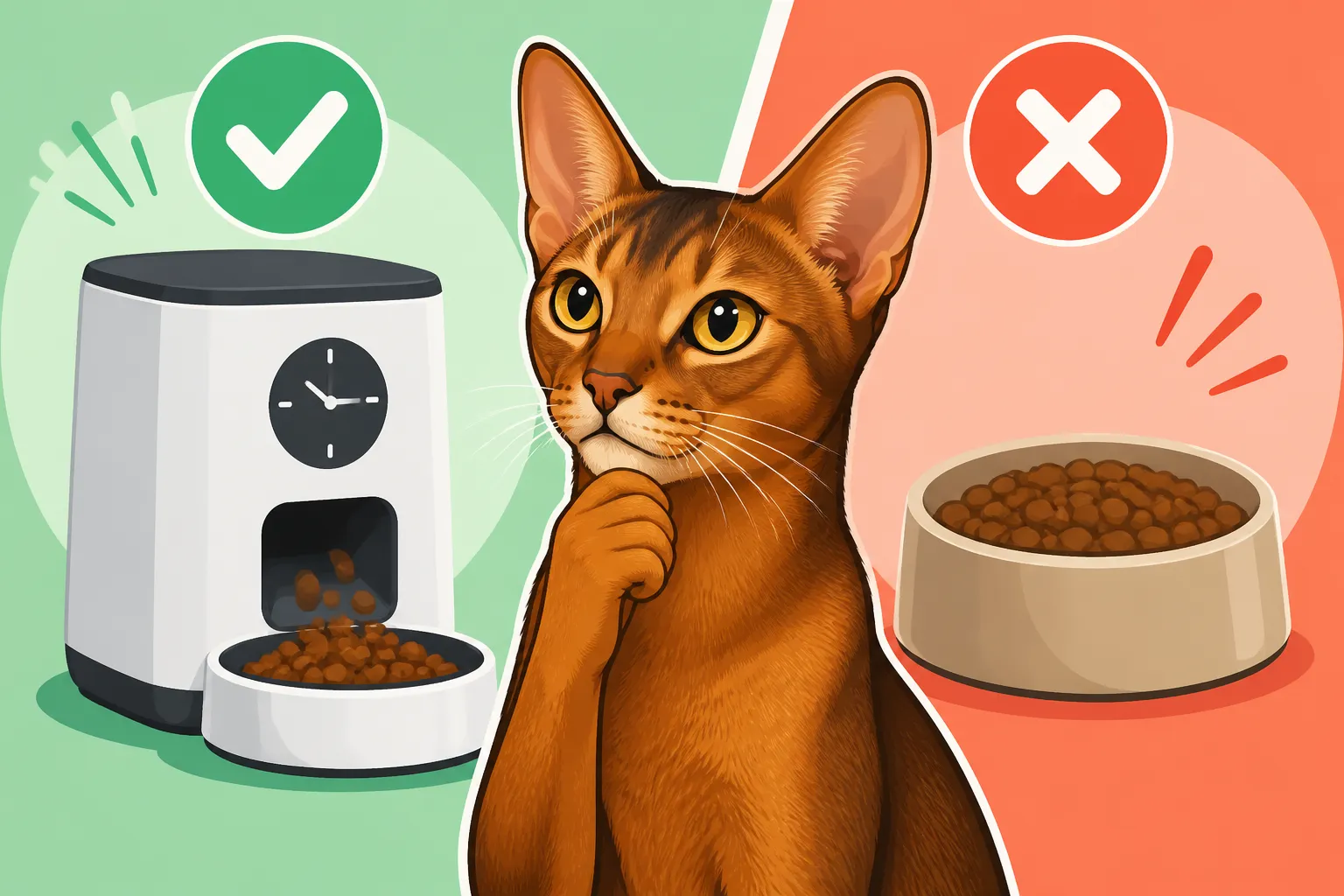
| Timed Feeder | Provides consistency, sets boundaries for human pestering, portion control. | Can be outsmarted, lacks social interaction, may cause frustration. | As a supplement for dry food, especially for specific meal times when owners are absent. |
| Puzzle Feeder | Mental and physical enrichment, slows eating, reduces boredom. | Can be messy, needs regular refilling/reloading, some are too easy. | Primary method for dry kibble, provides daily "work" for the cat. |
| Foraging (Hidden) | Mimics natural hunting, high mental stimulation, physical activity. | Requires owner effort to hide food, may miss some spots. | Supplemental enrichment, especially for single-cat households or during owner absence. |
Consistent Human Interaction at Mealtimes
Even if you use puzzle feeders or a timed feeder for some meals, never completely remove the human element from feeding. Abyssinians crave interaction. Dedicate time to sitting with them while they eat, talking to them, or even playing a short game before or after a meal. This reinforces your bond and ensures they still get that social connection that's so important to them. If you're using a timed feeder for dry kibble, consider feeding a separate wet food meal manually, making it a special, interactive time.
This consistent interaction isn't just about appeasing your Abyssinian; it's about strengthening your relationship. They look to you for more than just food; they look to you for companionship and security. If they only associate food with a machine, that bond can weaken. You can How to Portion an Abyssinian Across Three Sittings or more, ensuring you're present for at least one or two of those. Even just a few minutes of focused attention around their food bowl can make a huge difference in their overall happiness and reduce demand behaviors. Remember, the goal is not to eliminate their demands entirely, but to channel them into healthy, positive interactions.
Multi-Cat Households and Feeding Dynamics
In a multi-cat household, especially with another Abyssinian or an equally energetic breed, feeding dynamics become even more complex. A timed feeder might work for one cat but not another, or one cat might guard the feeder, preventing others from eating. Puzzle feeders can be excellent here too, ensuring each cat has its own "hunting" opportunity without competition. However, some cats eat faster than others, leading to an uneven distribution of food.
When you have more than one Abyssinian, you need to be extra vigilant. Ensure there are enough feeding stations, whether bowls or puzzle feeders, so each cat can eat without feeling threatened. Some owners even resort to microchip-activated feeders (like those from Sure Petcare) to ensure specific cats only access their designated food, especially if one requires a special diet or is prone to stealing. This allows for individual portion control even in a shared space. Abyssinians are generally social, but food can still be a point of contention. Observing their interactions during meal times is crucial to maintaining peace and ensuring everyone gets their fair share.
In conclusion, while a timed feeder can be a useful tool for bringing consistency and portion control to your Abyssinian's diet, it's rarely a complete solution on its own. Their intelligence, energetic nature, and deep need for interaction mean that a holistic approach incorporating puzzle feeders, foraging, and consistent human engagement around meal times is usually far more effective. It's about feeding their bodies and their brilliant minds.
Disclaimer
This article is for general informational purposes only and does not constitute professional advice. Laws, prices and regulations vary by location and change over time. Consult a qualified professional for guidance on your specific situation.