Which Kitten Started the Somali Breed
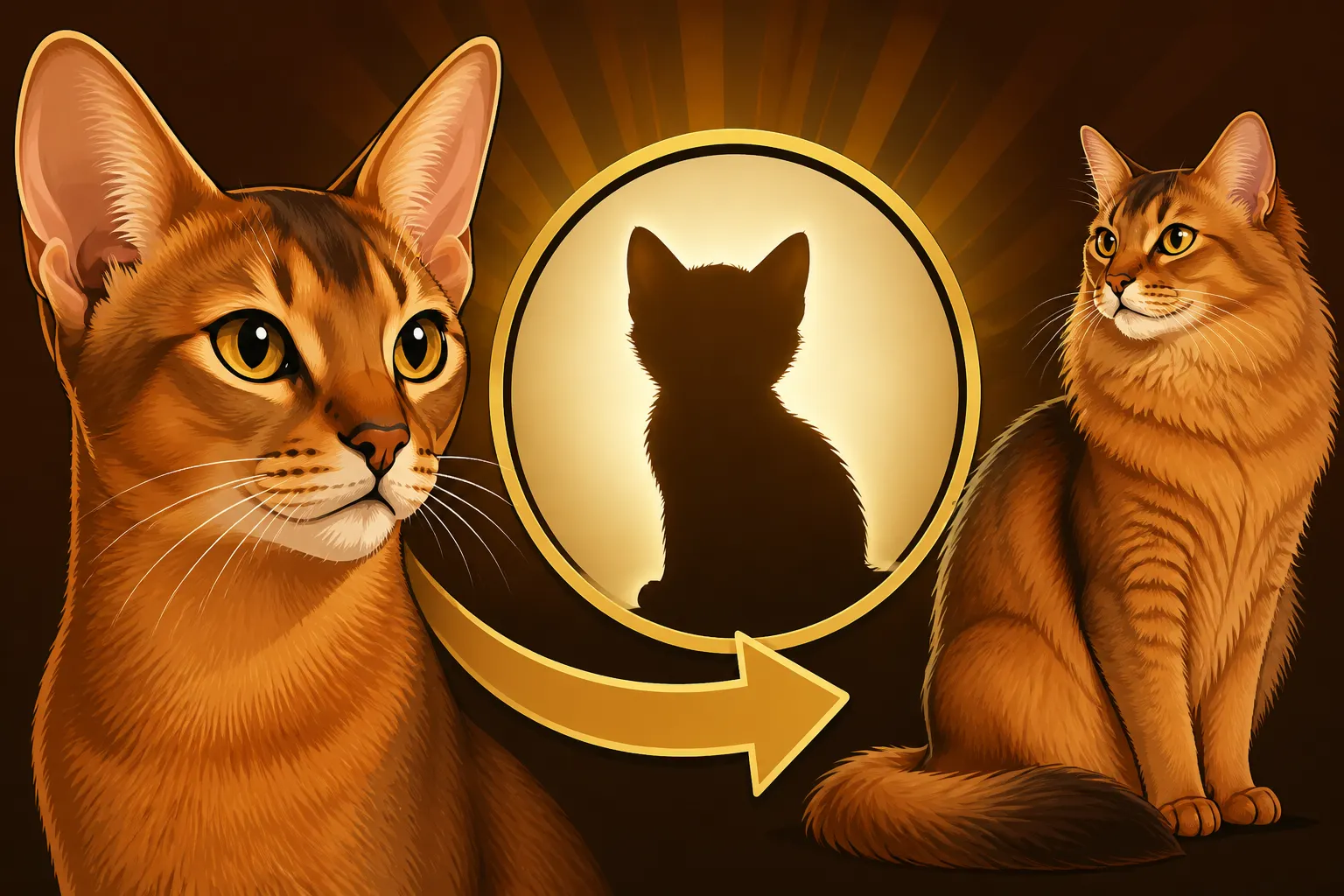
A longhaired kitten born to Abyssinian parents helped spark the Somali breed, but there was no single kitten that created it overnight. The Somali emerged when breeders began deliberately developing longhaired Abyssinians as a distinct breed. This guide explains the kitten and breeder most often connected with that story, why the coat appeared, and how the Somali became recognized.
The kitten behind the Somali breed
Why people ask which kitten started the breed
The Somali’s origin story can sound like it hinges on one special kitten. That’s understandable: the breed looks like an Abyssinian with a flowing, full-length coat, and the longhaired kittens that appeared in Abyssinian litters are central to its history. But a breed isn’t established simply because one unusual kitten is born. It takes a breeder’s decision to preserve that trait, other cats to build a healthy breeding population, and time for the cats to be recognized as a distinct type.
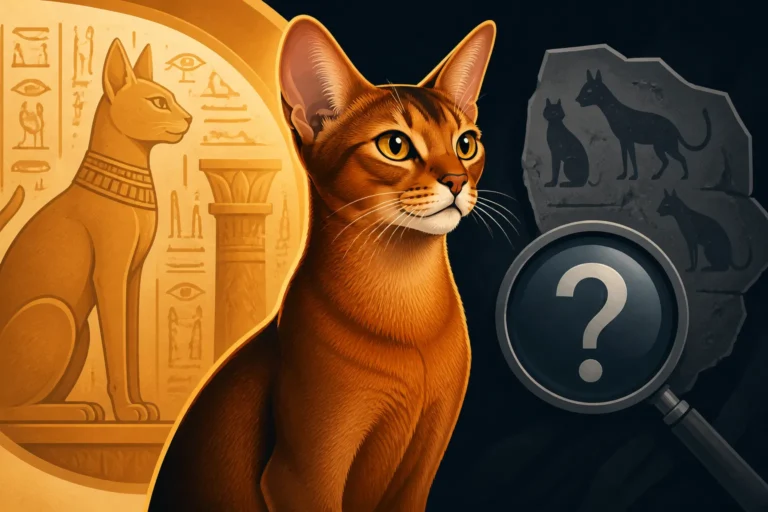
The most careful answer is that longhaired kittens born in Abyssinian lines supplied the beginnings of the Somali, while American breeder Evelyn Mague is widely associated with developing the breed as a deliberate program. Raby Chuffa of Selene is often named as an important early Somali foundation cat, though the story is broader than one cat’s name. Breeders in different places had encountered longhaired Abyssinians, and records of the earliest cats and breeding decisions are not always presented consistently.
That distinction matters if you’re trying to find a single “first Somali.” The first known longhaired kitten, an early foundation cat, and the first cat registered under a breed name are not necessarily the same animal. The history is better understood as a gradual transition from occasional longhaired kittens in Abyssinian litters to a planned breed. Who Bred the First Somali explores that breeder history in more detail.
Raby Chuffa of Selene and Evelyn Mague
Raby Chuffa of Selene is frequently connected with the Somali’s early foundation history. He is remembered as a longhaired cat with Abyssinian ancestry and is often described as one of the cats that helped establish the Somali type. It’s safer to think of him as a key early figure in the story rather than to claim he was the only kitten responsible for the breed.
Evelyn Mague played a different but equally important role. She worked to develop longhaired cats from Abyssinian lines as a breed in their own right, rather than treating the longer coat as an accidental variation. By selecting cats with the desired coat and Abyssinian features, she helped turn an occasional trait into a recognizable breeding direction. The Somali name also gave the new breed a distinct identity, separate from the name of its shorthaired relative.
These roles often get compressed into one sentence: “This kitten started the Somali.” In reality, a foundation cat can contribute genes, while the breeder’s sustained choices shape what the breed becomes. If you want the background on the recessive coat trait that made longhaired kittens possible, see Why the Long Hair Gene Was in Abyssinians All Along.
One kitten or a developing population
A breed needs more than a striking individual. A breeder must have enough related and unrelated cats to continue the line responsibly, preserve the desired features, and avoid relying too heavily on one animal. That is why breed histories usually involve several cats and people, even when one name becomes the most memorable.
In the Somali’s case, longhaired kittens appeared in Abyssinian breeding lines before breeders organized them as a separate breed. The trait could remain hidden in shorthaired cats and appear when two cats carrying the relevant gene passed it to a kitten. Once breeders recognized that the coat could be preserved, they could plan matings and develop cats with the Somali’s characteristic long, shaded coat and Abyssinian build.
| Part of the story | What it means |
|---|---|
| Longhaired kitten in an Abyssinian line | An early expression of the coat trait that made the Somali possible |
| Raby Chuffa of Selene | A frequently mentioned early foundation cat |
| Evelyn Mague | A breeder associated with deliberately developing the Somali |
| Recognition as a separate breed | The point at which breeders and registries treated the Somali as more than a longhaired Abyssinian |
The distinctions in this table help avoid a common mix-up: “first kitten,” “important foundation cat,” and “breeder credited with developing the breed” are different roles. Which Kitten Started the Somali Breed is one part of a much wider Abyssinian and Somali history.
How a longhaired kitten appeared in Abyssinian lines
The coat trait could stay hidden
Abyssinians are shorthaired, but the gene associated with long hair can be carried without making a cat’s coat long. This helps explain why longhaired kittens could appear unexpectedly in litters of shorthaired Abyssinians. If both parents carried the relevant recessive trait, a kitten could inherit a combination that expressed a longer coat.
To a breeder who was focused on producing shorthaired Abyssinians, a longhaired kitten could seem like an unwanted surprise. The kitten wasn’t a different species or a cross with a visibly longhaired breed just because its coat was longer. It could be a natural expression of inherited variation within the Abyssinian population.
The underlying genetics also explain why a longhaired kitten might not appear in every litter, even when the trait was present in a line. A carrier can look shorthaired, so the trait may pass quietly through generations. For a fuller explanation of the relationship between the two coats, read How an Abyssinian Differs From a Somali.
From an unexpected trait to a deliberate breeding choice
The change from “unusual kitten” to “breed foundation” came when breeders chose to preserve the long coat rather than exclude it. They could select cats with the coat and other desired qualities, then plan future matings to build a population with consistent features. This does not mean every longhaired kitten automatically met the emerging Somali ideal; breeders still had to assess health, temperament, structure, and coat.
That process takes patience. A long coat alone doesn’t define a Somali. Breeders aimed to retain the elegant, athletic form and expressive face associated with Abyssinians while developing the Somali’s fuller coat, plume-like tail, and soft ruff. The result was a cat that shares close ancestry with the Abyssinian yet has a distinct appearance and breed identity.
The broader history is one reason the Somali is often described as the Abyssinian’s longhaired relative. The phrasing is useful, but it can make the development sound more immediate than it was. The breed emerged through ongoing breeding choices and formal recognition, not through a single spontaneous event. The Somali Is an Abyssinian With Long Hair gives more context on that close relationship.
Why the breed name mattered
Giving the cats a separate name helped breeders explain what they were developing. “Somali” distinguishes the longhaired breed from the shorthaired Abyssinian, even though their histories are closely connected. The name also helped people discuss the cats as a group with their own standard and breeding goals rather than as a coat variation that happened to occur in Abyssinian litters.
A name alone doesn’t make a breed, of course. The cats also needed consistent descriptions, dedicated breeders, and acceptance from cat organizations. As the population developed, breed enthusiasts could compare cats, refine standards, and make the Somali recognizable to judges and prospective owners.
If you’re looking at a Somali kitten today, its coat is one obvious difference, but it doesn’t tell the whole story. Temperament, health, and responsible breeding practices matter just as much. It’s reasonable to ask a breeder how their cats are raised and what health information they can share, rather than relying on a breed label or an attractive photograph alone.
How the Somali became a recognized breed
Breeders turned a variation into a breed
Breed development takes place through repeated decisions. Breeders choose which cats to mate, which characteristics to preserve, and how to avoid narrowing the gene pool unnecessarily. For the Somali, those choices involved maintaining the Abyssinian-like appearance while selecting for a long, flowing coat and the features associated with the emerging breed.
There can also be differences between what breeders are developing and what a registry formally recognizes. A group of breeders may already be working with a distinct type before an organization grants it a particular status. Recognition is a process, not the moment a first longhaired kitten is born.
That gradual timeline is why the Somali’s beginnings are sometimes described in slightly different ways. One account may emphasize an early longhaired Abyssinian; another may focus on a prominent foundation cat; another may highlight the breeder who organized a breeding program. Those accounts can refer to different milestones rather than contradict one another outright.
Registration and championship status came later
Formal recognition helped establish the Somali as a breed that could be shown and evaluated under its own standard. Different cat registries have their own procedures, so the timing and terminology can vary. The important point for the origin question is that registration followed the cats’ development; it did not create the longhair trait or identify a single kitten as the sole origin.
Once recognized, the Somali could be judged according to its own features rather than treated as a longhaired Abyssinian in a different coat. Breed standards describe the appearance judges look for, while registries determine how cats are recorded and what status the breed has within their system. For the next step in that timeline, see When the Somali Got Championship Status.
Somali and Abyssinian breeding has also been shaped by registry rules and the goals of individual breeding programs. Practices can vary, so it’s best not to assume every Somali line has the same history or that cross-breeding is handled identically everywhere. Whether Abyssinians and Somalis Are Still Bred Together looks more closely at that question.
What remains shared between the breeds
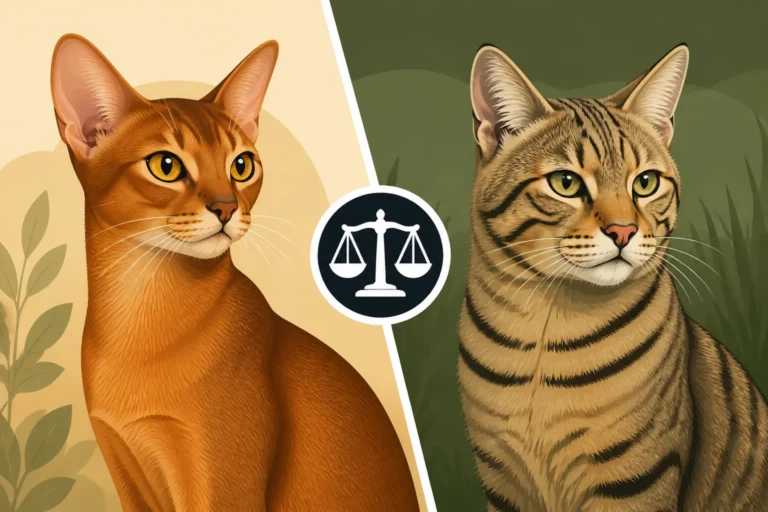
The Somali and Abyssinian share a close family relationship, and their similarities are easy to see in their alert expression, athletic bodies, and active personalities. Their coats create the most immediate visual contrast: the Abyssinian has a short, close-lying coat, while the Somali has longer fur that forms a fuller tail and often a more pronounced ruff.
The common ancestry can be useful when researching breed history, but it doesn’t mean the cats are interchangeable in everyday care. A Somali’s longer coat may need more attention to prevent tangles, particularly around areas where fur is fuller. Both breeds benefit from appropriate play, safe climbing opportunities, regular veterinary care, and a home environment that suits an energetic cat.
For example, a household choosing between the two might focus on coat care as well as appearance. A future owner browsing grooming supplies at a local shop or Chewy should choose tools suited to the individual cat’s coat, not simply buy a product because it is advertised for cats generally. Chewy is one place people may encounter grooming products, but the right choice depends on the cat’s coat and comfort. A breeder or veterinary professional can help clarify what care is appropriate; a retailer such as Chewy can be a place to look for basic supplies, not a substitute for that guidance.
What the Somali’s origin story means today
Don’t mistake coat length for proof of a breed
A longhaired cat with an Abyssinian-like appearance isn’t automatically a registered Somali. Breed identity usually involves documented ancestry and the standards used by a particular registry. If a seller describes a kitten as a Somali, ask what registration or pedigree information is available and what the description means in that seller’s context.
This is not about dismissing cats without papers. A wonderful companion can be a mixed-breed or unregistered cat, and papers do not guarantee health or temperament. The practical point is simply to understand what you are being offered. If you’re adopting, focus on the cat’s needs and known history. If you’re purchasing from a breeder, ask clear questions about ancestry, health, and the contract.
The same caution applies to claims that one specific kitten “started” the Somali. A famous name can be meaningful without being the entire explanation. History is more useful when it distinguishes the early cats, the breeders who developed the line, and the later recognition of the breed.
What a prospective owner can take from the history
The Somali’s story is a reminder that a coat difference can reflect inherited variation, not necessarily a recent cross. It also shows how breeders can develop a distinct breed by consistently selecting for a set of characteristics. That does not make every breeding decision automatically responsible. Health screening, thoughtful breeding choices, and transparent information still matter.
If you’re considering a Somali, ask about the kitten’s socialization, veterinary care, and the health history of the parents and relatives. Ask how the breeder handles questions after the kitten goes home, too. For practical coat care, choose a comb or grooming tool that works gently through longer fur. People may compare options at a pet shop or on Chewy, but a tool should suit the individual cat rather than a marketing label.
The short answer, then, is not that one kitten single-handedly created the Somali. Longhaired kittens from Abyssinian lines made the breed possible; cats such as Raby Chuffa of Selene are often remembered in its early foundation history; and Evelyn Mague is closely associated with deliberately developing it. The breed took shape through a community of breeders and the gradual recognition of a distinct longhaired relative of the Abyssinian.
Disclaimer
This article is for general informational purposes only and does not constitute professional advice. Laws, prices and regulations vary by location and change over time. Consult a qualified professional for guidance on your specific situation.