How the Abyssinian Contributed to the Ocicat
When people see an Ocicat’s bold spots and athletic build, it is easy to assume it must have wild ancestry—or that the Abyssinian itself passed those spots along. The real story is more interesting: Abyssinians were part of the domestic breeding program that helped create the Ocicat, but their ticked coats are not the same pattern as an Ocicat’s spots.
How the Abyssinian entered the Ocicat’s history
Virginia Daly’s breeding experiment
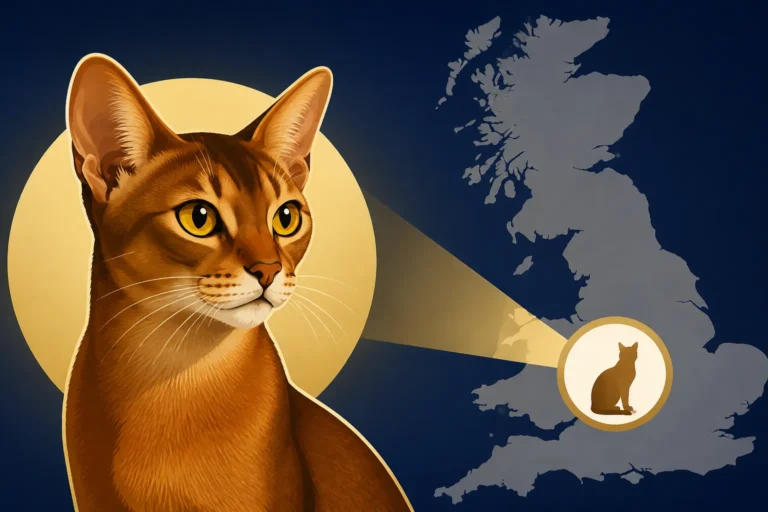
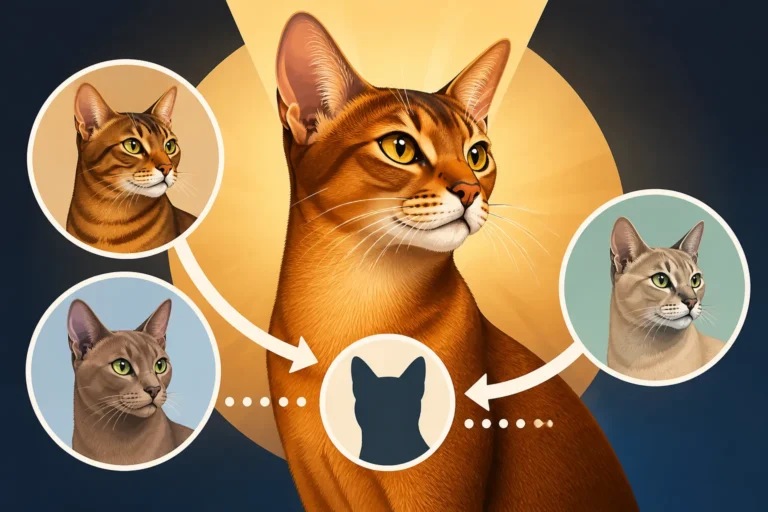
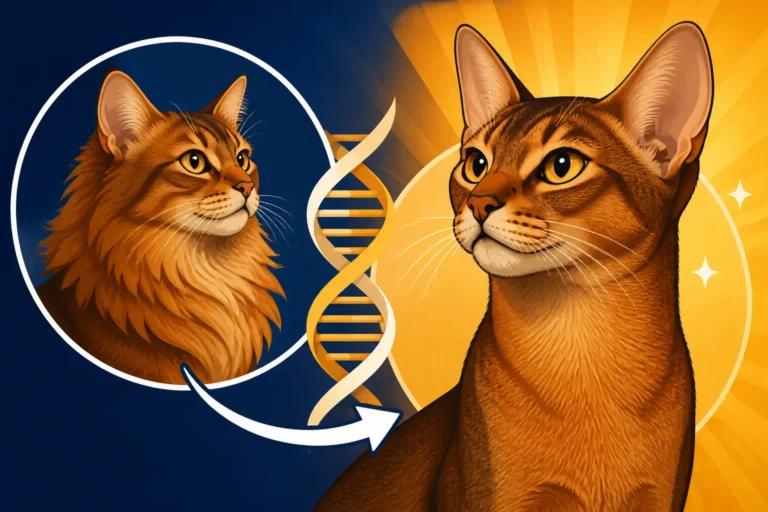
The Ocicat’s story began in the United States in the 1960s with breeder Virginia Daly. Her initial goal was to develop Siamese cats with Abyssinian-style color points. To work toward that look, she bred a Siamese cat with an Abyssinian. Their offspring were then bred back to Siamese cats.
The program was not originally designed to produce a spotted breed. The spotted kitten that drew attention was an unexpected result of the breeding work, rather than the intended target. That kitten, named Tonga, had a coat pattern that reminded people of a small wild cat. The striking appearance prompted further interest in developing a domestic cat with a similar spotted look.
That detail matters because it separates the Ocicat’s origin from a simple “Abyssinian crossed with a wild cat” story. The Abyssinian was one of the domestic breeds involved, and the spots were a surprising feature that breeders later worked to establish. The breed’s name evokes the ocelot, but the Ocicat is a domestic cat, not a wildcat hybrid.
For readers curious about the Abyssinian’s own background, The Abyssinian Is Probably Not From Abyssinia explains why the breed’s traditional origin story is less straightforward than its name suggests. The history of one breed can be full of surprises, but that does not mean its ancestry is mysterious or wild.
The Abyssinian was one contributor, not the whole recipe
The Abyssinian mattered because it was part of the Ocicat’s foundation. It was not the only breed involved, and it is not accurate to treat the Ocicat as simply an Abyssinian with spots. Siamese cats were central to Daly’s original breeding plan, and American Shorthairs were later introduced into Ocicat development. Those later crosses helped broaden the breed’s look and contributed traits breeders wanted to preserve.
A breed’s appearance does not come from one ancestor in a neat, one-trait-per-parent arrangement. Each cat inherits a mix of genetic material, and breeders select kittens that express the features they want to carry forward. The Abyssinian’s role is best understood as part of the early foundation that helped establish the Ocicat—not as the direct source of every feature the breed later became known for.
The history also highlights how planned breeding can lead to an unplanned discovery. Daly was working toward a particular Siamese appearance, but a kitten with a different pattern changed the direction of the project. Breeders then had to decide whether that unusual look could be reproduced consistently and whether it could become the basis of a stable domestic breed.
Why the Ocicat is not a wild hybrid
The Ocicat’s wild-looking coat can invite assumptions about ocelots or other wild cats. But its name describes its appearance, not its ancestry. The breed was developed from domestic cats, including Abyssinians, Siamese, and American Shorthairs. Its spotted coat does not make it a wild hybrid.
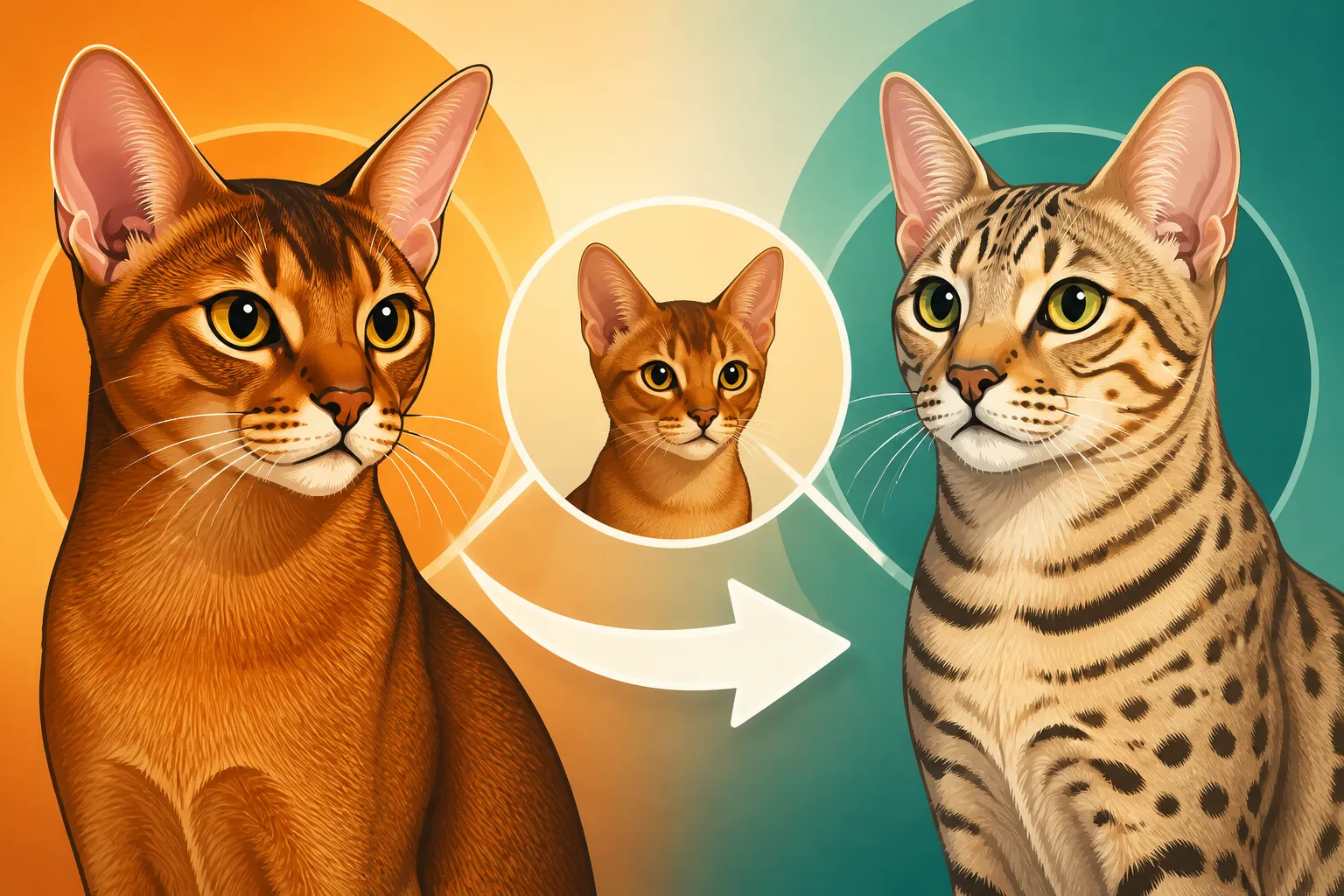
That distinction is useful when comparing breeds. The Ocicat has a bold, spotted tabby pattern, while the Abyssinian is known for a ticked coat in which individual hairs show alternating bands of color. Those patterns can both create a lively, richly colored appearance, but they are not interchangeable. Why an Abyssinian Has No Tabby Stripes gives a closer look at the pattern that makes the Abyssinian’s coat distinctive.
| Feature | Abyssinian | Ocicat |
|---|---|---|
| Coat pattern | Ticked hairs, usually with little or no visible striping | Clearly defined spots arranged in a tabby pattern |
| Role in Ocicat history | One of the domestic breeds in the foundation | The breed developed through selective breeding from domestic cats |
| Wild ancestry | Domestic breed | Domestic breed, despite the ocelot-inspired name |
| Overall visual effect | Shimmering, even color across the coat | Contrasting spots that stand out against the background |
What the Abyssinian contributed—and what it did not
Ticking is different from spotting
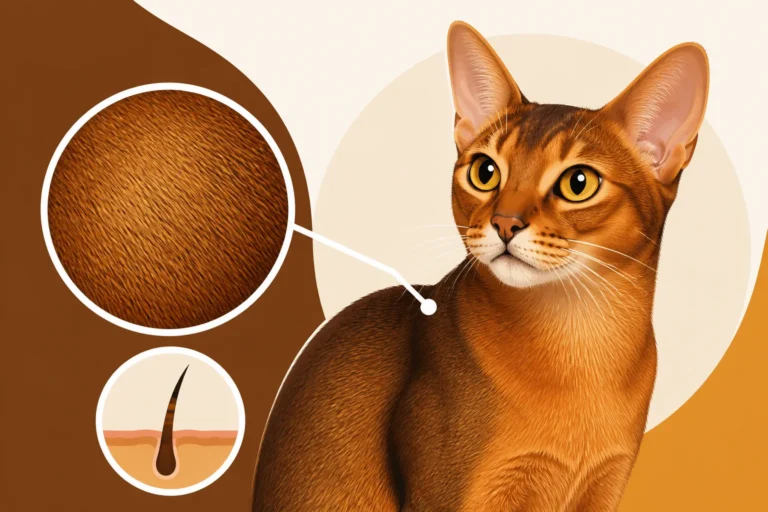
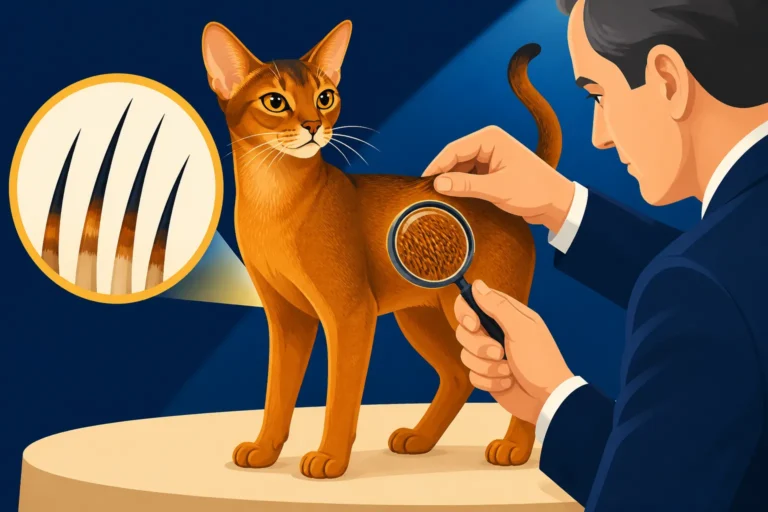
An Abyssinian’s coat is made up of hairs with alternating light and dark bands. This is called ticking, or agouti banding. From a few feet away, the bands blend together into a warm, even coat rather than forming bold stripes or spots. The effect can look like the coat is shimmering when the cat moves.
An Ocicat’s spots are different. They are visible markings across the body, not simply the result of each hair carrying bands of color. The two coats may share a sense of visual depth, but the patterns are distinct. A person looking at an Abyssinian should not expect to see the Ocicat’s spot pattern, and an Ocicat’s spots should not be explained as “Abyssinian ticking spread across the body.”
It is tempting to assign a single recognizable trait to a breed’s contribution: the Abyssinian brought ticking, the Siamese brought points, the American Shorthair brought spots. Genetics and breeding history are not usually that tidy. A breed can contribute to a foundation without every later feature being traceable to one ancestor or one cross. What Makes an Abyssinian’s Coat Ticked Rather Than Striped explains the coat structure more closely.
The Ocicat’s spots were selected and established through breeding
The first spotted kitten did not, by itself, create a new breed. A distinctive kitten is a beginning, not a finished population. Breeders need to determine whether the desired appearance can be reproduced, whether cats remain healthy, and whether the defining features can be carried forward without losing the breed’s overall type.
That is where selective breeding becomes important. Breeders choose cats with traits they want to preserve, then evaluate their offspring. Over generations, selection can make a particular look more consistent. In the Ocicat’s case, the spotted appearance became the hallmark of the breed, while the animals remained domestic cats with their own breed identity.
This process also helps explain why the Ocicat should not be thought of as a spotted Abyssinian. The Abyssinian was part of the breed’s history, but the Ocicat developed through a broader breeding program and a different selection goal. If you want a clearer picture of the Abyssinian itself, What an Abyssinian Looks Like Against the Show Standard describes the features breeders look for in that breed.
How other foundation breeds shaped the Ocicat
The Siamese was central to Daly’s early breeding plan, which aimed to produce Siamese cats with Abyssinian-style points. Later, American Shorthairs also became part of Ocicat development. These breeds contributed to a domestic foundation that breeders could shape over time, rather than relying on any wild species.
It is more accurate to describe the Ocicat as a breed with multiple domestic influences than to claim that the Abyssinian alone “created” it. The Abyssinian’s place in the story is real and important, but it is one chapter in a larger history. A similar caution applies when discussing other breeds: visual resemblance does not always reveal direct ancestry. For example, How an Abyssinian Differs From a Bengal looks at two cats that can both appear strikingly wild without sharing the same breed history.
How the Abyssinian and Ocicat compare as pets
Similar athletic energy, different coat patterns
Both breeds are often described as active, curious cats, but individual temperament varies. A cat’s personality is shaped by more than breed label: early experiences, socialization, health, and the home environment all matter. A prospective owner should meet the cat and ask about its habits rather than assume that every Abyssinian or Ocicat will behave in exactly the same way.
Their coats also create different everyday impressions. Abyssinians have short, close-lying coats with a fine, ticked appearance. Ocicats have short coats marked by spots. Neither breed is defined by a long, heavy coat, but grooming needs still vary from cat to cat. Regular handling can help owners notice changes in skin, coat, or body condition before they become easy to overlook.
If you are trying to decide which breed’s activity level would fit your household, focus on the time and interaction you can offer. A busy cat may benefit from climbing spaces, toys that invite chasing, and short play sessions throughout the day. Chewy is one place owners may browse for wand toys or puzzle feeders, but the important part is choosing safe, age-appropriate enrichment and using it regularly.
Choosing between the breeds means looking beyond looks
A spotted coat can be captivating, and an Abyssinian’s glowing ticked coat can be just as eye-catching. But appearance is only one part of living with a cat. Ask breeders or rescue organizations about the individual cat’s social needs, activity level, health history, and comfort with other pets or children. A cat that fits your daily routine is usually a better match than one chosen only for its markings.
Consider the home setup, too. Active cats can make good use of sturdy climbing structures, scratching surfaces, and play opportunities. If you are comparing products, Chewy may offer a convenient way to look at different styles of scratchers or climbing furniture; measure your available space and check that any structure is stable enough for the cat who will use it. A tall perch is only helpful if it can be used safely.
It is also worth asking what health screening and veterinary care the cat has received. Breed history is fascinating, but it does not replace a clear health record or ongoing veterinary care. For Abyssinian-specific questions about screening, What an Abyssinian Breeder Should Have Tested Before You Buy is a useful next read. If you are preparing for either breed, compare the breeder’s answers with the actual records rather than relying on a verbal assurance.
Everyday care should follow the individual cat
Abyssinians and Ocicats both benefit from routine care that fits the cat in front of you. Keep a consistent schedule for feeding, grooming, play, and veterinary checkups. Notice what is normal for your cat: how much it eats, how it moves, what its coat looks like, and whether it seeks more or less interaction than usual. Small changes are often easier to spot when you have a baseline.
For enrichment, rotate toys rather than leaving every option out all the time. A toy that disappears for a while may feel interesting again when it returns. Chewy can be a source for replacement toys or feeding puzzles when a cat has mastered an old one, but there is no need to keep buying new gear: cardboard boxes, paper bags with handles removed, and simple supervised games can also provide novelty.
Food choices should be made with a veterinarian’s guidance when a cat has a health condition, a changing body condition, or a special dietary need. Retail listings can help owners compare product formats and ingredients, but marketing language is not a substitute for an individualized feeding plan. If you browse food or supplies through Chewy or another retailer, check the label and discuss any significant diet change with your veterinary team.
The lasting significance of the Abyssinian’s role
A breed contribution is more than a single visible trait
The Abyssinian contributed to the Ocicat’s origin because Abyssinians were among the cats used in the breeding program that led to the breed. That is the strongest and clearest way to describe its role. It is less reliable to claim that every defining Ocicat feature came directly from the Abyssinian, or to equate the Abyssinian’s ticked coat with the Ocicat’s spots.
Breed histories are often simplified into memorable one-line explanations. Those shortcuts can be useful, but they can also erase the role of later crosses, breeder selection, and unexpected outcomes. In this case, the simplest version—“Abyssinian plus Siamese equals Ocicat”—leaves out the American Shorthair’s later part in the story and makes the spotted pattern sound more predictable than it was.
For a wider look at the breed’s visual identity, The Four Colors an Abyssinian Comes In explores the recognized color varieties of the Abyssinian, while How an Abyssinian Differs From an Egyptian Mau offers another useful comparison between cats whose appearances can prompt questions about ancestry.
The Ocicat’s identity is its own
The Ocicat began with domestic breeds and became a distinct breed through selective breeding. Its name and coat may bring an ocelot to mind, but its ancestry does not include wildcats. The Abyssinian helped form part of the foundation, yet the Ocicat is not simply a variation of the Abyssinian. The two breeds have different coat patterns, histories, and standards.
That distinction is a good reminder to separate resemblance from relationship. Cats can look alike because they share certain colors, body shapes, or patterns, but those similarities do not necessarily mean they have the same ancestry. The Ocicat’s spots are part of its own established appearance; the Abyssinian’s hallmark is the softly banded, ticked coat that gives it a very different look.
Understanding the Abyssinian’s contribution makes the Ocicat’s history richer, not less distinctive. It shows how domestic breeding can combine planned goals with an unexpected kitten—and how breeders can shape that discovery into a recognizable breed over time.
Disclaimer
This article is for general informational purposes only and does not constitute professional advice. Laws, prices and regulations vary by location and change over time. Consult a qualified professional for guidance on your specific situation.