Whether an Abyssinian Comes Microchipped
Bringing home a new Abyssinian kitten is an incredibly exciting time, filled with dreams of playful antics and purring companionship. However, many new owners find themselves wondering about the practicalities of identification, specifically whether their energetic little bundle of joy will come microchipped, or if that's a task they need to handle. It's a valid concern, because an Abyssinian's boundless curiosity and athletic prowess can sometimes lead them into unexpected adventures, and ensuring they can find their way home is paramount. This comprehensive guide will walk you through everything you need to know about microchipping your Abyssinian, from breeder expectations to what steps you should take as an owner to keep your beloved cat safe and sound.
The Standard Practice: Microchipping from Abyssinian Breeders
When you're investing in a purebred Abyssinian, you're not just getting a cat; you're often getting a carefully bred, well-socialized, and health-tested companion. Reputable breeders understand the value and importance of proper identification, and microchipping has become an industry standard for ensuring the safety and traceability of their kittens. It's a critical part of responsible breeding and a sign that your breeder cares deeply about the welfare of their cats long after they leave the cattery.
Why Microchipping Is Important for Abyssinians
Abyssinians are famously active, incredibly curious, and astonishingly agile. They're often called the "clowns of the cat world" or "Aby-dos," and for good reason – they're always exploring, climbing, and getting into everything. While this makes them incredibly entertaining companions, it also means they have a knack for finding their way out of seemingly secure environments. A loose screen, a door left ajar for just a second too long, or an unexpected dash when a visitor arrives can lead to a harrowing experience of a lost Abyssinian.
Imagine the panic of realizing your vibrant, copper-eyed companion has slipped out. Abyssinians, with their distinctive ticked coats and lean, muscular bodies, are beautiful but can also be mistaken for wild animals or stray tabbies by those unfamiliar with the breed. Without permanent identification, it can be incredibly difficult to prove ownership, or even for someone who finds them to know where to return them. The microchip provides that irrefutable link back to you, offering a vital layer of security against loss and heartbreak. It's truly a small investment for the immense peace of mind it offers, especially given How Many Years a Well Bred Abyssinian Lives.
What to Expect from a Reputable Abyssinian Breeder
Most ethical and responsible Abyssinian breeders will microchip their kittens as a routine part of their health protocol before they go to their new homes. This often happens around the same time as their final vaccinations, usually when the kittens are between 10 to 14 weeks old, which aligns with Why an Abyssinian Kitten Leaves at Fourteen Weeks. They understand that this tiny chip is a crucial first line of defense should a kitten ever get lost. When you are looking for a kitten, be sure to ask Which Questions to Ask an Abyssinian Breeder First.
A reputable breeder will typically register the microchip in their name initially, even if it's only for a short period. This allows them to ensure the chip is active and linked to someone if a kitten is ever found before the ownership transfer is complete. It also provides an extra layer of protection, allowing the breeder to be contacted if something goes wrong, serving as a failsafe to protect their beloved lineage. They should be transparent about this process and provide you with all the necessary documentation, including the microchip number, brand, and instructions on how to transfer ownership. This level of transparency is similar to how they provide The Test Results an Abyssinian Breeder Owes You for genetic health screenings.
The Transfer Process: Breeder to Owner
Receiving your kitten's microchip information is just the first step; the critical second step is completing the ownership transfer. The breeder will usually provide you with instructions, which often involve filling out an online form or mailing in a physical card to the microchip registry company. There might be a small fee associated with this transfer, though some breeders will include this in the initial purchase price of What an Abyssinian Kitten Costs in 2026 as part of their comprehensive care package.
It's absolutely vital that you complete this ownership transfer as soon as possible after bringing your Abyssinian home. Until the chip is registered in your name with your current contact information, it's essentially useless for helping your cat find its way back to you. Don't procrastinate on this! Double-check all the details you submit, including your phone number, address, and email. Think of it as activating a safety net; it's only there to catch you if you've properly set it up. Many microchip registries offer online portals where you can update your information as needed, which is incredibly handy for a mobile society. Knowing Why an Abyssinian Should Be Registered With Its Chip Company empowers you to ensure this crucial step is done correctly.
What to Do When Your Abyssinian Isn't Chipped, or You're Unsure
Perhaps you're adopting an adult Abyssinian from a rescue, or your breeder wasn't quite as proactive, or maybe you're simply unsure if your cat has a chip. Whatever the reason, it's never too late to ensure your Abyssinian has this vital piece of identification. Don't let uncertainty prevent you from taking this simple yet profound step to protect your feline friend.
Getting Your New Abyssinian Microchipped at the Vet
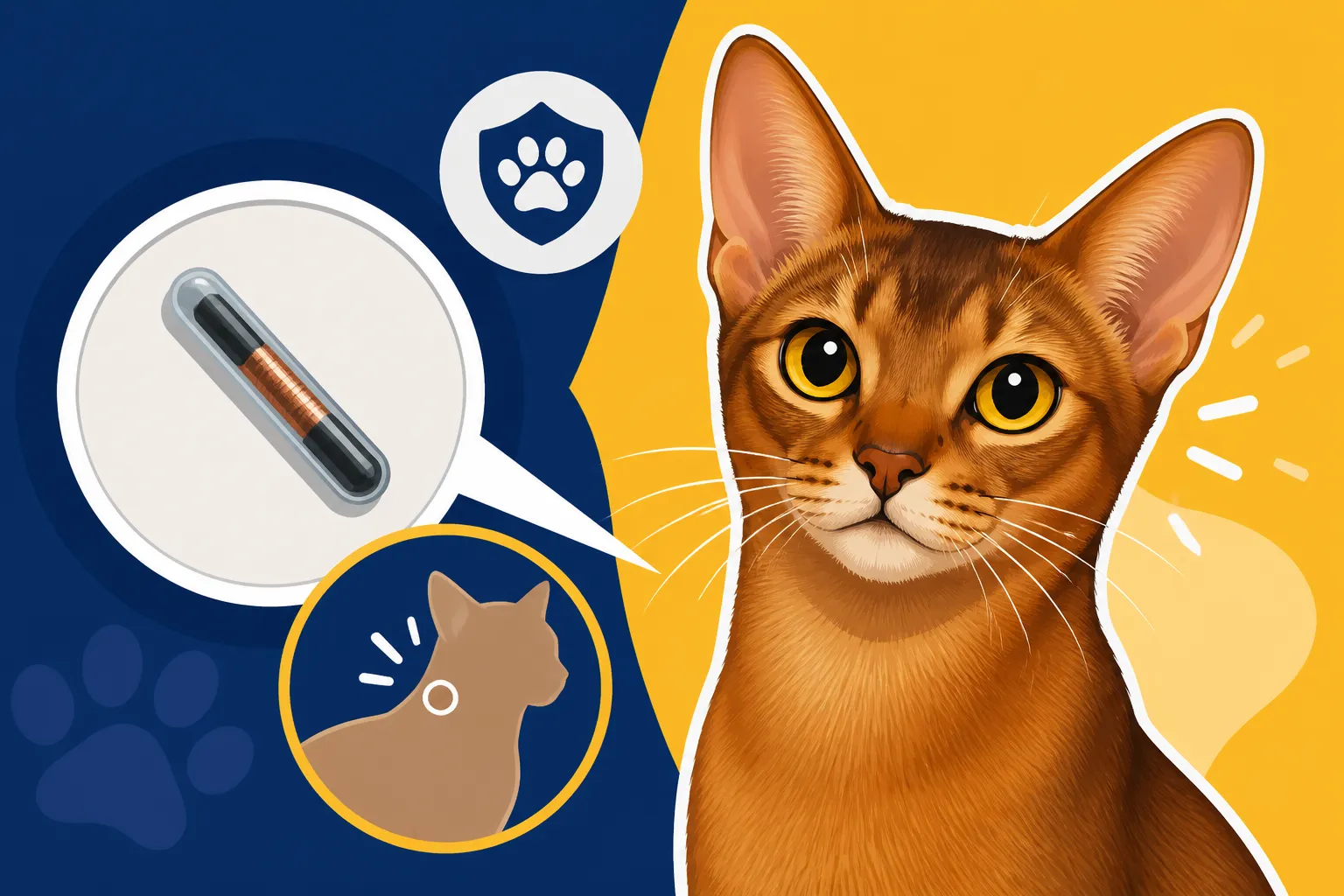
If your Abyssinian arrives without a microchip, or if you simply can't confirm one, getting them chipped is one of the easiest and most impactful things you can do. The procedure itself is incredibly fast and relatively painless, often taking less time than a routine vaccination. Your veterinarian will use a sterile needle to insert a tiny, rice-grain-sized microchip just under the skin between your cat's shoulder blades. Most cats barely react, or they might give a tiny flinch, much like they would for any injection.
This procedure can easily be done during a routine check-up, such as What an Abyssinian's Annual Checkup Costs, or during a spay/neuter appointment when they are already under anesthesia. The cost for the microchip itself is typically a small, one-time fee, making it a very accessible form of permanent identification for almost any pet owner. Many veterinary clinics in cities and towns across the country, from bustling urban centers to quiet suburban practices, offer microchipping services as a standard part of their preventative care, recognizing its immense benefit to pet safety.
Checking for an Existing Microchip
Even if you believe your Abyssinian does have a microchip, it's always a good idea to have your veterinarian scan for it during their first visit. Accidents happen, and sometimes a chip can migrate slightly, or a previous owner might have forgotten to register it properly. Your vet has a handheld scanner that emits a low-frequency radio wave, which reads the unique identification number on the microchip. It's a completely harmless process that only takes a few seconds.
If a chip is found, your vet can often tell you the brand of the chip and sometimes even verify if it's registered. If it's registered to someone else (perhaps a previous owner in a rescue situation), your vet can guide you on the steps to contact the relevant registry or the previous owner to facilitate a transfer. If a chip is found but completely unregistered, that's your cue to immediately register it in your name. Never assume a found chip is active and registered to the correct person; always verify.
Registering and Keeping Your Microchip Information Updated
A microchip is essentially a passive device; it doesn't have GPS or actively broadcast your cat's location. Its power lies entirely in its registration. The chip simply holds a unique ID number, and that number needs to be linked to your current contact information in a national pet recovery database. Without this link, the chip is just a number. It's a common and frustrating misconception that simply having the chip inserted is enough.
There are several major microchip registries, and your vet or breeder will typically provide information on the one associated with your cat's chip. Make sure all your contact information – phone numbers (cell and home), email addresses, and physical address – is up-to-date. If you move, change your phone number, or even get a new email address, update your microchip registration immediately. It's surprising how many lost pets can't be reunited with their families because the contact information linked to their chip is outdated. Think of your microchip like a personal emergency contact list for your Abyssinian; it only works if the numbers are current.
Beyond the Chip: Layers of Protection for Your Abyssinian
While a microchip is the most reliable form of permanent identification, it's just one tool in your pet safety arsenal. Given the adventurous spirit of Abyssinians, a multi-layered approach to identification and containment is the smartest way to protect them. You never want to put all your eggs in one basket when it comes to the safety of your beloved companion.
The Role of Collars and Tags and Their Limitations for Abyssinians
A collar with an ID tag is often the first thing people think of for pet identification, and for good reason: it's immediately visible. A tag with your current phone number can mean a quick call and reunion if your Abyssinian is found by a kind stranger. Many pet owners choose to engrave their cat's name and a primary phone number on a small, lightweight tag. You can find a wide variety of these tags and collars at pet supply stores, or even online retailers like Chewy.
However, collars and tags have significant limitations, especially for highly active cats like Abyssinians. They can get snagged on branches, fences, or furniture, posing a strangulation risk. For this reason, breakaway collars, which release if enough pressure is applied, are absolutely essential for cats. But even breakaway collars can come off and be lost, rendering the tag useless. Abyssinians are also prone to losing things during their wild adventures, or even simply scratching them off during vigorous grooming sessions. A microchip, on the other hand, is always with them, safely under their skin.
Why an Indoor Abyssinian Still Needs a Microchip
"My cat is strictly indoor, so they don't need a microchip, right?" This is a common, understandable assumption, but for Abyssinian owners, it's a dangerous one. Abyssinians are renowned escape artists. Their intelligence, agility, and insatiable curiosity mean they are experts at exploiting any weakness in your home's defenses. A momentary lapse in attention, a faulty window screen, or an open door during a grocery delivery can be all it takes. Why an Abyssinian Needs a Tall Cat Tree and Why an Abyssinian Opens Doors and Cabinets are just a couple of examples of their innate ability to navigate and manipulate their environment.
The truth is, an indoor cat that escapes is often at a greater disadvantage than a cat accustomed to some outdoor life. They're disoriented, more easily frightened, and less likely to know how to navigate back home. The panic you feel when an indoor cat goes missing is intense, and the microchip provides an invaluable safety net. While we hope our Abyssinians enjoy Why an Indoor Abyssinian Reaches Fifteen More Often, a microchip ensures that if they do manage to get out, they stand the best chance of being identified and returned to your loving home.
Leveraging Technology: GPS Trackers (Optional but Helpful)
For those who want an extra layer of real-time security, especially if your Abyssinian has supervised outdoor access in a catio or on a leash, GPS trackers can be a valuable addition. These small devices typically attach to your cat's collar and allow you to track their location via a smartphone app. Unlike a microchip, which is a passive identification system, a GPS tracker offers active location monitoring.
It's important to remember that GPS trackers require batteries, a subscription service, and can be heavier or bulkier than a simple ID tag. They are not a replacement for a microchip, but rather a supplementary tool. For an Abyssinian, who might be exploring every nook and cranny of your garden or even trying to climb a neighbor's tree, a GPS tracker can offer incredible reassurance by letting you see their movements. Think of it as an advanced safety feature that works in conjunction with the foundational security of a microchip.
The Value of a Microchip: Peace of Mind and Practical Benefits
The concept of a tiny chip under your cat's skin might seem futuristic, but its benefits are incredibly real and impactful. When you consider the deep bond we share with our Abyssinian companions, the value of a microchip extends far beyond just identification; it’s an investment in their long-term safety and your peace of mind.
The Cost of a Microchip vs. the Cost of a Lost Pet
Let's be blunt: the cost of microchipping your Abyssinian is negligible when compared to the emotional and potential financial costs of a lost pet. A microchip typically involves a small, one-time fee for insertion and a minimal, if any, annual fee for database registration. This is pennies compared to the heartache and stress of a missing cat. The time spent frantically searching, printing flyers, posting on social media, contacting shelters, and agonizing over their safety can be immense. For a valuable purebred cat like an Abyssinian, whose initial purchase price reflects their careful breeding and health clearances (similar to considering What a Pet Quality Abyssinian Sells For), the investment in a microchip is a non-negotiable part of responsible ownership.
Beyond the emotional toll, there can be tangible financial costs associated with searching for a lost pet, such as rewards, advertising, or even professional pet recovery services. All these costs dwarf the simple, affordable act of microchipping. It’s truly one of the most cost-effective forms of pet insurance you can get, protecting your investment and, more importantly, your family member.
How Pet Insurance Integrates with Microchipping
Many responsible pet owners choose to invest in pet insurance to help manage the costs of unexpected veterinary care. Companies like Healthy Paws, for example, understand that microchipping is a cornerstone of responsible pet ownership. While a microchip isn't usually a direct requirement for enrollment in most pet insurance plans, it strongly aligns with the proactive care that insurers appreciate.
In some situations, having a microchip might be beneficial for proving ownership, especially if your cat is recovered after an incident that leads to an insurance claim. It provides verifiable identification that ties your pet directly to you, streamlining any processes that require proof of ownership. Furthermore, if you're exploring options for the long-term health of your cat, such as what's covered by Whether Pet Insurance Is Worth It for an Abyssinian, knowing your Abyssinian is permanently identified adds another layer of security to their overall care strategy.
Planning for the Unexpected
Life is unpredictable, and emergencies can happen to anyone. What if you're incapacitated and someone needs to care for your Abyssinian? What if you have to evacuate your home suddenly? A microchip ensures that even if your pet becomes separated from you during a crisis, there's a permanent link back to your contact information. This is why it's also a good idea to ensure your emergency contacts are up-to-date with your microchip registry. This could be a trusted friend, family member, or even your veterinarian.
The peace of mind that comes from knowing your Abyssinian has a permanent form of identification is priceless. It’s a simple, effective tool that provides a powerful safety net, allowing you to breathe a little easier knowing you've done everything possible to safeguard your adventurous and beloved cat. Just as you provide high-quality food and sturdy cat trees to meet your Abyssinian's needs, microchipping is an essential item on the responsible pet owner's checklist.
| Identification Method | Pros | Cons | Ideal for |
|---|---|---|---|
| Microchip | Permanent, irrefutable ID, cannot be lost | Not immediately visible, requires scanning & registration | All pets, especially active or escape-prone Abyssinians |
| Collar & Tag | Immediately visible, easy to update contact | Can fall off, get snagged, or lost (breakaway collars) | Quick identification for pets who tolerate collars well |
| GPS Tracker | Real-time location tracking, geofencing | Requires battery, subscription, can be bulky/lost | Supervised outdoor access, escape artists, added security |
How Much an Abyssinian DNA Panel Costs
What an Abyssinian's Annual Checkup Costs
Why an Abyssinian Destroys Cheap Furniture Faster
How Often an Abyssinian Needs Its Teeth Cleaned
What an Abyssinian Cattery Should Look Like
How Much an Abyssinian Should Weigh at Its Frame
Disclaimer
This article is for general informational purposes only and does not constitute professional advice. Laws, prices and regulations vary by location and change over time. Consult a qualified professional for guidance on your specific situation.