How to Teach an Abyssinian to Sit
Trying to teach an Abyssinian to sit can feel like trying to teach a whirlwind to pause. They’re famously active, curious, and always on the move, which makes a stationary command like "sit" seem almost counter-intuitive to their very nature. But don't despair! With patience, understanding, and the right approach, you absolutely can teach your energetic companion to sit on cue, fostering a deeper bond and even providing them with valuable mental enrichment. This guide will walk you through the specifics of training your Abyssinian to sit, addressing their unique quirks and helping you achieve success.
Understanding Your Abyssinian's Mindset: Why "Sit" Seems Like a Big Ask
Before you even think about treats and clickers, it’s crucial to wrap your head around what makes an Abyssinian tick. They aren't your typical lounge-lizard lap cat. These are intelligent, high-energy felines who view the world as their personal jungle gym. Expecting them to just stop and sit without a clear motivation can feel like an uphill battle, but it's far from impossible when you understand their inherent drive.
The Abyssinian's Instinct for Motion
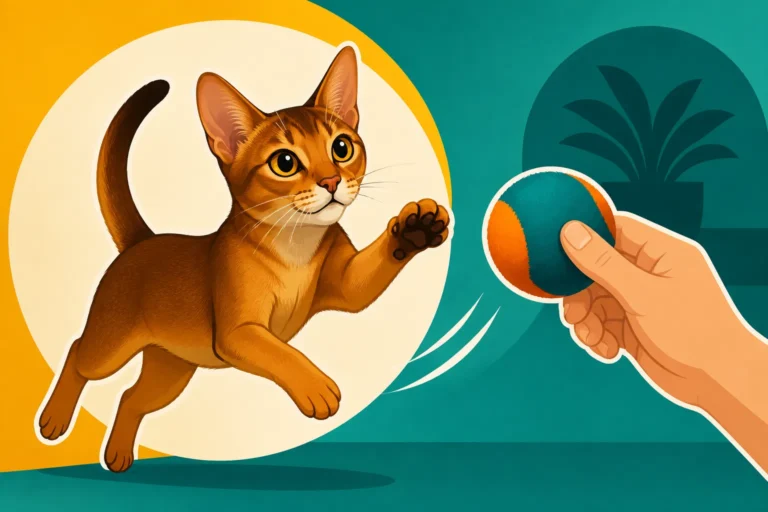
Abyssinians are renowned for their boundless energy and athletic prowess. They are often described as being in perpetual motion, dashing from one perch to another, investigating every new scent, and engaging in energetic play sessions throughout the day. Their sleek, muscular bodies are built for climbing, jumping, and exploring, not for long periods of quiet contemplation on your lap. When you ask an Abyssinian to sit, you're essentially asking them to override a very strong, ingrained instinct to be active.
This isn't them being defiant or stubborn, it's just who they are. They are constantly observing, processing, and reacting to their environment. For an Abyssinian, sitting still might feel like missing out on something incredibly important. This inherent drive for activity is why many Abyssinian owners often feel frustrated when trying to teach simple commands that seem easy for other breeds. It’s not a reflection of your training skills or their intelligence, but rather a testament to their unique personality. Acknowledging this can help you approach training with more empathy and realistic expectations.
Intelligence and Attention Span
There's no doubt that Abyssinians are smart cats. They solve puzzles, learn routines, and can often figure out how to open cabinets or doors with astonishing ease. However, this intelligence comes with a caveat: a relatively short attention span, especially for tasks that don't immediately appeal to their predatory instincts or offer a high reward. They're quick learners, but also quick to get bored if the activity isn't engaging enough or if there are more interesting things happening around them.
Unlike some dog breeds that possess a strong desire to please their human companions, Abyssinians are typically motivated by what's in it for them. A treat, a favorite toy, or even a moment of focused attention from you can be a powerful motivator, but you have to make it worth their while. This means your training sessions need to be short, sharp, and highly rewarding to capture and hold their attention. Lengthy, repetitive drills will quickly lead to disengagement, or worse, your Abyssinian simply walking away to find something more stimulating. Understanding this trait is key to successful training, as it guides your choice of rewards and the structure of your sessions. Training an Abyssinian Is Easier Than Stopping It because they pick up cues so quickly, but holding their attention is the real art.
Step-by-Step: The Abyssinian "Sit" Training Method
Now that we understand a bit more about the Abyssinian psyche, let's dive into the practical steps for teaching your spirited feline to sit. The key here is consistency, high-value rewards, and a dash of good humor. Remember, this should be a fun bonding experience for both of you, not a chore!
Gathering Your Tools and Timing
Preparation is half the battle when training an Abyssinian. You need to set yourself up for success, and that means having the right equipment and choosing the right moments.
First, let's talk about high-value treats. Forget the dry kibble they get every day; for training, you need something truly irresistible. Think small, soft, and pungent. Freeze-dried chicken or salmon, tiny pieces of cooked chicken or tuna, or even a smear of their favorite wet food on your finger can work wonders. The goal is to make the reward so appealing that it overrides their natural inclination to keep moving. Cut them into pea-sized pieces so they can eat them quickly and stay focused. You'll go through quite a few, so having a good stash is essential. Which Treats an Abyssinian Will Actually Work For is a good question to explore for your specific cat.
Next, a clicker. While not strictly mandatory, a clicker is an incredibly powerful tool for cat training, especially for smart, independent breeds like Abyssinians. The click acts as a precise marker, instantly telling your cat exactly what behavior they performed correctly to earn the reward. This clarity helps them understand faster and reduces frustration for both of you. Why Clicker Training Works on an Abyssinian is because of this precise communication. You can find simple, inexpensive clickers online or at most pet stores (Amazon has plenty of options).
Finally, timing and environment. Choose a quiet time when there are minimal distractions. Avoid peak zoomie hour! A good time is often just before a regular meal, when your Abyssinian is a little hungry and therefore more motivated by treats. Why an Abyssinian Learns Faster When It Is Hungry is a universal truth for many cats. Pick a calm spot in your home, away from other pets, loud noises, or tempting window views. Keep sessions short, no more than 3-5 minutes at a time, but try to do several throughout the day.
Luring the Sit: The Foundation
This is where the magic begins. We're going to use a technique called "luring," which is a gentle, hands-on way to guide your Abyssinian into the desired position.
- Get their attention: Hold a high-value treat between your thumb and forefinger, close to their nose. Let them sniff it, get excited about it.
- Move the lure: Slowly move the treat upwards and slightly back over their head, towards their tail. Your Abyssinian's nose should follow the treat. As their head tilts back to keep an eye on the treat, their bottom will naturally start to lower.
- The "Sit" Moment: The instant their bottom touches the ground, even for a split second, click your clicker and immediately give them the treat.
- Release and reset: Let them eat the treat, then either stand up or simply move away for a second before starting again. You want to avoid them staying in a sit forever, especially in the early stages; the goal is to reinforce the act of sitting.
Repeat this process several times. Don't worry about adding a verbal cue yet; we're just building the association between the physical movement and the reward. The more repetitions you get, the stronger the connection becomes in their mind. Remember, patience is key. Some Abyssinians will get it in a few tries, others might take a few sessions. Celebrate every tiny success!
Adding the Verbal Cue and Hand Signal
Once your Abyssinian is reliably following the lure and sitting down consistently, it's time to introduce the verbal cue and a hand signal. This is how you'll eventually communicate the command without needing to physically guide them with a treat.
- Introduce the verbal cue: As you begin to move the treat over their head and their bottom starts to descend, say your chosen word clearly and calmly – "Sit" or "Down" (whichever you prefer and is consistent).
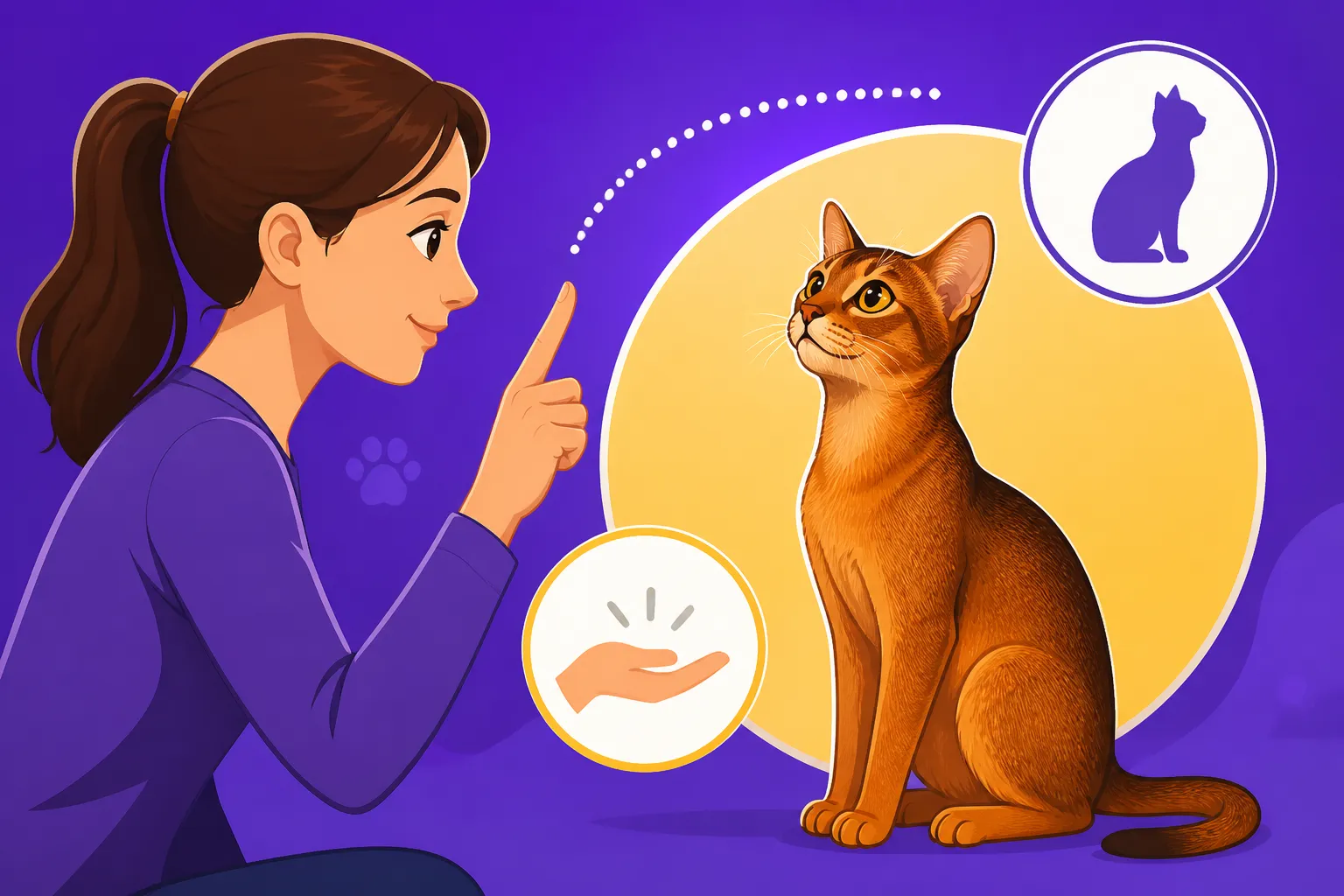
- Pair with a hand signal: At the same time you say the word, use a distinct hand signal. This could be pointing your index finger downwards, or making a gentle sweeping motion with your hand towards the floor. Make sure it's something you can easily replicate every time.
- Lure, cue, click, treat: Continue the luring motion, and the moment their bottom touches the ground, click and treat. The sequence is: Lure (while saying cue and showing signal) -> Sit -> Click -> Treat.
- Fade the lure: Gradually, you want to make the luring motion smaller and less obvious. Eventually, you should be able to simply give the verbal cue and hand signal, and your Abyssinian will sit without you needing to guide them with a treat to their nose. The treat will still follow the click, but it won't be used to initiate the sit.
This fading process is critical. If you rely on the lure too long, your Abyssinian will only sit when they see the treat. You want them to respond to your command. This might take a bit of back and forth, sometimes you might need to go back to a more obvious lure if they're struggling. It's all part of the learning curve!
Practicing and Proofing
Once your Abyssinian understands the "sit" command in a quiet, low-distraction environment, the next step is to solidify that learning by practicing and "proofing" the behavior. This means getting them to sit reliably in various situations and with different levels of distraction.
Start by practicing in different rooms of your house. What works in the living room might not work in the kitchen at first, especially if the kitchen is a high-traffic area with interesting smells. Gradually introduce minor distractions – another family member walking by, a quiet television, or another pet at a distance. Don't overload them with too much too soon. Build up slowly.
It's also important to vary your rewards. While high-value treats are excellent for initial learning, you don't want your Abyssinian to only work for food. Sometimes the reward can be a quick game with a favorite wand toy, a gentle head scratch (if they enjoy it), or simply verbal praise and affection. This helps keep them engaged and teaches them that good behavior can lead to many different positive outcomes. For example, if your Abyssinian loves a particular toy, you can ask them to sit before you launch into a play session.
Remember to keep training sessions brief and positive. Ending on a high note, even if it's just after one successful sit, is far better than pushing them until they're frustrated or bored. Multiple short sessions throughout the day are more effective than one long, drawn-out one. Think of it like a cat's version of interval training. How to Split an Abyssinian's Play Into Sessions applies to training too!
Common Challenges and Troubleshooting for Abyssinian Owners
Even with the best intentions and the clearest instructions, you might encounter some bumps in the road when teaching your Abyssinian to sit. Their unique personalities can present specific challenges, but with a bit of troubleshooting, you can usually get back on track.
"My Abyssinian Just Stares at Me"
This is a classic Abyssinian move. You're holding the treat, you're doing the lure, and they're just… staring at you. It’s not necessarily defiance, but a sign that something isn't quite right from their perspective.
- Motivation check: Are your treats truly high-value? Sometimes what you think is amazing is just "meh" to your Abyssinian. Experiment with different types of treats until you find one that truly sparks their interest. Perhaps a tiny piece of cooked salmon, or a brand-new type of freeze-dried protein. Why an Abyssinian Asks for Food It Does Not Need means they know what they want.
- Distraction overload: Is the environment too stimulating? Even a faint noise or a fleeting shadow outside the window can be more captivating than your training session. Try moving to an even quieter, less stimulating space.
- Timing is off: Are they too full, too energetic, or too sleepy? As discussed, a slightly hungry Abyssinian right before a meal often has better focus. Conversely, if they've just woken up from a deep nap and are in full zoomie mode, asking them to sit is probably a lost cause. Wait for a moment when they are alert but not hyperactive. How Many Hours a Day an Abyssinian Stays Active makes finding that sweet spot tricky, but worth it.
- Unclear lure: Is your lure clear and easy to follow? Sometimes, if the treat moves too fast, too slow, or in an awkward arc, your Abyssinian might not understand what you want them to do. Try slowing down your movements and making the path of the treat more distinct, guiding their nose in a way that naturally encourages their bottom to lower.
The "Pop-Up" Problem: Sitting for a Second and Then Bouncing
You got the sit! Victory! But then, almost immediately, they pop right back up, ready for the next thing. This is incredibly common, especially with highly energetic breeds like Abyssinians. They've understood how to sit, but haven't quite grasped staying in the sit position.
The solution here is to reinforce duration. In the early stages, you clicked and treated the instant their bottom touched the floor. Now, you're going to introduce a tiny delay.
- Lure, cue, sit: Get your Abyssinian to sit as usual.
- Delay the click: Instead of clicking instantly, wait for one full second with them in the sit position.
- Click and treat: After that one second, click and treat.
- Gradually increase duration: As they become more consistent with the one-second sit, slowly increase the duration by half-second increments: 1.5 seconds, then 2 seconds, then 3 seconds, and so on. Always click and treat while they are still sitting or immediately after the desired duration is achieved. If they pop up before your click, just try again.
- Vary the treats: To keep them engaged during longer holds, sometimes give a rapid succession of tiny treats while they are sitting (e.g., "click, treat, treat, treat" for a 3-second sit). This reinforces that staying in position brings more rewards.
Remember, the goal is not to have them sit for five minutes straight, especially in the beginning. Even a five-second sit is a huge accomplishment for an Abyssinian! This builds a strong foundation for future commands like "stay."
When Training Becomes a Chore
Let's be real, sometimes you just don't feel like it. And if you're not feeling it, your Abyssinian will definitely pick up on that energy. If training starts to feel like a chore for you or your cat, it's a sign to take a break.
- Don't force it: Never try to physically force your Abyssinian into a sit. This will only lead to negative associations, frustration, and a breakdown of trust. It's better to end a session than to resort to physical manipulation.
- Keep it positive: Every interaction should be positive. If you find yourself getting frustrated, stop. Walk away, take a deep breath, and come back to it later with a fresh perspective. Your Abyssinian should associate training with good things, not your exasperation.
- Focus on consistency over intensity: It's much more effective to do three 2-minute sessions a day than one 15-minute session where everyone ends up stressed. Little and often is the mantra for Abyssinian training. How Much Play an Abyssinian Needs Each Day is a lot, but short bursts of training can fit into their busy schedule.
It's okay if progress isn't linear. Some days will be great, others will feel like you're starting from scratch. That's normal! The bond you build through these positive interactions is just as important as the command itself.
Integrating "Sit" into Daily Life and Beyond
Teaching your Abyssinian to sit isn't just a fun party trick; it's a foundation for better communication, clearer boundaries, and even a calmer household. Once your cat has mastered the "sit" command, you'll find countless ways to integrate it into their daily routine, enhancing your relationship and their quality of life.
Practical Applications of the "Sit" Command
A reliable "sit" command can be surprisingly useful in a busy Abyssinian's life, helping to channel their energy and create moments of anticipation and cooperation.
- Waiting for Food Bowls: This is often the most popular and easiest place to start. If your Abyssinian turns into a furry piranha at feeding time, asking for a sit before placing the food bowl down can instill a sense of calm and good manners. They learn that stillness, not frantic meowing or circling, is what earns them their dinner. This teaches them impulse control, which is a huge win for a high-energy cat!
- Before Being Picked Up: Abyssinians are often very active and might wiggle when you try to pick them up. If they learn to sit on command, you can ask them to sit, allowing you to scoop them up more easily and safely, especially if you need to transport them to a carrier or for grooming.
- Calming Before High-Energy Play: Before you unleash the wand toy for a vigorous play session, ask your Abyssinian to sit. It creates a brief moment of calm anticipation before the excitement, helping them focus their energy more effectively rather than just exploding into chaos.
- As a Foundation for Other Tricks: "Sit" is the gateway drug of cat tricks! Once they understand sitting, it opens the door to teaching more complex behaviors. Which Tricks an Abyssinian Learns Fastest often build on foundational commands like sit. For instance, "stay" is a natural progression, where you ask them to hold the sit for progressively longer periods while you step away. Or perhaps "down" (lying down), which can be lured from a sit.
Think of "sit" as a valuable pause button for your Abyssinian. It helps them engage their brain before reacting and gives them a moment to connect with you.
The Benefits Beyond the Command Itself
Beyond the practical applications, teaching your Abyssinian to sit offers deeper, more subtle benefits that strengthen your bond and enrich their lives.
- Strengthening Your Bond: Every successful training session, every treat given, every positive interaction, reinforces the connection between you and your Abyssinian. They learn that you are a source of good things, that you understand them, and that cooperating with you is rewarding. This trust and mutual understanding is invaluable.
- Mental Enrichment for Your Smart Kitty: Abyssinians are incredibly intelligent and need mental stimulation just as much as physical exercise. Learning tricks like "sit" provides that crucial mental workout, challenging their brains and preventing boredom. A bored Abyssinian is often a destructive Abyssinian! This mental engagement can actually reduce unwanted behaviors, as their minds are occupied with productive tasks.
- Providing a Moment of Calm: In a breed known for its relentless activity, having a command that encourages a moment of stillness can be incredibly beneficial. It teaches them to self-regulate, even if just for a few seconds. This can be particularly helpful during stressful situations, like vet visits or when new guests arrive.
- Improved Communication: Learning a command like "sit" dramatically improves communication between you and your Abyssinian. You learn to read their body language, understand their motivations, and celebrate their successes. They, in turn, learn to understand your cues and respond to your requests. This two-way communication makes for a happier, more harmonious household. How an Abyssinian Signals It Wants Something becomes clearer as you learn to speak the same language.
What Comes Next?
Once your Abyssinian has truly nailed the "sit" command, you might find yourself itching to teach them more! The beauty of positive reinforcement training is that once a cat understands the concept of "do X, get Y," the sky's the limit.
- "Stay": A natural follow-up to "sit," this teaches them to hold their position for longer durations, even if you move away. This is great for those moments when you need them to stay put for a brief time, like when answering the door.
- "Down": Teaching your Abyssinian to lie down is another useful command that can be easily lured from a sit position. It’s a slightly more submissive posture, which can be helpful for relaxation.
- More Complex Tricks: With "sit" and "stay" under their belt, you can move on to a whole repertoire of tricks. Abyssinians excel at things like How to Teach an Abyssinian to High Five, weaving through your legs, jumping through hoops, or even retrieving toys. How to Turn an Abyssinian's Fetching Into a Routine if they already have a natural inclination for it. Remember to always keep it fun, positive, and full of high-value rewards!
Here's a quick reference for teaching your Abyssinian to sit:
| Step | Action | Key Takeaway | Troubleshooting |
|---|---|---|---|
| 1. Preparation | Gather high-value treats, clicker, choose quiet timing. | Motivation is key. Short, frequent sessions are best. | If distracted, change location or increase treat value. |
| 2. Lure the Sit | Hold treat, move it back over head; as bottom lowers, click & treat. | Instant click marks the exact behavior. Repeat until consistent. | If cat just stares, refine lure path or switch treats. |
| 3. Add Cue/Signal | As bottom lowers, say "Sit" and show hand signal. Then click & treat. | Pair verbal/visual cue with physical action. Fade the lure gradually. | If not responding, go back to clearer lure, ensure consistent cue. |
| 4. Practice/Proof | Practice in different locations with minor distractions. Vary rewards. | Generalize the behavior. Not just for food, not just in one spot. | If struggling with distractions, reduce complexity, increase reward value. |
| 5. Duration (Optional) | Wait 1-3 seconds while sitting, then click & treat. | Reinforce holding the position, not just getting into it. | If popping up, shorten duration, reward quickly, or offer multiple treats for holding. |
Teaching your Abyssinian to sit is more than just a trick; it's an investment in your relationship, fostering trust, stimulating their intelligent minds, and providing you both with a fun, rewarding activity.
Disclaimer
This article is for general informational purposes only and does not constitute professional advice. Laws, prices and regulations vary by location and change over time. Consult a qualified professional for guidance on your specific situation.